

A solid target audience analysis is the single most important thing a founder can do. It's where you stop guessing and start listening to the specific group of people most likely to buy what you're selling. This isn't an academic exercise; it's about finding real human needs, their biggest headaches, and the exact words they use. Get this right, and it informs everything from your product roadmap to your marketing copy.
Why Traditional Audience Personas Fail Startups

As a founder, I’ve wasted more time than I'd like to admit on personas that ended up being completely useless. We've all seen them: "Marketing Mike," a 35-year-old manager who likes hiking and owns a golden retriever. It feels like you're making progress, but what does that actually tell you about the problems that keep him up at night? Nothing.
The old way of doing things often spits out these sterile, vague descriptions that don't look anything like real customers. For a startup burning through cash, this isn’t just a waste of a few days. It's a critical mistake that can stall your momentum for good.
The Shift From Guesswork to Actionable Insights
This guide isn't about theory. It’s a hands-on approach I use to move from guessing who our customers might be to knowing exactly who they are by listening to what they're already saying. Forget those pricey focus groups that can run you upwards of $7,000 a pop. We're going straight to the source.
The process we've built at BillyBuzz trades abstract demographics for the actual language and pain points your future customers share every single day. We find them where they already are—in niche subreddits and online communities where they talk openly about their frustrations and what they wish they had.
At its core, our target audience analysis isn't about creating a fictional character. It's about building a "messaging cheat sheet" derived directly from the unfiltered voice of the customer. This ensures our marketing doesn't just reach people; it resonates with them.
For a small team, this method has some serious advantages:
- It's cheap. This approach takes time and focus, not a huge budget. You can start gathering incredible data right away without paying for expensive tools or research firms.
- Your messaging becomes authentic. When you use the exact phrases your audience uses, your copy and content connect on a completely different level. It feels genuine because it is.
- You can move faster. Getting real-time feedback from online communities lets you tweak your product and marketing much quicker than waiting on traditional research to come back.
Ultimately, doing the work this way gives you a much smarter foundation for growth. Instead of building something and then desperately trying to find people who want it, you find a real, painful problem first and build your entire company around solving it.
Finding Your Niche Communities on Reddit
Reddit is a chaotic, sprawling city of unfiltered conversations. For any founder, it's a goldmine, but trying to tackle it all at once is a recipe for overwhelm. The real magic isn't in boiling the ocean; it's in finding the specific neighborhoods where your ideal customers are already hanging out and talking shop.
Think of it as surgical precision versus a shotgun blast. You’re not just looking for any conversation, you’re looking for the conversation.
How We Find The Right Subreddits
Our process at BillyBuzz isn't about finding the biggest communities, but the right ones. We start broad with what we call "seed" subreddits—the big town squares that align with our general market. For us, that means places like r/startups, r/SaaS, and r/smallbusiness. These are just our jumping-off points.
From there, we dive into the "Related Communities" sidebar and watch for discussions that get cross-posted into smaller, more focused groups. This is how you escape the noise of a massive subreddit and find a niche forum where the signal is crystal clear.
What We Look For In A Community
Not all subreddits are created equal. An abandoned community is useless, no matter how perfect the topic seems. We have a simple checklist we run through to qualify a subreddit for our monitoring efforts. If it doesn't tick at least a few of these boxes, we move on.
- Active Moderation: Look for clear rules and mods who actually enforce them. This keeps the conversations on-topic and weeds out the spam, giving you much cleaner data to work with.
- Real Pain Points: The best subreddits are filled with people openly asking for help or venting about their frustrations. This is the raw material for your entire target audience analysis.
- Helpful, In-depth Comments: When you see users writing multi-paragraph replies to help each other out, you’ve struck gold. These threads are packed with incredible detail about workflows, existing tool stacks, and unmet needs.
It's also worth remembering who you're talking to. Reddit's audience skews young, with 44% of US users aged 18-29. This makes it the perfect place for us to connect with the early-stage founders and growth hackers who live in that demographic. The youthful, tech-savvy user base is a perfect match for the problems we solve for solo entrepreneurs and small marketing teams.
Once you’ve found these communities, the insights you gather can be used in all sorts of ways, even to understand things like how to increase visibility in ChatGPT searches through Reddit.
Turning Observation Into a System with BillyBuzz
Okay, this is where we turn casual observation into a repeatable, automated process. Inside BillyBuzz, we set up specific alerts for each high-value subreddit we've found. This creates a constant stream of insights that no static, AI-generated persona could ever give you. It’s the difference between a snapshot and a live video feed.
Our keyword tracking goes way beyond just our brand name. We build alerts around three core categories to capture the full spectrum of user problems and intent. This simple framework is the engine of our entire Reddit listening strategy.
We use this progressive discovery method to pinpoint the most valuable communities for our specific needs.
| Stage | Example Subreddits | Objective | BillyBuzz Alert Keywords |
|---|---|---|---|
| Broad Industry | r/startups, r/Entrepreneur |
Understand general market sentiment and identify emerging trends. | market research, new tool, startup idea |
| Specific Vertical | r/SaaS, r/marketing |
Find discussions around specific business models and functions. | SaaS growth, user acquisition, marketing stack |
| Niche Problem | r/sociallistening, r/GrowthHacking |
Uncover conversations about the exact problems your product solves. | brand monitoring, Reddit alerts, customer feedback |
| Hyper-Niche | r/solopreneur, r/SideProject |
Pinpoint your ideal customer persona in their natural habitat. | first 100 users, validate my idea, struggling with |
This framework helps ensure we're not just listening to noise, but are tapping directly into the conversations that matter most to our business.
Our Go-To BillyBuzz Alert Keywords
- Problem & Frustration Keywords: ‘frustrated with [problem]’, ‘struggling to’, ‘is there a better way to’, ‘annoyed by’
- Tool & Competitor Keywords: ‘[Competitor Name] alternative’, ‘how does [Competitor Name] work’, ‘tool for [task]’, ‘software for’
- Purchase Intent Keywords: ‘recommendation for’, ‘best tool for’, ‘what are you using for’, ‘need software that’
Setting up these alerts in BillyBuzz takes maybe 20 minutes, but it saves us hours of manual scrolling every single week. Instead of searching for needles in a haystack, the most relevant conversations are delivered right to our Slack. This lets us focus our energy on analyzing the insights, not the tedious work of finding them.
We've even shared some of our favorite spots in our guide to the top subreddits for small business insights.
How to Gather Insights That Actually Matter
Once you’ve found the right subreddits, the real work begins. This is where you stop scrolling and start systematically gathering signals. So many founders just lurk, but you need a process to spot and categorize the conversations that are actually worth your time.
Forget about sterile surveys. The unfiltered language people use when they think no one is trying to sell them something is pure gold. You're hunting for specific kinds of posts that expose their real-world challenges.
From Lurking to Active Signal Gathering
Here at BillyBuzz, we don’t just read comments; we look for distinct patterns. We've found that almost every genuinely useful insight falls into one of three buckets. If you focus your energy here, you can turn a chaotic Reddit feed into a structured goldmine of customer intelligence.
- ‘Problem’ Posts: This is what you’re really looking for. Users will lay out a challenge they're facing, often in painful detail. Keep an eye out for phrases like "I'm struggling with," "is there a better way to," or "I'm so frustrated by."
- ‘Alternative Seeking’ Posts: These users are already in the market and unhappy with what they've got. Keywords like "[Competitor Name] alternative," "switching from," or "looking for a tool that does X" are buying signals from people actively trying to make a change.
- ‘Workflow’ Posts: These are my personal favorite. Someone will walk through their entire process for doing a task, revealing all the clunky manual steps and duct-taped solutions they rely on. This is where you uncover the unspoken needs your product can solve.
By deliberately hunting for these post types, you filter out 90% of the noise. You’re left with conversations that can directly shape your product, marketing, and sales strategy.
The goal isn't just to find mentions, but to understand the context and emotion behind them. A user complaining about a competitor's pricing model is a far more valuable signal than a simple brand mention.
Our Internal Template for Capturing Insights
A messy folder of screenshots isn’t going to cut it. You need a simple, repeatable way to log what you find. We use a basic spreadsheet to capture all this qualitative data so we don't lose the original voice of the user.
Here’s a simplified peek at our internal template:
| Category | User's Exact Phrasing | Pain Point | Emotional Sentiment | Link to Post |
|---|---|---|---|---|
| Problem Post | "I spend hours every week manually checking 10 subreddits for mentions of our brand." | Manual, time-consuming process | Frustrated, Overwhelmed | [Link] |
| Alternative Seeking | "Is there a better alternative to [Competitor]? Their UI is so clunky and slow." | Poor user experience | Annoyed, Impatient | [Link] |
| Workflow Post | "First I export the data to a CSV, then I clean it in Excel, then I manually..." | Inefficient, multi-step process | Resigned, Seeking efficiency | [Link] |
A simple structure like this forces you to translate a raw comment into a core pain point and the emotion tied to it. Capturing the exact phrasing is crucial—this is the language you'll want to mirror later in your ad copy and on your landing pages. Of course, to get this data in the first place, it helps to know how to extract data from websites effectively.
Automating the Process with BillyBuzz
Doing this by hand is incredibly insightful, but it just doesn’t scale. This is exactly why we built BillyBuzz—to automate the grunt work. We basically took our manual process and turned it into a set of automated alert rules. What used to be hours of weekly scrolling is now a curated feed of intelligence delivered right to our Slack.
Inside BillyBuzz, we set up advanced filters that are way smarter than just matching keywords. Our AI-powered relevancy score also helps us see the most important conversations first.
Our Go-To BillyBuzz Filters:
- Negative Competitor Sentiment: We have an alert that flags any mention of a competitor that also has a negative sentiment score of 0.7 or higher. This instantly shows us when one of their customers is unhappy and ripe for switching.
- Explicit Pain Point Mentions: We set up alerts for keywords like "frustrated," "struggling," and "hate that," combined with terms related to our industry (like "social monitoring" or "brand alerts"). This finds people who know they have a problem but aren't looking for a specific tool yet.
- High-Intent Phrases: We’re always monitoring for buying phrases like "best tool for" or "recommendation for" inside our target subreddits. These are immediate opportunities to jump in. You can find more ideas like this in our guide on how to monitor keywords on Reddit.
This automated system lets our small team operate like a much larger market research department. Instead of a founder burning time scrolling, we spend about 15 minutes a day reviewing a handful of highly relevant conversations where we can offer real help and, when the time is right, introduce BillyBuzz.
4. Turning Raw Data Into Actionable Customer Segments
A spreadsheet packed with quotes and Reddit links is just noise. It’s a great starting point, but until you start connecting the dots, it’s not going to do much for your marketing. The real magic happens when you turn that raw information into clear, actionable customer segments that tell you exactly how to shape your message.
This isn't about cooking up imaginary personas with stock photos and fluffy details. We're building a practical foundation for messaging that actually connects because it’s built from your customers' own words. You’re moving from a random collection of comments to a unified understanding of distinct groups within your audience.
Here’s a peek at our internal process for identifying, categorizing, and making sense of this constant flow of information.
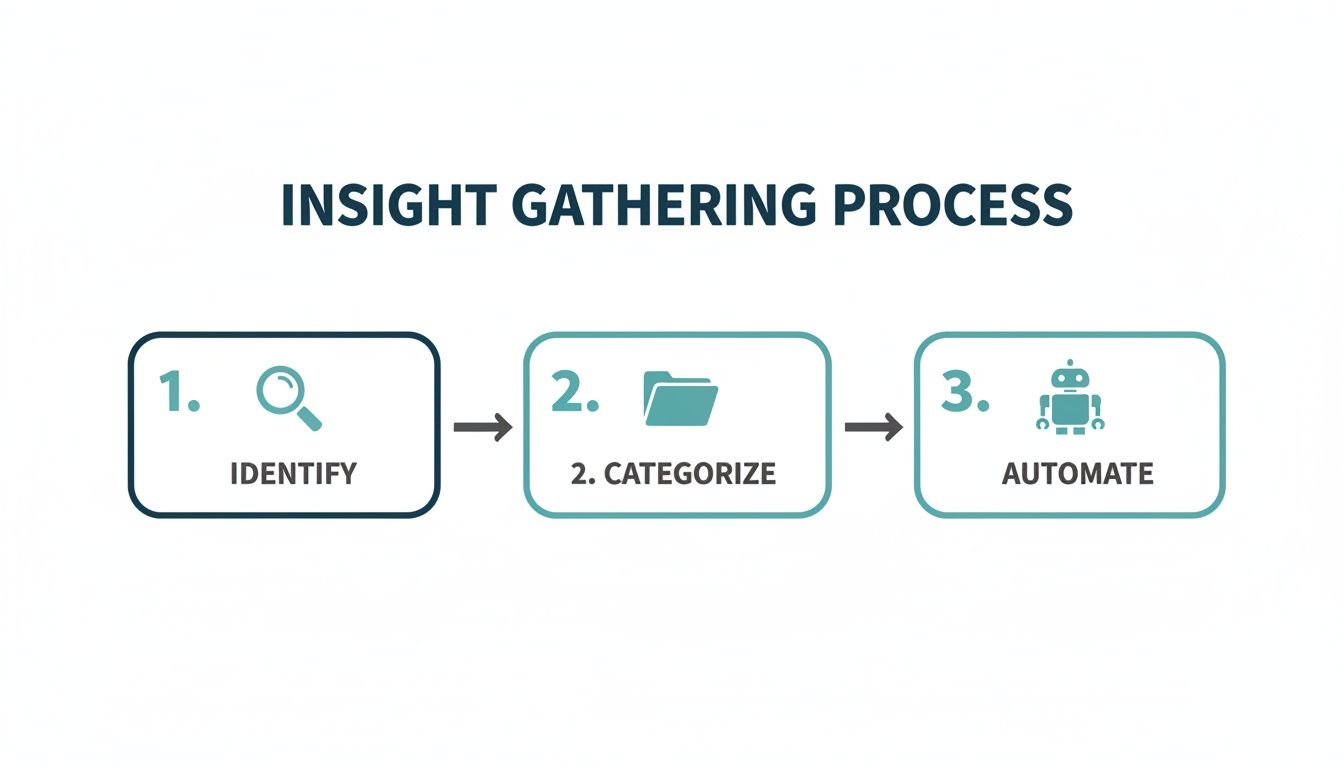
This is basically our roadmap for turning chaotic online conversations into structured, usable intelligence that we can plug directly into our campaigns.
From Themes to Segments
Inside BillyBuzz, the first thing we do is start grouping the insights we’ve gathered by recurring themes. As we read through comments flagged by our alerts, we simply start tagging them. Pretty quickly, you start to see patterns bubble to the surface, and these patterns become the bedrock of our segments.
For example, we kept seeing a flood of comments from users in r/solopreneur and r/SideProject who were laser-focused on cost. Their language was all about "bootstrapping," "affordability," and "monthly burn." That was a no-brainer. We created our ‘Budget-Conscious Solo Founder’ segment.
At the same time, we spotted another clear pattern over in r/marketing and r/SaaS. These folks were venting about the soul-crushing hours they wasted on manual tasks and how hard it was to scale their outreach. They used phrases like "so much manual work" and "I can't keep up." And just like that, our ‘Frustrated Marketing Manager’ segment was born.
Building the Messaging Cheat Sheet
Once a segment feels solid, we create a simple, one-page "messaging cheat sheet" for it. Think of this as our internal source of truth for how to talk to this specific group. It’s not complicated, but it's wildly effective because it’s built from their own vocabulary.
Each cheat sheet has three core parts:
- Primary Pain Points: A bulleted list of the top 3-5 frustrations we see this segment complain about again and again. For the ‘Frustrated Marketing Manager,’ this includes things like "Wasting hours manually checking subreddits" and "Missing important conversations."
- Their ‘Jobs to Be Done’ (JTBD): What are they really trying to accomplish? It’s never "buy a social listening tool." It’s "Prove the ROI of my community efforts to my boss" or "Find five qualified leads this week without cold emailing."
- The Language They Use: We literally copy and paste direct quotes and specific phrases from Reddit comments. This becomes our swipe file for writing ad copy, landing pages, and even our own responses on Reddit.
This process can transform a single, insightful Reddit comment into a core pillar of a marketing campaign. We once saw a user say, "I feel like I have to be online 24/7 or I'll miss a chance to get a customer." That exact phrase became the headline for one of our highest-converting ad campaigns.
A Global Perspective from Niche Communities
One of the most powerful things about using a platform like Reddit for this kind of work is its global reach. We can validate these segments across different markets without spending a fortune on international research.
Reddit is a global hub. While 49.59% of its daily active users are from the US, there are huge communities from India, the UK, Canada, Brazil, and Germany. This geographic spread is only growing—projections show Reddit surging 66% from 267.5 million weekly active users in Q4 2023 to 443.8 million by Q3 2025, making it a goldmine for spotting international trends. For a deeper dive, check out Reddit's impressive user statistics on adamconnell.me.
This isn't just theory; it’s a repeatable system that turns messy qualitative data into a powerful tool for growth. Once you have these segments defined, you can take action with much greater precision. To see how this plays out, you might be interested in our guide on how to use AI segmentation for personalized outreach.
Putting Your Insights to Work and Measuring What Matters
All the research and analysis in the world won't do you any good sitting in a spreadsheet. This is where the rubber meets the road—where we turn all that listening into actual conversations. A target audience analysis is only as good as the results it drives.
Let's be clear: this isn't about blasting your link across a dozen subreddits. That’s a great way to get downvoted into oblivion. Instead, this is a more surgical approach. We'll use the messaging cheat sheets we built to join conversations, offer real value, and only introduce our solution when it genuinely helps.
From Segment to a Real Conversation
At BillyBuzz, our golden rule for engaging on Reddit is simple: lead with value, always.
When an alert flags a conversation that’s a perfect match for one of our personas, say the ‘Frustrated Marketing Manager,’ we don't just dive in with a sales pitch. First, we pull up their messaging cheat sheet. We take a moment to re-read their main frustrations, the exact language they use, and what they’re trying to accomplish. This gets us in the right headspace to speak their language before we type a single word.
Our process starts with the AI-generated reply suggestions inside BillyBuzz. They give us a fantastic starting point that’s already context-aware and usually gets us 70-80% of the way there. It’s a huge time-saver and helps make sure we're on the right track from the beginning.
But the magic is in the manual refinement. We'll swap out a generic phrase for the specific vocabulary we documented in our research. If someone posts that they’re “drowning in manual work,” we’ll echo that exact phrase back in our reply. It’s a small detail, but it makes the response feel incredibly personal and proves we’re actually listening.
A Response Framework That Doesn't Feel Like Spam
We generally stick to a simple, three-part structure for our first interaction. The whole point is to build a little trust and be helpful, not to come off as a pushy salesperson.
- Acknowledge Their Pain: First, show you get it. Something like, "That sounds incredibly frustrating. Spending hours manually checking subreddits is a massive time sink."
- Offer a Real Solution (No Strings Attached): Give them a useful tip or a framework they can use right away, even if they never become a customer. This positions you as a helpful expert. "One thing that helped us was creating a simple spreadsheet to track mentions by theme. It’s not perfect, but it helps spot patterns."
- Make the Soft Introduction (Only When It Fits): If—and this is a big if—your tool is a direct solution to their problem, you can mention it gently. "We actually built a tool, BillyBuzz, to automate this whole process because we were so tired of doing it by hand. Might be worth a look if you’re still struggling with it."
The goal is to be seen as a helpful member of the community first and a founder second. When you consistently provide value, people become naturally curious about what you’re building. Your reputation becomes your best marketing asset.
Measuring the Metrics That Actually Move the Needle
Upvotes and karma are nice, but they don't pay the bills. The entire point of this effort is to connect your activity on Reddit to real business outcomes. If you can’t measure it, you can’t improve it.
We look past vanity metrics and zero in on the key performance indicators (KPIs) that tell us if our engagement is actually generating business. By using custom UTM parameters on every link we share, we can track the entire user journey, from a specific Reddit comment all the way to a sign-up.
This simple table shows how we connect our audience research directly to measurable results. It’s how we prove that this whole process works.
From Insight to Action: A Measurement Framework
Connecting audience analysis activities directly to measurable business outcomes and key performance indicators.
| Audience Insight | Action Taken | Primary Metric (KPI) | How to Track It |
|---|---|---|---|
| ‘Frustrated Marketing Managers’ hate manual processes. | Responded to a user's workflow complaint with a helpful tip and a soft mention of BillyBuzz. | Website Clicks from Comment | Custom UTM link (e.g., ?utm_source=reddit&utm_campaign=frustrated_manager_response) |
| ‘Budget-Conscious Founders’ are highly price-sensitive. | Shared a comment in r/solopreneur highlighting our free starter plan in a relevant discussion. |
Sign-ups from Source | Track sign-ups in your analytics platform where utm_source is 'reddit'. |
| Users are asking for alternatives to a specific competitor. | Engaged in a competitor comparison thread, explaining our unique value proposition. | Lead Quality Score | Note in CRM which leads came from Reddit and score them based on follow-up conversations. |
| People are searching for a tool to solve a niche problem. | Answered a "looking for a tool that..." post with a direct, value-led comment. | Conversion Rate | Measure the percentage of users from a specific Reddit campaign who convert to paying customers. |
By tracking these specific metrics, you can definitively prove the ROI of your target audience analysis efforts. You’re no longer just "doing marketing" on Reddit; you're building a repeatable, measurable growth engine fueled by genuine connection and a deep understanding of your customers.
Common Questions About Reddit Audience Analysis
Diving into Reddit to find your target audience can feel like exploring a new city. You know there are amazing things to discover, but you're not quite sure where to start or what the local customs are. As founders, we get it.
Here are some of the most common questions we hear from other teams, along with the straightforward, no-fluff answers we've learned from being in the trenches.
How Much Time Should I Dedicate to This Each Week?
Time is a founder's most precious resource, so this has to be efficient. The good news? You don’t need to live on Reddit to get incredible value from it.
We recommend blocking out an initial deep-dive session of 4-5 hours. Use this time to do your homework: identify your core subreddits, get a feel for their rules, and set up your initial monitoring. This upfront investment pays for itself almost immediately.
After that initial setup, the goal is consistency, not hours logged. A tool like BillyBuzz feeds you curated alerts, slashing your daily commitment. Honestly, we spend just 15-20 minutes a day reviewing the most relevant conversations and jumping in where we can add real value. This turns a potential time-sink into a focused, high-impact growth activity.
Can I Really Do This for B2B Audiences?
Absolutely. This is a common misconception that holds a lot of B2B startups back. While Reddit is famous for its consumer communities, it's also packed with highly engaged professionals talking shop.
The trick is to shift your search from interest-based communities to profession-based ones. Think less r/gadgets and more r/sysadmin, r/marketing, or niche software forums like r/salesforce. These are the digital water coolers where decision-makers and influencers discuss tools, troubleshoot business challenges, and vent about their workflows.
Don't underestimate the power of professional anonymity. On Reddit, a VP of Engineering is far more likely to give you an unfiltered take on a vendor's shortcomings than they ever would on a platform like LinkedIn. That honesty is pure gold for your research.
How Do I Avoid Looking Like a Spammer?
Authenticity is the currency of Reddit. The community has a finely tuned radar for self-promotion, and if you come in with a hard sell, you’ll get shut down fast. The key is to give far more than you take.
We live by a simple 90/10 rule:
- 90% of your activity should be genuinely helpful. Answer questions, share expertise, and participate in discussions without any mention of your product.
- 10% of your activity can be a subtle mention of your solution, but only when it directly and perfectly solves the problem being discussed.
Always lead with value. When you build a reputation as a helpful expert, people will naturally become curious about what you’re building. Your goal is to be a member of the community first, and a founder second.
Is Data From Anonymous Users Actually Reliable?
This is where Reddit's true power for audience analysis lies. The platform's anonymity is its greatest strength, not a weakness.
When people aren't tied to their real-world identities or professional profiles, they are brutally honest. They'll share their frustrations, their half-baked ideas, and their unmet needs with a level of candor you just won't find anywhere else.
While you can't build a demographic profile of a single anonymous user, you're not trying to. You're analyzing the patterns that emerge across hundreds of conversations. This collective signal—the shared language, the recurring pain points, the common frustrations—is often a more accurate reflection of your audience's mindset than any formal survey could ever provide.
Ready to stop guessing and start listening to what your customers are really saying? BillyBuzz automates the entire Reddit monitoring process, delivering high-intent conversations and actionable insights directly to you. Start uncovering hidden leads on BillyBuzz today.