
Brand awareness content marketing isn't about shouting into the void and hoping someone hears you. It’s the art of creating genuinely useful content—think articles, social media threads, or videos—to establish your brand as a credible voice in your space.
The goal isn't an immediate sale. It’s about becoming the go-to resource, building trust, and being top-of-mind long before someone is ready to pull out their credit card.
Move Beyond Generic Content and Build Real Brand Awareness
As a founder, your time is your most valuable asset. This isn’t another high-level guide filled with vague theories. This is the exact playbook we built at BillyBuzz to find and engage the communities that actually matter. We're skipping the fluff and getting straight to the strategies that turn silent observers into vocal supporters.
You'll learn how to pinpoint where your ideal customers are already talking, what to contribute once you're there, and how to do it all without a massive marketing budget. Think of this as the founder-to-founder guide I wish I had when we were starting out—focused, smart, and designed for measurable impact.
From Broadcasting to Engaging
The old model of blasting generic content at a wide audience is broken. It's expensive, inefficient, and it just doesn't build real connections. Instead, we're all about precision and value, showing up where our audience is actively looking for answers.
This isn’t just about getting your name out there. It’s about weaving your brand into the very fabric of the communities where your customers live.
Our strategy boils down to one powerful shift: stop shouting into a crowded room and start participating in meaningful conversations. That's how you build a brand people not only recognize but also respect and trust.
To lay the right groundwork, it helps to understand the core principles of how to effectively increase brand awareness. This reinforces the foundational idea of always leading with value.
Our entire playbook rests on this shift from broad, passive marketing to active, targeted community engagement. Here’s a quick breakdown of what that looks like in practice.
Our Core Brand Awareness Strategy Pillars
A quick overview of how we shift from traditional, broad-stroke marketing to targeted, high-impact community engagement.
| Pillar | Traditional Approach | The Founder-Focused Approach |
|---|---|---|
| Audience | Broadcasting to a wide, undefined demographic. | Engaging with niche, high-intent communities. |
| Goal | Website traffic and lead generation (often low-quality). | Building trust and authority by solving problems. |
| Content | Generic, SEO-first blog posts and scheduled social updates. | Valuable, conversational content tailored to community discussions. |
| Distribution | Paid ads and hope-based sharing. | Direct, authentic participation in relevant online spaces. |
This table captures the essence of our approach: it's less about volume and more about the quality and context of every interaction.
Why This Approach Wins
The data backs this up. In the B2B world, a massive 87% of marketers said their content directly boosted brand awareness in the last 12 months.
Even more telling? Brands with a documented distribution plan are 3x more likely to succeed. This proves that creating great content is only half the battle; getting it in front of the right people is what truly matters. It’s why our community-focused approach puts smart distribution at the heart of everything we do.
Find Your Audience in Niche Online Communities
Forget trying to be everywhere at once. Your biggest advantage as a startup is to go deep, not wide. The goal is to dominate the few online spaces where your ideal customers are already gathered, talking about the exact problems you solve.
We learned this the hard way. Casting a wide net with ads just didn't work. Our most valuable prospects weren't waiting for a paid promotion—they were in the trenches of niche online communities, actively trying to figure things out.

This is a fundamental shift from broadcasting your message to actually participating in the conversation. And the data backs it up. Consumers are flocking to social media, where a staggering 58% discover new businesses—more than any other channel.
Platforms like Reddit are a goldmine for this approach because organic engagement builds trust faster than any billboard ever could. To younger audiences, the user-generated content there feels 2.4x more authentic than branded content. It’s where you can build real connections.
How We Pinpoint High-Intent Subreddits
At BillyBuzz, we don't see Reddit as just one giant platform. We see it as thousands of tiny, hyper-focused forums full of people with specific problems. The trick is finding the subreddits where people are actively looking for solutions, not just killing time.
We skip the broad, generic communities entirely. Instead, our team hunts for signals of real purchase intent.
Our entire process inside BillyBuzz revolves around setting up smart alerts for non-branded keywords—the kind that tell you someone is in the problem-aware or solution-aware stage of their journey. This is where the magic happens.
We break down our keyword monitoring into three main buckets:
- Problem-Focused Queries: We listen for the exact phrases our ideal customers use to describe their pain points. Things like "how to track user feedback," "best way to monitor brand mentions," or "alternatives to manual searching." These are basically direct cries for help.
- Competitor Mentions: Keeping an eye on what people say about our competitors is non-negotiable. When someone posts "is [Competitor A] worth it?" or "I'm having trouble with [Competitor B]," it's the perfect opening to offer a genuinely helpful perspective and maybe introduce our solution.
- Integration Questions: We also track keywords related to tools our product integrates with. Queries like "does [Our Product] work with Slack?" or "best project management tool for a small team" let us join relevant conversations about the broader tech stack our customers are building.
Setting Up Alerts That Actually Work
The whole point is to cut through the noise. You want to engage only in conversations where you can provide instant, authentic value. Trying to do this manually is a recipe for frustration and wasted time, which is exactly why we built our own tool to automate it.
Here’s a peek at how we configure an alert in our BillyBuzz dashboard to find these high-value conversations.
You can see this alert is tracking keywords like "customer feedback" and "feature request" within specific, founder-focused subreddits like r/SaaS and r/startups. The AI relevancy score is a huge time-saver, helping us immediately spot the posts that are most likely a good fit.
Our guiding principle is simple: be a resource, not a salesperson. We never, ever lead with a pitch. The first priority is to solve the person's problem or answer their question as thoroughly as possible. The brand awareness just naturally follows.
This super-targeted approach is what makes community-led growth so effective. You aren't interrupting someone's feed with an ad; you're joining a conversation they started, right at the moment they need help. It’s a pull, not a push, strategy that builds a stellar reputation one helpful comment at a time.
If you’re looking for a few places to get started, check out our guide on the top subreddits for small business insights.
Create Content That Solves Problems Instantly
Let's be honest, sinking dozens of hours into a 1,500-word blog post that might never find an audience is a massive gamble. For building brand awareness in communities, there's a much sharper, more effective approach: creating "response assets."
A response asset is just a concise, high-value answer that solves the exact problem someone is asking about in a thread, right now. It's not about dropping a generic comment. It’s about seeing an alert from a tool like BillyBuzz and treating it as an opportunity to craft a mini-case study, a quick tutorial, or a data-backed reply that immediately makes you look like the smartest person in the room.
We had to completely shift our mindset from "creating content" to "solving problems." When an alert for Reddit pops up, we don't just see a keyword. We see a real person asking for help, and our one and only goal is to give them the best possible answer right there in the thread. It’s a targeted strike, not a blanket bombing campaign.
The Three Pillars of a Value-First Reply
After doing this hundreds of times, we've noticed that nearly every meaningful conversation falls into one of three buckets. To keep our responses consistent and efficient, we developed a few internal frameworks. These aren't rigid scripts, but more like mental models that guide our approach.
Using these frameworks helps us make sure we're always leading with genuine value. The brand becomes a natural part of the solution, not an awkward, shoehorned-in sales pitch.
1. The Helpful Expert Framework
This is our bread and butter. It's perfect for when someone asks a "how-to" question or feels stuck on a specific technical problem. The entire point is to give them a direct, actionable solution they can use immediately.
- Acknowledge their pain. Start by showing you get it. A simple, "Ugh, that's a tough spot to be in," or "I've been there, it's frustrating," builds instant rapport.
- Give them a step-by-step fix. Break your answer down into clear, easy-to-digest steps. Use bullet points or numbered lists so they can scan it easily.
- Weave in your own context (subtly). If it makes sense, you can add, "When we were tackling this, we found that doing X helped us achieve Y." This adds a layer of credibility without coming off as a hard sell.
Here's how it plays out: An alert fires for "how to track user feedback without a big budget." Instead of just saying "use our tool," we’d outline a simple process using free tools like Trello and Google Forms, explaining precisely how to set it up. We would only mention BillyBuzz if it directly solved one of the specific pain points they mentioned.
2. The Data Provider Framework
When a discussion is mostly opinion-based, dropping a relevant statistic can cut through the noise and instantly position you as an authority. This framework is killer for threads debating industry trends or the effectiveness of certain strategies.
The trick is to present data that adds new, valuable context to the conversation. Just stating a random fact isn't helpful. You have to connect the dots and explain what it means for the person who asked the question.
Our internal rule is simple: Never share data without interpretation. The number itself isn't the value—the insight it provides is. We always make sure we answer the "so what?" for the reader.
For example: A user in r/SaaS asks, "Is it still worth engaging on Reddit for marketing?" We might jump in with:
"Great question. It definitely depends on the niche, but recent data shows younger audiences find user-generated content on platforms like Reddit 2.4x more authentic than traditional branded content. For an early-stage company, that suggests genuine engagement here can build trust way faster than running another ad campaign."
3. The Shared Experience Framework
Sometimes, the most powerful way to connect is just to share a personal story. This approach is perfect for conversations where people are venting their frustrations or asking for advice from someone who's been there. It humanizes your brand like nothing else.
- Relate to their struggle. Kick it off with something like, "We ran into this exact same issue when..."
- Share your journey. Briefly explain the problem you faced, what you tried (even the things that failed), and what finally worked.
- Offer the lesson. Wrap up with the key takeaway or the principle you learned from the experience.
This approach builds an immediate connection. Suddenly, you're not a faceless company; you're a fellow founder from the trenches who's willing to share what they’ve learned. That’s how you build real loyalty and spark the kind of word-of-mouth that marketing dollars can't buy.
By sticking to these frameworks, we consistently craft replies that genuinely help people. This doesn't just position BillyBuzz as a useful resource; it drives high-quality referral traffic and builds long-term SEO value as these community threads start ranking on Google.
Our Internal Workflow for Community Engagement
Having a solid strategy is one thing; actually putting it into practice consistently is a whole different ball game. A great brand awareness plan needs a repeatable process, so I’m going to pull back the curtain on our exact workflow here at BillyBuzz. This is how we turn a single, real-time Slack alert into a published, genuinely helpful response.
This isn't theory. This is the engine that drives our predictable brand growth, one conversation at a time. It’s a lean, founder-friendly system we’ve built to be fast, efficient, and, most importantly, authentic.
The whole thing boils down to a simple, three-step process: Alert, Solve, and Reply.
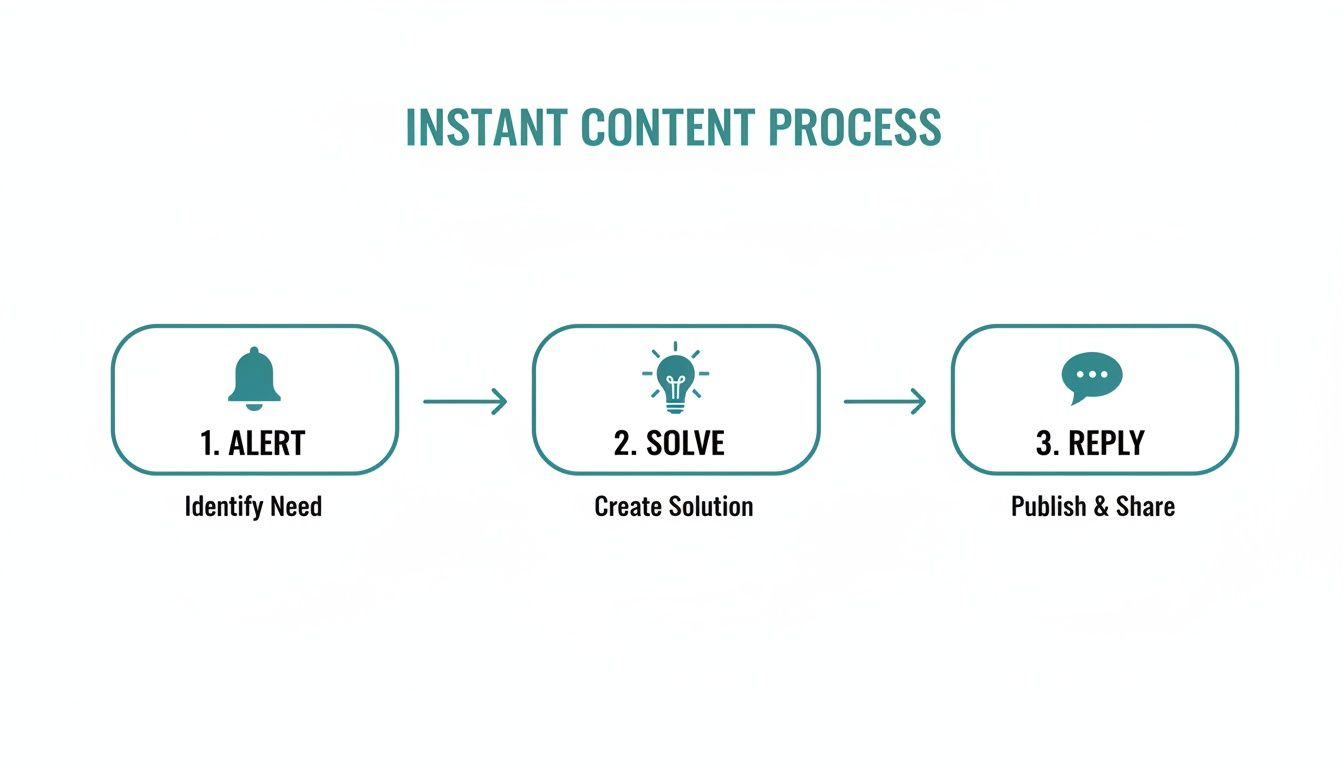
This little flowchart captures our core belief perfectly: creating instant value begins with a precise alert, shifts to actually solving the person's problem, and ends with a helpful, human reply.
From Slack Alert to Actionable Insight
Everything kicks off with a highly targeted alert. We have BillyBuzz configured to send real-time notifications straight into a dedicated Slack channel we call #reddit-mentions. This isn't just a firehose of random keyword hits; our alert rules are incredibly specific.
We filter every conversation by:
- Target Subreddits: We only listen in on communities where we know our ideal customers are active, like
r/SaaS,r/startups, andr/smallbusiness. - Negative Keywords: We cut out the noise by excluding common distractors like "hiring," "free," or "survey" to make sure every alert is worth our time.
- AI Relevancy Score: We set a minimum threshold, which means we only get notified about posts where the context is a strong match for what our tool actually does.
This level of precision is absolutely crucial. When you consider that 54% of businesses are increasing their content marketing budgets, yet 48% of startups have less than $5K/month to work with, every action has to count. The industry is projected to hit $1.95 trillion by 2032 for a reason—its ROI smokes traditional ads, making efficiency a massive advantage for small teams. For more stats on this, Power Digital Marketing has a great roundup.
Our Triage and Response Process
Once an alert hits our Slack, our small team jumps on it with a quick triage process. We manage the entire workflow right inside the channel using simple emoji reactions.
- Claiming the Conversation: The first person available reacts with the 👀 (
:eyes:) emoji. This signals ownership and, critically, prevents us from stepping on each other's toes. - Research and Draft: The owner digs into the user's question and drafts a thoughtful reply in a private thread directly under the alert. We lean on our "Helpful Expert" or "Shared Experience" frameworks to get started.
- Review and Post: A second team member gives the draft a quick once-over for tone and clarity, then drops a 👍 (
:thumbsup:) emoji. With the green light, the owner posts the reply on Reddit. - Mark as Done: After posting, the owner reacts with a ✅ (
:white_check_mark:) on the original Slack message. The loop is closed.
The entire process, from the alert hitting Slack to our response going live, often takes less than 15 minutes. It's a lightweight, collaborative system built for speed without ever sacrificing quality. If you want to get into the technical nitty-gritty, check out our guide on setting up real-time social media alerts.
To give you a clearer picture, here’s a template that breaks down exactly how we handle each alert.
Our Reddit Engagement Workflow Template
This table shows our step-by-step process for turning a BillyBuzz alert into a meaningful brand interaction. It's the simple, repeatable system that keeps our team aligned and efficient.
| Step | Action | Tool Used | Primary KPI |
|---|---|---|---|
| 1. Alert | A new mention in a target subreddit triggers a notification. | BillyBuzz, Slack | Alert Volume |
| 2. Triage | Team member claims the alert with 👀 emoji. | Slack | Response Time |
| 3. Draft | A helpful, non-promotional reply is drafted in a Slack thread. | Slack, Reddit | Reply Quality |
| 4. Review | Another team member reviews the draft and approves with 👍 emoji. | Slack | Team Collaboration |
| 5. Post | The approved comment is posted to the live Reddit thread. | Reply Rate | |
| 6. Track | The original Slack alert is marked with ✅. | Slack, Google Analytics | Attributed Sign-ups |
This workflow ensures nothing slips through the cracks and that every opportunity to engage is handled with care and purpose.
Measuring What Truly Matters
Vanity metrics like upvotes and karma are nice, but they don't pay the bills. We tie our brand awareness efforts directly to real business outcomes. It’s about moving beyond surface-level stats to track metrics that show we're actually making an impact on growth.
We stopped obsessing over upvotes and started measuring what actually moves the needle. An unsexy comment with two upvotes that drives a qualified sign-up is infinitely more valuable than a viral post that generates zero leads.
Our measurement strategy zeroes in on three key areas:
- Reply-to-Click Rate: We use custom UTM parameters in our links to see how many people are actually clicking through from our Reddit comments. This tells us if our answers are compelling enough to inspire action.
- Attributed Sign-ups: Our sign-up form has an optional "How did you hear about us?" field. It's been a goldmine. We see a steady stream of new users who write in "Reddit" or even mention a specific thread they saw us in.
- Sentiment Shift: We keep a close watch on our brand name in key subreddits to see how the conversation is evolving. The goal is to see the general sentiment shift from neutral or unknown to consistently positive over time.
This disciplined workflow ensures our community engagement isn't just a "nice-to-have" activity. It's a core, measurable driver of our brand's growth and reputation.
How to Scale Your Presence Without Losing Authenticity
As your brand starts to get traction, you hit a critical point: how do you grow without sounding like a faceless corporation? That authentic, founder-led voice that won over your first hundred customers can easily get lost in the noise as you bring on more people. It's a challenge we've lived through at BillyBuzz, and here's exactly how we've managed to scale our voice as the team expands.

The trick is to build a system. You can't rely on good intentions alone. The goal is to scale your impact while making sure every single interaction feels personal, valuable, and true to who you are.
Create a Founder-Led Voice and Tone Guide
The very first thing I did was document my own voice. It felt a little weird, I’ll admit, but it was the only practical way to give my team the confidence to speak on behalf of the company. A simple "voice and tone" guide is non-negotiable if more than one person is involved in your brand awareness efforts.
Forget those 50-page brand bibles nobody reads. Our guide is a simple two-page doc in Notion filled with practical, real-world examples.
- We Are: Helpful, a bit geeky, and always in the trenches with fellow founders.
- We Are Not: Corporate, pushy, or overly formal.
- Before and After Examples: This is the most important part. We show actual Reddit comments, one written in a generic "corporate" style and another in the "BillyBuzz" style. It makes the difference crystal clear.
- Approved Language: A running list of phrases we lean into ("That's a tough spot to be in," "We ran into this exact issue") and ones we steer clear of ("We're pleased to announce," "Per my last email").
This document has become our source of truth. Every new person reads it during onboarding, and we revisit it quarterly to make sure it still feels like us. It’s easily the most valuable asset we have for keeping our authenticity intact as we grow.
Build a Shared Response Library
Consistency is everything when you're trying to build a memorable brand. To help the team respond quickly without going off-brand, we built a shared library of what we call "response assets." These are absolutely not copy-and-paste templates. Think of them as battle-tested starting points based on replies that have performed well in the past.
We organize them in Slack based on the types of conversations we find through our BillyBuzz alerts:
- Problem-Focused: Pre-vetted answers for common technical or strategic questions people ask.
- Competitor Mentions: Neutral, value-first ways to respond when our competitors pop up in a conversation.
- Product-Specific: Short, clear explanations of how a particular BillyBuzz feature solves a specific problem.
When an alert comes in, a team member can find a relevant asset, tweak it to fit the exact context of the conversation, and post a solid, on-brand reply in just a few minutes. This dramatically cuts down our response time and ensures our core messaging is always on point. You can learn more about why real-time engagement is crucial for startup success in our deep-dive on the topic.
Scaling authenticity means empowering your team with the right guardrails, not a rigid script. The goal is to give them the confidence to be themselves, within the framework of the brand's personality.
This system turns every person on the team into a powerful brand advocate. They don’t have to guess what to say; they have a playbook that helps them add real value and reinforce who we are with every single comment.
Repurpose Community Wins into Evergreen Content
The final piece of the puzzle is amplification. A single, incredibly helpful Reddit comment that solves a person's problem is great, but its reach is naturally limited to that one thread. To really scale our impact, we systematically turn our best community interactions into standalone content.
This creates a powerful flywheel. Our community engagement directly fuels our wider content marketing machine.
- A Detailed Reddit Reply Becomes a Blog Post: If one of our comments gets a ton of upvotes or positive replies, we know we've struck a chord. We’ll expand on it and turn it into a comprehensive "how-to" article for our blog.
- A Helpful Insight Becomes a Twitter Thread: We'll pull the key takeaways from a great response and spin them into a bite-sized, shareable thread for Twitter.
- A Mini-Case Study Becomes a LinkedIn Update: When we share a story about solving a specific problem, we'll adapt it for a more professional audience on LinkedIn, maybe tagging relevant tools or industries.
This strategy ensures our most valuable insights don't just die in old threads. It transforms reactive community management into a proactive content engine, helping us scale that founder-led voice far beyond a single subreddit. It's how we make sure every great answer we give continues to build our brand long after the original conversation is over.
Got Questions? We've Got Answers.
When you're a founder trying to get your brand noticed, you're bound to have questions. We certainly did when we were building BillyBuzz. Here are the answers to the questions we hear most often, based on what we've learned in the trenches.
As a Solo Founder, How Much Time Does This Really Take Per Week?
You can make a serious dent with just 3-4 dedicated hours a week. Seriously. The trick is to focus on high-impact interactions, not just blasting out content everywhere. It’s all about consistency, not volume.
Think of it this way: with a good monitoring tool, you can spend about 30 minutes a day reviewing a hand-picked list of relevant conversations. No more endless, manual searching.
Here’s a realistic breakdown for a founder flying solo:
- The Setup: Block out one hour a week for your first month. Use this time to get your alerts dialed in with a tool like BillyBuzz. This initial investment pays off big time down the road.
- Daily Check-in: Spend 20-30 minutes each day jumping on the best alerts that pop up.
- Weekly Target: Aim for 5-10 genuinely helpful interactions per week. This is infinitely more powerful than dropping 100 generic, low-effort comments.
What Are the Biggest Landmines to Avoid on Reddit?
The absolute biggest mistake is treating Reddit like any other social media channel. It isn't. It’s a network of communities, and its users have a finely tuned radar for anything that smells like a sales pitch.
Things like overt self-promotion, dropping links to your homepage without context, and using corporate-speak are the fastest ways to get downvoted into oblivion or even banned from a subreddit. Another classic blunder is chiming in without taking the time to understand a community's unique culture, inside jokes, and rules.
The only way to win is to be a member of the community first and a marketer second. You have to spend time lurking, upvoting good content, and making helpful, non-promotional comments before you even think about mentioning your brand. Authenticity isn't just a buzzword here; it's the price of entry.
How Do You Actually Measure the ROI of Reddit Marketing?
Measuring the return on your Reddit efforts means looking beyond simple last-click attribution. This is a long-term play, and the value you get back shows up in a bunch of different ways.
We track a whole basket of metrics to get the full picture:
- Direct Traffic & Signups: We’re religious about using UTM parameters on any link we share. This lets us see exactly how much traffic and how many conversions are coming from specific Reddit threads right inside our analytics. It’s our source of hard data.
- Brand Mentions & Vibe: We keep a close eye on mentions of "BillyBuzz" across our target subreddits. The goal is to watch the sentiment shift over time from non-existent to positive and engaged.
- Qualitative Wins: We also track the "soft" ROI, which is often just as valuable. This includes incredible product feedback, ideas for new features, and content topics that come directly from these community chats.
- Long-Term SEO Juice: A really helpful comment on a popular thread can rank on Google and become a steady source of referral traffic for months or even years. We look at these as long-term assets we're building.
Will This Community-First Approach Work for B2C Brands?
Absolutely. While we’ve used our own B2B SaaS journey as an example, the core principles are universal. It all comes down to finding the digital campfires where your B2C audience is already gathered.
So, instead of targeting subreddits about startups, a B2C brand might dive into communities built around:
- Hobbies:
r/gardening,r/woodworking, orr/blender - Life Events:
r/NewParentsorr/personalfinance - Product Passions:
r/SkincareAddictionorr/MechanicalKeyboards
The playbook is exactly the same. Listen for problems, offer genuine help, build trust, and only bring up your product when it’s a natural fit. This strategy works across any business model because it’s built on real human connection, not just marketing tactics.
Ready to stop searching and start engaging? BillyBuzz finds the conversations that matter, so you can focus on building your brand. Discover your first leads on Reddit today.