
As a founder, your time is your most precious resource. It’s far too easy to get bogged down in the day-to-day grind of tracking every lead and manually tapping out one-off emails. A smart marketing automation workflow is your secret weapon. It’s about building a scalable system that sends the perfect message at the perfect time, freeing you up to think about the bigger picture.
This is how you build a machine that works for you 24/7.
Move Beyond the Manual Marketing Grind

Let's break this down without the corporate buzzwords. A marketing automation workflow is just a sequence of automated actions set off by something a user does. Think about it: instead of you having to remember to send a follow-up email when someone downloads your ebook, a workflow handles it instantly.
This isn’t about blasting your list with generic messages. It's about creating smart, repeatable processes that guide potential customers along their journey in a way that feels natural and helpful.
This shift from manual labor to automated systems isn't just a trend for big companies anymore. The global market size hit a staggering $6.65 billion in 2024 and is on track to smash $15.58 billion by 2030. That kind of explosive growth tells you one thing: automation is now a must-have for modern marketing.
Why This Matters for Founders
For any growing startup, doing more with less is the name of the game. A well-built workflow lets you scale your marketing without having to scale your team at the same frantic pace. It’s your safety net, making sure no lead gets forgotten and every touchpoint is timely and relevant.
As founders, we're hardwired to do everything ourselves. The real breakthrough happens when you realize that building a system is infinitely more valuable than just completing a single task. A workflow is that system—it’s your tireless, 24/7 marketing hire.
And this goes way beyond email. A truly effective marketing automation workflow can plug into your entire tech stack, from your CRM all the way to social listening tools like BillyBuzz. Understanding how marketing automation for agencies can streamline workflows is a key piece of the puzzle, even if you're not an agency, because the principles of efficiency are universal.
This guide is all about showing you how to build that machine, starting with the practical, founder-focused steps we use every single day.
Map Your Strategy Before Touching Any Tools
A killer marketing automation workflow doesn't start inside a software dashboard. It starts with a simple question that, frankly, a lot of founders skip: Who are we actually talking to, and what do we want them to do?
Jumping straight into the tools is like building a house without a blueprint. You'll end up with a complicated, expensive mess that doesn’t really do anything. This initial strategic work is what separates an automation that actually makes you money from one that just makes noise.
The proof is in the numbers. With at least 81% of marketing organizations now using automation, the ones winning are those who strategize first. They’re the ones automating tasks like social media posting (83%), email marketing (75%), and social ads (58%) with a crystal-clear purpose.
Define Your Ideal Customer Persona
At BillyBuzz, our personas aren't just dry demographic checklists. We dig into the psychographics—the real pain points, what drives our ideal users, and where they hang out online. I don’t really care if they’re 25-35; I care that they’re a B2B SaaS founder who is struggling to land their first 100 customers without a massive ad budget.
Here’s a quick look at one of our key personas:
- Persona: "Solo Founder Sam"
- Pain Point: Wastes hours manually scanning Reddit for mentions of his industry, but he knows he’s constantly missing important conversations.
- Goal: He just wants a reliable way to find high-intent leads on Reddit without it eating up half his day.
- Online Hangouts: Spends most of his time in
r/SaaS,r/startups, andr/marketing. - Trigger Keywords: "best tool for...", "how do you solve [problem]", "[competitor] alternative".
Knowing this inside and out lets us tailor every single piece of our automation. We know exactly which subreddcentral to monitor and what kind of language signals a perfect lead for us.
Map the Customer Journey
Once you know who you're talking to, you have to map their path. A customer journey is never a straight line; it's a messy series of touchpoints where you have a chance to build real trust.
We spend time visualizing this journey to pinpoint the critical moments where a marketing automation workflow can make a genuine difference. It’s not about blasting them with a message at every single turn. It’s about showing up and being helpful at exactly the right time.
The goal isn’t to automate for the sake of automation. It’s to automate empathy. Your workflow should anticipate a user's needs and deliver a solution before they even have to ask.
For our "Solo Founder Sam," that journey might look something like this:
- Awareness: Sam is scrolling through
r/SaaSand sees a genuinely helpful comment from the BillyBuzz account in a thread about lead generation. - Consideration: He’s intrigued, so he clicks our flair, lands on our site, and reads a blog post about finding your first customers on Reddit.
- Decision: He decides to sign up for a free trial to see if our Reddit monitoring alerts can work for his specific niche.
- Onboarding: He immediately gets a short, automated email sequence showing him exactly how to set up his first alert and get value from it.
Laying this out makes it obvious where to place your automation triggers. The awareness stage is handled by our active monitoring, while the onboarding stage is perfect for a simple, action-based email workflow. Before you even think about tools, it's vital to get these fundamentals right; learning how to create effective workflows is about understanding the process, not just the platform.
Set Clear Objectives and KPIs
Finally, every single workflow needs one clear, measurable goal. Are you trying to nurture leads? Onboard new users? Drive trial sign-ups? If you try to do everything at once, you’ll accomplish nothing. Pick one primary objective and build your entire workflow around that single purpose.
For our Reddit engagement workflow, our objective is dead simple: drive qualified trial sign-ups.
We measure success with just a few key performance indicators (KPIs):
- Engagement Rate: The percentage of our Reddit comments that actually lead to someone clicking on our profile.
- Click-to-Trial Rate: Of the people who visit our site from Reddit, what percentage starts a trial?
- Lead-to-Customer Time: How long does it take for a lead we found on Reddit to become a paying customer?
This simple framework keeps us honest. If our KPIs aren’t moving in the right direction, we know the strategy—not just the tool—needs a rethink. This foundational work is the non-negotiable first step.
The BillyBuzz Playbook for Engaging Reddit Leads
Theory is one thing, but seeing how a marketing automation workflow actually plays out is where the lightbulb goes on. So, I’m pulling back the curtain on the exact workflow we use at BillyBuzz to find and connect with high-intent leads on Reddit.
This isn’t some generic template. This is our live system—the same one that’s a core part of our growth engine. You'll see the specific subreddits, filters, and response templates we use every day.
Setting Up the Listening Post
It all starts with listening. The first layer of our automation is about surfacing the right conversations. We’re filtering out 99% of the noise to find that 1% of gold. We can't afford to burn hours manually scrolling, so our BillyBuzz dashboard is set up with laser-focused alerts.
Here’s a look at our actual alert setup:
- Target Subreddits: We hang out where our ideal customers—other SaaS founders and marketers—are asking for help. Our go-to list includes
r/SaaS,r/marketing,r/startups,r/growthhacking,r/b2b, andr/Entrepreneur. - Keyword Filters: We track more than just our brand name. Our filters are built to catch pain points and buying intent. We listen for phrases like "how to find leads on Reddit", "best tool for social monitoring", "alternative to [competitor name]", "struggling with customer acquisition", and "social listening tools".
- AI Relevancy Rules: This part is critical. A simple keyword match just creates more noise. Inside BillyBuzz, we set our alert sensitivity to "High Intent Only." This tells our AI to only flag posts where the context shows someone is genuinely asking for a recommendation, not just dropping a keyword in a random comment.
This setup is the trigger for our entire workflow. The whole point is to get an alert only when a conversation is a perfect fit for us to join.
The Automated Trigger and Triage Process
The moment our system flags a high-relevancy mention, the automation fires. Speed is everything on Reddit; a hot conversation can go cold in a few hours. Our workflow makes sure we never miss that window.
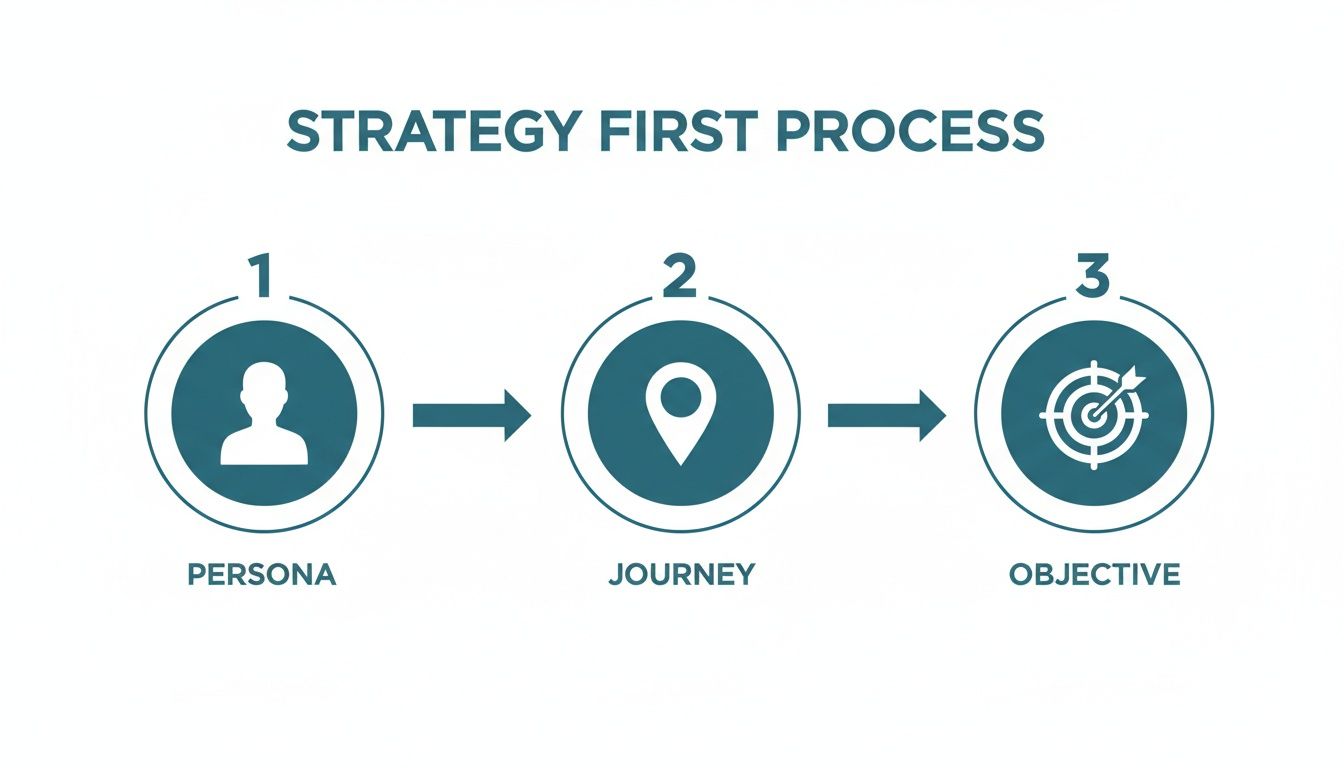
This is how we think about it strategically: map the persona, their journey, and our objective before even touching the workflow builder.
Here’s exactly what happens the second a relevant post is identified:
- Slack Notification: An alert gets pushed to a dedicated Slack channel,
#reddit-leads. It includes a direct link to the Reddit thread, the comment itself, and its AI relevancy score. - CRM Task Creation: At the same time, a new task is created in our CRM (we use HubSpot). It's assigned to our community manager and pre-filled with the Reddit URL and the user’s query. This gives us a system of record.
By the time our team sees an alert, it’s already been qualified and is ready for a thoughtful, human response.
Our philosophy is to automate the detection and delegation, not the conversation. The workflow brings the opportunity to us instantly, but a real person provides the genuine value.
This two-pronged alert system ensures nothing ever falls through the cracks. The Slack ping is for immediate action, while the CRM task lets us track that lead’s journey over the long haul.
Engaging with Smart Response Frameworks
Once our community manager gets the ping, they jump in using a set of internal response frameworks. I call them frameworks, not templates, because they aren't meant for mindless copy-pasting. They’re flexible guides that help us stay on-brand and helpful while allowing for plenty of personalization.
We have different approaches based on the user's intent:
Scenario 1: Someone Asking for Advice ("Help Me First")
- User Post: "I'm a founder struggling to find my first customers. What strategies worked for you?"
- Our Goal: Offer genuine, actionable advice first. Our tool is secondary.
- Response Template: "Great question. When we were starting out, we got a ton of traction by focusing on [specific, non-product-related strategy]. It's a grind, but it works. We actually built a tool to automate the Reddit monitoring part of that process, but the core principle of adding value first is what matters most."
Scenario 2: Someone Seeking a Specific Tool ("Direct Ask")
- User Post: "What's the best tool for monitoring Reddit for brand mentions?"
- Our Goal: Answer directly and highlight what makes us different.
- Response Template: "Hey, founder of BillyBuzz here. I'm obviously biased, but we built our tool specifically for this. The main difference is our AI relevancy scoring, which filters out the noise so you only see conversations where people are actually looking for solutions. Happy to answer any questions if you check it out."
This structured, personal approach is the final, crucial piece of the puzzle. The automation does the heavy lifting, but the human touch is what builds the relationship. For a much deeper dive into this strategy, you can learn more about how to get customers from Reddit in our detailed guide.
Crafting Your Automated Messaging Sequences
So, you've set up a trigger. Now what? This is the moment where your marketing automation workflow either shines or falls flat. A poorly designed sequence feels robotic and intrusive, but a great one feels personal and genuinely helpful—like getting a well-timed piece of advice from a trusted peer.
This is all about building multi-step messaging sequences, whether through email or social media, that actually nurture leads without being annoying. You're trying to start a conversation, not just broadcast a sales pitch.

Timing Is Everything
The most common mistake I see founders make is sending too much, too soon. Your prospect just engaged with you on Reddit; they aren't ready for a hard pitch five minutes later. That's why we build intentional time delays into our sequences. You have to let the relationship breathe.
My rule of thumb is simple: the value of the message should dictate its timing. A quick "thanks for the comment" notification can be instant, but a message with a real resource or a deeper insight needs some space. For new leads from Reddit, we wait a full 24 hours before our first automated email ever goes out. This creates a bit of distance from the initial interaction and feels less like a transactional, tit-for-tat response.
Using Conditional Logic to Stay Relevant
A linear, one-size-fits-all sequence is just lazy marketing. The real magic happens when you use conditional logic to create branching paths in your workflow. This simply means your automation adapts based on what the user actually does.
At BillyBuzz, our sequences are built around simple "if/then" rules:
- If a user clicks the case study link in Email 1, then we tag them as "High Intent" and send a follow-up about a specific feature mentioned in that case study.
- If a user doesn't open Email 1 after three days, then we send a second email with a completely different subject line and a more direct question to try and re-engage them.
- If a user replies to any email, then they're immediately pulled from the automation, and a task is created for a real person to take over the conversation.
This isn't about building some monstrously complex web of rules. It’s about creating just two or three key branches that make the conversation feel dramatically more personal and responsive.
This approach ensures we’re always sending the most relevant message possible. If you want to go deeper on this, our guide on personalized outreach with AI segmentation breaks down some more advanced strategies.
A Look at Our 3-Step Reddit Nurture Sequence
To make this concrete, here’s a simplified breakdown of the 3-step email sequence we use after someone from Reddit engages with our content and signs up for a trial or newsletter. The goal is to be helpful, not salesy.
Here’s a simplified look at the flow.
Sample 3-Step Reddit Lead Nurture Sequence
| Step | Timing | Message Goal | Example CTA |
|---|---|---|---|
| Email 1 | 24 hours after signup | Provide immediate, relevant value. No sales pitch. | “Check out the guide here.” |
| Email 2 | 3 days after Email 1 (if no click) | Re-engage with a simple, direct question. | “Is this a priority for you?” |
| Email 3 | 4 days after Email 2 (if no reply) | Gently introduce the problem our product solves. | “See how it works here.” |
This sequence works because it respects the user’s space while progressively introducing our solution in the context of their problem.
A/B Test Your Way to Success
Finally, never assume your first draft of a message is the best one. A great marketing automation workflow is never really "done." It's a living thing that you should constantly be tweaking. We run small A/B tests all the time to optimize performance.
My advice? Start by testing just one variable at a time so you know what's actually making a difference.
- Subject Lines: Test a question ("Struggling with X?") versus a statement ("Here's how to fix X").
- CTAs: Compare the results from a button that says "Learn More" against one that says "See How It Works."
- Body Copy: Pit a short, punchy message against a more detailed, story-driven one.
Even a small lift in open or click-through rates from these simple tests can have a massive impact on your conversion numbers over time. This is how you turn a good sequence into a true revenue-driving machine.
How to Measure and Optimize Your Workflow
Getting your marketing automation workflow live is just the first step. The real magic—the part that actually moves the needle on revenue—happens when you start digging into the data and making smart, targeted improvements. It’s far too easy to get distracted by flashy vanity metrics, but what really matters are the numbers that signal genuine business growth.
This is all about turning a decent workflow into a well-oiled, revenue-generating machine. And that starts with knowing exactly what to look for.
Focus on Metrics That Matter
We’ve learned to ignore most of the noise on our dashboards. Instead, we zero in on a few key performance indicators (KPIs) that tell us the real story of whether our workflow is pulling its weight. These aren't just numbers; they're diagnostic tools that show us the health of our entire funnel.
For our Reddit engagement workflow, here’s what we live by:
- Conversion Rate at Each Stage: We don’t just look at the final sale. We meticulously track the drop-off between each step—from a Reddit comment to a site visit, from a site visit to a trial signup, and from that trial to a paid account. A steep drop-off between any two points is a massive red flag.
- Lead-to-Customer Time: How long does it take for someone we find on Reddit to become a paying customer? If that timeline starts to creep up, it’s usually a sign that our nurture sequence isn't hitting the mark.
- Engagement Rate Per Message: We obsess over the click-through rates (CTR) for every single email in our automated sequences. A high open rate with a pitiful CTR tells us one thing: the subject line worked, but the content inside fell flat.
This focus on measurement is backed by some serious numbers. On average, companies can see a return of $5.44 for every $1 invested in marketing automation over three years—that’s a 544% ROI. When you also consider that automation can cut operational overhead by 12.2% and boost productivity by 14.5%, the motivation to get this right is pretty clear.
Find and Fix Bottlenecks
Data is useless if you don't use it to find the weak links in your system. We run a simple diagnostic check every month to spot these bottlenecks before they cause any real damage to our pipeline.
We always start by asking two fundamental questions:
- Where are people dropping off? If we’re getting great engagement on Reddit but hardly any clicks through to our website, the problem is almost certainly our on-platform messaging. Maybe the call-to-action in our comments is weak, or it just isn’t clear.
- Where is engagement stalling? If people are signing up for a trial but then vanishing after the first automated email, that email is the culprit. We immediately dive in to pick apart its content, timing, and CTA.
A marketing automation workflow is not a 'set it and forget it' tool. It’s a hypothesis. The data is your experiment's result, telling you whether your hypothesis was right or wrong. Your job is to keep running new experiments.
This exact process led us to a huge breakthrough a while back. We noticed that users who clicked a link in our very first onboarding email were 3x more likely to become paid customers. So what did we do? We completely redesigned that first email to have one single, laser-focused goal: get them to take one specific, high-value action in the product. That one tweak boosted our trial-to-paid conversion rate by 18%.
The Iterative Optimization Loop
Fixing a bottleneck isn't a one-and-done task. It’s a continuous cycle of reviewing, refining, and redeploying your workflow. Honestly, this is what separates the companies that scale from those that stagnate.
Our process is a simple loop we follow religiously:
- Review the Rules: Are our triggers still firing correctly? Are the segmentation filters we set up still aligned with our ideal customer?
- Refine the Messaging: Can we write a more compelling subject line? Is there a clearer, more direct way to phrase this call-to-action? We are constantly A/B testing something.
- Update the Logic: Should we add a new branch to the workflow for users who exhibit a specific behavior? Or maybe we need to adjust the time delays between messages?
This constant tweaking is the very essence of an effective marketing automation workflow. It’s how you adapt to what your audience is telling you through their actions. The same principles of tracking ROI apply here just as they do anywhere else. For a closer look at that, check out our guide on measuring social media ROI with a cost-benefit analysis. At the end of the day, your workflow's success comes down to your commitment to listening to the data and having the discipline to act on what it tells you.
Common Questions from Fellow Founders
Let’s be honest, diving into marketing automation can feel like a lot. As founders, we're already juggling a million things, and the last thing we need is another complex tool with its own language. I’ve had tons of conversations with other startup leaders and learned plenty from my own screw-ups here at BillyBuzz, so I've compiled answers to the questions I hear all the time.
How Complex Should My First Workflow Be?
My advice? Start painfully simple. Your very first workflow should be something you can knock out in an afternoon, not a project that takes a full week.
A perfect example is a classic welcome series. Someone signs up for your blog newsletter, and it triggers a sequence of just three emails. That’s it. You don't need a sprawling, 20-step masterpiece.
The real goal here isn't to build your forever-system on day one. It's to get something live, see what happens, and prove the concept works. The number one reason I see founders abandon automation is that they try to build something way too complicated from the start.
Our first “workflow” at BillyBuzz wasn't even a sequence. It was a single trigger: if a keyword got mentioned on Reddit, it fired off an alert to our Slack. That was it. We built everything else on top of that one simple, effective alert.
What Are the Biggest Mistakes to Avoid?
The single biggest mistake is automating a broken process. Automation is just an amplifier. If your manual outreach feels clunky or spammy, automating it will only help you annoy more people, faster. You have to prove the messaging and the approach work on a small, manual scale first. If it resonates in a one-on-one conversation, it stands a chance of working in a workflow.
The other huge error is skipping the testing phase. Please, don't do this. You have to run through the entire flow yourself before it goes live.
- Test every trigger: Does the workflow actually start when it's supposed to?
- Check your delays: Do the time gaps between messages feel natural, or are they too quick or too slow?
- Proofread everything: One broken link or a janky personalization tag (like seeing
Hello, [FNAME]!) can instantly kill the trust you're trying to earn.
How Do I Know If My Workflow Is Working?
Before you write a single email or set up a single trigger, define one primary KPI. What is the single business outcome this workflow needs to achieve? Are you trying to book more demos? Boost trial sign-ups? Maybe improve user retention?
Focus on that one metric. Obsess over it. While secondary stats like email open rates and click-throughs are good for diagnosing problems, they aren't the main goal. They don't tell you if your automation is actually making you money.
To get a real answer, you need a baseline. Know where you stand before you launch the workflow. Then, give it 30 to 60 days and compare the results. If your primary KPI is heading in the right direction, your marketing automation workflow is a win. If not, it’s time to dig into the data and start tweaking. It’s all a cycle of learning and refining.
Ready to stop missing high-intent conversations on Reddit? See how BillyBuzz uses AI to find your next customers and automate your outreach. Start your free trial today.