
Forget "building a community." That's the wrong frame. You don't build one; you earn one. Stop chasing users and start earning members. This isn't semantics. At BillyBuzz, our community is the product, not a marketing channel we tacked on.
The Real Mindset for Building a Community
Most founders get this backward. They build a product, hunt for users, then try to staple a "community" on the side to fix retention.
This is why most online communities are digital ghost towns. You're treating people like numbers, not individuals with real problems. The space becomes a glorified support forum or feature request board.
Flip the script. Validate the community's purpose before you write a single line of code. Your job isn't to build an audience for your solution; it's to create a space for people who share an urgent pain point. Your product becomes the tool that serves this community, not the other way around.
From User Acquisition to Member Validation
Before we built BillyBuzz, we ran a dead-simple validation playbook. We didn't build a platform; we went looking for a tribe. We had to prove that a group not only shared a common problem but were also actively looking for solutions and connections.
This required a mental shift:
- Forget features. Obsess over the conversations people are already having. What questions pop up constantly? Where are they venting?
- Find their watering holes. Where do your ideal members hang out? For us, it was niche subreddits beyond the obvious r/startups. We looked for threads where founders complained about manually tracking brand mentions or missing customer conversations.
- Solve a tiny problem by hand. We didn't pitch a product. We offered to manually track mentions for a few founders. This tested if the pain was acute enough for them to accept help from a stranger. It proved the demand was real.
Powerful communities are born from a shared struggle. When you build a space around a common enemy—a frustrating process, a lack of information—you create an instant bond.
Don't skip validation. It’s what separates a thriving ecosystem from an empty Slack channel.
This principle of targeted action isn't new. The Sustainable Development Goals Report 2025 highlights how focused actions in digital transformation are key to progress. The same logic applies to building niche groups. For more foundational insights, see how to build an online community.
Focus on the collective pain first. You'll earn the right to build a solution for the people living it. You're not building a community; you're creating a home for members you’ve already earned.
Your Pre-Launch Plan to Find Your First 100 Members
Forget growth hacking. Finding your first 100 members is a personal, hands-on process. You’re not broadcasting; you’re personally inviting the right people into a space built for them.
First, decide where your community will live. This choice is foundational.
Choosing Your Platform: Slack vs. Discord vs. Circle
Match the tool to your community's purpose and your members' habits.
- Slack is our pick for professional communities. Threaded conversations and integrations are perfect for B2B startups where discussions are project-based.
- Discord is king for real-time hangs. If you need live events, gaming, or casual chatter, its voice channels are unbeatable.
- Circle shines for content-centric communities. For a course, resource library, or structured knowledge sharing, its organization feels premium.
What is the primary "job" your community does? Quick problem-solving (Slack), live connection (Discord), or deep learning (Circle)? The answer makes the choice obvious.
The decision tree below gets at the core mindset for these early choices.
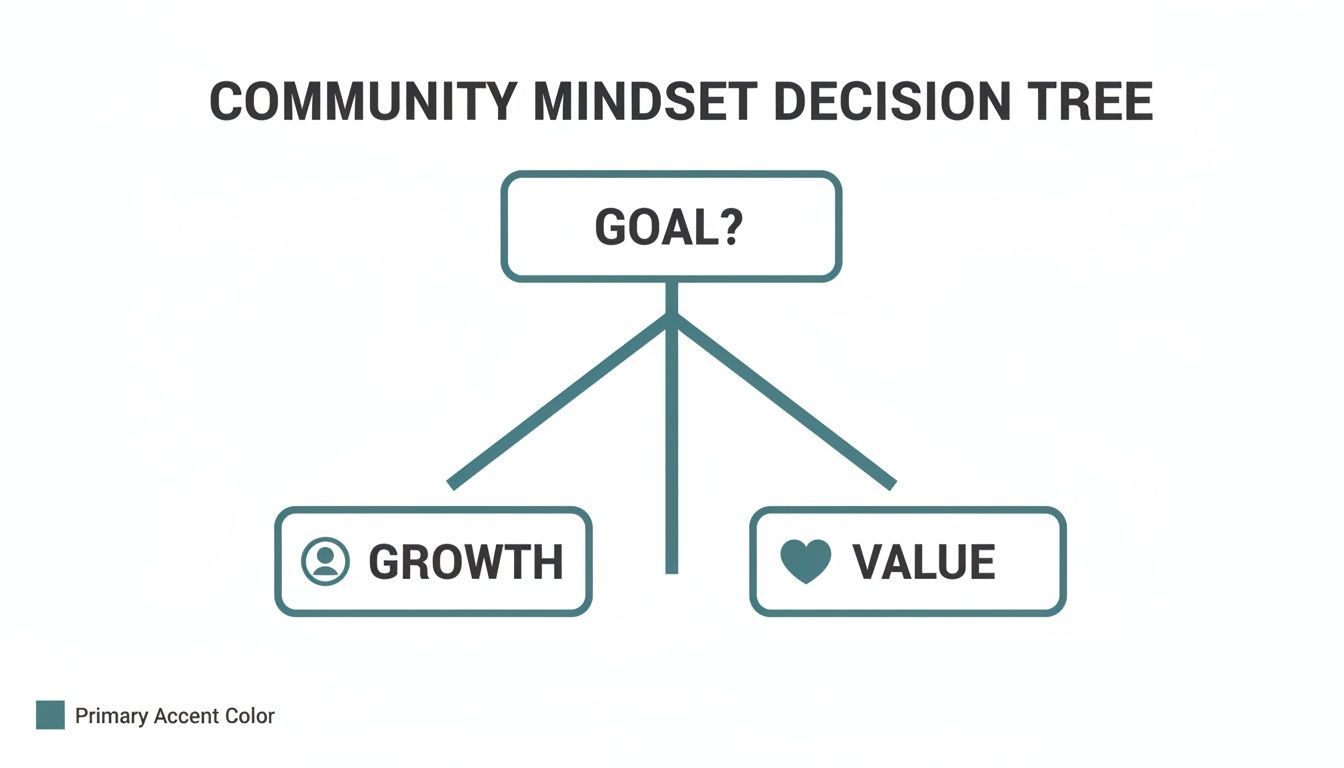
Whether your main objective is growth or value, both demand a clear strategy from day one.
Creating Your Community Charter Documents
Once you have a home, draft the documents that define its soul. This "charter" sets expectations and makes members feel safe.
Your charter needs three parts:
- A Clear Mission Statement: Nail down why you exist in one sentence. Ours was: "A space for founders to share practical strategies for discovering customers in online forums without spamming." Simple. Direct.
- Community Guidelines: Your house rules. Spell out what’s encouraged (sharing wins and losses) and what's not tolerated (zero self-promotion, no harassment). Clear rules prevent moderation headaches.
- A Welcome Sequence: Onboard every new member. Include a personal welcome, a link to the guidelines, and a nudge to introduce themselves.
Clear rules and a transparent mission give members the confidence to organize and solve problems together. This is the energy you want from your founding group.
Finding Your First 100 True Fans
Now, the real work: recruiting. One by one. You aren't filling seats; you're finding true believers who will become your cultural bedrock. This means knowing how to identify your target audience from the start.
Here’s where we put our energy:
- Your Personal Network: Comb through LinkedIn, Twitter, and email contacts. Who have you already talked to about this problem? Send them a personal note, not a blast.
- Relevant Online Forums: Go back to those "watering holes." Participate authentically. When you spot a perfect fit, DM them a personal invitation to a new, dedicated space.
- Early Product Users: Your first customers and beta testers are gold. They've already bought into your vision. They get the first invites.
This high-touch outreach is intentionally unscalable. It's what guarantees your first 100 members are deeply aligned with your mission, setting you up for a healthy community.
Our Reddit Playbook for Member Discovery
Let's be blunt: Reddit isn't just another social network. It's a universe of hyper-niche communities where your future members are already talking about the problems you solve. The challenge isn't finding conversations—it's finding the right ones without losing your day to scrolling.
This is the exact system we honed at BillyBuzz to turn Reddit into our most powerful channel for finding new community members.
This setup is about cutting through noise and getting high-intent conversations delivered directly to our team.
Setting Up Context-Aware Monitoring
The biggest mistake on Reddit is tracking generic keywords. Searching for "SaaS" or "marketing tool" is a recipe for failure. You'll get buried in low-quality posts and self-promotion.
We go deeper. We set up alerts that look for intent and context, not just keywords. Inside BillyBuzz, we build specific alert rules combining triggers to pinpoint high-value discussions. Think less "brand name" and more "problems we solve."
This strategy is amplified by broader societal shifts. With the global urban population projected to hit 58.1% by 2025, digital hubs are becoming more concentrated. Conversations are packed into tighter online spaces, making them easier to find—if you have the right monitoring. Dive into the data with the World Bank’s detailed analysis.
Our Go-To Niche Subreddits
Forget the obvious places like r/startups or r/entrepreneur. They're too noisy. The real gold is in smaller, focused subreddits where professionals have candid conversations.
Here are the subreddits we actually monitor inside BillyBuzz:
r/saas: A goldmine for founders and marketers talking about growth, customer acquisition, and churn—prime topics for us.r/productmanagement: We constantly find conversations here about understanding user feedback and digging into pain points.r/PPC: A fantastic source for marketers discussing lead quality, signaling a need for better discovery channels beyond paid ads.r/indiehackers: Raw, honest discussions from solo founders and small teams trying to grow.r/growmybusiness: Direct requests for help on topics where we can provide value.
Think about the second-order problems your community helps with. Don't just monitor your industry; monitor the jobs-to-be-done your members are wrestling with. For a deeper dive, check our guide on how to get customers from Reddit in 2025.
Your best community members won't be in a subreddit about "community building." They'll be in subreddits about the niche problem your community exists to solve.
The Exact Alert Rules We Use in BillyBuzz
Here’s a look behind the curtain. This is how we configure our alerts inside our own tool, combining keywords with context filters so we only get notified about conversations where we can add value.
This table shows the actual filter settings we use. This is our secret sauce.
BillyBuzz Alert Configuration for Community Discovery
| Filter Type | Configuration Example | Why It Works |
|---|---|---|
| Pain Point Monitoring | Keywords: "tired of manually checking", "how do you track mentions", "missed a conversation" in r/saas, r/marketing |
This targets users actively feeling the problem BillyBuzz solves. It’s a direct signal of high intent. |
| Competitor Mentions | Keywords: "SparkToro alternative", "mention.com vs", "Awario review" | This lets us jump into comparative discussions, highlight our differentiators, and engage users already in a buying mindset. |
| "Looking For" Intent | Keywords: "tool to find customers", "recommend a social listening", "best way to monitor Reddit" | This is the lowest-hanging fruit. These users are explicitly asking for a solution like ours. |
| Negative Sentiment | Keywords: "frustrated with", "hate using", "is so expensive" + Competitor Name | This helps us find unhappy customers of competing products, creating an opportunity to present a better alternative. |
These rules filter over 90% of the noise on Reddit. Instead of a firehose of mentions, our team gets a curated feed of high-potential engagement opportunities delivered to Slack. It's a game-changer.
Our Non-Spammy Response Templates
This is critical. The goal on Reddit is never to just drop a link. You want to add so much value that people ask you what you’re building or click the link in your profile out of curiosity.
Our responses follow a simple, three-part framework:
- Empathize and Validate: Start by acknowledging their problem. "I've been there" or "That's a super common frustration" builds immediate rapport.
- Offer Actionable Advice: Give a genuine solution that's helpful even if they never use your product. Share a specific tactic, resource, or personal experience. This positions you as an expert.
- Subtle Product Mention (Optional): If it feels natural, briefly mention how you solved this for yourself. Frame it as "We built a small tool to automate this..." instead of "Check out my product!"
Here’s a real template we use for pain point conversations:
"Hey [Username], that's a tough spot. Manually tracking mentions is a huge time-drain. One thing that helped us early on was setting up a few specific Google Alerts with advanced operators (like
site:reddit.com/r/subreddit "keyword") to narrow the focus.We actually ended up building an internal tool at BillyBuzz to automate this because it was taking up so much of our founder's time. But the advanced Google Alerts trick is a solid free starting point."
This approach respects Reddit culture. It provides immediate value and introduces our solution without being pushy. It's the most effective tactic we’ve found to grow a community of engaged members who found us organically.
Keeping the Fire Alive: How to Drive Engagement and Retain Your Core Members
Getting your community off the ground is one thing; making them stick around is the real work. You have to transform initial sign-ups into a passionate core that defines your culture.
This isn’t about throwing content at a wall. It's about intentionally creating an environment where people feel they belong.
At BillyBuzz, we learned you can't hope for engagement—you have to design for it. This requires a deliberate, consistent effort to build rituals and create a space where everyone is excited to contribute.
Create a Rhythm with Community Rituals
Sporadic posts and random check-ins don't work. You need predictable, high-value rituals that make your community a can't-miss destination.
Here are three rituals that worked for us:
- Weekly AMAs: We bring in industry experts for "Ask Me Anything" sessions. This gives members direct, exclusive access to people they admire.
- Member-Led Show & Tell: Every Friday, a dedicated thread goes live for members to demo what they’re building. This fosters a culture of mutual support and real-world learning.
- Collaborative Problem-Solving: We kick off Mondays with a "Stuck Session." Members post their biggest roadblock, and the community jumps in with solutions. This turns passive consumption into active co-creation.
These rituals aren't about us. They’re about creating member-to-member value and providing a reliable structure for connection.
Moderation is Gardening, Not Policing
Don't see moderation as a chore. It's the single most important act of community gardening. Your job isn't to be a cop; it's to cultivate a healthy, supportive, and psychologically safe environment.
Good moderation is almost invisible. It’s about gently reinforcing rules, celebrating positive interactions, and knowing when to step in—and when to let the community handle things. This proactive approach stops small issues from becoming toxic dumpster fires.
When members feel safe enough to disagree productively, real learning happens. Your goal as a moderator is to create an environment where members trust each other enough to have these conversations.
This subtle guidance makes a community special. A teacher who lets students critique each other's work sees the dynamic change. Members defend their own thinking and respectfully question others—far more powerful than top-down correction.
Building a Self-Sustaining Ecosystem
The ultimate goal is a community that largely manages itself. This happens when core members feel enough ownership to uphold the culture on their own.
We use a simple framework for handling conflict:
- Acknowledge and Isolate: Acknowledge the issue in public, but move the discussion to a private message. This prevents public dogpiling.
- Listen First: Never jump to conclusions. Listen to everyone involved. Conflict usually comes from misunderstanding, not bad intentions.
- Lean on the Guidelines: Refer back to community guidelines as the objective source of truth. It's not, "I think you're wrong," but, "Here's the rule we all agreed to."
This process builds trust. Over time, veteran members will start using this same language to guide new folks. That’s when you know you've built something special. For more on this, check our checklist for effective social media engagement.
Retaining your best members isn't about hacks. It’s about consistent rituals, thoughtful moderation, and empowering members to take ownership. Get that right, and you'll build a community that thrives.
Measuring Community Health Beyond Vanity Metrics
"If you can't measure it, you can't improve it." But what you measure separates a thriving group from a ghost town.
It’s tempting to get excited about total member count. For us at BillyBuzz, that’s one of the least important numbers. A big number feels good, but it tells you nothing about the health of your community.
True health isn't population size; it's the quality of interaction. Obsess over the flow of conversations and connections between members. Our internal dashboard is built around a few core metrics that give us a real-time pulse on whether we're building something of value.

Ditching Vanity for Actionable KPIs
Vanity metrics are easy to track but impossible to act on. An "actionable" metric tells a story and points toward a specific action. Are people lurking or participating? Are they talking at the community or with each other? These are the questions that matter.
Let's look at the metrics that are noise versus the ones we actually track.
Community Health Metrics We Actually Track
This table breaks down the surface-level numbers we ignore and the deeper KPIs we focus on.
| Vanity Metric (Avoid) | Actionable Metric (Track) | What It Tells You |
|---|---|---|
| Total Member Count | Active Member Ratio | What percentage of your members are actually showing up? This reveals the true "stickiness" of your community. |
| Page Views | Contribution Rate | What's the ratio of members who post or comment versus those who only consume? This signals a culture of participation or passivity. |
| Total Messages Sent | Network Density | How many members are connecting directly with each other? High density means you're building a resilient community that doesn’t depend solely on you. |
These three KPIs are the bedrock of our community health dashboard. They stop us from chasing empty numbers and keep us focused on depth of engagement.
Turning Numbers into Action
Knowing what to track is half the battle. You have to read the signs and react.
Here’s how we interpret these numbers:
Active Member Ratio dipping? That’s a sign of a weak onboarding experience. We audit our welcome sequence. Are we making it easy for new people to jump into their first conversation?
Contribution Rate low? This tells us we need to be better conversation starters. We'll launch a new ritual, like a "Show & Tell" thread, or personally tag specific members into discussions.
Network Density flat? A huge red flag that the community is too reliant on the founder. We actively facilitate member-to-member connections: "Hey @Jane, you should connect with @John—he was working on a similar problem last month."
Your metrics shouldn't be reports; they should be triggers. If a number is red, you should know exactly what three things you're going to try that week to fix it.
This approach transforms measurement from a passive task into an active, strategic tool. We once noticed our Contribution Rate dipping. We launched a "Stuck Session" where members could post their biggest challenge. Engagement shot up because the content was generated by and for the members, solving real problems in real-time.
Ultimately, measuring community health is about understanding human dynamics. Are people showing up? Are they talking? And most importantly, are they talking to each other? Focus on those three questions, and you'll build a community that lasts.
Common Questions About Building a Community
As we've helped other founders get communities off the ground, the same questions pop up. Here’s our honest, founder-to-founder advice.
How Much Time Should a Founder Dedicate to Community Building?
In the beginning, for your first 100-200 members? Clear your calendar. Expect to spend a solid 5-10 hours per week on this. This is active, hands-on engagement. You have to be the spark.
Your job is to personally welcome every person, kickstart conversations, and play matchmaker. As the community grows and leaders emerge, you can pull back. Your role shifts from doing everything to enabling others.
Tools make a huge difference. Using a platform like BillyBuzz to automate conversation discovery cuts down on the time you spend finding people. That frees you up to focus on the high-value work: engaging them. That's where your insight as a founder shines.
What Is the Biggest Mistake Startups Make When Building a Community?
Treating the community like another marketing channel. If you build a community just to funnel people into your product, it's dead on arrival. People join for connection, to learn, or to build their reputation, not to be sold to.
The second your community feels like a sales pitch, you’ll lose your best members first. They have a sixth sense for inauthenticity and will quietly exit.
Pour 90% of your energy into creating value between members. Help them solve each other's problems. The other 10% of your effort can then be spent gently connecting the dots back to your product.
When Should You Start Monetizing a Community?
Don't even think about it until you've hit "community-market fit." This is the point where the community is so valuable it hums along without your constant involvement.
You'll know you're there when:
- Members answer questions before you can.
- People start organizing their own discussions or meetups.
- They become your best advocates, bringing in new, high-quality members without you asking.
Trying to charge for access before this stage will poison the well. Once the free community is thriving, then you can explore premium tiers, exclusive content, or paid workshops. The value has to be undeniable long before you ask for a credit card. Be patient.
Ready to stop scrolling and start engaging? BillyBuzz uses AI to find high-intent conversations on Reddit, so you can focus on building relationships that grow your business. Discover your next customers today.