

Market research, for a founder, isn't some academic exercise. It's the brutally honest process of figuring out if anyone will actually pay for the thing you're about to pour your life into. It’s not about commissioning a massive report; it’s about getting into the trenches, listening to real conversations, and de-risking your idea before you write a single line of code. This is how we do it at BillyBuzz.
Stop Guessing, Start Validating

Forget the textbook definitions. This is a founder-to-founder playbook on the scrappy, practical research that actually works when you're moving fast with zero budget.
At BillyBuzz, we don’t have a research department. What we have is hustle, a few clever tools, and a belief that market research isn't a one-time project. It's the continuous feedback loop that takes the guesswork out of every product decision we make.
The Startup Reality Check
Traditional market research is broken for startups. Formal focus groups and hundred-page industry reports are way too slow and expensive when you need answers this week, not next quarter.
This is where a more nimble, practitioner-led approach wins. You have a direct, unfiltered line to your future customers through platforms like Reddit. You can hear their frustrations in their own words, see the clunky workarounds they've built, and spot the problems they would happily pay you to solve.
The global market research industry itself exploded between 2008 and 2022, reaching over $82 billion. That number tells you one thing: your competitors are taking customer insight seriously. For a startup, that means you have to be smarter, not richer, in how you get that insight.
Here’s a quick look at how our scrappy methods stack up against the old-school corporate playbook.
Scrappy vs Traditional Research Methods
| Method | BillyBuzz Approach (Startup-Friendly) | Traditional Approach (Enterprise) |
|---|---|---|
| User Interviews | Informal 20-min Zoom calls with people from a relevant subreddit. | Formal, 1-hour moderated interviews with a recruited panel. |
| Market Listening | Daily monitoring of keywords and conversations on Reddit & Twitter. | Commissioned reports on market trends and sentiment analysis. |
| Surveys | Quick, 5-question surveys shared in relevant online communities. | Large-scale, statistically significant surveys via professional panels. |
| Idea Validation | A simple landing page with a "Sign up for early access" button. | A fully staffed pilot program in a specific geographic market. |
The key takeaway is that you don't need a huge budget to get high-quality signals from the market. You just need to be where your customers are and listen carefully.
Adopt a Continuous Discovery Mindset
The single biggest shift we made was moving from "doing market research" to building a habit of continuous discovery. This just means weaving customer conversations and market listening into your weekly routine.
For us, it looks something like this:
- Weekly Reddit Dive: We dedicate a few hours every single week to specific subreddits where our ideal customers complain, share, and ask for help.
- Pain Point Log: Every time we spot a complaint, a request for a tool, or a frustrating process, it goes straight into a shared document.
- Pattern Finding: Over time, these individual data points connect. They form undeniable patterns that point directly to what we should build next.
"Your goal isn't to ask customers what features to build. It's to understand their problems so deeply that you can build the solution they haven't even imagined yet."
This is how you turn random online chatter into a concrete action plan. To truly get out of the guessing game, you have to master some essential market analysis techniques that uncover what customers really need and what your competitors are missing. It's all about building something people will actually pay for, not just an idea that sounds cool in your head.
Find Unfiltered Customer Insights on Reddit

Forget expensive panels and stuffy focus groups. Your ideal customers are already gathered in one place, talking candidly about their biggest headaches, the tools they despise, and the exact solutions they’re desperate to find.
That place is Reddit.
At BillyBuzz, Reddit is our bedrock for market research for new product development. We treat it like a living, breathing focus group that runs 24/7. This is where we tap into raw, high-intent conversations that tell us exactly what we need to build.
Pinpointing High-Value Conversations
The power of Reddit is its structure. People self-organize into niche communities (subreddits) based on their jobs, interests, and industries. Your first job is to find where your Ideal Customer Profile (ICP) hangs out.
For us, that's places like:
- r/SaaS
- r/marketing
- r/startups
- r/smallbusiness
- r/productmanagement
But just lurking isn't a strategy. You need a system. We don’t scroll endlessly; we’ve built precise monitoring rules to catch the conversations that matter.
The shift to real-time, AI-driven market intelligence has completely changed this game, compressing research cycles from weeks into hours. In fact, research from Deloitte's 2025 marketing outlook found that companies investing heavily in marketing tech see an 18% greater sales lift and 7% higher overall revenue growth than their peers. It shows that having the right tools to turn conversations into decisions gives you a serious edge. You can read the full research on market intelligence trends to see the full impact.
Our Internal Alert Rules and Keyword Filters
We use our own tool, BillyBuzz, to automate this, piping alerts directly into a #reddit-mentions Slack channel. This turns passive listening into an active, real-time research engine.
Here’s a look at the exact keyword filters we use to find high-value threads. These aren't just single words; they're phrases designed to catch specific conversations.
| Filter Type | Example Keywords & Phrases | Why It Works |
|---|---|---|
| Problem & Pain Point | "frustrated with", "annoyed by", "is there a tool for", "how do you handle" | Captures raw, emotional language that points directly to a painful problem someone wants to solve. |
| Competitor Complaints | "[Competitor Name] alternative", "hate using [Competitor Name]", "is [Competitor Name] down" | Directly identifies weaknesses and dissatisfaction with the tools people are already using. |
| Purchase Intent | "recommend a tool", "best software for", "looking for a solution", "budget for" | Finds people who are actively shopping and are in a buying mindset right now. |
| Tool Stacking | "Zapier integration", "connect [Tool A] to [Tool B]", "API for" | Uncovers how people are already piecing together solutions and reveals huge integration opportunities. |
Automating this is a total game-changer. If you want to try it yourself, we put together a guide on how you can set up Slack alerts for Reddit mentions in about 10 minutes.
Engaging Authentically to Dig Deeper
Once an alert flags a relevant conversation, your goal is to learn, not to sell. Dropping a link to your product is the fastest way to get ignored.
Instead, we use a simple, helpful approach. Here’s a template we often adapt:
"Hey, saw you’re struggling with [specific problem mentioned]. I’ve seen a few teams solve this by [offering a genuinely helpful tip or process]. Out of curiosity, have you already tried [mentioning a common workaround]? Trying to understand the problem better."
This simple reply does three critical things:
- It shows you listened. You’re referencing their specific issue.
- It adds value first. You’re offering help with zero strings attached.
- It opens a dialogue. You’re asking a clarifying question that invites a response.
By consistently showing up to help, not pitch, you build trust and can start having deeper conversations, often moving to DMs for candid feedback.
We track these conversations in a simple Notion database, tagging each entry by theme, pain point, and requested feature. Over time, this becomes a living document of customer needs—your most valuable asset.
Crafting Surveys and Interviews That Get Real Answers
Social listening gives you the raw "what"—the problems and desires people are voicing. Now you need to dig into the "why" with targeted surveys and interviews. This is where you graduate from broad observations to the specific insights that shape a product.
We skip the expensive panels. The best insights come from the same Reddit communities we're already monitoring. You'd be surprised how willing people are to talk when you approach them with genuine curiosity.
Recruiting Your First Participants from the Wild
Finding people to talk to is simpler than you'd think. After jumping into a relevant thread and adding value, we'll often just send a direct message to a user who posted an insightful comment.
Our outreach message is straightforward. We tweak it, but the core ingredients are the same:
Subject: Your Reddit comment about [Topic]
"Hey, really appreciated your comment in the r/SaaS thread about the frustrations with CRM reporting.
I'm a founder working on a new tool to make that process less painful, and I'm trying to make sure I'm not building in a vacuum.
Would you be open to a 15-minute chat next week to share your thoughts? Happy to send a $20 Amazon gift card for your time."
This approach just works. It’s personal, respects their time, and offers a small token of appreciation. For this initial discovery phase, we aim for conversations with 5-10 people.
Asking Questions That Uncover Truth, Not Bias
The quality of your research lives and dies by your questions. The biggest mistake founders make is asking leading questions to confirm their own biases. Fight the urge to fish for compliments.
Let's look at the difference:
- Bad Question: "Wouldn't it be great if you had a feature that automatically generated marketing reports?" (Asks them to agree with you).
- Good Question: "Tell me about the last time you had to create a marketing report. What was that process like?" (Prompts a story, revealing real pain points).
Our interview script is built around open-ended, backward-looking questions. We want to understand past behavior—what they actually did—not get them to speculate about some hypothetical future.
Your goal isn't to validate your specific solution. It's to validate the problem. If you understand the problem better than anyone else, you can build the right solution.
Once you’ve gathered these responses, the next challenge is making sense of it all. Knowing your way around analyzing qualitative data is what turns anecdotes into a prioritized feature list.
From Interviews to Actionable Insights
We don't use complex analysis software. A simple spreadsheet or a Notion database is all you need. We create a row for each participant and set up columns for the key themes that emerge.
- Problem: The core issue they described.
- Current Solution: The workaround or tool they're using now.
- "Magic Wand" Quote: A direct quote about what their ideal solution would do.
- Pain Level (1-5): Our subjective rating of how intensely they feel this problem.
This simple tagging system lets us quickly spot which problems pop up most frequently and, just as importantly, which ones carry the most emotional weight.
This data, combined with insights from our social listening, flows directly into our product roadmap. It's a potent mix of high-level R&D trends—which WIPO's Global Innovation Tracker noted hit nearly $1.3 trillion in 2024—and focused, on-the-ground user research. You can explore the full findings on global innovation spending to see the bigger picture.
To close the loop, check out our guide on how AI improves customer feedback integration, where we explore how to turn all this feedback into a much smarter product development cycle.
From Insight to Action: Validating Your Idea with Smoke Tests and MVPs
You’ve listened, you’ve talked, and now you’re sitting on a mountain of insights. But talk is cheap. The most critical step is finding out if people will actually commit—even in a small way—before you pour hundreds of hours into building the real thing.
At BillyBuzz, we have one non-negotiable rule: no production code gets written until we've validated the core idea with a real-world test. This is where we stop researching and start experimenting with smoke tests and Minimum Viable Products (MVPs).
The Power of the Smoke Test
Our first stop is always a smoke test. Think of it as a storefront for a product that doesn't exist yet. It's usually just a simple landing page with one goal: to see if people are interested enough to trade their email address for the promise of your solution.
It’s the ultimate low-cost, high-signal experiment. You can spin one up in a day using a tool like Carrd or Webflow and drive a small amount of targeted traffic to it. We just want to know if the value proposition resonates enough to earn an email.
Here’s our internal checklist for a smoke test landing page:
- A Crystal-Clear Headline: Nail the problem and promised outcome in one line. No jargon.
- A Compelling Sub-Headline: Briefly explain how you solve that problem for a specific audience.
- A Single, Obvious Call-to-Action (CTA): "Request Early Access" or "Join the Private Beta."
- A Simple Email Capture Form: Just the email field. Every extra field kills conversions.
- Three Key Benefit Bullet Points: Focus on what the user gains, not what the product does.
The conversion rate on this page is your first real data point. If we see a rate of 5-10% from highly targeted traffic, that’s a strong signal to move forward.
Defining Your Minimum Viable Product
If your smoke test looks promising, it’s time to scope an MVP. The key word here is minimum. An MVP isn't a buggy version of your final product. It's the simplest possible thing you can build that solves the core problem for your earliest customers.
The real purpose of an MVP is to test your biggest assumption—will people actually use this thing to solve their problem? It's a learning tool, not a sales tool.
To keep ourselves from getting lost in feature creep, we use a simple three-question framework at BillyBuzz:
- What is the #1 job the user is hiring this product to do? Be brutally specific.
- What is the absolute leanest set of features needed to get that one job done? Strip away everything else.
- Who is the niche user that feels this pain most acutely? Build for them and them alone, for now.
This process forces you to focus on what makes the MVP viable. It has to work and solve the core pain point, but that’s it.
Measuring What Matters with Your First Users
Once your MVP is live with a small group of users (often from your smoke test page), your research hat goes back on, but now you're measuring behavior. We zoom in on two metrics that tell us if the product has a real pulse:
- Activation Rate: What percentage of users who sign up actually complete the single most important action? For us, that might be setting up their first keyword alert.
- Week 1 Retention: Of those users who activated, how many come back and use the product again within the first seven days?
These numbers tell you if your research translated into a solution that provides real value. If activation is low, your onboarding is confusing. If retention is low, the product isn't solving the problem well enough. This is how you close the loop, feeding real user behavior right back into the next iteration.
Translate Research into Your Product Roadmap
All the Reddit threads, survey responses, and MVP feedback are useless if they die in a spreadsheet. This is where you turn raw insights into a living product roadmap, connecting customer pain points directly to the code your team ships.
At BillyBuzz, we don't let research become a static report. We treat it as the fuel for our development engine. The goal is to move from a pile of interesting data to a clear, prioritized list of what to build next.
Prioritizing Features With a Simple Scoring Framework
After synthesizing themes from research, you’ll have a huge backlog of potential features. To decide where to start, we rely on a simple scoring framework to bring objectivity to the process.
We score every potential feature on two axes:
- Customer Impact (1-5): How many users does this affect? How painful is the problem this solves? A score of 5 means it addresses a critical, widespread issue.
- Engineering Effort (1-5): How complex is this to build? This is a rough estimate from our dev lead. A score of 1 is a quick win, while a 5 is a major project.
The highest-priority items are those with high impact and low effort. This straightforward model helps us focus our limited resources where they'll make the biggest difference for our users.
This process ensures that everything from your early smoke tests to your full MVP is designed to validate specific, high-impact assumptions.
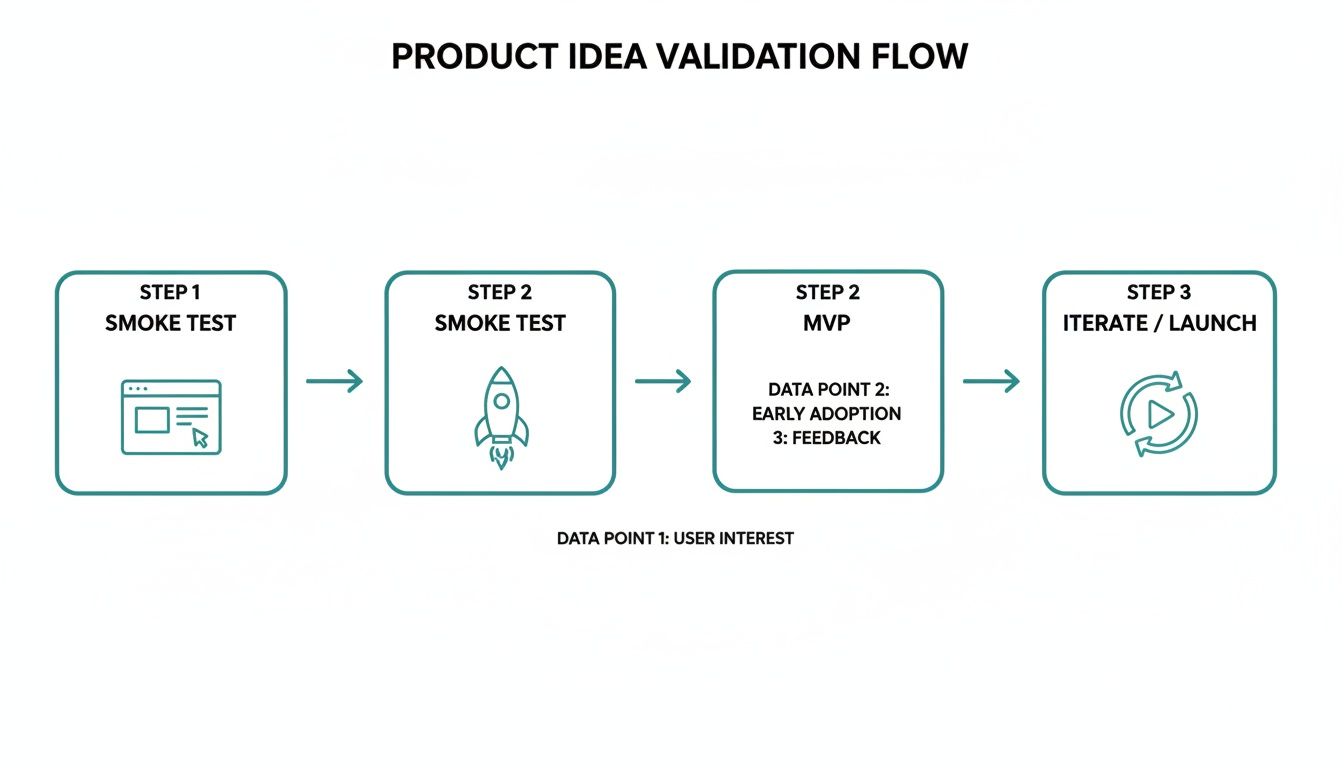
This simple flow—from a low-commitment smoke test to a functional MVP—is the core of how we de-risk our roadmap before committing significant engineering time.
From Actionable Insight to Product Feature
Here's a simplified view of how we convert different types of research data into concrete product development tasks.
| Research Input Type | Key Question It Answers | Example Actionable Output |
|---|---|---|
| Qualitative Interview | What is the real "why" behind a user's problem? | A user story for the backlog with direct quotes to provide context for developers. |
| MVP Feedback | Is the core value proposition strong enough for users to engage? | Prioritize bug fixes and usability improvements for the most-used MVP features. |
| Social Listening (Reddit) | What are the unfiltered frustrations and desires of our target audience? | An idea for a new feature that directly addresses a commonly cited "I wish X could do Y" complaint. |
| Quantitative Survey | Which pain point is most widespread among our user base? | Validation to prioritize a feature that 65% of respondents rated as "very important." |
This table isn’t exhaustive, but it shows how every piece of data has a purpose and a path toward becoming part of the product.
Writing User Stories Grounded in Reality
To make sure our developers understand the "why" behind what they're building, we write user stories that are directly tied to customer quotes. It's a small change that has a huge impact.
Instead of a generic story, we get specific:
- Generic Story: "As a user, I want to filter alerts so I can see what's important."
- BillyBuzz Story: "As a busy founder, I need to filter out low-intent keywords so I can focus on the 3-5 conversations that could actually lead to a demo this week. Like Sarah from r/SaaS said, 'I get a ton of alerts, but 90% are just noise.'"
This addition of context and a real voice transforms an abstract task into a tangible problem for a real person, ensuring the final product solves the intended pain point.
"A roadmap isn't a timeline of features to be delivered. It's a strategic document that communicates the 'why' behind the problems you're solving for your customers."
Setting KPIs to Close the Feedback Loop
The launch of a feature isn't the end of the process; it's the beginning of the next feedback loop. For every significant feature we ship, we define Key Performance Indicators (KPIs) before it goes live to know if it's successful.
Common KPIs we track include:
- Adoption Rate: What percentage of active users engage with the new feature in their first two weeks?
- Task Completion Rate: Can users successfully accomplish the core job the feature was designed for?
- Impact on Retention: Do users who adopt this feature stick around longer than those who don't?
Tracking these KPIs tells us if our research led to the right conclusions. It's also critical for knowing how your product stacks up. For a deeper dive, check out our ultimate guide to competitor analysis to see how we track our position in the market. This ongoing measurement turns your roadmap from a static plan into a dynamic engine for growth.
A Few Common Questions From the Trenches
When you're in the whirlwind of building, market research can feel like a detour. As founders, we've wrestled with the same questions: How much will this cost? Where do I find people to talk to? And when have I done enough research to actually build something?
Let's tackle these head-on.
How Much Should an Early-Stage Startup Really Budget for Market Research?
Honestly? As close to zero cash as possible. But it will cost you a significant amount of founder time.
In the pre-seed or seed stage, your sweat equity is the only currency that matters. Forget expensive industry reports or hiring a firm. Instead, invest your own time—this part is non-negotiable. Your primary "cost" should be the 5-10 hours per week you personally block out to lurk in online communities, talk to potential users, and run scrappy experiments. The only cash you might spend is on a low-cost tool to automate social listening.
Don't think in dollars; think in focused hours. The insights you gain from personally engaging with your future customers are worth more than any report you can buy.
That time investment pays off massively because it’s how you build genuine empathy and a gut-level understanding of the problem.
What's the Best Way to Find People for Customer Interviews?
Go where the conversation is already happening. Your target users are already gathered in niche online communities—for us, that's Reddit, but it might be a specific Slack group, a Discord server, or a professional forum.
The trick is to participate authentically first. Add value to a conversation, offer a helpful tip, and then slide into the DMs of the most insightful people.
A simple, direct message works wonders. Here’s a template we've used with great success:
- "Hey, saw your comment about struggling with [specific problem]. I'm a founder building a tool to solve that exact thing and would love your honest feedback for 15 minutes. Happy to send you a $20 Amazon gift card for your time."
This approach is effective because it’s personal, shows you respect their expertise, and offers a small incentive. You'll be surprised how many people are happy to share their thoughts.
How Do I Know When I’ve Done Enough Research to Start Building?
Research isn't a one-time task; it’s a continuous loop. That said, there's a point where you have enough signal to de-risk the initial build.
You've probably done enough preliminary research when you can confidently answer these three questions:
- What is the specific, painful problem we are solving? Nail this in a single, crystal-clear sentence.
- Who is our ideal first customer, and where do they hang out online? You need to know how you'll find your first ten users.
- Have we heard the same core problem described in similar language by at least 10-15 different people?
That last point is your strongest signal. When you start hearing the same frustrations repeated back to you without prompting, you’ve struck a nerve. The goal of early-stage market research for new product development isn't to eliminate all uncertainty. It's about building enough conviction to commit resources to your MVP.
Ready to stop guessing and start listening? At BillyBuzz, we built the tool we wished we had. It automates Reddit monitoring, filters out the noise with AI, and sends high-intent conversations directly to your Slack. Find your next customers where they're already talking. Start your free trial today.