

Forget asking, "Can we build this?" The only question that matters is, "Should we build this?" The answer comes from treating product development and market research as one continuous loop: listen, build, validate, repeat.
This isn't theory. This is the playbook we built from the trenches at BillyBuzz. Here’s how we turn raw chatter from online communities into our most valuable asset.
Stop Guessing and Start Listening
It’s easy to fall in love with your own idea. But gut feelings don’t pay the bills. We learned the hard way that building in a vacuum is the fastest route to a product nobody wants.
Early on at BillyBuzz, we ditched slow, expensive focus groups. The real gold was embedding ourselves in the daily conversations our ideal customers were already having online.
It's all buried in the unfiltered, real-time discussions on platforms like Reddit. People aren't performing for a moderator; they're venting about real problems, desperately searching for solutions, and wishing out loud for better tools. Tapping into that stream of consciousness de-risks every product decision we make.
This simple visual sums up the massive shift in our product philosophy. It’s all about listening first.
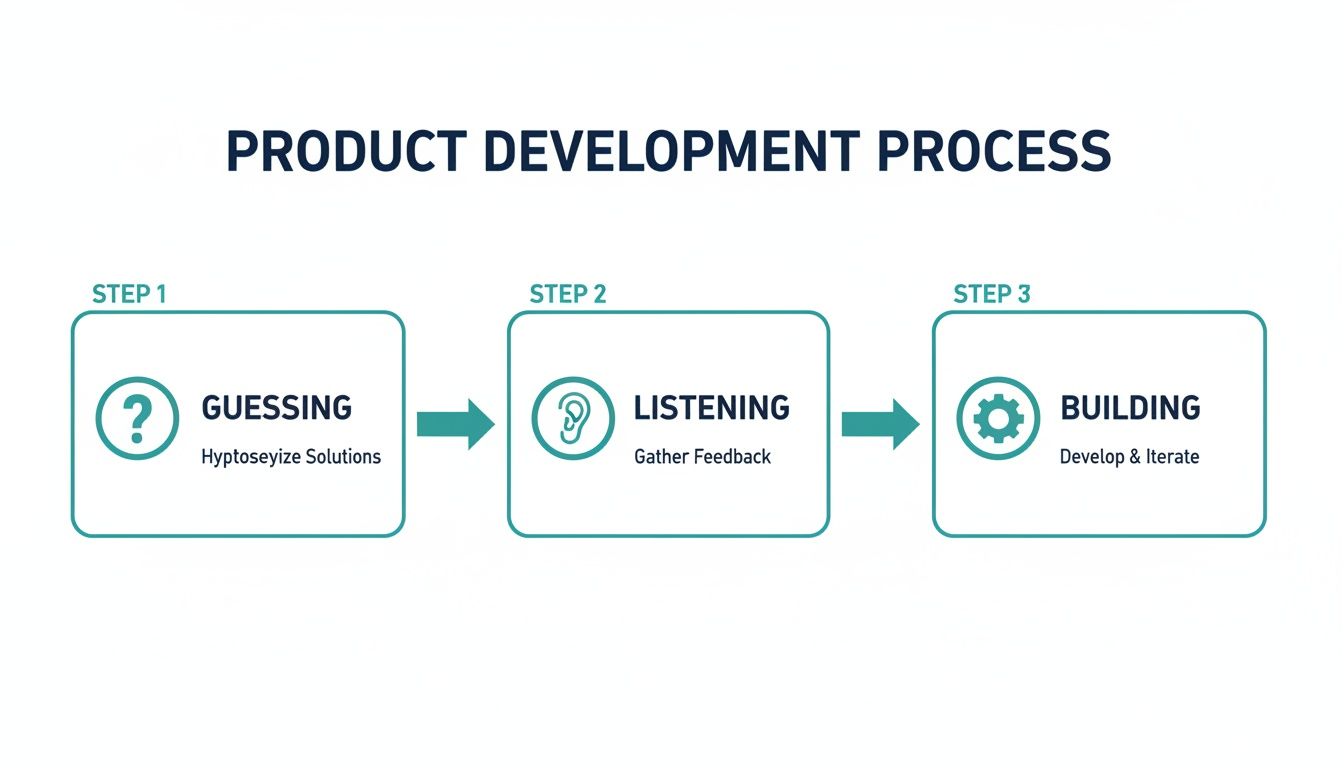
Think of active listening as the bridge connecting a vague idea to a validated product that people will actually line up to buy.
Our Mindset Shift
If you truly want to stop guessing, you have to get good at knowing how to get customer feedback that works. It’s less about asking broad, hypothetical questions and more about observing specific behaviors and hearing raw, unprompted pain points.
At BillyBuzz, our core principle is this: Your future customers are already telling you what to build. You just need to be in the right place, at the right time, to hear them.
This belief is the bedrock of our entire strategy. Before we write a single line of code for a new feature, we validate the core hypothesis with direct insights from the community. This isn't just a software development trick; it’s a universal framework.
We’ve gone deep on this topic in our guide to https://www.billybuzz.com/blog/social-listening-for-b2b-lead-generation-guide. This isn’t just about market research; it's about true market integration.
Finding Your Niche on Reddit
Your first customers are already gathered in online communities, talking about their problems every single day. For us, Reddit is that goldmine. But the trick isn't just showing up in r/startups. The breakthroughs come from digging into hyper-niche forums where people share their most unfiltered frustrations.
This is step one in our product development cycle at BillyBuzz. It's not passive listening; it's an active intelligence-gathering operation that shapes everything we build.
There’s a reason the market research industry is booming. The US sector alone is projected to hit $36.4 billion by 2025, and over 75% of companies now rely on targeted research to steer their decisions. With social media usage for product research climbing to 32%, platforms like Reddit have become non-negotiable for understanding what people actually need. It's how you avoid becoming one of the 90% of startups that fail because they built something nobody wanted. You can get a deeper dive into these industry trends over at IBISWorld.
Move Beyond the Obvious Subreddits
Everyone knows to check the big, general-interest subreddits. But your ideal customer isn't just a generic "SaaS founder." They’re a SaaS founder wrestling with churn analysis tools or a B2B marketer desperately trying to prove ROI from their community efforts. Those are the conversations you need to find.
We call this the ‘adjacent interest’ method. If you’re building software for video editors, r/videography is a start. But the real gold is in places like r/editors, r/davinciresolve, or forums for specific camera brands where users troubleshoot highly technical workflow problems.
While broad communities are useful for getting the lay of the land, the most potent, actionable insights almost always come from smaller, more dedicated groups where specific problems are debated daily.
Setting Up Your Intelligence Engine
Once we’ve mapped out a cluster of potential subreddits, we turn our own tool, BillyBuzz, into an automated research assistant. This goes way beyond simple keyword tracking. We're setting it up to monitor for intent, pain, and opportunity.
This table shows a simplified version of the exact alert rules we use inside BillyBuzz to turn Reddit into our market research engine.
Our BillyBuzz Alert Setup for Market Discovery
| Alert Type | Keywords/Phrases Monitored | Target Subreddits (Examples) | Goal of this Alert |
|---|---|---|---|
| Competitor Mentions | "HubSpot alternative," "frustrated with Mailchimp," "Zapier vs Make" | r/SaaS, r/marketing, r/smallbusiness |
Find users actively evaluating tools in our space and identify competitor weaknesses. |
| Problem-Based Keywords | "how to track mentions," "struggling with PR," "need to find conversations" | r/solopreneur, r/growthhacking, r/indiehackers |
Uncover raw, unfiltered pain points that our product can solve. This is direct market demand. |
| Buying-Intent Phrases | "recommend a tool," "looking for software," "best app for" | r/Entrepreneur, r/startup, r/b2b |
Pinpoint potential customers who are in the final stages of their search for a solution. |
This isn't an exhaustive list, but it's the core of our discovery process. We've written more about some of the most consistently valuable communities we monitor in our guide on the top 5 subreddits for small business insights.
We don't wait for people to find us. We configure our tools to find people actively describing the exact problems our product is designed to solve. This flips the traditional research model on its head.
This systematic approach transforms Reddit from a simple social media site into a dynamic, real-time focus group. The feedback you get is raw, honest, and comes from people who are genuinely feeling the friction you want to eliminate. The insights gathered here aren't just interesting—they become the blueprint for our product hypotheses and feature prioritization, which we'll dive into next.
Turning Raw Feedback into Actionable Hypotheses
A stream of Reddit conversations is just noise until you have a system. When a BillyBuzz alert hits our Slack, the real work starts. This is our founder-to-founder workflow for translating community chatter into validated hypotheses, saving us from building features on a hunch.
The process kicks off the second an alert hits our Slack. We don’t just glance at it; we categorize it immediately. A simple tagging system is your best friend here. We set up a small, shared Notion database where we drop conversation snippets and apply a few key labels.
This isn’t about building some complex data warehouse. It's about moving from a one-off comment to a pattern of evidence.
Our Qualitative Tagging System
We keep our tags simple and laser-focused on action. Every comment or post we save gets one or more of these labels, which lets us quickly filter the database and spot themes that keep popping up.
- Pain Point: This is gold. The user is explicitly describing a frustration or a problem they're struggling with. It’s the strongest signal you can get.
- Feature Request: The user is asking for a specific solution. This is helpful, but you have to be careful—dig deeper to find the underlying problem they're trying to solve, don't just take the solution at face value.
- Desired Outcome: Here, the user describes what they wish they could achieve. Think, "I just want to see all my brand mentions in one place without logging into five different tools."
- Competitor Complaint: Someone mentions a competitor and points out a specific weakness or frustration. This is a wide-open opportunity for you to step in.
When one person in r/videography complains about a specific software bug, that’s just an anecdote. But when ten people across three different subreddits all complain about the same bug over a month? That's a signal. Our tagging system is how we tell the difference.
From Signal to Structured Hypothesis
Once you've spotted a cluster of related signals, it's time to structure them into a formal hypothesis. This is how you transform a vague idea into something you can actually test. We use a simple, consistent format for every potential feature or product idea that comes through.
We believe [a specific user segment] will [take a specific action, e.g., pay for a tool] because [they are facing a specific problem] which results in [a quantifiable negative outcome].
This structure forces you to be crystal clear. It makes you define exactly who you're building for, what problem you're solving, and why it actually matters.
Here’s a real-world example from our own process:
- The Signal: We kept seeing posts in
r/solopreneurandr/indiehackerswhere founders were complaining about how much time they wasted manually checking Reddit for mentions. They talked about missing opportunities and just feeling overwhelmed. - The Hypothesis: We believe solo founders will pay for an automated monitoring tool because they currently waste 5+ hours per week manually searching Reddit for relevant conversations.
See the difference? It's no longer just a feature idea; it's a testable business case. This gives our development a clear "why" and directly informs what the MVP needs to do. A structured approach like this is critical. New product development is a high-stakes game—research shows 23% of investments fail due to fuzzy strategies and 35% add features just to close deals, not to add real value. By focusing on validated hypotheses, you join the companies that are 62% more likely to succeed by using MVPs shaped by genuine feedback.
If you really want to drive product growth from the insights you gather, you need to get good at mastering customer feedback analysis. The entire process is about moving from observation to deliberate action.
Connecting Qualitative Data to Your Roadmap
This hypothesis-driven approach has a direct, tangible impact on our product roadmap. It gives us the confidence to prioritize effectively. A feature backed by 20+ unique Reddit conversations tagged as a 'Pain Point' is always going to jump ahead of a founder's "cool idea." It takes ego out of the equation and replaces it with cold, hard evidence.
For more on this, check out our guide on how AI improves customer feedback integration for even deeper analysis.
Ultimately, this system turns your market research into a repeatable engine for innovation, ensuring every development cycle kicks off with a clear, customer-validated problem to solve.
How to Validate Your Ideas Without Being Spammy
You have hypotheses. Now you need to see if they hold up. This is where founders trip up, mistaking validation for promotion and spamming subreddits with "Check out my new app!" That’s a surefire way to get downvoted into oblivion.
The key is strategic engagement. It’s about being helpful, not hyping your product.
Our whole approach at BillyBuzz is built on this. We find people already talking about a problem we can solve, and we reach out as a fellow founder looking for guidance—not as a salesperson. That shift in framing makes all the difference.

Remember, this process isn't about getting a "yes" on a sale. It’s about getting an honest reaction to an idea. It’s the fastest way to pressure-test your assumptions before you sink time and money into engineering.
Our "Helpful Not Hyping" Outreach Template
When a BillyBuzz alert flags someone talking about a problem our tool solves, we slide into their DMs. We never post a public reply that looks like self-promotion. The goal is always a genuine one-on-one conversation.
Here's the exact template we use. It works because it's transparent, respects their time, and positions them as the expert.
Subject: Saw your comment in r/[SubredditName]
Body: Hey [Username],
I saw your comment about struggling with [problem they mentioned]. I'm a founder working on a tool to solve that exact issue, and I'm trying to make sure we're on the right track.
Would you be open to a 15-minute chat sometime next week to share your thoughts? No sales pitch, I promise. Just want to learn from your experience.
Let me know if that’s something you’d be up for.
Cheers,
[Your Name]
Why does this work? It’s authentic. It establishes context ("I saw your comment"), states a clear, non-threatening purpose, and makes a low-commitment ask. That bolded "No sales pitch, I promise" is critical—it instantly disarms skepticism and shows you're there to learn.
Running a Concierge MVP Test
Sometimes, the best way to validate an idea is to deliver the solution manually before writing code. This is a Concierge MVP, and it’s a powerful way to test your core value proposition.
We did this for an early version of BillyBuzz. We offered to monitor three subreddits for five founders for one week, for free. It was scrappy—we used basic scripts and a lot of manual searching, then sent them a daily email with relevant conversations.
The lessons were invaluable:
- Timing is everything: A daily email wasn't good enough. Users wanted real-time Slack alerts.
- Context is king: Simple keyword matches were too noisy. They needed to understand why a conversation was relevant at a glance.
- The real pain point: The value wasn't just finding mentions. It was saving them the 1-2 hours per day they were already spending on manual searches.
That hands-on service gave us more insight than a hundred surveys ever could. It proved the core problem was real and painful, and it directly shaped the features that went into the final product.
Using Mockups to Guide the Conversation
Once you get someone on a call, don’t just talk in hypotheticals. Show them something. Even a bare-bones Figma mockup can turn a theoretical discussion into a concrete feedback session.
Here’s our go-to process for validating a new feature with a mockup:
- Frame the Problem: Start by playing back the problem they described in their own words. "You mentioned you struggle with X. Does this screen capture that workflow correctly?"
- Present the Mockup: Share your screen and walk them through a simple, clickable prototype. The key here is to shut up and let them react. Don't explain every button.
- Ask Open-Ended Questions: Ditch questions like, "Do you like it?" Instead, ask:
- "What do you expect to happen when you click this?"
- "How would this fit into your daily routine?"
- "What feels like it's missing here?"
These conversations are where you test more than just features. It’s your first chance to float pricing ideas ("If this saved you 5 hours a week, what would that be worth to you?"), test your messaging, and see if your value proposition actually lands. This early feedback is the best insurance against building something nobody will pay for.
Don't Stop at Launch: Turn Your Research into Your Go-To-Market Engine
Launch day isn’t the finish line. If you've been doing the work, you've accidentally created a powerful listening engine. And that engine is about to become the core of your go-to-market strategy.
This isn't about awkwardly switching from "building" to "selling." It's a natural evolution. The same groundwork you laid to validate your idea now becomes your primary channel for acquiring your first users.
Let's face it, the product development space is noisy. There are over 126,000 companies out there, with 8,000 startups all fighting for the same eyeballs. High-performing teams are shipping 6.2 major projects a year, and 41% are already using AI to get ahead. For startups, where 85% of PMs rely on MVPs, getting real-time signals from places like Reddit is a lifeline—especially when you realize 80% of your production costs are locked in before you even launch. If you want to dive deeper, there are some great product development market trends on startus-insights.com.
Make Your Brand Name Your Most Important Monitored Keyword
The first thing we do after launching is set up a new alert in BillyBuzz: one for our own brand. We track "BillyBuzz," "billybuzz.com," and common misspellings across every relevant subreddit.
Think of this as your real-time, unfiltered customer feedback hotline. It catches everything.
- Social proof gold: When someone gives us a shout-out, we can jump in, thank them, and add more context.
- Surprise bug reports: We often hear about minor bugs on Reddit before they hit our official support channels. This lets us be ridiculously fast with fixes.
- Public feature requests: These are fantastic. They validate our roadmap and show other potential customers that we’re actually listening.
- Customer questions: When we answer a question in a public thread, we're helping everyone who stumbles upon that post down the line.
Jumping on these conversations quickly and authentically is how you transform early adopters into a community of advocates. They see a real founder who gives a damn, and that builds loyalty faster than any marketing campaign.
Your brand name is the single most important keyword you'll ever track. Monitoring it isn't just a PR move; it’s about creating a tight, public feedback loop that builds trust and helps you build a better product, faster.
From Listening in the Shadows to Proactive Engagement
Beyond just watching for our own name, we keep all our problem-based keyword alerts running indefinitely. This is where our market research directly becomes our most powerful customer acquisition channel.
The process itself is dead simple. We have alerts running for phrases like:
- "How can I track mentions on Reddit?"
- "Best tool for Reddit monitoring?"
- "Alternative to [Competitor Name]"
- "Struggling to find leads on Reddit"
When BillyBuzz pings us, we never just drop a link and run. That’s spam. Instead, we lead by providing a genuinely helpful, detailed answer to the person's question. We might share tips on using manual search operators or suggest a few different ways to tackle their problem.
Only at the very end of a genuinely helpful reply do we add a soft, transparent mention of our own tool.
Our Playbook for a Genuinely Helpful Response
Here’s the basic template that has worked wonders for us:
"Great question. I've found a few methods work well for this. You can start by using Reddit's advanced search with operators like
subreddit:SaaS "your keyword"to narrow things down. It’s manual but effective for quick checks.Another approach is to use a dedicated monitoring tool. There are a few out there that can automate this.
Full transparency, I'm the founder of BillyBuzz, which we built to solve this exact problem. It sends you alerts in Slack when someone mentions your keywords. Might be helpful for your use case, but the manual search method is a great place to start. Hope this helps!"
This works because it leads with value. It shows respect for the community, gives the person a solution that doesn't cost them a dime, and then positions our product as a relevant option. Over time, these helpful threads start to rank on Google, turning one thoughtful comment into a long-term SEO asset that keeps driving sign-ups. This strategy, born from our research phase, has become our number-one source of high-quality leads.
Common Questions from Founders
Folding market research into your product development isn't just adding a new step. It's a different way of thinking. We've been through this ourselves, and we keep answering the same questions from other founders in the trenches.
Here’s our founder-to-founder take on the most common hurdles.
How Much Time Should a Solo Founder Dedicate to Market Research on Reddit?
This is a classic trap. If you think of research as a separate task, you’ll stop doing it. The trick is to weave it into your daily rhythm.
Honestly, with a tool like BillyBuzz, this is manageable. We spend about 15-20 minutes a day glancing at real-time alerts in our Slack. It’s a quick scan for opportunities, pain points, or competitor mentions.
Consistency beats intensity every time. In the super-early idea stage, you might spend a more focused 30-60 minutes a day digging into subreddits. But post-launch, it shifts into maintenance mode—spotting opportunities as they come to you.
What if My Target Audience Isn't on Reddit?
It's a fair question, but don't get hung up on the platform. The framework is universal; you just change the venue. The core strategy of listening before you build doesn't change.
If your ideal customers hang out elsewhere, adapt your approach:
- Facebook Groups: Jump into the right groups and just watch the discussions. You'll see the same patterns of common questions and frustrations.
- LinkedIn Communities: For B2B, LinkedIn groups are indispensable. It's where you'll learn the specific professional pain points and industry jargon.
- Niche Forums: Never underestimate old-school forums. If there's a forum for a specific hobby or profession, the people there are the most passionate and vocal customers you could hope for.
The steps are the same. Tweak your tools and engagement style to fit the culture of the platform.
The platform is irrelevant. The behavior is everything. Find where your people congregate, observe their unfiltered problems, and engage with them on their terms. That’s the core of effective market research.
How Do You Know When You Have Enough Research to Build an MVP?
The biggest risk here isn't building too soon; it's getting stuck in "analysis paralysis." You will never have 100% certainty. The goal is to gather just enough evidence to make an educated leap of faith.
For us, it comes down to two key signals that tell us it's time to build.
First, you start seeing the same problems and hearing the same phrases pop up over and over again, from different people in different threads. When you can almost predict the complaints in a new post before you read it, you've found a real, validated pattern. That’s your green light.
Second, your initial outreach actually gets a response. Let's say you message ten people with that "Helpful, Not Hyping" template. If five of them agree to a quick chat, you’ve hit a nerve. That kind of response rate is a powerful sign that the pain is real enough for people to give you their time.
Does This Process Work for Physical Products Too?
Absolutely. The core loop—listen, hypothesize, test, and build—is identical whether you're shipping code or shipping boxes. The principles of understanding customer needs, validating demand, and iterating on feedback are universal.
The day-to-day execution just looks a bit different.
For a physical product, your market research might happen in r/3Dprinting or r/woodworking where people obsess over details.
Instead of sharing Figma mockups, you might be sharing CAD renderings or photos of early 3D-printed prototypes. Instead of giving early software access, your validation sprints might involve sending a small batch of handmade prototypes to a handful of engaged Redditors.
The medium changes, but the method is exactly the same. You’re still grounding every decision in what the market is telling you.
Ready to stop guessing and start listening? BillyBuzz is the AI-powered tool we built to find and engage customers on Reddit. Get real-time alerts for keywords, competitors, and pain points delivered right to your Slack or email, and never miss another opportunity. Start your free trial today.