

A real customer pain point isn't just a minor annoyance. It's a genuine roadblock that's costing your customers time, money, or their sanity. Finding true product-market fit means you have to get obsessed with understanding and solving these critical issues, not just building cool features you think people will want.
Your Product Is Only as Good as the Problem It Solves
As founders, our natural instinct is to build, build, build. But the classic—and often fatal—mistake is building a solution for a problem that just isn't painful enough for people to care. Here at BillyBuzz, we don’t start with a feature list. We start by relentlessly hunting for customer pain.
This isn’t just some abstract theory. It’s the very foundation of our product roadmap and our marketing. Proving that the pain is real, frequent, and expensive is the single most important step you can take. To get there, we’ve found it helps to organize these problems into three core categories. This simple framework lets us zero in on exactly where our customers are hurting the most.
To help you start spotting these issues in the wild, I’ve put together a quick reference table. It’s a simple way to categorize the different kinds of problems your customers face.
Three Core Types of Customer Pain Points
| Pain Point Type | What It Looks Like | Example Question to Ask |
|---|---|---|
| Financial | Customers feel they're overpaying, hit with hidden fees, or losing out on potential revenue. The issue hits their wallet directly. | "How much is your current solution costing you, not just in price but in lost opportunities?" |
| Productivity | It's all about wasted time and effort. They're stuck with inefficient tools, clunky workflows, or manual tasks that should be automated. | "Walk me through your process for [Task X]. Where do you find yourself spending the most time?" |
| Process | These are operational bottlenecks that lead to a frustrating customer experience—confusing checkout flows, bad support, or a difficult onboarding. | "What was the most frustrating part of getting started or trying to get help?" |
This framework helps you move from vague feedback to a clear diagnosis of what's actually broken for your customers.
This diagram helps visualize how these three core areas—financial, productivity, and process—are often deeply interconnected challenges for any business.
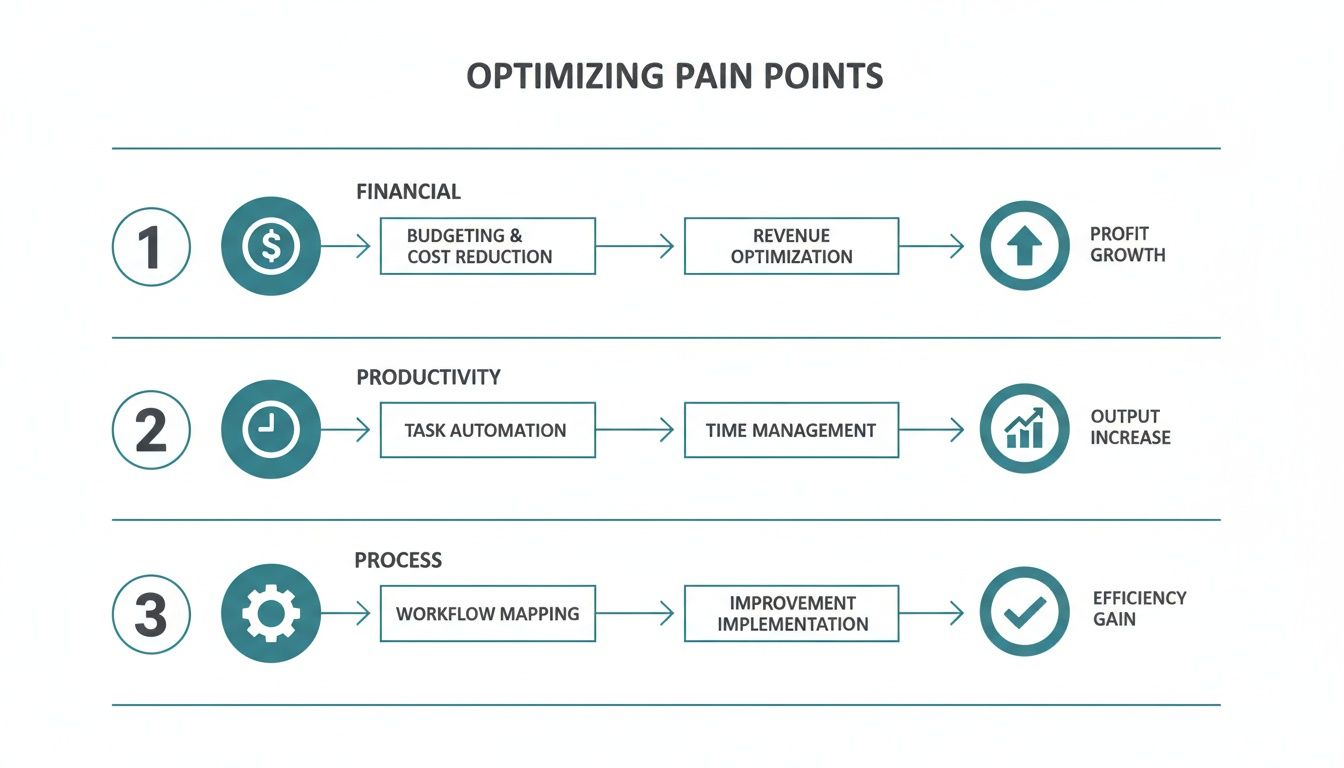
You can see how a breakdown in one area, like a confusing process, almost always cascades into lost productivity and, ultimately, financial strain for the customer.
These issues are especially painful in the B2B space. Take B2B e-commerce, for instance. A shocking 85% of buyers have reported major frustrations when placing orders online. One huge process pain point is order accuracy, where a full 33% of all online orders contain errors.
The consequences are severe. These mistakes are so costly that 68% of buyers have abandoned online ordering platforms entirely. You can dig deeper into these B2B commerce challenges to see just how deep these problems can run.
Finding the Unvarnished Truth on Reddit
If you want to find out what really drives your customers crazy, skip the focus groups. The most honest, raw, and unfiltered feedback you’ll ever get is bubbling up on Reddit right now. People aren't there to be polite; they're venting about real problems and desperately searching for solutions. This is where you find the gold.
At BillyBuzz, we live on Reddit. It’s our primary source for understanding what the market actually needs, not just what it says it needs. But just browsing subreddits is a waste of time. You need a surgical approach to cut through the noise and pinpoint the conversations that matter.
Our Internal Playbook for Reddit Monitoring
We start by zeroing in on the specific communities where our ideal customers spend their time. Sure, you can look at the big, generic subreddits, but the real magic is in the niches.
Here are the actual subreddits we monitor inside BillyBuzz:
- Broad Business Hubs: r/startups, r/saas, and r/growmybusiness for high-level entrepreneurial pain points.
- Marketing & Sales Focused: r/marketing, r/sales, r/PPC for tactical frustrations.
- Niche Industry Forums: r/ecommerce, r/msp for IT service providers, and r/b2b.
Once we have our target communities, we build out specific alert rules inside BillyBuzz. We're not just tracking our brand name—that’s rookie stuff. We’re hunting for intent. The best way to do that is by combining problem-oriented keywords with our competitors' names.
Our most effective alerts inside BillyBuzz track these exact keyword combos:
"[Competitor Name]" + "alternative","[Competitor Name]" + "frustrated with", and"is [Competitor Name] down". This setup instantly flags conversations where someone is at their breaking point and actively looking to switch.
This strategy is powerful because you find people at their exact moment of need, often before they've even heard of you. For a more detailed breakdown, you can check out our guide on how to monitor keywords on Reddit.
This is what it looks like in action. Here's a peek at how we use BillyBuzz to surface these conversations.

That AI relevancy score is crucial. It acts as our filter, pushing aside the low-quality mentions and highlighting posts where users are describing a problem we can genuinely solve. This turns Reddit from a simple listening post into a targeted lead-generation engine, powered by the frustrations your competitors are causing.
Think about how often these frustrations boil down to a terrible self-service experience. A staggering 77% of consumers globally say that a bad self-service portal wastes more of their time than if it didn't exist at all. People want to solve simple issues themselves (61% prefer it), but they’re met with dead-end FAQs and clunky interfaces. This sends them straight to places like Reddit to complain, creating a perfect opportunity for you to step in.
How to Run Customer Interviews That Uncover Real Pain
Social listening and analytics are great for spotting problems at scale, but nothing beats a real, human conversation for getting to the why behind a customer’s frustration.
This is where so many founders go wrong. They treat these calls like a sales pitch. But a good customer interview isn't a sales call—it's more like a therapy session for your user's workflow.
Your only job is to ask open-ended questions and then shut up and listen. Seriously. You have to fight every impulse to "solve" their problem right there on the call or to start talking about your amazing features. The entire goal is to get them to open up about their world, not to pull them into yours.
Your Script Is Not About Your Product
At BillyBuzz, we designed our interview script to be completely non-salesy. We want the person on the other end to almost forget we even have a product. The conversation centers entirely on their current process, what drives them crazy, and what a "magic wand" solution would do for them, in their own words.
We always come back to a few core questions:
- "Walk me through how you currently handle [the process your product addresses]." This is the perfect opener. It gets them telling a story, and from there, you just follow the breadcrumbs.
- "What's the most annoying or time-consuming part of that?" This one cuts right to the chase. You're listening for emotional words like "frustrating," "hate," "manual," or "takes forever." That’s where the gold is.
- "Tell me about the last time you dealt with that problem." This grounds the pain in a real, recent memory. It helps you get concrete details instead of just vague complaints.
- "What happens if you do nothing about it?" This uncovers the consequences of the pain point, which is critical for understanding what it truly costs them in time, money, or sanity.
The most valuable insights you'll get are the stories people tell. When someone says, "Last Tuesday, I spent three hours manually exporting data, and my boss was breathing down my neck," you have marketing gold. That's a story other potential customers will immediately connect with.
Finding People Who Actually Want to Talk
So, where do you find people willing to chat? Forget cold outreach—it's a grind with a low success rate.
We use social listening to find people who are already complaining in public. When we spot someone on Reddit venting about a competitor's shortcomings or a workflow problem, we slide into their DMs with a simple, honest message.
Here’s the actual DM template we use:
"Hey [Username] - saw your post in r/saas about the trouble you're having with [Competitor's Product]. As a founder building in the same space, I'd love to hear more about your experience (no sales pitch, I promise). Would you be open to a quick 15-min chat next week? Happy to offer a $25 gift card for your time."
This approach works so well because you're reaching out at their peak moment of frustration. The conversation is already warm before it even begins.
Of course, direct interviews are just one piece of the puzzle. It's also important to learn how to collect customer feedback effectively using surveys and other channels to get a more complete picture. To see how this all fits together, check out our guide on how AI improves customer feedback integration.
Ultimately, your goal is simple: walk away with direct quotes and real stories you can plug directly into your product roadmap and your marketing copy.
So, Which Problems Do You Solve First?
After talking to customers and digging through online conversations, you'll probably have a long list of pain points. And that's a good thing! But it also brings up the next big challenge: where do you even start?
As a founder, you know your time and resources are stretched thin. Trying to fix everything at once is a classic recipe for burnout, and you'll end up making very little real impact. You need a way to cut through the noise.
At BillyBuzz, we don’t rely on gut feelings for this. We use a simple but powerful tool called the Pain and Frequency Matrix. It’s a straightforward 2x2 grid that brings a ton of clarity to our product roadmap and marketing.
Breaking Down the Pain and Frequency Matrix
Here’s how it works. You plot each customer problem on the matrix by asking two simple questions:
- How intense is the pain? (Low to High)
- How often do they feel it? (Low to High)
This gives you four clear quadrants. The issues that fall into the High Pain, High Frequency box? Those are your goldmines. These are the daily headaches and expensive roadblocks that have customers desperately searching for a better way. They’re your most urgent opportunities to step in and save the day.
Problems in the Low Pain, Low Frequency quadrant, on the other hand, are just distractions. They might be real issues, but solving them won’t really move the needle for your business.
I remember this framework forced us to kill a "pet feature" the team was really excited about. It was a cool idea, but it just didn't solve a high-frequency problem. Instead, we shifted our focus to speeding up our alerting system—a high-pain, high-frequency issue for anyone monitoring real-time conversations. The engagement data later proved we made the right call.
This kind of ruthless prioritization is more important than ever. Customer patience is paper-thin. Research shows that 72% of consumers will jump ship to another brand after just three (or even fewer) bad experiences.
And what really gets under their skin? Repetition. A massive 54% will leave if they have to explain the same problem to different people. This data, which you can read more about in these critical customer experience stats, highlights just how urgent it is to fix those high-frustration, high-frequency issues before they cost you customers.
When you map out your pain points on this matrix, you get a visual, no-nonsense guide. It aligns your entire team and channels your limited resources into the things that truly matter. It’s a simple, effective way to make sure you’re building something people actually need.
And often, understanding what your customers need starts with seeing where your competitors are dropping the ball. You can learn more about that in our guide on how to conduct a competitor analysis for emerging businesses.
Turning Pain Points Into Your Best Marketing Copy
Alright, you’ve put in the legwork and uncovered some genuine customer pain points. Now for the fun part: turning that raw, honest feedback into your most powerful marketing asset. This is the moment you shift from talking about your product's features to speaking directly to the problems that keep your audience up at night.
Let's be honest, features tell, but pain points sell. Nobody rolls out of bed thinking, "You know what I need today? An AI-powered social monitoring solution." What they are thinking is, "I know I’m missing out on leads from Reddit, and it’s driving me nuts." Your marketing has to live in that reality.
From Pain Point to Powerful Headline
Here at BillyBuzz, we’re big fans of the classic Problem-Agitate-Solve (PAS) framework. It's not fancy, but it works like a charm for translating raw customer feedback into copy that actually connects. You start by stating the Problem in your customer's own language. Then you Agitate that problem, poking at the frustration and real-world consequences. Finally, you introduce your product as the Solve.
Take a look at a real before-and-after example from one of our own landing pages:
- Before (All about us): "AI-Powered Social Monitoring"
- After (All about them): "Stop Missing Leads on Reddit."
The first one is corporate-speak. The second one speaks directly to the financial pain of leaving money on the table. It grabs attention because it’s the exact thought that wakes a founder up in a cold sweat. That tiny shift in perspective is everything.
The goal is to have your ideal customer read your headline and feel seen. When your copy sounds like their own internal monologue, you’ve already won half the battle and built a foundation of trust.
Creating Your Voice of Customer Document
To make this a repeatable process and not just a one-off stroke of genius, we keep a "Voice of Customer" document internally. It’s nothing more than a simple spreadsheet, but it’s probably one of our most valuable marketing assets. This is where we systematically map raw feedback to killer messaging hooks.
Here's the exact template we use:
| Raw Customer Quote (The Pain) | Core Problem | Emotion/Agitation | Messaging Hook (The Solve) |
|---|---|---|---|
| "I spent 3 hours yesterday just searching subreddits for our competitors." | Manual monitoring is a soul-crushing time-suck. | Frustration, Wasted Time | "Get back 3 hours a day. Let our AI find leads for you." |
| "I'm worried a competitor is stealing our unhappy customers and I wouldn't even know." | No visibility into competitor weaknesses is a huge risk. | Anxiety, Fear of Loss | "Get alerted the moment someone complains about your competitor." |
| "I tried setting up alerts but just got a bunch of junk notifications." | Most monitoring tools are noisy and useless. | Annoyance, Overwhelm | "Finally, alerts you'll actually want to open." |
This simple document gets our marketing, sales, and product teams all on the same page. It’s the bridge we use to go from listening to customer problems to creating marketing copy that converts, all because it speaks our customers' language.
Common Questions About Finding Pain Points

We field a lot of questions from other founders about the real-world process of finding and acting on customer pain points. It’s easy to talk about the theory, but actually putting it into practice is a whole different ball game.
So, here are a few of the questions we get asked most often, along with some honest, no-fluff answers straight from our experience building BillyBuzz.
How Many Customer Interviews Are Enough?
There's no magic number here, but you'll almost always see a strong pattern emerge after 5 to 8 interviews with people from the same customer segment. The goal isn't to get a statistically significant sample size; it's to spot recurring themes.
If you run ten interviews and hear ten completely different problems, it’s a big red flag that your target audience is probably way too broad. You’re looking for that moment when you can practically predict what the next person is going to say.
When you have multiple people describing the exact same frustration, often using similar language, you’ve struck gold. That's a pain point worth digging into.
Pain Point Versus Feature Request
This is a critical distinction, and it’s one that trips up a lot of founders. A feature request is a customer's proposed solution ("I wish you had a button that did X"), while a pain point is the underlying problem they're trying to solve ("It takes me forever to do Y").
You have to learn to always dig deeper. Ask "why" behind every single feature request. A customer asking for a CSV export might actually be struggling with the weekly pain of manually pulling data for their boss. Once you understand that core problem, you might realize a simple, automated reporting feature is a far better solution.
Focus on the problem, not their prescription for a solution.
Can I Find Real B2B Pain Points on Reddit?
Absolutely. It's a huge mistake to think of Reddit as just a B2C platform. Professionals, department heads, and key decision-makers are on there every single day—complaining, asking for advice, and venting about their work struggles.
We find incredibly rich B2B insights in subreddits like r/sysadmin, r/marketing, and tons of other niche industry communities. They're having unfiltered conversations about their frustrations with their current software, broken workflows, and budget headaches. It’s a goldmine for understanding the day-to-day pain your B2B customers are feeling.
How We Monitor for Competitor Pain Points
This is genuinely one of our most effective growth tactics at BillyBuzz, and it’s surprisingly simple to set up. We create monitoring alerts that track our competitors' brand names combined with negative or problem-focused keywords.
Inside BillyBuzz, we have active alerts tracking keyword combinations like:
"[Competitor Name]" + "slow""[Competitor Name]" + "alternative""frustrated with [Competitor Name]""how to fix [Competitor issue]"
Our AI relevancy score then filters these conversations, flagging only the posts with strong negative sentiment. This process delivers high-intent leads straight to our team. When someone is publicly complaining about a competitor's weakness that just so happens to be one of your strengths, that’s the perfect moment to step in and offer a real solution.
Stop guessing what your customers want and start listening to where they're hurting most. With BillyBuzz, you can automatically find high-intent conversations on Reddit, get alerted to competitor weaknesses, and turn customer pain points into your biggest advantage. Discover your next customers today.