

Finding product-market fit is that magical moment when your product solves a problem so compellingly that the market itself starts pulling you forward. It’s the transition from constantly pushing your solution onto people to having customers actively pulling it from you because they desperately need it.
What Product Market Fit Actually Feels Like
Forget the dry, academic definitions. If you're building a startup, you know product-market fit (PMF) isn't a line item on a checklist. It's a palpable shift in your company's momentum.
It’s the difference between pushing a boulder uphill and sprinting to keep up with it as it barrels down the other side.
Before PMF, every conversation is a hard sell. You're fighting for every demo and every trial. After, your calendar mysteriously fills with inbound requests. Users start flooding your inbox, not with complaints, but with urgent demands for new features and questions about how they can pay you.
Growth stops feeling like a manual grind and becomes the organic outcome of solving a real, painful problem.
This journey is the most critical phase for any startup. This infographic breaks down the two distinct stages of that process: the search and the discovery.
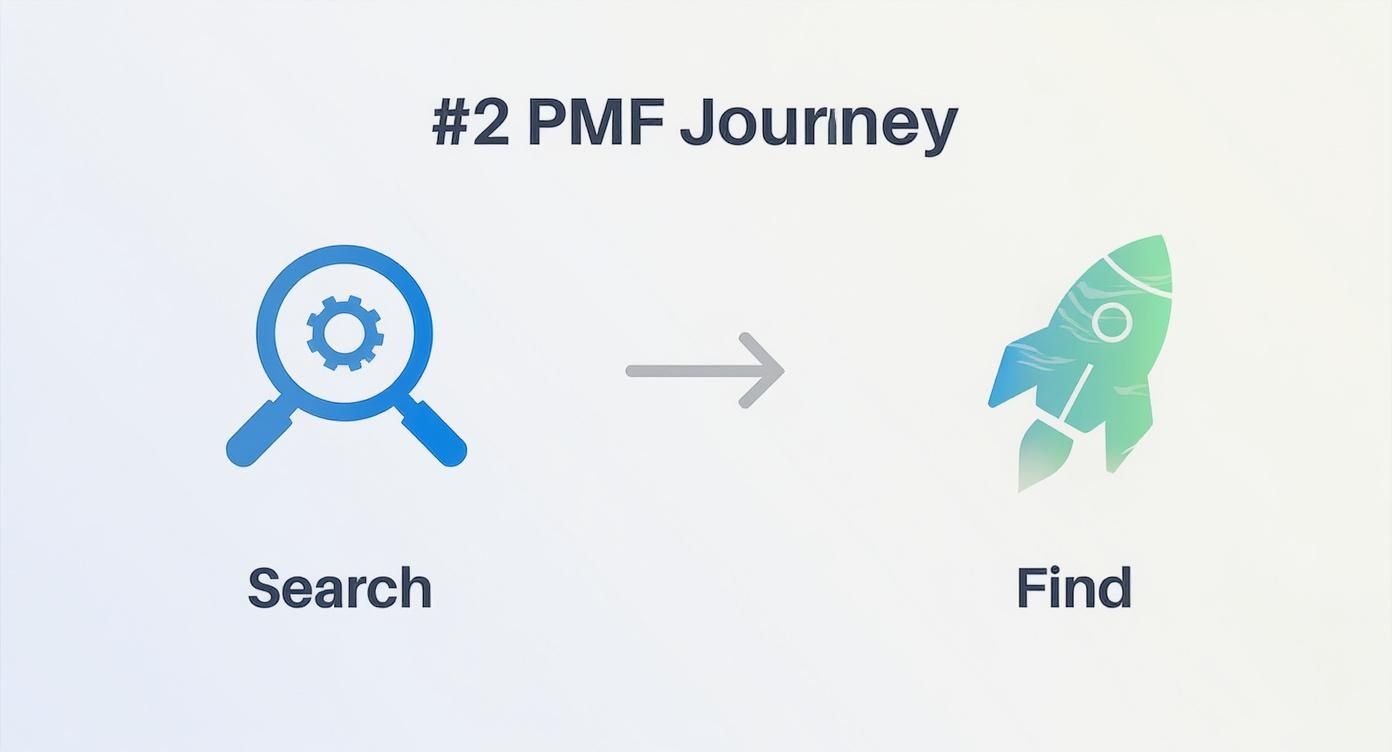
As you can see, the process is split between an active, investigative "searching" phase and an accelerated "finding" phase. This distinction is crucial—PMF is a destination you arrive at through deliberate, focused effort, not by accident.
Why This Feeling Matters More Than Anything
Chasing this feeling isn't vanity; it's survival. The data doesn't lie: the number one reason startups fail is a lack of PMF. A CB Insights study found that a staggering 42% of failed startups died because they built something with 'no market need'.
Nearly half of all ventures collapse because they never solved a real problem for enough people.
At BillyBuzz, we learned this the hard way. It's dangerously easy to mistake polite feedback for genuine demand. Hearing someone say, "Oh, that's a cool idea," means nothing. The only feedback that counts is action—a sign-up, a credit card, or an email asking where to send the invoice.
"Product-market fit is the point where your product solves a problem so effectively that the market itself begins to drive your growth. Until you get there, nothing else matters."
Sometimes, the difference between having PMF and not is subtle. This table can help you gauge where you stand.
Signs You Have (and Don't Have) Product Market Fit
| Indicator | Without Product Market Fit | With Product Market Fit |
|---|---|---|
| Growth | Growth is slow and linear. You're pushing hard for every new user. | Growth is exponential and feels organic. Users are coming from word-of-mouth. |
| Customer Feedback | Feedback is vague or polite. Users say it's a "nice to have." | Customers are passionate and specific. They'd be "very disappointed" if it disappeared. |
| Sales Cycle | The sales process is long and complex. You're doing all the talking. | Deals close quickly. Customers often "get it" without a lengthy demo. |
| Media/Press | You have to beg for press coverage, and it rarely generates leads. | Reporters and bloggers are reaching out to you. |
| Revenue | Revenue is unpredictable. You're struggling to find a repeatable sales model. | You have a clear, repeatable path to making money. |
Seeing these signs in the "With Product Market Fit" column is your signal to step on the gas.
Learning from Real-World Success
To truly understand what this looks like, check out these Product Market Fit Examples That Changed Industries. Seeing how companies like Slack, Dropbox, and Airbnb hit their stride shows the path isn't a straight line, but the outcome—explosive, organic growth—is unmistakable.
The framework we're about to share is the exact system we use at BillyBuzz to cut through the noise. It’s a practical, founder-to-founder guide for identifying a high-value problem, validating your solution, and measuring what actually moves the needle.
Finding Your Ideal Customers in the Wild
Your first users—the ones who will give you the brutally honest feedback you need—aren't waiting for an ad. They’re already gathered in niche online communities, actively complaining about the exact problem you’re trying to solve. You have to go find them.
Forget casting a wide net. In the early days, this is a surgical operation. You go directly to the source: the high-signal subreddits, Slack groups, and Discord channels where your target audience lives online.
Pinpointing Your Customer Hotspots
The goal isn't just to find any community, but the right one. We look for places where conversations are laser-focused on specific pain points. For a SaaS founder, a general subreddit like r/technology is useless noise. The gold is in communities where people are sharing workflows and asking for tool recommendations.
Here are the actual filters we use at BillyBuzz to identify these hotspots:
- High Pain-Point Density: Are people constantly talking about problems, frustrations, or workarounds related to a specific task? Look for threads titled "How do you handle X?" or "Any good alternatives to Y?"
- Solution-Seeking Language: Do members actively ask for software or tool recommendations? This is a huge signal they’re ready to pay for a fix.
- Authentic Engagement: Steer clear of communities that are just a wall of self-promotion. The best feedback comes from places where real practitioners share their experiences.
For us, communities like r/saas, r/growmybusiness, and r/b2b have been invaluable. These are the places where founders get real about their struggles. If you want a deeper dive, we've laid out our exact process for how to get customers from Reddit in 2025.
This screenshot from Reddit is a perfect example of a user expressing a specific need.

See how they're not just asking a generic question? They're detailing their specific context and limitations. That kind of detail is pure gold.
Setting Up Your Listening Engine
You can't manually refresh forums all day. You need an automated system that monitors these communities for you, flagging pain-point language in real time. This lets you jump into conversations the moment they happen.
We use our own tool at BillyBuzz, but you can get a basic version going with services like F5Bot or Google Alerts. The key is to set up alerts for keywords that signal a problem, not just your brand name.
Here are the exact alert rules we start with inside BillyBuzz:
- "Problem & Frustration" Keywords:
(help OR frustrating OR annoying OR stuck) AND (workflow OR process OR tool) - "Seeking Alternatives" Keywords:
(alternative to [competitor]) OR (tool like [competitor] but) - "How To" Questions:
(how do you OR how to) AND ([your core function])
These alerts become your inbound feed of potential customer conversations. Every notification is a chance to learn and engage.
Engaging Without Selling
Once you find a relevant conversation, your approach is everything. Don't barge in with a sales pitch. You'll get ignored or banned.
Your goal here isn't to make a sale. It's to start a conversation.
Your first interaction should be about understanding their problem better, not pitching your solution. Offer help, ask clarifying questions, and show genuine curiosity. The sale comes later, after you've built trust.
Here's the simple template we use internally. It’s all about empathy and curiosity.
BillyBuzz Outreach Template (Internal Use)
"Hey [Username], saw your post about dealing with [the problem]. I’m a founder working on a tool that aims to solve this exact issue for [target audience, e.g., SaaS founders].
Not trying to sell you anything. Just trying to build something people actually want. Would you be open to a quick 15-minute chat to share your experience? I’d love to hear what your ideal solution would look like."
This approach works because it reframes the interaction. You're not a salesperson; you're a fellow builder asking for help. It disarms people and makes them far more likely to give you the candid, unfiltered feedback you need for PMF.
Uncovering the Truth with Customer Interviews
So, you’ve found where your ideal customers hang out. Great. Now comes the part where most founders stumble: the customer interview. The biggest trap is going in to validate your idea. You ask leading questions, fish for compliments, and end up with polite "yeses" that are completely useless.
At BillyBuzz, our approach is different. We don't try to validate our solution. We're on a mission to deeply understand their problem. The entire conversation is focused on one thing: past behavior.

Someone's opinion on a non-existent feature is worthless. What's gold? Finding out how they’ve actually tried to solve the problem before. It's the difference between hearing, “Yeah, I’d probably use that,” and discovering they've duct-taped together three different tools and a clunky spreadsheet to do what your product does. That’s a real, bleeding pain point. That's what you're hunting for.
The Anti-Pitch Interview Method
Our entire script is designed to get people talking about their lives, not our product. We keep our solution a secret for as long as possible. The goal is to get them to tell a story about their workflow and their frustrations.
The most effective questions are open-ended prompts that encourage storytelling.
Here’s the core of the script we use at BillyBuzz:
- The Broad Opener: "Can you walk me through your current process for [task related to your product]?" Let them talk. Don't interrupt. Just listen and take furious notes.
- The "Hardest Part" Question: "What's the hardest part about doing that?" This is the money question. It cuts right to the heart of their pain.
- The "Last Time" Follow-Up: "Tell me about the last time that happened. What did you do?" This grounds their abstract frustration in a concrete, recent example. Here you'll learn about their workarounds.
- The "Consequence" Probe: "When that problem occurs, what's the actual impact?" This helps you figure out if the problem is a minor annoyance ("vitamin") or a major blocker that costs them time or money ("painkiller").
This line of questioning reveals the true depth of their pain. If someone struggles to recall the last time they faced the problem, or if the consequences are zero, that's a massive red flag.
Listening for Emotion and "Money Moments"
During the interview, your job is less interrogator and more therapist. Listen for the emotional currents. When does their tone of voice change? Do they sigh? Do they laugh in frustration?
We call these "money moments." They are the points of maximum pain where your product can provide immense value.
A single customer describing a frustrating workaround with a heavy sigh is a stronger PMF signal than ten people telling you your idea is "cool." Emotion signals a problem worth solving.
Pay attention to the specific words they use. If they describe a process as "tedious," "manual," or "a total nightmare," write those exact words down. This is the language you’ll use in your marketing copy later.
From Messy Notes to Actionable Themes
After a dozen of these conversations, you'll have messy notes. The final piece is to synthesize this raw data into clear themes. You need a system to spot the patterns.
Here's a simple table we use to organize our takeaways:
| Theme/Problem Area | Customer Quote (Verbatim) | Observed Emotion | Current Workaround | Potential Opportunity |
|---|---|---|---|---|
| Lead Discovery | "I spend hours every morning just scrolling through Reddit, hoping I don't miss a good lead." | Frustration, Exhaustion | Manual searching, noisy keyword alerts. | Automated, context-aware monitoring to surface high-intent leads. |
| Competitor Tracking | "I have no idea what people are saying about my competitors until it's too late." | Anxiety, FOMO | Google Alerts, occasionally checking social media. | Real-time alerts for competitor mentions in relevant communities. |
| Response Time | "By the time I see a relevant post, there are already 20 other comments." | Defeated, Rushed | Bookmarking subreddits and checking them periodically. | Instant Slack/email notifications to enable a rapid response. |
This process forces you to connect a specific problem (Theme) with real human emotion and a broken solution (Workaround). That "Potential Opportunity" column becomes the bedrock of your product roadmap. You're no longer building on assumptions; you're building on direct evidence of user pain. This is how you find product-market fit.
The Only Product-Market Fit Metrics That Matter
That click you feel with customers is amazing, but "feelings" don't get you funding or guide your next sprint. You need cold, hard data. While qualitative insights from interviews are your compass, a solid set of metrics is your GPS.
At BillyBuzz, we don't bother with bloated dashboards of vanity metrics. We focus on a handful of signals that directly reflect customer value and business viability.
The Superhuman Engine Question
Before you have enough data for complex cohort analysis, you can get a powerful signal with one question. Made famous by Superhuman, it cuts straight through the noise.
The question is simple: “How would you feel if you could no longer use [your product]?”
We send this survey out after someone has had about 30 days to integrate BillyBuzz into their workflow. The possible answers are just as straightforward:
- Very disappointed
- Somewhat disappointed
- Not disappointed
The magic number is 40%. If 40% or more of your users answer "very disappointed," you've got a strong, early signal of product-market fit. Anything less, and you still have work to do.
Segmenting to Find Your Superfans
Now, here’s the magic: segmentation. Don't just look at the overall score. Dive deep into the responses from that "very disappointed" group. These are your superfans, the living embodiment of your ideal customer profile.
Talk to them. Ask follow-up questions. Figure out what specific features they can't live without. Their answers are the blueprint for your roadmap and your guide for finding more customers just like them.
Leading Indicators for Sustainable Growth
Once your user base grows, you can layer in more traditional SaaS metrics. These are leading indicators that tell you if you can build a sustainable business.
A classic is the Net Promoter Score (NPS), which tells you how willing customers are to recommend you. A score above 50 is a fantastic sign. Another vital one is the customer lifetime value (CLV) to customer acquisition cost (CAC) ratio. A CLV:CAC ratio of 3:1 or higher is the benchmark for a healthy, scalable business. Of course, high customer retention and low churn prove customers find ongoing value. For a deeper look, this article on PMF metrics on growthrocks.com is a great resource.
The goal isn't just to find users who love your product, but to prove you can acquire and retain them profitably. A 3:1 CLV to CAC ratio is the gold standard for a reason—it shows your growth engine is efficient and scalable.
Our BillyBuzz PMF Metrics Dashboard
To keep our team focused, we use a simple, actionable dashboard. It's a straightforward view of the numbers that matter most right now.
Here’s a snapshot of what we track.
BillyBuzz PMF Metrics Dashboard
| Metric | Target Threshold | What It Tells Us |
|---|---|---|
| "Very Disappointed" % | > 40% | Are we building a "must-have" for a core group of users? |
| User Retention (Month 1) | > 60% | Do new users find immediate value and stick around? |
| NPS | > 50 | Are our happy customers willing to become advocates? |
| CLV to CAC Ratio | > 3:1 | Is our growth model financially sustainable? |
| Feature Adoption Rate | > 25% for new features | Are we building things that actually solve user problems? |
These metrics tell a story. High retention but low NPS might mean your product is sticky but the UX is painful. A great NPS but poor retention could mean you're delighting users who don't have a recurring need. Understanding these nuances is crucial. You might even find that learning how AI identifies purchase intent can help you refine this analysis even further.
Ultimately, these numbers are your reality check. They transform PMF from a vague feeling into a measurable target.
Turning Customer Feedback Into Product Momentum
Getting feedback is easy. The real work—what separates companies that find PMF from those that flame out—is wrestling that chaotic input into a focused product roadmap.
We learned a hard lesson at BillyBuzz: treating all feedback as equal is a fast track to failure. You end up with a bloated, confused product. To stop that, we developed a straightforward internal system to categorize every piece of feedback we get.
Vitamins, Painkillers, and Bugs
Every user suggestion gets dropped into one of three buckets. This first cut is the most critical step in our process.
- Bugs: Things that are just plain broken. A flawed feature, a confusing UI—anything that doesn't work as expected. Bugs always jump to the front of the line. A buggy product kills trust. We fix them. Fast.
- Vitamins: These are the "nice-to-haves." They might add a bit of polish or a minor convenience. We log them, but they don't get to cut in line.
- Painkillers: This is where you find the gold. Painkillers solve a real, nagging, and often expensive problem. These are the features that get people to say, "Finally! I've been searching for this."
This simple framework gives us a powerful lens for prioritization. If a request isn't a bug fix or a clear painkiller, it goes to the back of the line. This discipline keeps you from becoming a "feature factory."
Obsessing Over the "Very Disappointed"
Remember that "very disappointed" group? Their feedback isn't just another data point; it’s our guiding star. Their insights are worth ten times more than anyone else's. Why? Because these are the people who already get real value from your product, even with its flaws. Their problems are your biggest opportunities.
Their feedback directly fuels our development sprints. We don't just take their feature requests at face value—we dig deeper to understand the problem behind the request. Focusing on super-serving your most passionate fans is how you build something indispensable.
Building a product is a game of inches. You don't achieve product-market fit with one giant leap. You close the gap methodically, sprint by sprint, by solving the most acute pains for your most committed users.
This is the playbook Rahul Vohra, CEO of Superhuman, used. By relentlessly tracking how users would feel if the product disappeared and zeroing in on the feedback from that "very disappointed" segment, they engineered a massive turnaround. In just three quarters, they rocketed their PMF score from a worrying 22% to a stellar 58%. It’s a powerful lesson.
This isn't just about building features; it's about building momentum. Every painkiller you ship deepens the bond with your core audience and makes your product stickier. It creates a powerful feedback loop. And to really speed up this cycle, understanding how AI improves customer feedback integration can be a total game-changer.
Answering Your Burning Questions About Product-Market Fit

We've walked through the framework, but the path to PMF is never a straight line. It's filled with tough questions. Here are some of the most common ones we hear from founders, with answers straight from our own experience.
How Do I Know if It's a "Must-Have" or Just a "Nice-to-Have"?
This is the million-dollar question. The best clue is seeing how your potential customers are already trying to MacGyver a solution.
Are they wrestling with a messy spreadsheet? Hacking together a clunky workflow with three different apps? That’s your sign. If they are actively trying to solve this problem with subpar tools, you're onto a real pain point—a "must-have."
Another giveaway is their willingness to pay. People don't open their wallets for "nice-to-haves." They pay to make a genuine problem disappear. If you get a lot of polite compliments but no one's pulling out a credit card for your early version, you're probably selling a vitamin, not a painkiller.
Is Product-Market Fit a Permanent State?
Not a chance. This is one of the biggest myths in the startup world. PMF isn't a trophy you win and put on a shelf. Markets change, competitors show up, and customers' needs evolve.
Think of it as a moving target. The product that was a perfect fit last year might be table stakes today. Complacency is the number one killer of PMF. You have to keep listening, learning, and iterating.
Product-market fit is a moving target. The moment you stop iterating and listening is the moment you start drifting away from it. Staying in sync with your market is a continuous process, not a one-time achievement.
Can You Have PMF with Just a Small Number of Customers?
Yes, and that's exactly where you should start. Strong PMF with a small, die-hard group of ideal customers is infinitely more valuable than weak interest from a huge audience. Your first goal isn't to be everything to everyone; it's to be indispensable to a specific niche.
Focus on making 10 customers so happy they can't imagine their lives without your product. If you can get to that point, you've built a rock-solid foundation. Their feedback and referrals are what will help you find the next 100 customers.
What if I Just Can't Seem to Find PMF?
First, breathe. This is normal. Finding product-market fit is a brutal grind that often takes 12-24 months. If you’re pushing hard but not feeling any pull from the market, it’s time for some radical honesty.
Go back to basics:
- Are you truly talking to the right audience?
- Is the problem you're solving painful enough?
- Is your solution genuinely better than what they're doing now?
Often, the breakthrough comes from narrowing your customer focus to a more specific niche or making a bold pivot. If you're feeling stuck, there are many different perspectives out there; you might find this article with additional resources on finding product-market fit helpful.
Ready to stop searching for customers and have them come to you? BillyBuzz uses AI to monitor Reddit for high-intent conversations, sending you real-time alerts so you can engage with potential customers the moment they express a need. Start finding your next customers today.