

Let's be blunt—negative feedback stings. A scathing review, a blunt email, a critical comment on social media. When you've poured everything into your product, that criticism feels personal.
But I've learned that the sting is where the growth is. At BillyBuzz, we've trained ourselves to see every piece of negative feedback as a gift. It’s a free, unfiltered consultation that points out exactly where our product has weaknesses, where our messaging is missing the mark, and what our customers are truly struggling with.
The feedback that stings the most often holds the biggest opportunities for growth. It’s not a report card on your worth; it’s a compass pointing you toward improvement.
The Founder's Feedback Mindset Shift
Thinking about feedback differently is a game-changer. It’s about consciously moving from a gut reaction of "this is a threat" to a strategic mindset of "this is an opportunity."
It's a subtle but powerful shift that can completely change how you build your company. Here’s a quick breakdown of what that looks like in practice:
| Common Gut Reaction | A Founder's Strategic Mindset |
|---|---|
| "They don't get it." | "What part of our messaging is unclear?" |
| "This is a one-off complaint." | "Is this the tip of a larger iceberg?" |
| "This person is just being difficult." | "What frustration is driving this feedback?" |
| "I need to defend my product." | "I need to understand their experience." |
Adopting this mindset has a massive ripple effect. When customers feel heard and see you actually take action on their concerns, you start improving customer satisfaction scores and building a base of fiercely loyal advocates.
This isn’t just a startup thing, either. The corporate world is notoriously bad at this. A Gallup study found that only 26% of employees feel that the feedback they get actually helps them improve. As founders, we have the chance to build a culture that does the opposite—one that actively seeks out and learns from criticism.
This is why we believe that monitoring your brand reputation isn't just about damage control. It's about proactive product development and building genuine connections with your users. Turning that tough feedback into a strategic advantage is what separates the good companies from the great ones.
Building Your Internal Feedback Radar
You can't act on criticism you never see. Waiting for negative feedback to hit your inbox is a recipe for disaster. It forces you into a defensive crouch. Instead, you need a proactive system—an internal radar—to catch mentions across the internet. This lets you jump into conversations and solve problems before they snowball.
This doesn't mean you need to shell out for enterprise-level software. It's all about being smart and methodical.
Our first line of defense is dead simple: Google Alerts. It's free and surprisingly powerful if you use it right. We have alerts running for our brand name, our founders' names, and our main competitors. The key is using boolean search operators to cut the noise.
For instance, instead of a broad alert for "BillyBuzz", we get specific:"BillyBuzz" -site:billybuzz.com -site:twitter.com -site:linkedin.com
This tiny bit of code works wonders. It filters out mentions from our own site and high-volume social platforms, which we monitor with other tools. What’s left are the valuable mentions—blog posts, forum threads, and articles where people are talking about us without tagging us.
Tuning Into Community Channels
Let's be real, the most potent, unfiltered feedback isn't going to come from a formal review. It’s brewing in niche online communities. For anyone in SaaS, Reddit is a goldmine of candid conversation. We don't just casually browse; we're actively plugged into specific subreddits where our customers and peers talk shop.
Our actual watchlist at BillyBuzz is short and focused:
- r/SaaS: For spotting industry trends and seeing how we stack up.
- r/startups: A direct line into the pain points of our target audience—other founders.
- r/marketing: A great place to see what people are saying about brand monitoring tools.
Here’s a quick look at the r/saas subreddit, which is one of our go-to spots for picking up on authentic customer chatter.
This is the raw, founder-to-founder dialogue we're looking for. These discussions give us a real-time pulse on the challenges our potential customers are trying to solve.
Creating Specific Alert Rules
Once your general monitoring is in place, get surgical. We use a social listening tool (our own, BillyBuzz) to create highly specific alerts that go beyond simple keywords. This is where you find high-intent conversations.
One of the most effective alerts we've set up is designed to find people who are unhappy with a competitor and actively looking for a change.
Our actual alert rule inside BillyBuzz: We combine competitor names (
CompetitorA,CompetitorB) with keywords that signal frustration like("frustrating" OR "can't figure out" OR "alternative to" OR "buggy"). This immediately flags conversations where a user is practically begging for the solution we offer.
Turning your listening into a structured system like this changes everything. It shifts monitoring from a random, time-sucking task into a core business process. This is how you get ahead of negative feedback—by making sure you're always the first one to know about it.
How to Analyze and Prioritize Criticism
Once your listening systems are running, feedback will start flowing in. The trick is figuring out what’s valuable insight and what’s just noise. If you react to every comment, you’ll burn out. But ignoring a legitimate complaint can be a death sentence for a growing business.
At BillyBuzz, we don’t get emotional about criticism. We get methodical. We push every piece of significant negative feedback through our internal "Four-Filter Method" to sort the chaos and prioritize what matters. It’s a simple framework, but it's incredibly effective.
Our Four-Filter Triage Method
This process is about cutting through the clutter so we can put our energy where it will make the biggest difference.
Filter 1: Is It from a Real User? First, we check the source. Is this person a paying customer, on a free trial, or just an anonymous account stirring the pot? Feedback from an active user with a history with our product always jumps to the front of the line over a vague, hit-and-run comment.
Filter 2: Is It Specific and Actionable? "Your app sucks" is useless. It gives us nothing to work with. But "the dashboard takes over 10 seconds to load on Chrome" is a gift. We hunt for concrete details our product team can actually dig into and solve.
This infographic gives you a bird's-eye view of how we listen, filter, and act on the feedback we receive.
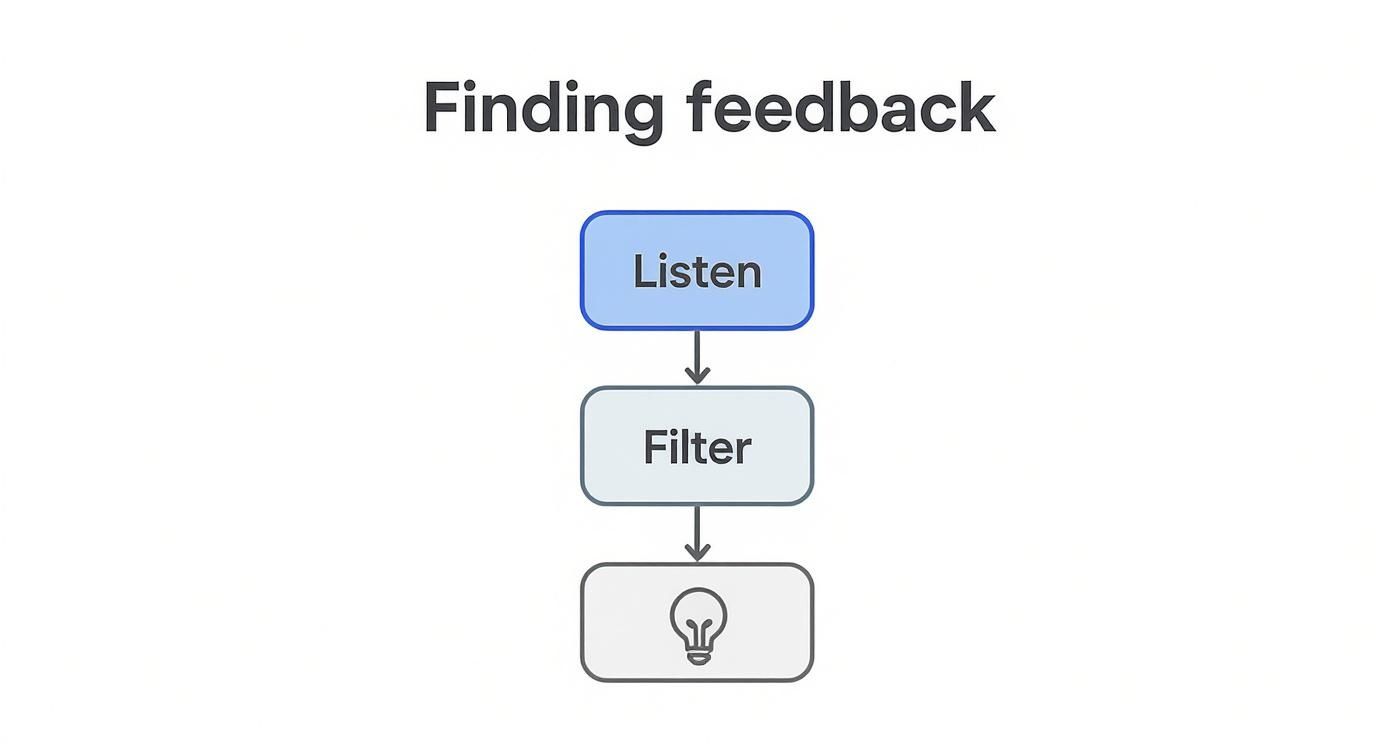
As you can see, that filtering stage is essential. It’s how we separate the valuable signals from all the distracting noise before we even think about taking action.
Filter 3: Does It Reflect a Wider Sentiment? A single complaint might be an outlier. But when we see three different users mention the same bug on Reddit and Twitter in the same week, that’s a trend. We use this to spot recurring pain points that might not be obvious from individual support tickets. To really get a handle on this, you can explore the best sentiment analysis tools that help decode the subtle emotional cues in feedback.
Filter 4: What’s the Impact of Ignoring It? Finally, we do a quick risk assessment. What’s the potential damage? A minor UI glitch is annoying, but a bug that corrupts user data is a five-alarm fire. We prioritize based on severity and how many users are affected.
This filtering process ensures we're not just reacting to the loudest voice in the room, but to the feedback that offers the clearest path to improving our product.
Having a systematic approach like this is absolutely critical. Research from Harvard Business Review shows that while 92% of employees believe well-delivered negative feedback improves performance, its actual impact is often minimal unless it's specific and handled with care. You can read more about these feedback findings on hbr.org.
Crafting a Response That Builds Trust
That canned, robotic apology you see from big brands? It often does more damage than no reply at all. When you're dealing with negative feedback, your response is a golden opportunity to show your company's true colors. At BillyBuzz, we ditch the corporate jargon and focus on a human touch. It shows we’re actually listening.
The goal isn't to win the argument—it's to make the other person feel genuinely heard. Start by immediately acknowledging their frustration. You have to prove you understand where they're coming from before you even think about explaining your side.

Our Response Templates
We have a few go-to templates we adapt for different places like Reddit, Twitter, or direct email. They all boil down to the same core elements: Acknowledge, Thank, Explain, and Offer.
Template 1: Bug Report on Reddit/Twitter:
"Hey [Username], thanks for flagging this – really appreciate the detailed write-up. That definitely sounds frustrating. I've just created a ticket for our dev team to investigate, and I'll post an update here as soon as I have one."
This simple script nails three critical things. It validates their effort, shows you're taking immediate action, and promises a follow-up. This is huge, especially when you consider the complex dynamics of feedback. A Fortune report, for example, found that 76% of high-performing women received negative feedback compared to just 2% of high-achieving men, which really underscores how carefully these interactions need to be handled. You can read more about these feedback distribution findings on fortune.com.
Template 2: Feature Suggestion:
"That's a fair point, we hadn't considered that angle. It's a really interesting idea. I've added it to our product feedback board for the team to review during our next planning session. Thanks for sharing!"
The magic here is showing you appreciate their insight. You’re not just logging another complaint; you’re treating them like a co-creator who is helping your product get better. It’s a subtle shift that can turn a critic into a collaborator. We talk more about this in our guide on using social listening to manage brand perception.
By having these templates on hand, we can jump in quickly and consistently. It ensures every piece of negative feedback becomes a chance to build a little more trust and prove that we actually care.
Turning Criticism Into Your Product Roadmap
Let's be honest, the real endgame for handling negative feedback isn't just putting out fires or managing your reputation. It’s about building a better product. When you create a system for it, criticism stops being a reactive support chore and becomes a goldmine for proactive product development. Here at BillyBuzz, we make sure that kind of valuable insight never dies in a support ticket.
Every single piece of validated criticism gets logged in our central repository. We happen to use a pretty straightforward Notion database, but the tool itself matters less than the process. Each entry is tagged by theme, which makes the entire system searchable and, more importantly, quantifiable.
From Complaint to Concrete Feature
Those tags are the secret sauce. They're what help us spot the patterns that would otherwise get lost in the noise. We keep it simple with a few core categories to stay organized:
- UI/UX: Anything related to clunky interfaces or workflows that just don't make sense to our users.
- Pricing: Feedback that touches on our cost, perceived value, or the way our tiers are structured.
- Bug: Straight-up technical glitches that our developers need to squash.
- Feature Request: When a complaint is really a cry for a missing capability.
This tagged feedback then becomes a cornerstone of our quarterly product planning sessions. When we suddenly notice 15 separate tickets all tagged with ‘UI/UX’ pointing to our main dashboard, that’s no longer just a one-off complaint. It’s a data point. It’s a bright, flashing sign telling us exactly where the user friction is, giving us a clear mandate for our next sprint.
We've found ways to make this even more efficient, which you can read about in our guide on AI's role in customer feedback integration.
We treat our feedback log like a treasure map. The "X" marks the spot where customer pain is greatest, showing us exactly where to dig to find our next big product improvement.
This structured approach ensures our roadmap is built on what our users are actually telling us they need, not just on what we think they want.
Frequently Asked Questions About Handling Feedback
As a founder, you'll run into tricky feedback situations. I've heard the same questions pop up time and time again from other entrepreneurs. Here are the straight-up answers based on years of experience building communities and products.
What If the Feedback Is Public and Unfair?
It’s tempting to jump in and defend yourself with a point-by-point rebuttal, especially when you know they've got it wrong. Resist that urge. It almost always backfires and just adds fuel to the fire.
Unless the comment contains a serious, damaging factual error, the best move is a quick, calm, public reply that takes the conversation private. Something like:
"Hey [Name], I'm really sorry to hear you're running into this frustration. I want to understand what's happening and help get it sorted. Would you mind sending me a DM or an email at [email]?"
This simple script does two things beautifully: it shows everyone else you’re on top of things, and it de-escalates the situation by moving it out of the public eye.
When Should You Just Ignore Feedback?
Not all feedback is created equal. Your time and energy are your most valuable assets, so you have to be ruthless about where you spend them. We've found it's best to ignore feedback that's:
- Completely anonymous and untraceable.
- Incredibly vague ("Your product sucks" with no details).
- Purely inflammatory or personal attacks.
- Clearly from a bad-faith actor or troll.
Engaging with this kind of stuff is a losing battle. You won't win them over, and it'll just drain you.
A core principle we live by is simple: Don't feed the trolls. Giving them a platform by responding only encourages them and drags down your team's morale. Delete, block, and refocus on what matters.
Your real gold is in the feedback from genuine users who are invested enough to want to see you succeed. Those are the people you should be listening to.
Ready to stop missing those critical conversations on Reddit? BillyBuzz uses AI to find relevant customer discussions and pain points, so you can engage at the perfect moment. Discover your next customers at https://www.billybuzz.com.