

Your social media reputation is the story people tell about your brand when you're not in the room. It's the sum of every Reddit comment, every tweet, and every public review—all of it shaping how the world sees you. This isn't just about looking good; it's your digital handshake, a 24/7 signal of trust.

What Exactly Is a Social Media Reputation?
Picture your brand's presence as a living, breathing digital town square. Every conversation happening there—the good, the bad, and the just plain neutral—is public, permanent, and easily found. Your social media online reputation is the collective perception built from all those discussions.
It's a crucial distinction. Your marketing materials broadcast who you claim to be. Your social media reputation is who your customers—real people on platforms like Reddit or X—say you are.
For any founder, that's a make-or-break difference. A beautiful website might get someone in the door, but a single, unanswered negative thread on a popular subreddit can slam it shut before you even know they were there. Why? Because that raw, user-generated feedback feels infinitely more authentic than any polished ad copy ever could.
Why Your Digital Handshake Matters
A solid online reputation is your silent salesperson, building trust long before a potential customer ever clicks "buy." On the flip side, a negative or nonexistent one throws up immediate red flags and creates friction. This isn't just a fuzzy concept; it hits your bottom line in very real ways:
- Sales and Lead Generation: Before buying, people check you out on social media. A feed filled with helpful replies and happy customers makes their decision to trust you a whole lot easier.
- Talent Acquisition: The best candidates do their homework. They're looking at how you treat people online, and a history of toxic comments will scare them away before they even apply.
- Investor Confidence: Investors crave proof of market validation. Nothing screams "customer loyalty" louder than an active, positive community built around your brand.
For busy founders, it’s helpful to break down social reputation into its core components. This table gives you a quick overview of what you should be paying attention to.
Key Pillars of Social Media Reputation
| Pillar | What It Means for Your Business | Key Platform Example |
|---|---|---|
| Sentiment | The overall emotional tone (positive, negative, neutral) of conversations about your brand. Are people happy or frustrated? | Monitoring praise or complaints about your product updates on X (formerly Twitter). |
| Engagement | How you interact with your audience. Are you responsive and helpful, or do you ignore feedback? A fast, empathetic reply matters. | Actively answering user questions and troubleshooting issues in a relevant subreddit. |
| Perception | The common themes and narratives people associate with your brand. Are you seen as innovative, reliable, or overpriced? | Analyzing Instagram comments to see if customers perceive your brand as "premium" or "accessible." |
Each of these pillars works together to build a complete picture of your brand's standing in the digital world. They're all interconnected and all demand your attention.
As a founder, you can't control the conversation, but you can absolutely influence it. Proactively shaping this narrative isn't just a "nice-to-have"—it's a core business function for survival and growth.
This is especially true when you realize that over 95% of people say a strong online reputation is the top factor boosting trust in a company. That statistic alone highlights why social media has become the ultimate reputation maker or breaker. For a deeper look into professional strategies, you might consider exploring reputation management services that specialize in building these positive narratives.
Ultimately, managing your social media reputation is about systematically building a fortress of trust, one authentic interaction at a time. The rest of this guide will show you exactly how we do that at BillyBuzz, moving from high-level ideas to concrete playbooks you can use today. You can get a head start by learning more about how AI helps monitor brand reputation with feedback.
Why Reddit Is Your Reputation Goldmine
Most guides on social media reputation management will steer you toward the usual suspects: LinkedIn, X, maybe Instagram. They'll advise you to polish your brand page and push out carefully curated content. But here's the thing—they're missing where the real conversations are happening. They're missing the raw, honest, and completely unfiltered discussions that pop up every minute on Reddit.
As a founder, you should think of Reddit as the unvarnished voice of your customer. It’s the place where potential buyers are asking, "Is [Your Product] actually worth the money?" and where your most dedicated users are sharing detailed feedback they'd never bother sending to a support inbox. Ignoring these threads is like letting a single, unanswered one-star review on Google define your entire business.
From Forum Thread to SEO Asset
The real power of Reddit lies in its staying power. A tweet is gone in an instant, but a Reddit thread is a permanent, community-driven discussion that search engines absolutely love. A well-answered question in a niche subreddit can show up on Google for years, becoming an evergreen source of high-intent leads who are already looking for what you offer.
Just imagine this scenario: someone searches for "best alternatives to [Your Competitor]" and lands on a Reddit thread. There, they find you—the founder—personally and helpfully answering questions. That one interaction builds more trust than a dozen paid ads ever could. We've seen it play out time and time again, and it's a game-changer. You can learn more about how we help founders turn Reddit threads into evergreen SEO for your startup.
Here at BillyBuzz, we don’t just see Reddit as a listening post; we see it as a proactive machine for building your reputation. When you get it right, you transform your brand from a faceless company into a trusted, human-led authority.
This dashboard gives you a peek at how we visualize these opportunities, cutting through the noise to find the conversations that truly matter.
Every mention is a chance to step in, clarify a point, and build goodwill that pays off for years to come.
The Unfiltered Voice of Your Market
The data doesn't lie. By 2026, an incredible 88% of consumers will trust online reviews as much as a personal recommendation. This trend is turning platforms like Reddit into the main arena where brand perception is won or lost. With over 500 million monthly active users and huge growth happening in Europe and Asia, even a conversation in a small, niche subreddit can make or break your visibility. You can find more insights about these digital marketing trends on reputationshield.ae.
This massive shift means that mastering your social media online reputation on community platforms isn't just a good idea—it's essential for survival.
Founders often see Reddit as a place to be feared, full of critics. We see it as the ultimate focus group. It’s where you get priceless product feedback, connect with passionate early adopters, and build a loyal community before your competitors even know you exist.
The trick is to stop being a passive observer and start participating authentically. In the next few sections, we'll walk you through exactly how to do that. We’re sharing our internal playbooks for monitoring key subreddits, setting up smart alerts, and engaging in a way that builds serious authority without ever sounding like a corporate shill.
The Proactive Reputation Building Playbook
The best reputation management is an offense, not a defense. It’s about building a fortress of goodwill and positive sentiment long before a crisis ever hits. Here at BillyBuzz, this isn't just a theory; it's the daily workflow we use to build unshakeable brands. Forget waiting around to put out fires—we’re here to build fireproof walls.
Think of your social media reputation like an investment account. Proactive engagement means you're making small, consistent deposits of goodwill. When an unexpected withdrawal comes along (like a negative comment or a tough review), your account is more than healthy enough to handle it.
This section pulls back the curtain on our exact founder-to-founder playbook. It's a step-by-step guide for setting up smart monitoring that turns everyday conversations into powerful brand endorsements.
This simple flow shows our core philosophy for creating real value on platforms like Reddit.
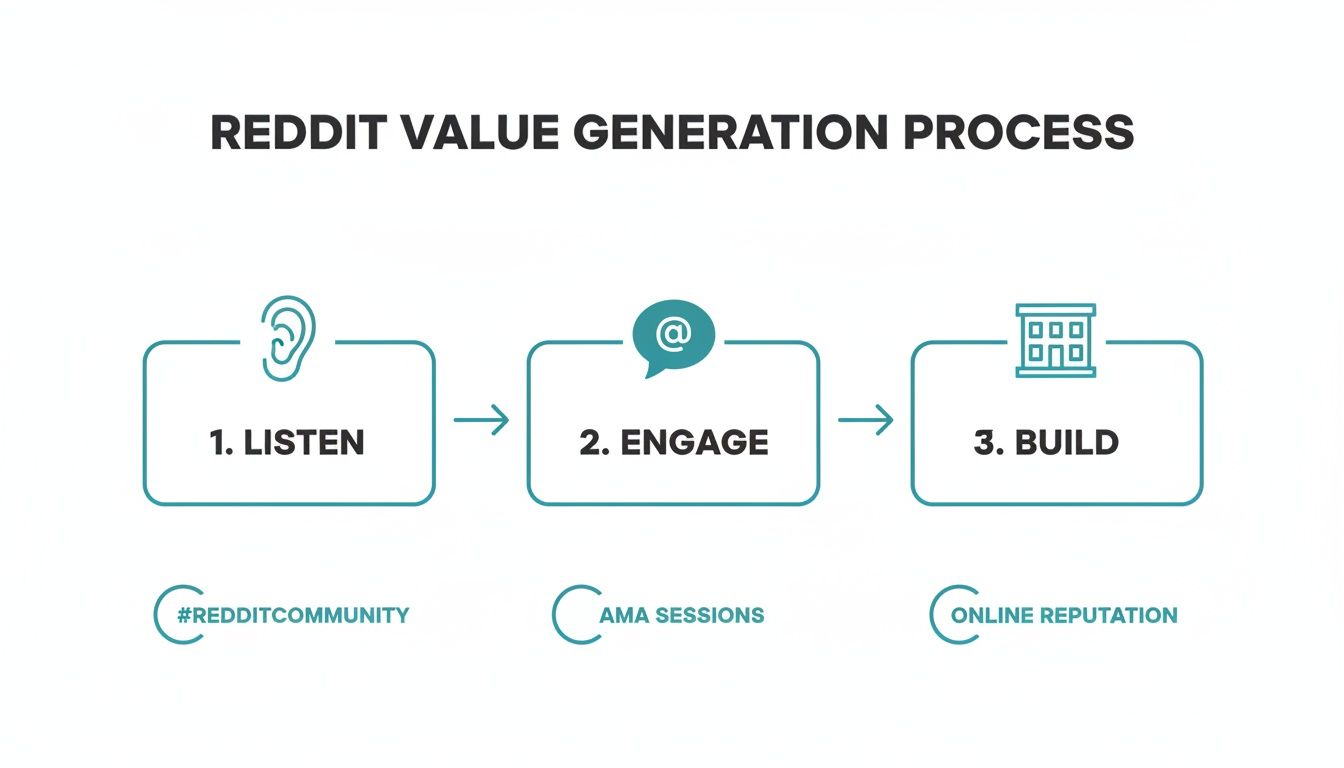
It’s a continuous loop. Listening tells you where the conversations are, and authentic engagement is what builds a lasting, positive reputation from the ground up.
Step 1: Set Up Your Listening Posts
You can't join a conversation you don’t know is happening. The first move is to automate discovery with absolute precision. Inside BillyBuzz, we set up alerts not just for our brand name, but also for competitor mentions and—most importantly—customer pain points.
We guide founders to monitor the high-value communities where their ideal customers are already hanging out. These aren't just random forums; they're digital town squares where your audience is actively seeking solutions.
- For SaaS Founders: We’re constantly in subreddits like r/SaaS, r/startups, and r/growmybusiness. These are absolute goldmines for user feedback and organic leads.
- For B2C Tech: Communities such as r/gadgets, r/techsupport, and niche product subreddits (think r/homeautomation) are essential listening posts.
- For Marketers: We keep a close eye on r/marketing, r/PPC, and r/SEO to jump into discussions about new tools, tactics, and strategies.
The goal isn't just to catch mentions of your brand. It’s to find people asking questions that your product—or your expertise—can solve. That’s your opening to add genuine value.
Step 2: Define Your Alert Rules to Cut Through the Noise
The real magic happens in the filters. A broad keyword alert will just drown you in noise. We configure our alerts to separate the signal from the static, making sure every notification is a real, actionable opportunity. We zero in on phrases that signal "buying intent" and "problem awareness."
Here’s a look at the kinds of alert rules we bake directly into BillyBuzz to surface the best conversations:
- Pain Point Alerts: We track phrases like “how do I solve X,” “frustrated with Y,” or “looking for a tool that does Z.”
- Competitor Comparison Alerts: Monitoring for “Brand A vs. Brand B” or “alternatives to Competitor X” gives you the perfect chance to jump in and highlight what makes you different.
- Integration Request Alerts: We look for “[Your Tool] + [Another Tool] integration” to spot partnership opportunities and user needs before anyone else.
This level of filtering means that by the time an alert hits your Slack, it’s already pre-qualified as a conversation worth your time. To run a solid proactive strategy, you need the right tech stack. You can explore some of the best social media automation tools to see how you can make this whole process smoother.
BillyBuzz Proactive Alert Configuration Template
Here’s a ready-to-use template for founders to configure their social monitoring alerts, inspired by our internal best practices. It’s designed to help you go from just listening to actively building your brand.
| Alert Type | Keywords/Filters to Use | Target Subreddits | Goal of Engagement |
|---|---|---|---|
| Pain Point Discovery | "how to fix", "struggling with", "any tool for", "annoyed by" | Industry-specific (e.g., r/sales, r/content_marketing) | Provide a helpful, non-promotional tip or solution. |
| Competitor Mention | "[Competitor A] vs", "alternative to [Competitor B]", "better than [Competitor C]" | r/SaaS, r/startups, product review communities | Highlight a key differentiator without being negative. |
| Recommendation Request | "looking for a tool", "best software for", "recommend a platform" | Niche communities (e.g., r/ecommerce, r/podcasting) | Introduce your product as a solution to their specific need. |
| Integration Opportunity | "[Your Brand] integration", "connect [Your Brand] to" | r/zapier, r/nocode, relevant tech subreddits | Acknowledge the request and share roadmap info or workarounds. |
By setting up alerts this way, you ensure that every notification is a chance to add value, solve a problem, or build a new relationship.
Step 3: Engage With a "Value-First" Mindset
Once you've got a steady stream of relevant conversations, the last piece is engagement. Our golden rule is simple: never sell, always help. We use flexible templates that position the founder or brand as a helpful expert, not a pushy salesperson.
Here’s a simple template we often adapt when responding to a pain-point discussion:
"Hey [Username], I saw you were struggling with [the specific problem]. I've run into that a ton and found that [share a genuinely useful tip or insight]. My team and I actually built [Your Product] to fix this exact issue by [mention one key feature]. No pressure to check it out, but I hope the tip helps you out either way!"
This approach accomplishes three things beautifully: it shows you understand their frustration, provides immediate value, and only then introduces your product as a natural solution. Over time, these small, helpful interactions compound to build a powerful and positive social media online reputation that money just can't buy.
The Reactive Playbook for Negative Feedback
Sooner or later, it’s going to happen. Negative feedback isn't a possibility; it's a guarantee. The moment a customer has a bad experience, the clock starts ticking. In that very public, very permanent moment, your response—or your silence—is what will define your brand’s character. A clumsy reply can snowball a small issue into a full-blown PR nightmare, but a thoughtful one can actually turn a detractor into your biggest fan.

This section is our battle-tested, founder-to-founder guide for turning those negative comments into powerful opportunities. It's all about empathy, de-escalation, and showing you're accountable. Believe it or not, a well-handled negative review can often become your most convincing piece of social proof, showing everyone you’re a brand that listens and genuinely cares.
The Founder's Triage Framework
When a negative comment pops up in our BillyBuzz alerts, we don't just dive in headfirst. We run it through a quick mental triage to figure out the right course of action. Speed matters, of course, but the right strategy is absolutely critical for managing your social media online reputation.
Here’s the simple framework we use every time:
Reply Publicly: This is our default move for legitimate customer complaints. When a real user has a real problem, addressing it out in the open shows everyone you take accountability. This builds massive trust with all the lurkers who are watching to see how you handle a little heat.
Move to Private: This is for any issue that requires sensitive user information. If you need an email, order number, or account details to solve the problem, your public reply should be a quick and friendly invitation to connect privately via DM or email.
Ignore Completely: Save this for the obvious trolls or bad-faith attacks. Getting into a mud-slinging match with someone who just wants to argue is a game you can't win. It drains your team's energy and gives their baseless claims a bigger platform. Starve them of oxygen.
BillyBuzz Response Templates
Having templates doesn't make your responses robotic. It makes them fast, consistent, and effective, especially when you're under pressure. Here are the core templates we’ve developed at BillyBuzz, which we tweak for different situations.
Scenario 1: The Valid Customer Complaint A user is frustrated with a bug or a service issue. The goal here is simple: empathy and resolution.
Template: "Hey [Username], thank you so much for bringing this to our attention, and I'm really sorry you're running into this issue. That sounds incredibly frustrating. Our team is looking into [mention the specific problem] right now. Could you DM us your account email so we can investigate your specific case and get this fixed for you?"
This response does three things perfectly: it validates their feeling, shows you’re taking action, and gives them a clear next step.
Scenario 2: The Misinformed User Someone is complaining about something, but it's based on a misunderstanding of how your product works. The goal is to educate, not correct them.
Template: "Hey [Username], thanks for the feedback. I can totally see why you'd expect [their assumption]. The feature actually works by [provide a simple, clear explanation]. We could probably do a better job of explaining that in the app. Appreciate you pointing this out!"
This approach avoids making the customer feel stupid and smartly reframes their confusion as valuable UX feedback for your team.
Scenario 3: The Unfair Attack A comment is aggressive and misrepresents your brand, but it doesn't feel like pure trolling. The goal is to correct the record calmly and professionally.
Template: "Hi [Username], I'm the founder of [Your Company]. I'm sorry to see you feel this way. To clarify, [state the fact calmly and concisely without emotion]. We stand by our commitment to [mention a core value, e.g., 'our customers']. If you'd like to discuss this further, my DMs are open."
This response is firm and factual, and it effectively shuts down the argument without escalating it.
Managing negative feedback is a core part of building a resilient brand. By having a clear playbook, you can turn moments of friction into opportunities for connection and trust. For more on this, check out our guide on using social listening for crisis alerts.
KPIs That Actually Measure Your Reputation
If you're not measuring your reputation, you can't improve it. It's that simple. It’s so easy to fall into the trap of chasing vanity metrics—follower counts, likes, you name it. But those numbers are mostly fluff; they don't tell you what people actually think and feel about your brand.
As a founder, you need a clear line of sight connecting your reputation work to real business outcomes. You have to connect the dots between, say, a helpful conversation you had on Reddit and the trust you're building with potential customers. At BillyBuzz, we’ve boiled it down to a handful of metrics that cut through the noise and give us the real story.
You don’t need some ridiculously complicated dashboard to get started. Honestly, a simple spreadsheet combined with a smart discovery tool like BillyBuzz is more than enough. The real secret is consistency. Track these numbers every single week, and you'll start to see exactly how your proactive and reactive efforts are paying off.
Metrics That Matter for Founders
Let's stop chasing vanity and start focusing on what really moves the needle. These are the KPIs that give you a true read on your brand's health and how well your engagement strategy is working. These are the numbers we live by.
Sentiment Score: This is your reputation's pulse. It's the ratio of positive to negative mentions about your brand. Is your score trending up? Great, that means your value-first approach is resonating. BillyBuzz handles this automatically by analyzing the emotional tone of every mention it surfaces.
Share of Voice (SoV): How big is your slice of the pie? SoV tracks how often your brand is mentioned compared to your main competitors. It’s a direct measure of how much of the conversation in your niche you truly own. If you’re consistently part of more relevant discussions, you’re winning the awareness battle.
Average Response Time: When a tough comment pops up, how long does it take for you to jump in? Speed is a signal. It shows you're listening and that you genuinely care. A quick, thoughtful reply can defuse a negative thread before it blows up and demonstrates to everyone watching that you’re on top of your game.
Think of it this way: every interaction is an opportunity. With the average social media post engagement rate at 1.8% in 2026, you can't afford to waste a single one. And get this—brands that reply quickly see 47% higher engagement on their future posts. Responsiveness literally builds its own momentum. You can find more social media marketing statistics on newmedia.com that back this up.
Tracking Your Reputation Over Time
So, how do you make this practical? We recommend a dead-simple tracking system. Just create a spreadsheet with a column for each of your core KPIs. At the end of every week, pull the data from BillyBuzz and plug it in.
Don't aim for perfection on day one. The goal is to set a baseline. Once you know where you stand, you can set real, achievable goals, like boosting your sentiment score by 10% this quarter or slashing your average response time in half.
For example, after you start using our reactive playbook, you should see your average response time drop and the number of unanswered negative comments shrink. Once you launch a proactive campaign, you should see your Share of Voice start to climb as you naturally join more and more conversations.
This simple act of tracking transforms reputation management from a fuzzy idea into a concrete, results-driven part of your growth engine. It's how you prove that building a good name directly helps you build a great business.
How to Weave Reputation Management Into Your Workflow
Let's be realistic. If you're running a lean startup, you can't afford to make social media reputation a full-time job. It can’t be another chore you dread. The only way it works is if it becomes a lightweight, almost automatic part of your daily operations.
The secret is to bake it into the tools and routines you and your team already live in every day.
At BillyBuzz, we built our platform around this very idea. We don't think founders should have to force themselves to log into yet another dashboard. Instead, the most important conversations should find you. This is all about creating a system that keeps working, even when you’re a solo founder juggling a million other things.
Make It a Daily Habit, Not a Project
The trick is to pipe the monitoring alerts directly into your team's communication hub. When you connect a tool like BillyBuzz to your workspace, the critical conversations happening online become impossible to ignore. They show up right next to your internal project updates and team chats.
Here’s the exact setup we use ourselves:
- High-Priority Alerts Go to Slack: We funnel all crucial alerts from BillyBuzz into a dedicated Slack channel we call
#billybuzz-mentions. This channel catches mentions of our brand name, our key competitors, and specific high-intent phrases that signal someone is looking for a solution like ours. - Lower-Priority Keywords Go to Email: For broader industry terms we want to keep an eye on, we just get a daily email digest. This keeps us in the loop without creating a constant stream of notifications.
This simple split means urgent opportunities get our attention right away, while the general industry chatter is something we can scan once a day. It’s a beautifully efficient way to filter the signal from the noise.
Your goal should be to make reputation monitoring as natural as checking your email. It should take no more than 15-20 minutes a day to see what's happening and decide what, if anything, needs a response. Let the automation do the heavy lifting of discovery; you just focus on the human part.
The 15-Minute Daily Reputation Routine
With this system, one person can easily stay on top of a brand’s entire presence on a platform like Reddit. We always suggest a simple daily check-in—either first thing in the morning with your coffee or as you wrap up your day—to build a consistent habit.
Here’s the founder-friendly workflow we teach our users:
- (5 Mins) Scan the Slack Channel: Give the real-time alerts a quick scan. See any fires that need putting out? Any frustrated customers who need a hand right now? That’s your first priority.
- (5 Mins) Spot Your Proactive Openings: Next, look for questions or discussions where you can genuinely help. Someone describing a problem your product solves? Star that message or use an emoji to flag it for a proper reply later.
- (5 Mins) Assign or Act: If you have a team, tag the right person to jump in. If it’s just you, pick one or two of the most impactful conversations you flagged and take a few minutes to write a helpful, non-promotional response.
And that’s it. Seriously. This isn't about responding to every single mention online. It's about consistently and strategically showing up in the few conversations that really matter. By building this simple habit into your daily routine, reputation management stops being a burden and becomes one of your most powerful and sustainable growth engines.
Founder FAQ on Reputation Management
As founders, we get asked the same sharp, practical questions about social media reputation all the time. Here are our straight-to-the-point answers to the most common concerns we hear from teams putting these playbooks into action.
How Long Does It Take to Repair a Damaged Social Media Reputation?
There's no magic number here. The timeline really depends on the severity of the issue and how consistently you work to fix it. That said, a proactive, value-first strategy can start showing positive results within just a few weeks of dedicated effort.
We've seen founders turn negative sentiment around in as little as 3-6 months. They did it by consistently adding value to communities, transparently addressing feedback, and just being genuinely helpful. The key is sustained, authentic effort, not a flashy, one-time campaign. You're rebuilding trust one interaction at a time.
Should I Delete Negative Comments on My Social Media Channels?
Our advice is almost always no. Deleting legitimate criticism looks like you're dodging the issue and instantly erodes the trust you’re trying to build. It sends a clear signal that you have something to hide—and you can bet someone has already taken a screenshot.
The only times you should hit delete are for clear violations:
- Spam or malicious links that are a security risk.
- Hate speech or personal attacks that break platform rules.
- Comments that leak private information about you or a customer.
For everything else, use the response templates we covered earlier. A public complaint handled with grace can become one of your most powerful testimonials for great customer service.
Can I Manage My Online Reputation Without Expensive Tools?
You can definitely start manually, but it's not a long-term solution and you'll absolutely miss important conversations. Trying to manually search Reddit or X is a massive time-sink and often fails to catch the subtle, indirect discussions where your biggest opportunities—and threats—are hiding.
This is exactly what a tool like BillyBuzz is built for. It automates the discovery process, letting you focus your limited time on high-impact engagement instead of getting lost in endless search queries. It saves founders hours every week and makes sure you never miss a chance to shape your brand’s story.
Ready to stop searching and start engaging? BillyBuzz uses AI to find your next customers on Reddit and alerts you in real-time. Start your free trial today and see the conversations you've been missing.