
When a brand-threatening issue blows up on social media, you have to be ready to identify it, jump on it, and shut it down before it does any real damage to your reputation. This means having your team roles figured out, key messages pre-approved, and the right monitoring tools in place before you're in the hot seat. It's all about being able to act fast and with confidence when things go sideways.
Your Next Social Media Crisis Is Inevitable—So Prepare Now

Don't fool yourself into thinking social media crises are a "big brand" problem. As a founder, you know better than anyone that one nasty Reddit thread can completely torpedo a product launch, spook investors, or even hijack your SEO with a complaint that shoots to the top of Google. This isn't just a fire drill; it's about survival.
Here at BillyBuzz, we don't bother with those complicated crisis flowcharts that just gather dust. Our approach is built around a lean, practical preparedness kit that even a small team can execute perfectly under pressure. Being prepared is what makes the difference between a controlled, professional response and an all-out panic.
The Three Pillars of Our Preparedness Kit
Our whole strategy is built on three simple, non-negotiable pillars. You need to get these right from the very beginning.
- Define Your Crisis Thresholds: What actually counts as a "crisis" for your startup? Is it five angry tweets? A single post hitting the front page of a major subreddit with 100+ upvotes? We set specific, quantitative triggers so we don’t overreact to every little complaint but never, ever miss a real threat.
- Establish a Clear Chain of Command: Who gets the alert at 2 AM? Who has the final say on that public apology? On a small team, it's probably the founder, but writing it down eliminates any guesswork when every second is critical.
- Set Up Your Digital Listening Posts: It's simple: you can't respond to conversations you can't see. Proactive social media monitoring is the foundation of any credible crisis plan.
As founders, we have to accept that we no longer control the narrative—our customers and communities do. Our only advantage is being prepared to join their conversation with speed, empathy, and a clear plan of action.
Why Planning Makes a Quantifiable Difference
This isn't just about peace of mind; having a plan has a real, measurable impact on your business. The data draws a bright line between companies that prepare for a social media crisis and those that just hope for the best.
One analysis found that 89% of businesses with a documented communication plan were able to minimize reputational damage. Meanwhile, 46% of companies without a strategy ended up losing significant customer trust. You can dig into more of these crisis management marketing statistics yourself.
This is the foundational work that lets a small team react with the speed and confidence of a much larger company. It’s how we protect our reputation when it matters most, turning potential disasters into chances to prove we actually care about our users.
Building Your Real-Time Crisis Detection System
A crisis doesn't wait for a formal introduction. It doesn't arrive in a neatly formatted email from your support team. It ignites the second a negative conversation catches fire online. By the time it reaches you through official channels, you've already squandered your most valuable asset: time.
As founders, we live and die by the first hour of a crisis. That’s why we’ve completely rewired our approach to social listening. It's not a passive, check-it-once-a-day task anymore. It’s an active, automated early-warning system that acts as our frontline defense.
Let me pull back the curtain on the exact monitoring setup we use right here at BillyBuzz. This isn't theory. This is our battle-tested system, designed to spot the sparks before they have a chance to become infernos. We eat our own dog food, using BillyBuzz as the central nervous system for our brand's health.
Configuring Your Automated Frontline Defense
Simply listening for mentions is a recipe for getting blindsided. You need a system that actively pushes high-stakes conversations directly to you, the second they happen. We do this by creating incredibly specific, context-aware alerts that pipe straight into a dedicated Slack channel we call #crisis-comms.
Our alerts aren't just looking for "BillyBuzz." That would be a firehose of noise. Instead, they’re built on smart combinations of triggers that signal genuine reputational risk.
Here are a few of the actual alert rules we have running 24/7:
Rule 1: The Code Red Brand Attack. This is our highest-priority trigger. It fires if our brand name appears alongside a list of truly damaging keywords. We're not talking about "bad review" or "don't like." Think much, much bigger.
- Keywords:
BillyBuzz+ (scam,fraud,data loss,unethical,lawsuit,broken,security flaw) - Action: Immediately pushes a
[CODE RED - URGENT]alert to Slack and sends an email straight to the founding team's phones. No delays.
- Keywords:
Rule 2: The Competitor Poaching Snipe. This one is more strategic. It fires when a competitor's name shows up in the same thread as keywords related to a customer pain point we solve. This is both a threat and an opportunity.
- Keywords:
[Competitor Name]+ (poor support,too expensive,missing feature) - Action: Pings our marketing channel, giving them the intel to potentially jump into the conversation.
- Keywords:
Rule 3: The Unseen Sentiment Spike. This is our safety net. It alerts us if there's a sudden >30% jump in negative-sentiment mentions about us on Reddit within a 3-hour window. This is designed to catch slow-burn issues that our more specific keyword alerts might miss.
- Action: Sends a
[CODE YELLOW - Spike Detected]alert, prompting an immediate investigation.
- Action: Sends a
Here’s a look at how BillyBuzz actually surfaces these conversations, letting us see the context and sentiment at a glance.
It's the tool's ability to filter out the noise and show us what's truly relevant that turns these alerts from a distraction into an actionable defense system.
Monitoring Reddit Hotspots Where Crises Are Born
For a SaaS startup, not all corners of the internet are created equal. A complaint on a random forum is one thing. A highly-upvoted critical post on the front page of an industry subreddit? That’s a five-alarm fire.
Reddit is often ground zero. Its communities are influential, and its SEO value is off the charts. A negative thread can hit the first page of Google for your brand name and stay there for years.
We don't just monitor Reddit; we continuously monitor a curated list of "hotspot" subreddits where our customers, prospects, and industry peers hang out. This is where the conversations that matter happen.
We don't wait for conversations to find us. We go where they live, with alerts configured to tell us not just what is being said, but how much it matters. This is the core of proactive crisis management in social media.
Our essential Reddit monitoring list includes:
- r/SaaS: The premier community for SaaS founders, professionals, and enthusiasts.
- r/startups: A massive hub for early-stage discussion, feedback, and, you guessed it, complaints.
- r/marketing: To keep a pulse on how the broader marketing world sees tools like ours.
- Industry-Specific Subs: For us, that means communities built around SEO, digital marketing, and community management.
To get started building your own system, check out our detailed guide on setting up real-time social media alerts which walks you through the process step-by-step. To really level up your detection, you can also explore some of the best AI search tracker tools for monitoring conversations beyond just social platforms.
Following this blueprint transforms social listening from a chore into your most powerful early-warning system.
How We Triage and Escalate Social Media Threats
When a high-urgency alert hits your inbox, the absolute worst thing you can do is panic. The second-worst? Treating every single negative comment like a five-alarm fire. As founders, our time is our most valuable asset, and overreacting to minor complaints can drain your resources just as quickly as ignoring a legitimate threat.
That's why a simple triage framework is the heart of our social media crisis management. It’s not some complex, multi-page flowchart; it’s a quick mental model that helps us categorize incoming alerts and assign the right level of response, instantly. Without it, you’re just guessing, and guesses get expensive when a crisis is brewing.
This decision tree gives you a peek into our rapid-fire process for figuring out if an alert needs an immediate, all-hands-on-deck escalation.
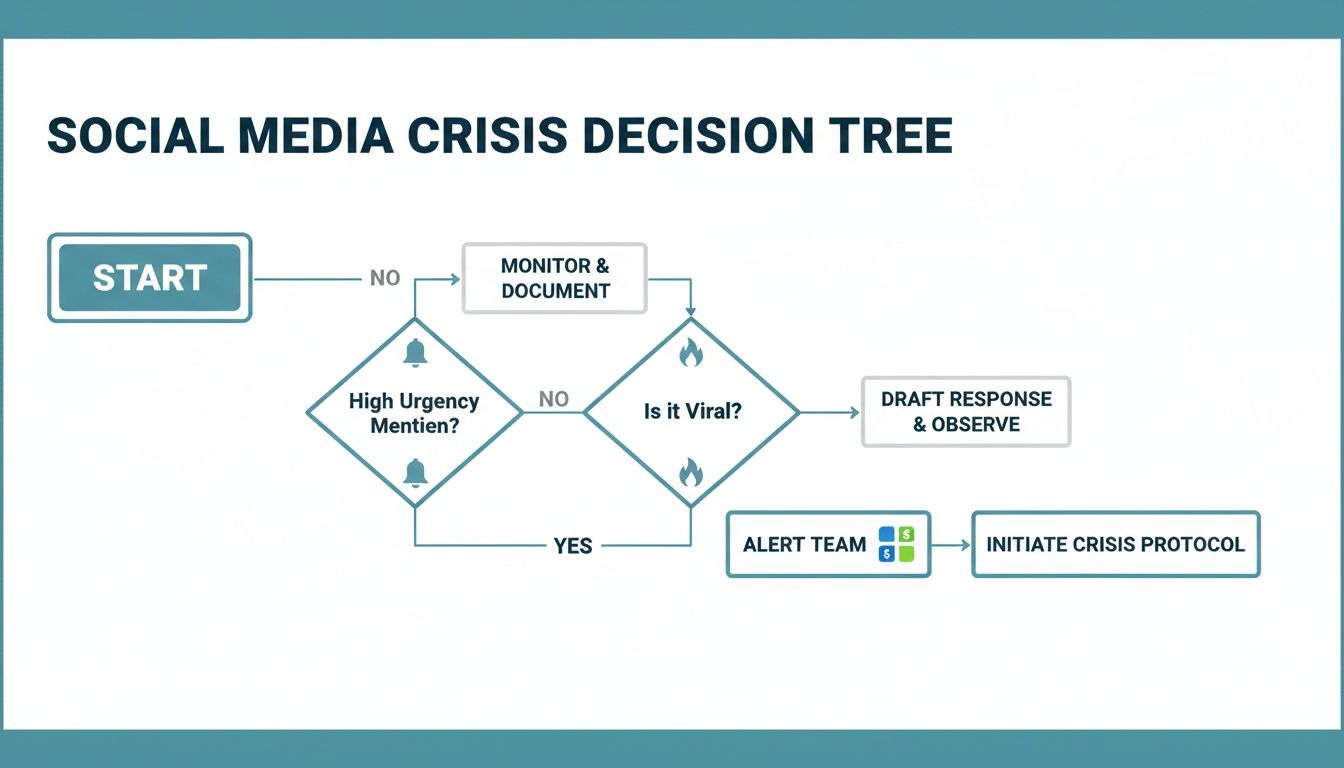
The whole point is to quickly separate the noise from the real threats—the ones that could go viral and require immediate, high-level intervention.
Our Code Yellow vs. Code Red System
We boil every alert down to two simple categories: Code Yellow and Code Red. This isn't just internal jargon; it's a shorthand that instantly tells our team who needs to act and how fast.
- A ‘Code Yellow’ is a contained issue. Think of a frustrated user in a support thread, a feature request that’s getting a few upvotes, or a single negative review. It’s important, for sure, but it isn't threatening the entire brand.
- A ‘Code Red’ is a potential company-level crisis. This is the stuff of nightmares: a viral post alleging a security flaw, a highly-upvoted Reddit thread accusing us of unethical practices, or a key influencer publicly trashing our product.
Making this distinction is critical. A Code Yellow gets routed to the right person—usually someone in customer success or product—with a clear expectation for a timely, but not frantic, response. A Code Red, on the other hand, triggers an immediate escalation to the founding team. No delays, no questions asked. This ensures the people with the most authority are on the case within minutes.
Mapping Scenarios to Owners and SLAs
To make this system actually work when the pressure is on, you need to write down who owns what. A simple matrix removes all ambiguity. It connects a specific type of alert to a primary owner and sets a clear Service Level Agreement (SLA) for how fast we need to make the first public response.
At a startup, you can’t afford to have three different people trying to solve the same problem—or worse, nobody solving it at all. A clear triage matrix ensures every threat has a designated owner from the first minute.
Here’s a simplified version of the internal guide we use at BillyBuzz. We treat it as a living document, updating it as our team and product evolve.
BillyBuzz Internal Crisis Triage Matrix
This table is our internal cheat sheet for categorizing social media mentions and defining the right response protocol. It ensures consistency and speed.
| Alert Type | Severity Level | Primary Owner | Response Time SLA |
|---|---|---|---|
| Public Bug Report | Code Yellow | Head of Product | Acknowledge within 4 hours |
| Negative Review | Code Yellow | Customer Success Lead | Respond within 24 hours |
| Feature Complaint | Code Yellow | Product Manager | Acknowledge within 8 hours |
| Viral Accusation | Code Red | Founding Team | Acknowledge within 60 minutes |
| Security Concern | Code Red | Co-Founder (CTO) | Acknowledge within 30 minutes |
This kind of clarity is non-negotiable for an early-stage startup that lives and dies by word-of-mouth, especially in communities like Reddit. Without early detection and fast, thoughtful replies, the probability of brand damage skyrockets within the first 24–48 hours of a negative thread taking off.
Ultimately, this system is our defense against chaos. It ensures we spend our limited resources effectively, focusing our full attention on the fires that can actually burn the house down. You can see more about how AI ranks social media alerts by importance to make this process even sharper.
Crafting the Right Response at the Right Time
Once you’ve spotted a threat and figured out how serious it is, the clock starts ticking. Loudly. What you say next—and just as importantly, how fast you say it—can either calm the storm or pour gasoline on the fire. This is where all the planning meets reality, and frankly, it’s where most startups get it wrong.
At BillyBuzz, our internal rule for any high-severity, ‘Code Red’ issue is simple: get our first public acknowledgment out the door within 60 minutes. It feels aggressive because it is, but if you want to control the narrative, it's non-negotiable.
Our Acknowledge, Empathize, Action Framework
We've seen too many bland, corporate-speak apologies that do more harm than good. Forget those. We built our entire initial response strategy on a simple but incredibly effective three-part framework we call AEA: Acknowledge, Empathize, Action. It’s designed to be human, direct, and focused on what's next.
- Acknowledge: Directly address what the person is saying. This proves you've actually read and understood their specific problem, not just seen a keyword and fired off a canned reply.
- Empathize: Connect with them as a person. Phrases like, "Wow, that sounds incredibly frustrating," or "I can totally see why that would be a major headache," go a long way. It validates their feelings and shows you actually give a damn.
- Action: This is the most critical part. Tell them exactly what you’re doing next and when they can expect an update. This single step turns an angry complaint into a collaborative effort to find a solution.
Here’s a real, battle-tested template we use as a jumping-off point. It’s not fancy, but it works.
"Thanks for flagging this. That sounds incredibly frustrating (Acknowledge, Empathize). I'm personally looking into the issue with our engineering lead now and will post an update here within the hour (Action)."
This one sentence does three crucial things in an instant: it stops the user from feeling ignored, it shows anyone else watching that you're on it, and it buys you a precious hour to dig in without the panic of radio silence.
The Founder's Call: Public Reply vs. Private DM?
Deciding whether to keep a conversation in the public thread or move it to DMs is one of the trickiest calls you'll have to make. Get it wrong, and you either look like you're hiding something or you accidentally over-share sensitive info.
My rule of thumb is this: Always acknowledge publicly, but resolve privately when necessary.
- Respond Publicly When... The issue impacts a lot of people (like a service outage or a bug), you need to shut down a false rumor, or you simply want to show your community that you’re accountable. That first AEA response? It should almost always be public.
- Move to DMs When... You need to get account-specific details, personal data is involved, or the person is extremely upset and a public back-and-forth will only make things worse.
Make the handoff smooth and transparent. Something like, "I've just sent you a DM to get your account details so we can dig into this for you," tells everyone you’re taking action while protecting that user's privacy.
Using AI as a Springboard, Not a Crutch
Inside BillyBuzz, we use AI-powered reply suggestions to help us draft responses quickly. When you're under the gun, having a tool that can spin up a solid AEA-based reply in seconds is a huge advantage.
But—and this is a big but—we never just copy and paste what the AI gives us. We treat it as a first draft. It’s a starting point that our team then polishes to fit our authentic, founder-led voice. The AI gets the structure right; we inject the personality and specific context.
As you build your crisis response plan, never forget the importance of transparent communication with users. AI can't fake sincerity, but it can absolutely help you deliver a sincere message faster.
Ultimately, a great response is a mix of speed, strategy, and genuine sincerity. The AEA framework gives you the blueprint, your internal goals create the urgency, and your gut instinct as a founder tells you the right way to see it through.
Getting Your Whole Team on the Same Page—Fast
Let's be real: a social media crisis never stays in its lane. A single nasty Reddit thread can blow up on Twitter in an hour, get featured in an industry newsletter by lunch, and poison your branded search results by morning. This is precisely why a siloed response is a recipe for disaster.
At BillyBuzz, our entire approach to crisis management in social media is built on having one single source of truth and moving in lockstep across every channel. The moment a ‘Code Red’ alert fires, our first action isn't to start drafting a reply. It's to spin up a dedicated, temporary Slack channel we call #crisis-comms.
Think of it less like a chatroom and more like our central nervous system. This channel gives everyone—from marketing and product to the founders—the exact same information at the exact same time. We’re in there sharing screenshots, linking to the original threads, and hammering out our AEA response together. This completely avoids the cardinal sin of crisis comms: mixed messaging. Nothing kills trust faster than your Twitter account saying one thing while your customer support reps are saying something else entirely.
Setting Up Your Crisis War Room
Our #crisis-comms channel becomes our command center. It’s where we execute the playbook and ensure we’re singing from the same hymn sheet, everywhere.
The very first message in that channel always lays out three critical pieces of information:
- Link to the Primary Threat: A direct URL to the Reddit post, tweet, or article that started it all. No confusion.
- Designated Owner: The one person responsible for posting all official public responses.
- Next Check-In: A specific time (e.g., "reconvene in 30 minutes") to keep us moving and prevent the conversation from spiraling.
This simple structure keeps the team aligned and focused on action. Everyone can see what’s happening, but there’s zero ambiguity about who's steering the ship. This is how we keep our communication tight and effective, preventing the chaos that can derail even the most well-intentioned plans.
How to Tell if Your Response is Actually Working
So, you’ve posted your response. How do you know if it’s helping? You can't just cross your fingers and hope for the best. As founders, we need data. We track a few simple, direct metrics to see if we're putting out the fire or just pouring gasoline on it.
We don’t get bogged down in vanity metrics. Our focus is on the tangible stuff that tells us whether the narrative is shifting back in our favor. This lets us tweak our strategy on the fly.
As a founder, you have to be your own first responder. That means creating a system that gives your team a single, unified view of the problem so you can execute a coordinated, multi-channel response with absolute clarity and control.
Here’s what we look at:
- Sentiment Shift on the Original Thread: Is the tone of new comments getting more positive or neutral since we replied? We use BillyBuzz to track sentiment scores in real-time for this.
- Rate of New Negative Mentions: Are new, separate fires popping up on other platforms? A good response contains the conversation; it doesn’t start new ones.
- Impact on Core Business Metrics: We keep a close eye on our dashboard. Are we seeing a sudden dip in sign-ups? A spike in cancellations? This shows us if the social media noise is hitting the bottom line.
Speed is everything. Research shows the average time from the first sign of a crisis to the first news story is just under 19 hours. For a startup, that means you have less than a day to spot the problem, get your team coordinated, and start shaping the story before it’s out of your hands. It's no wonder AI-powered listening is becoming so critical, as this market analysis from GMI points out.
For a deeper look at how to wire these systems together, check out our guide on integrating moderation tools with your existing systems. Having that operational backbone is what allows a small team to manage a crisis with the coherence of a much larger organization.
Learning and Recovering After the Dust Settles
When a crisis finally blows over, the first instinct is to take a deep breath and just get back to work. I get it. The temptation to move on is powerful. But as a founder, I’ve learned the hard way that the real work—the stuff that actually makes you stronger—starts right after the chaos ends. A crisis isn't truly over until you’ve squeezed every possible lesson out of it. This is how you build real resilience.
At BillyBuzz, we treat every crisis, no matter how small, as a data point. It’s a painful but incredibly valuable opportunity to make our product more robust and our team more prepared. This post-mortem process is what ensures that the next time a storm gathers, you’re faster, smarter, and ready for it.
Our Post-Crisis Retrospective Meeting
We make it a rule to schedule a "crisis retrospective" meeting within 48-72 hours after things have calmed down. This isn't about pointing fingers; it’s a blameless session focused entirely on learning. We keep it simple and powerful by centering the entire conversation around just three questions.
- What went well? Did our alert system fire off like it was supposed to? Was our initial response on point? It's just as important to recognize what worked under pressure so you can double down on it.
- What could we have done better? Maybe our first-line triage was too slow, or the messaging wasn't consistent across Twitter and Reddit. This is where you have to be brutally honest about what broke down.
- What will we change to prevent this from happening again? This is the money question. The goal here isn't a vague promise to "do better." It's to come away with a concrete action item.
This debrief is the heart of our recovery process. It’s how we shift from simply putting out fires to actively fireproofing the business.
Turning Lessons into Actionable Tasks
The output of our retrospective isn't some report that gets filed away and forgotten. It’s a list of concrete tasks, each assigned to a specific person in our project management tool with a firm deadline. This is absolutely critical—it ensures our hard-won lessons don't just evaporate. They get baked right back into our product and our daily workflows.
A crisis is a terrible thing to waste. The true measure of recovery isn't just getting back to normal; it's creating a new normal where your team is stronger, your product is better, and your processes are more resilient than they were before.
Here are a few actual examples of tasks that have come directly out of our own retrospectives:
- Product: Push the bug fix that caused the initial user complaint to the top of the next sprint.
- Marketing: Tweak a specific response template to better handle the kind of frustration we saw from users this time around.
- Engineering: Fine-tune the sensitivity on a BillyBuzz alert so we catch this type of issue even earlier next time.
- Leadership: Update our internal triage guide to clarify who owns a new category of problem we hadn't seen before.
By turning every lesson into a tangible task, we close the loop. This is how you transform a stressful, brand-damaging event into an engine for growth. It’s how you make sure every single crisis, big or small, makes your startup more antifragile and ready for whatever comes next.
Ready to build your own early-warning system and manage social media conversations before they become crises? BillyBuzz is your AI-powered command center for Reddit, helping you find and engage customers with precision. Start monitoring the conversations that matter at https://www.billybuzz.com.