
Forget PR fluff. Corporate reputation management isn't a cleanup job—it's the daily grind of building and defending the trust people have in your business. As a founder, you're juggling a dozen priorities, but your reputation underpins all of them. It's the invisible asset that dictates whether you win or die.
A decade ago, a press release was enough. Today, your reputation is forged in the fire of Reddit threads, Twitter storms, and angry customer reviews. This isn't about broadcasting; it's about engaging in the chaotic, real-time conversation happening with or without you.
Why Your Reputation Is Your Most Valuable Asset
Let's get straight to it. Your reputation isn't a "soft" metric. It directly impacts your ability to acquire customers, hire top talent, and survive a crisis. It's the bedrock of your business.
A rock-solid reputation works for you 24/7. It's:
- Your Best Marketing Tool: A glowing recommendation in an online community is worth more than any ad you can buy. When people genuinely trust you, they sell for you.
- A Magnet for Top Talent: The best people have options. They want to work for companies they admire and believe in. A great reputation doesn't just make recruiting easier; it keeps your best people from walking out the door.
- Your Primary Defense in a Crisis: When things inevitably go sideways, a deep reserve of goodwill is your lifeline. A community that trusts you is far more likely to give you the benefit of the doubt instead of grabbing their pitchforks.
The Tangible Value of Trust
This isn’t just feel-good talk; it’s a financial reality. The C-suite has woken up to the fact that a damaged reputation is now one of the biggest threats to a business.
In a recent survey, a stunning 84% of executives ranked brand and reputation risk as their number one external concern—beating out even cyber threats. That tells you everything you need to know. The money backs it up, too. Companies with strong, positive reputations can command up to a 25% premium in their valuation. Why? Because investors know that public trust is a priceless asset. You can discover more insights about these reputation statistics.
The fundamental truth for founders is this: your reputation isn't what you claim it is. It's what the community consistently says about you when you're not in the room.
Ultimately, getting ahead of your reputation is about building a brand that's resilient and authentic. It’s the foundation you need for real, sustainable growth.
The Proactive Reputation Monitoring Playbook: How We Do It at BillyBuzz
Great reputation management is about stopping fires before they start. It’s a proactive game of listening, analyzing, and engaging before a minor complaint becomes a full-blown crisis.
At BillyBuzz, our internal process is built on a simple framework: Listen, Analyze, and Engage. This isn't about scrolling through social feeds. It's a focused, systematic effort. This is our playbook—a look behind the curtain at how we use our own tools to stay ahead of the narrative.
Building Your Listening Engine
First, you need a digital radar. You have to know where your audience hangs out and what they're talking about. For most startups, especially in tech, Reddit is a goldmine of unfiltered feedback.
Here’s a breakdown of the actual subreddits we monitor for different types of companies:
- For SaaS Startups:
r/SaaS,r/startups,r/smallbusiness. This is where founders and decision-makers talk shop. - For Developer Tools:
r/programming,r/webdev, and specific language communities liker/Pythonorr/javascript. Developers vent their pain points here—pain points your tool can solve. - For B2C Brands: Niche hobby or lifestyle subreddits. For a coffee brand, we're watching
r/coffee. For a fitness app, we're inr/bodyweightfitness.
Once you know where to listen, you have to figure out what to listen for. We go beyond just our brand name. After all, a huge part of this is learning how to master your online reputation by managing Google reviews and other third-party platforms.
This is a great way to visualize how reputation has evolved from a one-way street to a continuous cycle of conversation and trust.
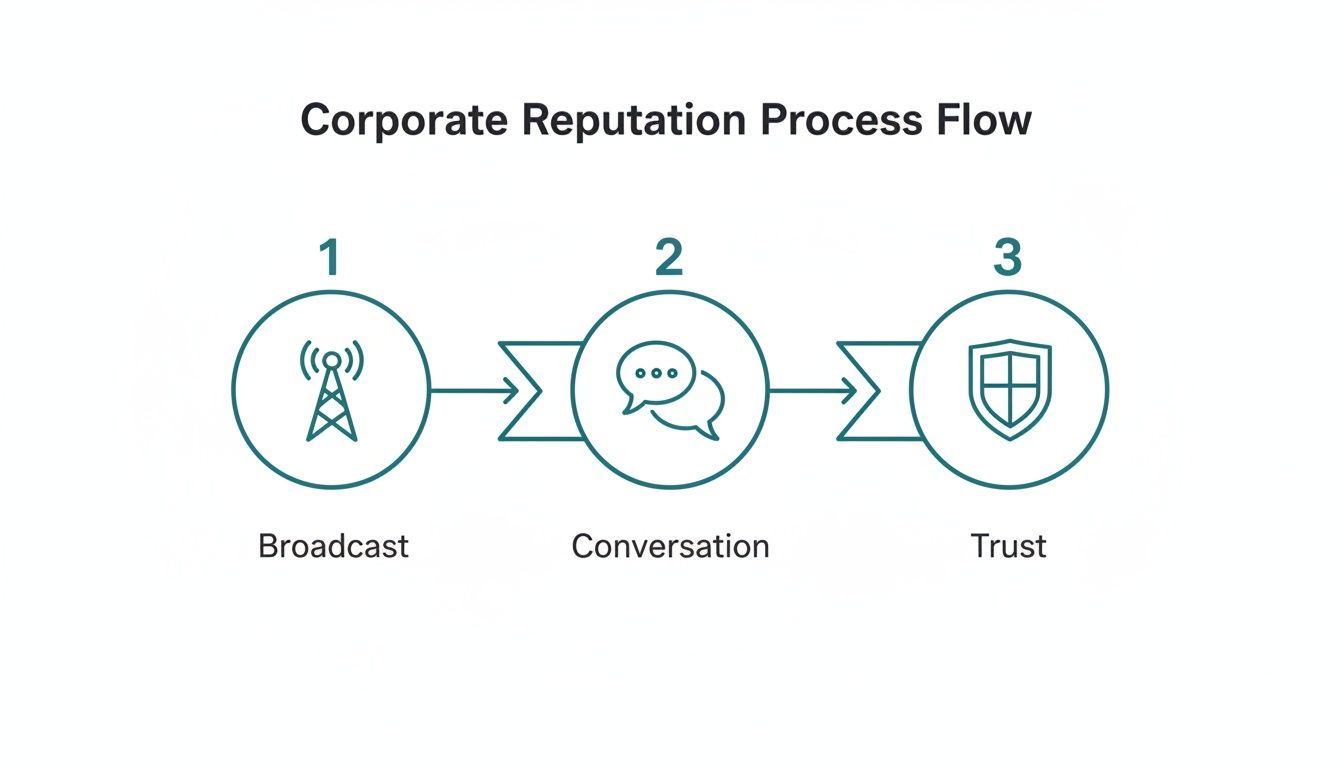
The flow from 'Broadcast' to 'Conversation' and finally to 'Trust' perfectly illustrates that just shouting your message into the void isn't enough anymore. Earning trust means showing up and actively participating.
Filtering Signal From Noise: Our Internal Alert Rules
Listening without filtering is useless. A firehose of data won't help you. You need to separate casual mentions from urgent customer complaints.
This is where we lean on our own tool, BillyBuzz. We build alert rules that act as a smart filter, ensuring our team only sees conversations that demand a response.
Our rule of thumb is pretty straightforward: If a human would read a comment and think, "We need to jump on this," our AI should flag it. This simple filter cuts out 90% of the noise, letting us focus on the high-stakes conversations.
For instance, we set up alerts to trigger only if our brand name appears alongside negative keywords like "frustrated," "broken," or "terrible support." Or we track a competitor’s name when it appears with phrases like "looking for an alternative to" or "switching from."
This precision turns monitoring into an active reputation defense system.
Our BillyBuzz Alert Configuration for Reputation Monitoring
Here’s an actual template showing how we set up BillyBuzz to track key conversations on Reddit for a hypothetical project management SaaS. This keeps us on top of our brand, competitors, and customer pain points.
| Alert Name | Keywords Tracked | Target Subreddits | AI Filter (Example) |
|---|---|---|---|
| Brand - High Urgency | "OurBrand," "ourbrand.com" | r/projectmanagement, r/SaaS, r/startups |
Trigger if keywords like "issue," "bug," "can't log in," "down," or "frustrated" are present. |
| Competitor - Opportunity | "Competitor A," "Competitor B" | r/projectmanagement, r/smallbusiness |
Trigger if keywords like "alternative," "switch from," "better than," or "cheaper" are present. |
| Industry - Pain Points | "hate organizing tasks," "project tracking is a mess" | r/Productivity, r/smallbusiness |
Trigger if post has high engagement (upvotes/comments) and asks for tool recommendations. |
This setup turns a flood of information into a handful of actionable insights each day.
To get even more tactical, you can dive into our complete guide to setting up real-time social media alerts. Following this process transforms monitoring from a time-sucking chore into a powerful strategic advantage.
How to Turn Negative Feedback Into Your Best Asset
Negative feedback feels like a gut punch. As a founder, it’s personal. But the biggest mistake is seeing criticism as an attack.
At BillyBuzz, we treat every piece of negative feedback—a frustrated Reddit comment, a one-star review—as a priceless data point. It’s an unfiltered look into your customer’s mind.
Don't dread it; reframe it. Negative feedback is an opportunity. It pinpoints friction in your UX, reveals gaps in your messaging, and highlights unmet needs. How you handle it publicly can become one of your most powerful marketing assets, turning a potential crisis into a showcase of incredible customer care.

Our Founder-to-Founder Response Playbook
When criticism hits, speed, empathy, and transparency are everything. A slow or defensive response is fuel on the fire. Our internal rule: respond to high-priority negative mentions within the hour.
Here’s the playbook we use, with templates you can adapt for your own corporate reputation management strategy. We categorize negative feedback into three main buckets:
- The Misinformed User: Someone is complaining about something your product doesn't do. The goal is education, not correction.
- The Genuinely Unhappy Customer: Your product failed them. A bug, bad service, or a broken promise caused legitimate frustration. The goal is to acknowledge, apologize, and resolve. Fast.
- The Vague Complaint: The feedback is short on details ("your app sucks"). Your goal is to get more information and show you’re listening.
Our Internal Response Templates
These are the exact templates we start with inside BillyBuzz. We always customize them to sound human, but they provide a solid foundation for a quick, effective reply.
Template 1: For the Misinformed User
"Hey [Username], thanks for bringing this up. It sounds incredibly frustrating to expect X and get Y. I think there might be a misunderstanding about how [Feature] works—it's actually designed for [Purpose]. I'd be happy to walk you through how to achieve [Goal] with our current setup, or hear more about what you were trying to do. Let me know what works best!"
This validates their feeling without getting defensive. It gently corrects while offering a solution.
Template 2: For the Genuinely Unhappy Customer
"Hi [Username], I'm so sorry you ran into this issue. That's definitely not the experience we want for our users, and I completely understand your frustration. I've already flagged this for our engineering team to investigate. Could you DM me your account email so I can look into this for you personally and get it sorted out?"
This leads with a sincere apology, takes ownership, and moves the details to a private channel while showing public accountability.
Template 3: For the Vague Complaint
"Hey [Username], sorry to hear you're not having a good experience. Could you share a bit more about what's not working for you? We're always looking for feedback to improve, and specifics really help us figure out where we’re falling short."
This opens the door for a real conversation.
While AI can help you scale this process, that human touch is what builds a genuine connection. If you want to dig deeper into the tech side, we've outlined more on how AI helps monitor brand reputation with feedback in another post.
By systemizing your responses, you turn chaotic, stressful situations into controlled, reputation-building moments. This isn't just damage control; it's demonstrating your company's values out in the open.
Building Long-Term Brand Equity in Online Communities
Putting out fires is reactive. The real secret is playing offense—proactively building a fortress of goodwill before you need it. Online communities like Reddit are the perfect place for this.
But this isn't about spamming links. That’s a surefire way to get banned and earn a terrible reputation. The goal is to become a genuinely valued member of the community. It’s a long game, and it starts with giving value, not asking for it.
At BillyBuzz, we build this equity by finding non-promotional conversations where our team can share legitimate expertise. We don't jump in to sell; we jump in to help. This value-first approach is the single best investment you can make in your brand’s resilience.
Finding Where to Add Real Value
The trick is to find conversations where your expertise is needed, but your product isn't the star. This means setting up your monitoring differently. Instead of tracking your brand name, create alerts for industry pain points.
Here’s a peek at how we configure BillyBuzz alerts to find these opportunities:
- Alert Type: Industry Expertise
- Keywords: "how do I analyze customer feedback," "best way to track brand sentiment," "tools for social listening." These are problem-focused, not brand-focused.
- Target Subreddits:
r/marketing,r/AskMarketing,r/CustomerSuccess. - AI Filter: We fine-tune the filter to flag posts that are questions or discussions, while specifically excluding any that mention "BillyBuzz" or our direct competitors.
This setup gives us a clean feed of chances to simply be helpful. We can join the conversation, offer a detailed, thoughtful answer, and build a reputation as an expert in our space—all without ever mentioning our own product unless someone directly asks.
Aligning Your Voice with Your Values
Beyond being helpful, your engagement has to feel authentic. This is where your public voice needs to sync with your company's core values. If you value transparency, be open and honest. If you're customer-centric, every interaction should prove it.
People don’t build relationships with logos; they build them with the people behind the brand.
As a founder, think of it this way: every helpful comment you leave is like making a small deposit in a bank account of community trust. You won't need it every day, but when a crisis hits, that account will be what saves you.
This approach also ties into your company’s bigger mission. Corporate Social Responsibility (CSR) is a massive factor in reputation today, with 92% of consumers saying they view companies that support social and environmental issues more positively. This isn't just about feeling good, either. A study found that 87% of consumers will actually purchase a product because a company advocated for an issue they care about, linking reputation directly to revenue.
Even better, when a crisis does happen, 63% of the public gives socially responsible businesses the benefit of the doubt—a crucial shield when you need it most. You can dig into all the numbers in these online reputation management statistics on ReputationX.com.
Building long-term equity is a patient, deliberate process. It’s about showing up consistently, adding value, and proving you’re a member of the community, not just a marketer in disguise.
Measuring The Metrics That Actually Matter
If you can’t measure your reputation, you can’t improve it. But getting bogged down in vanity metrics is a waste of time. Forget tracking every single mention.
You need a straightforward report that answers one critical question: is our reputation getting stronger or weaker?
At BillyBuzz, we keep it lean. We zero in on a handful of KPIs that give us a real look at our brand's health. This makes reputation a data-driven part of our growth engine.
The Core Three Reputation KPIs
We’ve distilled our reporting down to three core metrics. Together, they give us a clear snapshot of our brand's health without any fluff.
- Share of Voice (SoV): How much of the conversation in your space do you own compared to your competitors? A rising SoV means you're becoming more relevant.
- Sentiment Score: The vibe check for your brand. It’s the ratio of positive to negative mentions. Is the general feeling improving or taking a nosedive? This is your early warning system.
- Engagement Rate: When you jump into conversations, how do people react? This tracks upvotes and replies, showing if your contributions are valuable or just noise.
As a founder, your goal isn't to win every single conversation online. It's to see a steady, positive trend in these three key areas over time. Slow, consistent growth in reputation is far more valuable than a few viral spikes.
By focusing on these three numbers, you sidestep "analysis paralysis" and get a clear picture of your reputation in minutes.
Our Monthly Reputation Report
We use a basic monthly report. It’s not fancy, but it forces us to look at trends and pull out insights. Here’s the exact template we use. You can build this in a spreadsheet.
This structured approach turns fuzzy feelings about your brand into solid data you can act on. If you want to dig deeper into the data visualization behind these metrics, you can learn more about how to interpret sentiment graphs for brand monitoring.
Monthly Reputation Health Report Template
Here's the simple template we use to track our core KPIs. It’s all about comparing month-over-month performance to spot trends.
| Metric | This Month | Last Month | Change (%) | Notes/Insights |
|---|---|---|---|---|
| Total Mentions | 125 | 110 | +13.6% | Volume is up, driven by a new feature launch. |
| Share of Voice | 18% | 15% | +3% | Gained ground on Competitor A this month. |
| Sentiment Score | 78% Positive | 75% Positive | +3% | Positive sentiment grew, fewer bug complaints. |
| Engagement Rate | 3.5% | 3.1% | +0.4% | Our helpful comments in r/SaaS are resonating. |
| Negative Mentions | 12 | 15 | -20% | Complaints about UI issues have decreased. |
This isn’t about hitting arbitrary targets. It’s about understanding the story your data is telling you.
In the example above, the story is clear: the new feature launch boosted visibility (SoV), product improvements reduced negative feedback, and community engagement is working. That’s a powerful story to share with your team and investors.
Answering Your Reputation Management Questions
The theory is great, but execution is what matters. Here are the most common questions we get from other founders, with the practical, no-fluff answers we’ve learned from the trenches.
How Much Time Should a Founder Dedicate to Reputation Management?
The goal isn't to spend your day doom-scrolling. With a tool like BillyBuzz, the "listening" is automated. Your job is high-impact engagement.
We recommend 15-20 minutes every day to go through your high-priority alerts. This needs to be a focused block of time.
The workflow is simple: scan flagged conversations, decide which need a human touch, and use templates to respond quickly.
Consistency beats intensity. That small daily habit is your best defense against small problems snowballing into massive crises.
What Is the Biggest Reputation Management Mistake Startups Make?
The single biggest mistake is silence. So many founders see a negative comment and hope it will blow over.
It won’t.
On platforms like Reddit, silence is seen as guilt, arrogance, or disregard for feedback. This creates a vacuum, allowing a negative story to be defined by everyone except you.
The second huge mistake is getting defensive. Firing back with corporate jargon, blaming the user, or getting into a public fight only makes you look bad.
The right move is to engage quickly, publicly, and with genuine empathy. Acknowledge their frustration, thank them for the feedback, and show them a path to resolution. This simple act can transform a public complaint into a live demonstration of how much you care.
Can I Get a Negative Review or Post Removed?
Almost never. Trying to strong-arm a platform into removing negative content usually backfires. If the community thinks you're censoring criticism, you risk triggering the Streisand Effect—where your attempt to hide something only makes it go viral.
Instead of focusing on removal, shift your mindset to dilution.
Your best strategy is to create a wave of positive content and authentic, helpful engagement that buries the negative stuff. By consistently solving problems and adding value, you build a resilient online presence. Over time, that one bad post becomes an insignificant blip in a much larger, positive story. For a deep dive into this and other common questions, check out this comprehensive online reputation management guide.
How Should We Handle a Full-Blown Brand Crisis?
When a real crisis hits—a server outage, a major product failure—you need a simple framework. We use a three-step model we call A.C.T.
Acknowledge: Your first move is to acknowledge the issue publicly and immediately. A quick, simple message to show you're aware of the problem and on it. This stops the "they don't even care" narrative from spreading.
Clarify: As soon as you have facts, clarify what happened. Be radically transparent about what you know and what you don't know yet. Avoid speculation. Stick to verified details to become the single source of truth.
Take Action: Finally, tell everyone the concrete steps you are taking to fix the problem. Detail the plan for those affected and explain what you're doing to make sure it never happens again. This shows accountability and moves the conversation from the problem to the solution.
At BillyBuzz, we built our tool specifically to make this entire process easier for founders. By automating the listening and analysis, we free you up to focus on the human side of reputation: engaging with empathy, building relationships, and turning feedback into fuel for growth. Discover how BillyBuzz can protect your brand's reputation today.