

Competitive analysis is about digging into what your competitors are doing to understand their strengths, weaknesses, and marketing playbook. For a startup founder, this isn't a business school exercise; it’s how you find market gaps, sharpen your message, and make smarter bets with a tiny budget.
Move Beyond Guesswork to Win Your Market
Let's be real. For a founder, competitive analysis isn't an academic project—it's your survival guide. It’s about making smarter decisions with limited resources to find the fastest path to revenue. Forget the textbook definitions; this is a non-negotiable part of your growth engine.
At BillyBuzz, we don't create massive reports that collect dust. We hunt for actionable intel that gives us an edge right now. A proper analysis helps you define what makes you different, refine your message until it connects with your ideal customer, and discover acquisition channels before your rivals dominate them.
The whole thing boils down to answering three critical questions. Getting these right gives you a genuine competitive edge.
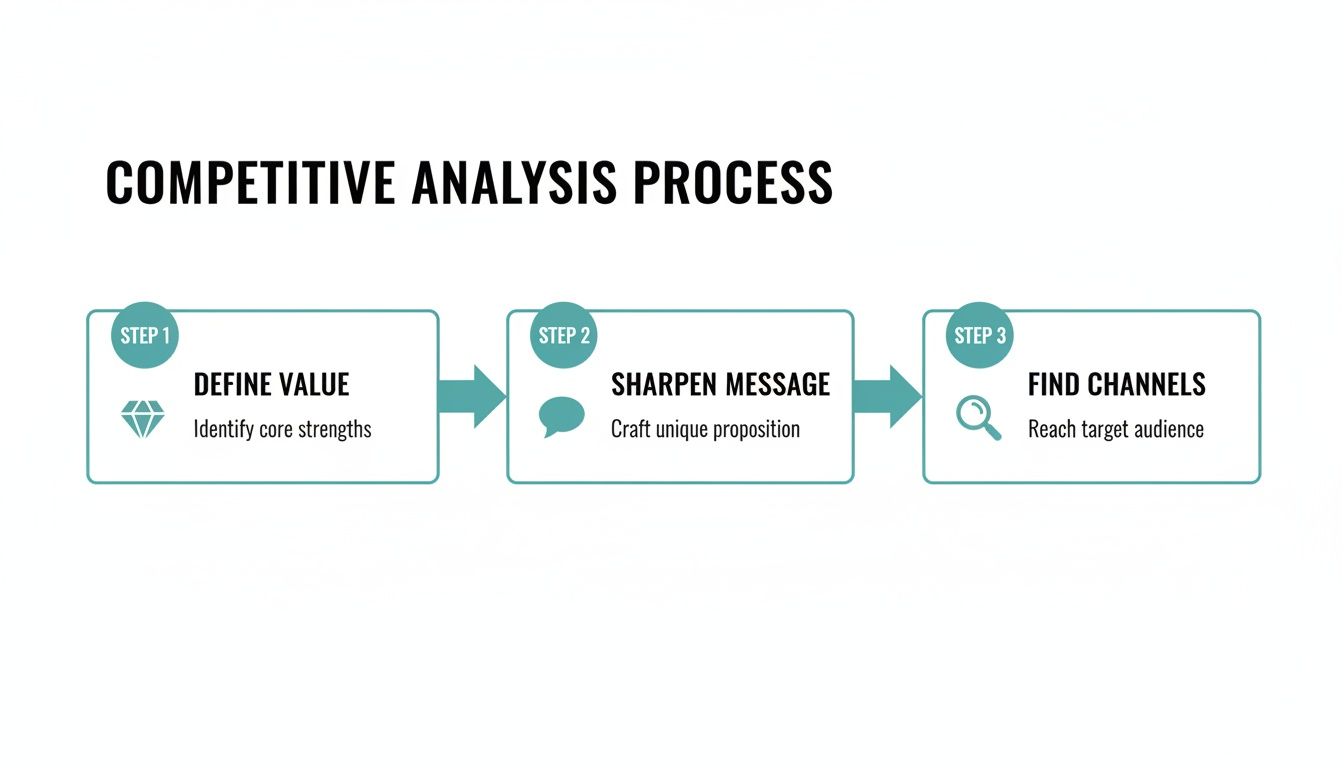
It’s a logical flow: define your value, figure out how to talk about it, and find the best places to deliver that message.
The Three Core Questions
Your entire competitive analysis should be built to answer these three questions. Honestly, if an activity doesn't help answer one of them, it's a waste of your limited time.
What is our unique value? You need to know exactly where you fit in the market. This isn't just about features; it's about the specific pain you solve better than anyone else. You're looking for that sweet spot where customer needs and competitor weaknesses overlap.
How do we sharpen our message? Once you've nailed your unique value, you have to communicate it. By analyzing competitor ad copy, landing page headlines, and social posts, you see what language already connects with your target audience. This is your shortcut to crafting a brand voice that actually gets noticed.
Where can we find our customers? You can have the best product and the sharpest message, but it's all for nothing if you're invisible. Analyzing where competitors get their traffic and mentions uncovers proven acquisition channels. Are they killing it with SEO? Building a community on Reddit? Is there a paid ad strategy that's clearly working?
At its core, competitive analysis is about pattern recognition. You're looking for the patterns in your competitors' successes and failures to create a smarter, more efficient marketing playbook for your own startup.
This approach turns analysis from a passive research project into an active tool for growth. It ensures every piece of data you collect is tied directly to a strategic outcome.
How to Identify Your Actual Competitors
It’s easy to get tunnel vision. So many founders I talk to fixate on the big, obvious rivals. But here’s the thing: you don’t decide who you compete against. Your customers do. And if you’re only looking at companies that look just like yours, you’re missing most of the picture.
A proper competitive analysis in marketing means mapping the entire battlefield. To get this right, you have to categorize your rivals. It brings much-needed clarity.
We break them down into three groups:
- Direct Competitors: The obvious ones. They offer a nearly identical product to the same audience. For us at BillyBuzz, these are other Reddit monitoring tools.
- Indirect Competitors: This is where it gets interesting. These companies solve the same problem with a different solution. Think of a marketing agency that offers manual Reddit monitoring services—they're an indirect competitor to our automated software.
- Aspirational Competitors: The brands you admire. They might not be in your direct space, but they are crushing an area you want to own, like content marketing or community building. We study them to get a blueprint for what excellence looks like.
Uncovering Competitors with Search Operators
Okay, before you can start sorting, you need a list. We always start with Google, using specific search operators to find what people search for when they're actively looking to buy or switch.
Here are the go-to search strings we use at BillyBuzz:
intitle:"alternative to [direct competitor]""[competitor name] vs""better than [competitor name]""[competitor name] reviews"
These queries instantly pull up comparison articles, heated forum discussions, and review sites. Just like that, you have a raw, unfiltered list of companies your target audience is already comparing.
This isn’t just a startup exercise; it’s a core business function. The U.S. Small Business Administration even points out that assessing market share and indirect rivals is fundamental to finding your own opportunities.
Our Playbook for Finding Competitors on Reddit
Google is a solid starting point, but the real gold is on Reddit. You have to find out who your customers truly see as your competition, in their own words.
We don't just browse aimlessly. We have a system. We use our own tool, BillyBuzz, to set up alerts for specific phrases that tell us a user is deep in the buying process.
Every time we see a "[Competitor A] vs [Competitor B]" mention on Reddit, we treat it like a high-priority signal. It's a real person, actively weighing their options, and giving us a live, user-centric view of the competitive landscape.
Our team keeps a close eye on subreddits like r/SaaS, r/marketing, and r/startups. Here’s a peek at the exact alert rules we use inside BillyBuzz to dig up competitors:
| Alert Trigger | Subreddit(s) | Why It's Valuable |
|---|---|---|
[competitor] vs |
r/SaaS, r/startups | Directly captures users comparing solutions, revealing our true direct and indirect competitors. |
alternative to [competitor] |
r/marketing, r/entrepreneur | Finds users who are actively unhappy and looking to switch, highlighting competitor weaknesses. |
"[pain point keyword]" tool |
r/sales, r/PPC | Uncovers discussions about the problems we solve, often leading to mentions of niche competitors we hadn't considered. |
This isn’t just about adding names to a spreadsheet. It’s about understanding the context of the conversation. What features are they comparing? What frustrations are pushing them to find an alternative? That intel feeds directly into our product roadmap and marketing messages.
Build Your Intelligence Gathering Toolkit
Once you know who you're up against, it's time to build your listening post. Raw data is noise until you have a system to collect and analyze it. This isn't about splurging on expensive tools; it's about piecing together a lean, effective intelligence machine.
At BillyBuzz, we focus our energy on three core areas: SEO, social listening, and product/messaging analysis. Nail these, and you’ll know almost everything you need to make your next move.
Uncovering SEO and Content Opportunities
Think of your competitors' SEO strategy as a public playbook. You can see which keywords they're chasing, what content is earning them backlinks, and where their traffic is coming from. The goal isn't to copy them—it's to find the gaps they've missed.
We start by digging into two things:
- Content Gaps: What high-intent keywords are they ranking for that you aren't? This is low-hanging fruit for your content calendar.
- Backlink Profiles: Where are they getting mentioned? A backlink from a respected site is a massive vote of confidence. It hands you a ready-made list of publications and blogs that already trust players in your space.
The BillyBuzz Way: A Deep Dive into Social Listening
This is our bread and butter. Many companies see social media as a place to shout their message. We see it as the world’s largest, most honest focus group. For us, that means going deep into places like Reddit, where people are candid and unfiltered.
We do more than just search for our brand name. We’ve built a sophisticated alert system that monitors conversations around competitor pain points, feature requests, and complaints. This is how we turn competitive analysis in marketing from passive research into an active lead-gen engine.
Here’s exactly how we set up alerts for a hypothetical competitor, "SocialListenCo":
- Competitor Mention + Negative Sentiment: An alert for
SocialListenCoalongside keywords likefrustrating,confusing,expensive, ordoesn't work. This is a neon sign flashing "unhappy customer." - "Alternative to" Queries: We monitor
alternative to SocialListenCoorSocialListenCo vsin key subreddits liker/SaaS. These people are in the final stages of making a decision. - Feature Request Monitoring: We track keywords for features we offer that they don’t. An alert for
"SocialListenCo" + "Reddit alerts"immediately surfaces users feeling a specific pain we can solve.
Our goal with social listening is to find the moment of need. When someone publicly vents their frustration with a competitor, it’s the perfect, most authentic opportunity to step in with a helpful solution, not a hard sales pitch.
This entire process is getting supercharged by new tech. With 92% of businesses planning to invest in generative AI, the game is changing fast. At BillyBuzz, our own AI relevancy scoring is the secret sauce; it filters conversations by sentiment and competitor mentions to spot opportunities a human would almost certainly miss.
Dissecting Product and Messaging
Finally, you have to get your hands dirty and understand how your competitors present themselves. This means looking beyond their glossy homepage.
On a regular basis, our team will:
- Sign up for their free trial. We go through their entire onboarding flow. Is it easy? What features do they push you toward first?
- Analyze their pricing page. A pricing page tells you who a company thinks its ideal customer is. Are they gunning for small businesses or enterprises? This reveals their entire market positioning.
- Deconstruct their ad campaigns. Tools like the Meta Ad Library are a goldmine. You can see the exact ads your competitors are running, letting you study their headlines, imagery, and value props.
To pull all this off, you need the right tools. There are tons of best competitive analysis tools for marketers out there, but you don't need all of them.
The BillyBuzz Competitor Analysis Toolkit
Below is the lean toolkit we actually use at BillyBuzz. This is our core stack—perfect for a scrappy team that needs maximum impact on a tight budget.
| Data Category | Our Go-To Tool | Why We Use It (The 'Get-It-Done' Feature) | Cost Level |
|---|---|---|---|
| SEO & Content | Ahrefs | Content Gap analysis: Instantly shows keywords competitors rank for that we don't, giving us a clear content roadmap. | $$ |
| Social Listening | BillyBuzz (of course!) | AI Relevancy Scoring: Filters Reddit conversations by sentiment and pain points, delivering high-intent leads directly to Slack. | $ |
| Ad Campaigns | Meta Ad Library | Creative Analysis: Lets us see every ad a competitor is running on Facebook and Instagram, revealing their core messaging angles. | Free |
| Product Onboarding | FullStory / Loom | User Session Replays: While we use this for our own UX, reviewing competitor flows manually with Loom recordings helps dissect their user journey. | $-$$ |
This stack gets us 90% of the way there. If you're looking to explore more advanced options, especially on the AI front, we put together a guide on our other favorites: 10 AI tools for competitor analysis in 2024.
Translate Raw Data into a Cohesive Strategy
An unorganized pile of data is just noise. The intelligence you've gathered is useless until you connect the dots and turn it into a simple, coherent plan that shows you exactly where to attack.
The goal isn't to create a 50-page report nobody will read. It's to build a one-page summary that becomes your marketing team's north star. This process is about moving from "what are they doing?" to "what should we do next?"
At BillyBuzz, we don't get bogged down in complex frameworks. We use a few simple tools to synthesize our findings quickly, ensuring our competitive analysis in marketing translates directly into action.

Building Your Competitor Grid
The first step is to get everything onto a single page. A Competitor Grid is perfect for this. But we skip the typical feature-for-feature comparison—that’s a product team's job. Our grid is purely focused on marketing execution.
It maps your efforts against your top three to five competitors across the channels that matter most.
A well-built competitor grid doesn't just show you data—it tells a story. It reveals who is winning the conversation on social, who is dominating search, and, most importantly, where the undefended territory lies.
Here’s a simplified version of the grid we use. It’s designed to be filled out quickly and spark immediate discussion.
Actionable Competitor Grid Template
A simple grid like this is the fastest way to visualize the competitive landscape. It cuts through the noise and puts everyone on the same page.
| Competitor | Primary Marketing Channel | Core Value Proposition | Perceived Target Audience | Key Opportunity/Weakness |
|---|---|---|---|---|
| Your Company | [e.g., Reddit Marketing] | [e.g., AI-driven lead gen] | [e.g., SaaS Founders] | [e.g., Strong community, low brand awareness] |
| Competitor A | [e.g., SEO/Content] | [e.g., All-in-one platform] | [e.g., Enterprise Marketing Teams] | [e.g., High authority, but slow to innovate] |
| Competitor B | [e.g., Paid Social] | [e.g., The cheapest option] | [e.g., SMBs with no budget] | [e.g., Aggressive ads, poor customer support] |
Filling this out forces you to articulate what you’ve learned. The "Key Opportunity/Weakness" column is where the magic happens. This is where you note things like, "Competitor B's customers constantly complain about support on Reddit," which is a clear signal for your messaging.
For those looking to create more visual summaries, we’ve put together some resources you might find helpful. Check out our guide on custom visual templates to simplify data overload.
Conducting a Streamlined SWOT Analysis
Next, we run a quick, marketing-focused SWOT analysis (Strengths, Weaknesses, Opportunities, Threats). Again, the key is to keep it lean and actionable. We're not analyzing the entire business, just our marketing position.
- Strengths: What are we uniquely good at? Maybe it's our deep expertise in a niche like Reddit, or our authentic brand voice.
- Weaknesses: Where are we getting beaten? Perhaps our domain authority is low, or we lack the budget for large-scale paid campaigns.
- Opportunities: What gaps did we find? Examples: "Competitor A ignores early-stage startups," or "No one is creating content around [specific customer pain point]."
- Threats: What external factors could hurt us? This could be a new competitor entering the space or a platform algorithm change.
This exercise shouldn't take more than an hour. The output is a clear list of advantages to lean into and vulnerabilities to address.
Mapping Your Competitor's Messaging
The final piece is understanding how your competitors talk about themselves. What words do they use? What benefits do they emphasize? We use a simple 'Messaging Map' to visualize this.
It's essentially a mind map where we chart the core themes and emotional hooks each competitor uses in their ad copy and on their homepage. For example, does Competitor A focus on "saving time," while Competitor B hammers "reducing costs"?
This map helps us identify the overused clichés in our industry and carve out a unique space for our own voice. If everyone else is shouting about "efficiency," we can win by talking about "discovery."
Turn Your Insights into Marketing Action
All the data in the world means nothing if it sits in a spreadsheet. Your competitive analysis should be a living document that fuels your marketing engine. At BillyBuzz, our analysis isn't done until we have a concrete list of testable hypotheses. This is where research turns into revenue.
How to Prioritize Your Marketing Experiments with ICE
Once you’ve got a list of opportunities—a content gap, a customer complaint you can solve—how do you decide where to begin? We use a dead-simple framework called ICE: Impact, Confidence, and Ease.
It’s a quick scoring system (1-10 for each) that cuts through the noise.
- Impact: If this works, how much will it move the needle on our main goal (like signups or leads)?
- Confidence: Based on the data, how sure are we that this will succeed?
- Ease: How much time and effort will this take to launch?
Just multiply the three scores (I x C x E) to get a priority score. The ideas with the highest scores get worked on first. It’s a beautifully simple way to kill "analysis paralysis."
Your competitive analysis is only as valuable as the experiments it generates. Don't just collect data; use it to build a backlog of smart, data-informed tests that can systematically grow your business.
From a Reddit Insight to a 30% CTR Spike
Here's a real-world example.
While monitoring Reddit, our alerts flagged a thread where users were roasting a competitor's complex UI. We saw multiple people saying they "gave up" during onboarding.
At the time, all of our ad messaging was focused on "powerful features." That Reddit thread was a lightbulb moment. We were selling the what, but the market was screaming about the how.
Our experiment was simple:
- Hypothesis: Swapping our ad copy from "Powerful AI Monitoring" to "Reddit Monitoring in 5 Minutes" will resonate better with users fed up with competitor complexity.
- ICE Score:
- Impact: 8 (could seriously improve our lead quality)
- Confidence: 9 (we had direct evidence from customer complaints)
- Ease: 10 (just changing a few lines of ad text)
- Result: We launched the A/B test. The new "simplicity-focused" messaging had a 30% higher click-through rate (CTR). This one insight, found through diligent competitive analysis in marketing, led directly to more efficient ad spend and better-qualified leads.
Turning Competitor Pain into Your Leads
Sometimes, the opportunity is even more direct. When we spot users on Reddit actively complaining about a specific competitor weakness that we solve, we have a template ready to go. This turns analysis into lead generation in real-time.
This isn't about spamming. It's about showing up with a genuinely helpful solution at the exact moment someone needs it.
Our Go-To Reddit Response Template
Here’s the template we've honed for jumping into these conversations. The key is to be helpful, not salesy—critical for building trust on Reddit.
"Hey [Username], saw you were running into issues with [Competitor Pain Point]. That can be super frustrating. A few others in [Subreddit] have mentioned that before.
If you're looking for an alternative that handles [Our Solution], you might find our approach useful. We built BillyBuzz specifically to solve that problem.
No pressure at all, but thought it might help. Happy to answer any questions if you have them!"
This approach positions us as a helpful resource, not a pushy salesperson. It acknowledges their frustration, provides social proof, and offers a gentle path toward a solution. It's been a fantastic, low-cost way to get in front of high-intent users. For more ideas on this front, check out these top strategies to boost your startup's visibility online.
Your Questions, Answered
Even with the best playbook, questions come up once you start digging. Let's tackle the most common ones we hear from founders.
How Often Should I Be Doing This?
Competitive analysis isn't a "set it and forget it" task. The market moves too fast. Think about it on two timelines: the deep dive and the ongoing pulse check.
Do a full analysis quarterly. This is your chance to step back, reassess the landscape, and inform your strategy for the next three months.
But you also need a daily pulse check. This is a habit of monitoring mentions, new ad campaigns, or customer reviews. Automated alerts are your best friend here, keeping you in the loop without you having to manually stalk everyone.
Your quarterly deep dives are for refining strategy. Your ongoing monitoring is for informing daily tactics.
What are the Most Common Ways People Mess This Up?
It’s easy to get this wrong. We've made these mistakes ourselves.
Here are the three biggest traps founders fall into:
- Direct Competitor Tunnel Vision: Only looking at companies who sell the exact same thing is a huge mistake. Your indirect and aspirational competitors are often where the most interesting insights are hiding.
- Analysis Paralysis: The whole point is to find something you can act on. Don't get stuck creating the perfect report. If your research doesn't lead to a clear marketing experiment, it was a waste of time. Act on the 80% you know; don't wait for 100% certainty.
- The "Features and Pricing" Fallacy: It's tempting to just create a feature spreadsheet. But how a competitor sells—their brand story, their customer experience—is often far more important than what they sell.
How Can I Do This With a Small (or Non-Existent) Budget?
You do not need expensive enterprise tools. A scrappy approach will get you 90% of the insights you need with a bit more elbow grease.
Here’s a practical, low-budget toolkit:
- Google Alerts: Non-negotiable. Set up alerts for all your competitors' brand names. Also track phrases like "[competitor] alternative." It’s a free way to see where they’re being talked about online.
- Manual Social Browsing: Block out 30 minutes a day to browse relevant subreddits or industry forums. Actively search for competitor names and discussions around the problems you solve.
- Free Tiers of SEO Tools: Most big SEO platforms have free versions that are more than enough to get started. You can easily analyze a competitor's top-performing pages and keywords.
- Become a "Customer": The ultimate free intel. Sign up for every competitor's newsletter. Go through their free trial. Experience their onboarding firsthand. This gives you a ground-level view no tool can replicate.
Paid tools save time, but the raw intelligence is almost always out there for free if you're consistent and know where to look.
Ready to stop guessing and start winning on Reddit? BillyBuzz uses AI to find high-intent conversations and competitor pain points, delivering actionable leads right to your Slack. See how it works.