
Forget the spreadsheets. For us founders, competitive benchmarking isn't about tracking vanity metrics. It's a scrappy, surgical operation to find your rival's unhappy customers and build exactly what they're crying out for. This isn't passive monitoring; it's proactive intelligence, and it's how we find our next big win.
Why Most Competitive Benchmarking Fails Startups
As a founder, your time is your most valuable asset. The old-school approach of analyzing marketing channels, pricing pages, and feature lists is slow and reactive. It tells you where your competitors were, not where the market is going.
The real gold is in the unstructured, brutally honest conversations happening right now in online communities. We've found Reddit is a treasure trove of insights that can directly shape a product roadmap. This is where benchmarking with competitors flips from a chore into a growth engine.

From Reddit Complaint to Roadmap Feature
Here’s a real example from our playbook at BillyBuzz. We were tracking a major competitor in r/SaaS. An alert fired, flagging a new thread where a user was venting about how clunky and slow the competitor's alert system was. They were missing critical mentions because notifications took hours to arrive.
That single comment was all the validation we needed for an internal hypothesis. We immediately pushed the development of our instant Slack and email alerts to the top of our priority list.
Founder-to-Founder Takeaway: The goal isn't copying features. It's listening for the pain your competitors are ignoring and building the solution. Their customer's complaint became one of our key differentiators.
Of course, understanding the nuances of your competitive space is vital. Many common pitfalls can be sidestepped by following a solid founder's guide to competitive landscape analysis before you start digging into specific tactics like this.
This shift—from broad analysis to surgical, insight-driven action—is what separates the winners from the "me-toos." You can dive deeper into this mindset in our ultimate guide to competitor analysis for emerging businesses.
Setting Benchmarking Goals That Actually Drive Growth
Before you dive in, know what you're aiming for. Without a clear target, you're just collecting data. A fuzzy goal like "improve brand awareness" is a wish, not a plan. You have to be surgically precise.
At BillyBuzz, we skip the vanity metrics. We’re obsessed with KPIs that directly inform our product roadmap, sharpen our marketing messages, and give our sales team an edge.
Our Core Benchmarking KPIs
We don't try to boil the ocean. We zero in on a few key metrics that give us the best signal-to-noise ratio. Here’s what we track internally:
- Share of Voice in Key Subreddits: We measure our brand's slice of the conversation against our top 2-3 competitors in high-value communities like
r/SaaS,r/marketing, andr/startups. If our share of voice is climbing, our content and engagement are hitting the mark. - Sentiment Shift During Product Launches: When a competitor rolls out a new feature, we immediately track the community's reaction. Is the sentiment positive, or are people complaining about bugs? This tells us how the market is really receiving their update.
- Feature Gap Identification Rate: This is pure gold. We count the number of actionable feature gaps we spot in user complaints about rivals each month. A comment like, "I just wish Competitor X did this," is a direct line into your potential customer's brain.
This isn't about creating reports. It's about building a direct feedback loop from your competitor's unhappy customers straight to your product team. Every complaint is a free piece of market research.
Tying Goals to Business Outcomes
Every goal needs a "so what?" attached. If you can't connect a KPI to a real business outcome, don't track it. It's that simple.
To keep ourselves honest, we use a simple framework. This table connects the dots between the metric, what it tells you, and what you can do about it.
Actionable KPIs for Competitor Benchmarking
| KPI | What It Measures | Why It Matters for Startups | Example Tool/Method |
|---|---|---|---|
| Share of Voice | Your brand's percentage of the conversation vs. competitors. | Indicates brand awareness and market presence in key channels. | Social listening tools like BillyBuzz or Brand24. |
| Sentiment Analysis | The ratio of positive, negative, and neutral mentions. | Gauges public perception and identifies competitor weaknesses. | NLP-powered sentiment analysis in monitoring tools. |
| Engagement Rate | Likes, comments, and shares on competitor content. | Shows what content resonates with your target audience. | Manual tracking or social media analytics platforms. |
| Feature Gap Analysis | Mentions of features your product has but competitors don't (or vice versa). | Directly informs your product roadmap with validated user needs. | Reddit/forum monitoring; customer feedback platforms. |
| Pricing Mentions | How customers discuss your and your competitors' pricing. | Reveals perceived value and potential pricing advantages. | Keyword searches in social listening or community forums. |
This forces accountability and turns passive data collection into an active growth strategy. You'll stop asking, "What are our competitors up to?" and start asking, "How can we use what our competitors are doing to get ahead?"
How We Identify and Track Competitors on Reddit

Choosing who to benchmark against is critical. I’ve seen two-person startups waste hours tracking a Fortune 500 company. It’s a classic mistake.
At BillyBuzz, we don’t monitor everyone. We zero in on a small, curated list to get the clearest view of the landscape.
Our Competitor Selection Framework
We keep our list tight to avoid analysis paralysis. Our list always includes:
- Two or three direct competitors: The companies solving the exact same problem for the exact same audience. We need to know every complaint their customers have.
- One aspirational brand: A company we admire, often in an adjacent space. We watch them for inspiration on marketing and brand voice, not feature-by-feature comparisons.
This keeps our benchmarking with competitors focused on what matters: understanding immediate threats and learning from the best.
Setting Up Our Automated Intelligence Engine
Once we know who to track, we automate the how. Manually scouring Reddit is a brutal time sink. We use our own tool, BillyBuzz, to build an automated intelligence engine.
Here’s our secret sauce: we create specific alert rules combining competitor names with keywords that signal user frustration or purchase intent.
We don’t just track brand names. We track intent. "Competitor X" is interesting, but "Competitor X alternative" is a lead knocking on our door.
Here’s a look at an actual alert we have running inside BillyBuzz.
Our BillyBuzz Alert Setup:
- Keywords:
“Competitor A” OR “Competitor B” - Must include one of:
alternative OR vs OR slow OR hate OR expensive OR complaint OR issue - Subreddits:
r/SaaS, r/marketing, r/startups, r/smallbusiness - Notifications: Send to our
#intel-feedSlack channel instantly.
This turns Reddit into a proactive source of competitive intelligence. Instead of us hunting for insights, the insights come to us. You can set up Slack alerts for Reddit mentions in about 10 minutes to build a similar system.
With the explosive growth of the social media analytics market, startups that can turn this firehose of data into actionable insights will be the ones who win.
Analyzing Data to Find Your Competitive Edge
Collecting data is only half the battle. Raw mentions are just noise until you figure out what they mean.
At BillyBuzz, we immediately categorize every alert to understand the story the market is telling us. A word of caution: it's easy to get led astray by misleading statistics, so it's critical to make sure the insights you're pulling are genuinely accurate.
How We Categorize Competitive Mentions
Every alert that comes through our system gets tagged. This transforms a chaotic stream of notifications into an organized intelligence database.
Our core categories are simple and built for action:
- Feature Gaps: Any comment like, "I wish Competitor X could do Y." This is a direct signal to our product team.
- Pricing Complaints: Mentions of rigid contracts, confusing tiers, or high costs. This is gold for positioning our own offers.
- Positive Sentiment: When users rave about a competitor, we analyze what they're doing right to see what we can learn.
- User Success Stories: Concrete examples of customers hitting a major goal using a rival's product. This helps us understand the real "jobs-to-be-done" in our market.
This structured approach makes sure every piece of data has a purpose. It’s a huge part of effective benchmarking with competitors because it forces you to look for recurring themes, not just one-off comments.
A Real-World Example: Pricing Friction
We were tracking a key competitor and noticed a theme bubbling up in r/SaaS. Multiple founders were complaining about their rigid, high-cost annual contracts. They felt locked in and were openly wishing for a more flexible model.
This wasn't a few random complaints; it was a clear pattern. That data was the final nudge we needed to double down on our own flexible monthly plans and starter package for solo founders. Our competitor's weakness became our messaging strength.
Founder-to-Founder Tip: Don't just read the mentions—count them. A simple tally like "12 pricing complaints for Competitor A this month" turns anecdotal feedback into a trend you can't ignore.
This is the essence of moving from monitoring to true analysis. With the social media listening market valued at $9.15 billion in 2024, this is no longer a niche practice. You can read more about how real-time competitor tracking fuels brand growth. To dig deeper, you can also explore our guide on 10 AI tools for competitor analysis.
Turning Competitive Insights Into Action
An insights report is worthless if it just sits in a folder. The most important part of benchmarking with competitors is translating intelligence into real-world business actions. This is where you get your ROI.
At BillyBuzz, we’ve built a simple workflow to stop good insights from dying in a random Slack channel. Information is noise until it gets to the person who can do something with it.
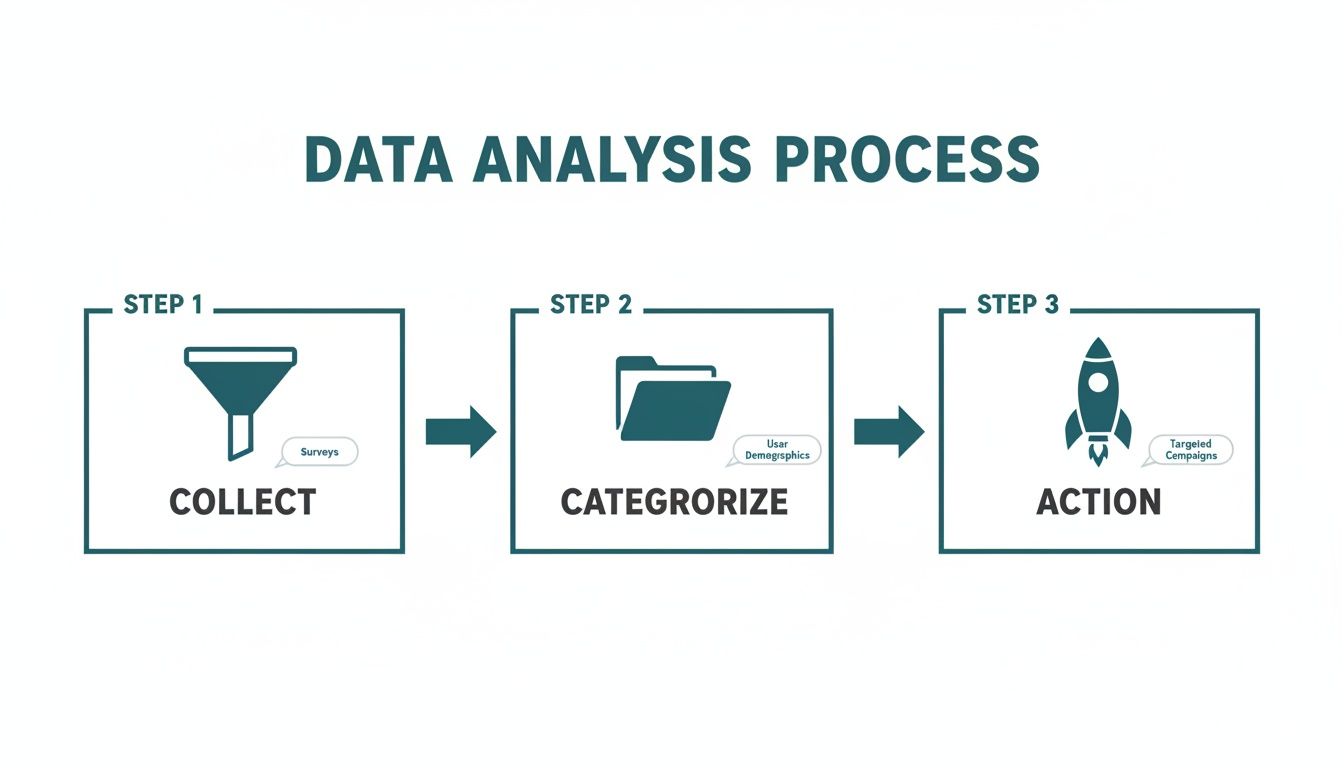
The trick is to treat intelligence as a live feed that flows throughout the company.
Our Internal Distribution Playbook
Different findings demand different responses, so we route them to the teams best equipped to handle them.
Here’s how it works for us:
- Feature Gaps & Requests Go to Product: A comment like "I wish Competitor X had an integration with Salesforce" gets zapped straight to our product manager. These raw customer quotes are a thousand times more valuable than another brainstorming session.
- Messaging Angles Go to Marketing: A thread where users tear apart a competitor's confusing pricing is gold for marketing. It hands them the exact words real people use to describe their frustrations.
- Churn Signals Go to Sales: If someone publicly announces they're ditching a competitor, our sales team gets the heads-up. It's about understanding why they're shopping for an alternative so our team can lead with a solution.
How We Engage Directly on Reddit
When we find a user talking about a competitor's flaws, we have a specific, non-pushy way of jumping in. The goal is always to be helpful, not to hard-sell.
Here’s our go-to response template, which we adapt for the situation:
Hey [Username], saw you were running into issues with [Competitor's Pain Point]. That can be super frustrating.
We actually built BillyBuzz to solve that exact problem by [our solution, e.g., 'providing real-time alerts so you never miss a conversation'].
Not trying to sell you anything here, just thought I’d share in case it’s helpful. Happy to answer any questions if you have them!
This positions us as a helpful resource, not an aggressive vendor. It builds credibility and turns a competitor's weakness into a chance for us to show our value.
Frequently Asked Questions
As founders ourselves, we get asked a lot about how to make competitive benchmarking practical. Here are some straight answers to the questions we hear most often at BillyBuzz.
How Often Should My Startup Benchmark Competitors?
We use a hybrid approach. Continuous, passive monitoring for qualitative signals—the day-to-day chatter from our real-time Reddit alerts. This is how you spot a customer complaint you can solve instantly.
Then, for the more structured KPIs like Share of Voice, we do a formal review on a quarterly basis. This keeps you nimble enough to react daily but also gives you a strategic, long-term view without getting buried in spreadsheets.
What Are the Biggest Mistakes to Avoid in Benchmarking?
I see founders make the same three mistakes over and over.
- Analysis Paralysis: Collecting data but never doing anything with it. The entire point is to make a decision and take action.
- Tracking Vanity Metrics: Getting distracted by numbers like follower counts that don't connect to revenue or product adoption. Stick to KPIs with a clear line to business goals.
- Becoming a Copycat: Benchmarking isn't mimicry. The goal is to find their weaknesses, understand unmet needs, and build something fundamentally better, not just a replica.
The biggest mistake is collecting endless data without taking action. An insight is only valuable if it leads to a decision.
Can I Do Competitive Benchmarking on a Small Budget?
Absolutely. A tight budget forces you to be smarter and more focused.
Forget the giant, all-in-one market intelligence suites. Get surgical. Pick the channels where your customers are having the most honest conversations—for many of us in tech, that's Reddit.
A targeted tool like BillyBuzz can give you deep insights from those specific communities for a fraction of the cost. Pair that with free tools like Google Alerts and a quick manual check of a few key social media profiles each week. Smart, focused effort always outperforms a bloated, unfocused budget.
Ready to turn competitor complaints into your next big win? BillyBuzz gives you the real-time Reddit insights you need to get ahead. Start monitoring your competitors for free today.