
Think of a social media community manager as your brand's direct line to customers. This isn't about blasting out content. It's about building relationships and turning online chatter into tangible brand value by listening, engaging, and adding value.
As a founder, I learned that a good community manager isn't a marketer; they're an intelligence operative and a relationship builder, rolled into one. They are your eyes and ears on the ground, proactively finding conversations that matter.
What a Social Media Community Manager Actually Does

Let's get straight to the point: this role isn't about scheduling posts. A social media manager broadcasts; a community manager engages. They are the bridge between your company and your audience, creating a space where people feel heard.
Their primary goal is to foster a sense of belonging that turns followers into advocates. For a founder, this is mission-critical. It generates raw customer feedback and genuine loyalty—assets far more valuable than likes.
Beyond Broadcasting to Building Relationships
A marketer pushes messages out. A community manager pulls people in. They spend their days in the digital trenches, finding conversations about your industry, your competitors, and the problems your product solves.
How we do it at BillyBuzz: Our community manager acts as a proactive intelligence gatherer. We don't wait for brand mentions. We're actively searching subreddits and forums, adding value to discussions long before a sales pitch is even considered.
This approach changes the game. You stop being another company shouting into the void and become a trusted resource.
The Strategic Value of Listening
A great community manager knows listening is more powerful than talking. They monitor discussions for sentiment, trends, and customer frustrations, creating a feedback loop that informs product development and marketing.
Their work breaks down into a few key areas:
- Proactive Engagement: Searching for and joining relevant conversations on platforms like Reddit, LinkedIn, or niche forums.
- Relationship Nurturing: Building rapport with key influencers, brand advocates, and even vocal critics.
- Feedback Synthesis: Translating raw online chatter into actionable insights for the product, marketing, and sales teams.
- Community Cultivation: Fostering a welcoming environment where members feel safe sharing ideas.
Knowing how to build an online community that thrives is the foundation. Ultimately, this role elevates social media from a marketing channel into a strategic asset that drives retention, generates organic leads, and builds a resilient brand. It's an investment in relationships, not just reach.
The Daily Playbook of a High-Impact Community Manager
Forget aimless scrolling. A high-impact community manager runs a disciplined, strategic routine built around finding and joining the right conversations at the right time. It's about proactively shaping your brand’s story from the inside out.
The day is broken into three core blocks: morning check-in, mid-day engagement, and end-of-day wrap-up. This rhythm ensures every action ties back to business goals, not vanity metrics.
With 5.17 billion people on social media, the noise is deafening. According to the latest social media statistics, connecting with an audience that spends nearly two hours and forty minutes scrolling daily requires precision, not volume.
Morning Rituals: Monitoring and Triage
The first hour sets the tone. It's a surgical scan of all channels to gauge the community's pulse, spot overnight developments, and identify urgent issues.
How we do it at BillyBuzz: Our morning starts in Slack, where we get real-time alerts. Our system scans Reddit for specific keywords, competitor mentions, and problem-based discussions. This delivers only high-intent conversations to our manager, cutting through the noise.
This initial sweep prioritizes the day's tasks. A customer complaint? An influencer mention? A new thread blowing up in a key subreddit? These get addressed first.
Mid-Day Sprints: High-Value Engagement
The middle of the day is for focused "engagement sprints." This isn’t about replying to every mention. It's about strategically placing your brand in conversations where you can add genuine value. Quality over quantity, always.
A single thoughtful, detailed reply in a Reddit thread where a user compares your product to a competitor's is worth more than a dozen likes. This is where expertise shines.
Here’s what these sprints typically involve:
- Content Curation: Finding and sharing genuinely helpful articles, case studies, or user-generated content.
- Conversation Moderation: Keeping discussions on track and positive.
- Amplifying User-Generated Content (UGC): Finding and celebrating great posts from customers—the best social proof.
- Customer Support Triage: Handling simple questions and routing technical issues to the right team.
End-of-Day: Reporting and Planning
The final hour is for reflection and preparation. Log key interactions, note shifts in community sentiment, and measure results. A simple end-of-day summary provides useful insights for the entire team.
This is also the time to prep for tomorrow. What content needs creating? What conversations need a follow-up? This forward-thinking approach turns the role from reactive to a strategic driver of growth.
5 Essential Skills and Tools for Today's Community Manager
A great social media community manager is part artist, part scientist. They need the empathy of a diplomat and the analytical mind of a data scientist. Soft skills build the relationships; hard skills prove the value.
You need empathy to understand a frustrated customer and crisis management to handle a snowballing complaint. You also need punchy copywriting to grab attention and solid data analysis to show how your work helps the business grow.
This image gives you a glimpse into how these skills fit together throughout a typical day, from the morning check-in to wrapping up with strategy.
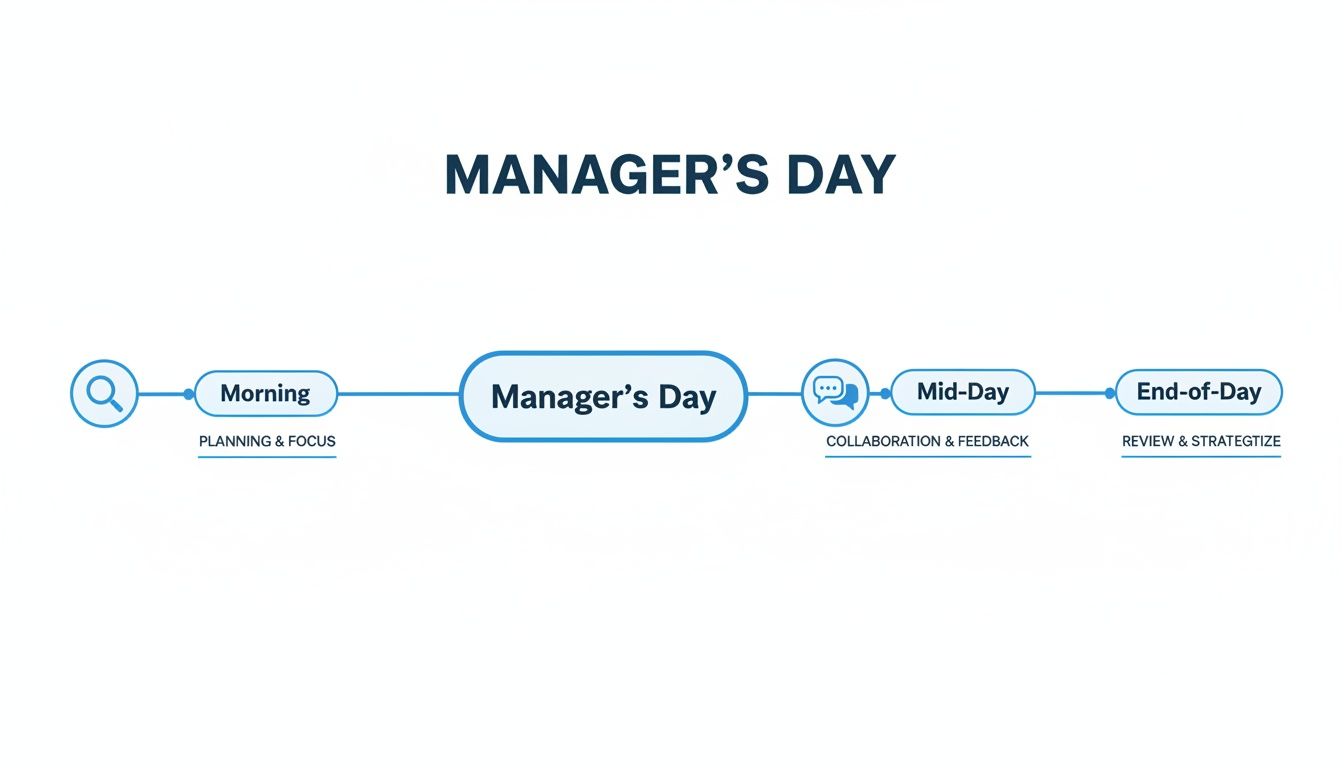
It's a structured rhythm. A community manager constantly moves from listening and engaging to analyzing and planning, using different skills at every step.
The Modern Community Manager's Toolkit
Managing a community without the right tools is like trying to build a house with only a screwdriver. Automation isn't a "nice-to-have"; it's essential for scaling your efforts and focusing on what matters—building relationships.
The right tools help you zero in on the conversations that move your business forward. It's about working smarter.
How we do it at BillyBuzz: We built our platform because founders don't have time to hunt for leads. Our philosophy is simple: let the machine find the conversation so you can bring the human touch to the response.
This shifts the role from reactive to proactive growth driver.
Here’s a look at how different tools stack up and where automation really shines.
Community Manager Toolkit Breakdown
| Tool Category | Example Tools (Manual Focus) | AI-Powered Alternative (e.g., BillyBuzz) | Primary Benefit of Automation |
|---|---|---|---|
| Monitoring | Google Alerts, TweetDeck, Manual Reddit Searches | BillyBuzz, Brandwatch | Filters out 90%+ of noise by scoring leads on intent, not just keywords. |
| Engagement | Hootsuite, Sprout Social (for scheduling & replies) | Tools with smart inboxes that prioritize urgent messages | Surfaces critical customer issues or high-value leads first. |
| Analytics | Native platform analytics (e.g., Meta Business Suite) | Platforms with sentiment analysis and trend reporting | Identifies community sentiment shifts automatically; no manual data crunching. |
The takeaway is clear: automated systems give you back your most valuable asset—time—so you can focus on genuine, high-quality interactions.
A Look Inside Our Own BillyBuzz Workflow
As founders, we live this every day. We use BillyBuzz to monitor Reddit with a precision that would be impossible manually. Our AI sifts through conversations to find what really matters for a startup.
Here’s our exact monitoring setup:
- AI Relevancy Filters: We don’t just track "social monitoring." Our system scores conversations based on buying intent, frustrations with competitors, or problems our tool solves. This cuts out 90% of irrelevant chatter.
- Targeted Subreddits: We focus on communities where our audience gathers, like r/SaaS, r/startups, and r/marketing, avoiding broad, noisy subreddits.
- Real-Time Slack Alerts: The moment a high-potential conversation appears, our #community-mentions Slack channel gets an alert with a summary and a direct link.
This system lets us jump into relevant discussions in minutes, not hours. The goal is always to add value first. We offer help and insights before ever mentioning our product. That’s how you build trust. If you're curious about other ways to set up your workflow, check out our guide on the top social monitoring tools for startups in 2024.
This blend of automated discovery and fast, human engagement is the core of our community strategy. It saves us time and ensures we never miss a chance to connect.
Our Playbook for Turning Reddit into a Startup Growth Engine
Most founders are terrified of Reddit. We see it as an untapped goldmine for genuine connection, but only if you respect the community and play by its rules. This is the internal playbook we've used to make Reddit a reliable source for leads.
The secret? Stop broadcasting. Start adding value. Redditors can sniff out a sales pitch from a mile away. You win by listening, zeroing in on real problems, and offering solid advice with no strings attached.
This is critical when you look at the numbers. Engagement rates vary wildly, from 3.70% on TikTok to 0.15% on Facebook. Reddit conversations are harder to measure with standard metrics but are often incredibly focused, creating priceless opportunities. You can see more social media benchmarks on SocialMediaToday.com.
Finding the Right Conversations
You need to know where to look. We ignore huge, general-interest communities and focus our monitoring on niche subreddits where founders and marketers discuss their struggles.
Here are a few of our go-to subreddits:
- r/SaaS: The watering hole for founders talking pricing, churn, and marketing.
- r/startups: Perfect for finding early-stage founders sharing their pain points. "How do you handle X?" threads are gold.
- r/marketing: A great place to spot trends and discussions around lead generation or SEO.
- r/b2b: All about business-to-business sales and marketing, right in our wheelhouse.
We use our own tool, BillyBuzz, to automatically scan these communities for keywords signaling pain points ("find new customers," "competitor pricing"), purchase intent ("best tool for," "alternatives to"), and competitor frustrations ("HubSpot is too expensive," "Brandwatch limitations").
How to Engage Without Sounding Like a Salesperson
How you reply is everything. Your goal is to be the single most helpful person in the thread. We use simple, non-promotional response templates that put value first.
Our Internal Response Template for Reddit:
- Acknowledge and Empathize: Start by showing you get their problem. "Finding early customers is a huge challenge. I've been there."
- Offer Actionable Advice (No Strings Attached): Give them a useful tip they can implement immediately. "One thing that worked for us was focusing on just one or two subreddits and becoming a known expert there before branching out."
- Share a Relevant Personal Experience: Briefly mention how you tackled a similar problem. This builds credibility. "We used to track mentions manually, and it took hours. We learned that focusing on intent was more important than volume."
- Never Pitch Directly: Do not mention your product unless someone explicitly asks. Let your helpfulness do the selling.
This transforms you from a marketer into a trusted advisor. If you provide enough value, people will naturally check out your profile. You can explore this strategy in more detail in our guide on how to get customers from Reddit in 2025.
Setting Up Real-Time Alerts
On Reddit, speed matters. A helpful reply posted an hour after the original comment is ten times more powerful than the same reply posted a day later. This is where automation is a game-changer.
Here's an actual alert rule we use inside BillyBuzz:
- Trigger: New post or comment in
r/SaaSORr/startups. - Filter 1 (Keywords): Contains "lead generation," "find customers," OR "social monitoring."
- Filter 2 (Negative Keywords): Excludes "hiring," "jobs," OR "for sale."
- Action: Send a real-time alert to our
#reddit-leadsSlack channel.
This setup turns Reddit from a time-sucking black hole into a predictable source of leads and lets our community manager be the first to help.
Measuring Success with KPIs That Actually Matter

How do you prove this engagement grows the business? A great community manager knows vanity metrics like follower counts are noise. They track KPIs that connect directly to business goals.
It's about showing how community building drives tangible results, proving the role is a growth driver, not a cost center.
Today, 76% of consumers feel more loyal to brands that actively engage with them. Top marketers now track engagement (68%), conversions (65%), and revenue (57%) to prove ROI. The biggest roadblock, according to a 2026 social media trends report from Power Digital Marketing, is often poor tool integration, which is why it's so important to have systems that link monitoring to reporting.
Beyond Likes and Follows: Core Community KPIs
To show real impact, focus on a handful of metrics that answer the one question every founder has: "Is this working?"
Here’s a quick look at the KPIs we believe truly matter for a social media community manager.
Community Management KPI Dashboard
This dashboard focuses on the key performance indicators that track the real business impact of your community management efforts. Instead of just looking at activity, these metrics measure the outcomes of that activity.
| KPI | What It Measures | Why It Matters | How to Track It |
|---|---|---|---|
| Engagement Rate | The percentage of your audience that interacts with your content. | This shows if your content is actually resonating and if your community is active, not just a group of passive followers. | (Likes + Comments + Shares) / Followers x 100 |
| Sentiment Analysis | The overall tone (positive, negative, neutral) of brand conversations. | It's a direct pulse-check on brand health and customer satisfaction. A negative shift is an early warning sign. | Use a tool like BillyBuzz to get real-time sentiment alerts. |
| Share of Voice (SOV) | Your brand’s mentions compared to your top competitors. | This tells you how much of the conversation in your market you actually own. Are you a leader or a bystander? | (Your Mentions / Total Industry Mentions) x 100 |
| Community Growth Rate | The speed at which your community is adding new members. | This shows if your brand awareness and engagement strategies are actually attracting new people to your ecosystem. | (New Members / Total Members) x 100 |
These metrics shift the conversation from "How many people saw this?" to "How did people react, and what does that mean for our business?"
Connecting Community Activity to Business Results
The final step is to connect these community KPIs to bottom-line business metrics. You have to draw a straight line from your engagement to real-world outcomes.
The most powerful report is a simple story: "This month, we engaged in 50 high-intent Reddit threads. From those conversations, we generated 15 qualified leads and saw a 10% reduction in support tickets for common issues."
Here are a few practical ways to build that connection:
- Qualified Lead Generation: Track how many conversations on platforms like Reddit or LinkedIn lead to demo requests or trial sign-ups using UTM links or a "How did you hear about us?" field.
- Improved Customer Retention: Monitor sentiment in customer-only groups (like a private Slack). A drop in negative comments often correlates with lower churn.
- Reduced Support Costs: When a community manager proactively answers common questions in public forums, it deflects support tickets. Track this to show cost savings.
By focusing on these outcomes, a social media community manager can clearly articulate their ROI. To go deeper on this topic, check out our complete guide on measuring social media ROI with a cost-benefit analysis. This frames community management for what it is: an essential investment in sustainable growth.
How to Hire Your First Community Manager
When hiring your first community manager, look beyond the resume. You're hiring a community architect, not a content scheduler. The most important traits have less to do with marketing and everything to do with genuine human connection.
We look for three core qualities: genuine empathy, strategic thinking, and platform-specific savvy. Empathy is non-negotiable. They must be able to feel a customer's frustration and respond with patience, not a canned script.
Strategic thinking is the ability to see how a single angry comment on Reddit ties back to a major business goal, like lowering churn. And platform savvy means they just get it—the tone that works on LinkedIn will get them torn apart in r/SaaS.
Interview Questions We Actually Ask
Forget fluff questions. We use situational prompts that throw candidates into the fire to see how they think under pressure.
Here are a few questions we’ve found that reveal who can really handle the job:
- To Test Empathy: "An angry customer posts in a popular subreddit, calling our product overpriced and full of bugs. It's starting to get a lot of upvotes. What is your very first move, and what is your word-for-word reply?"
- To Test Strategic Thinking: "You've got exactly one hour a day for proactive engagement. Where are you spending that time, and why? What specific numbers will you track to show me it's worth it?"
- To Test Platform Savvy: "Walk me through how you'd build a positive reputation for our brand in a community like r/startups without ever directly mentioning our product."
These questions don't have a single "right" answer. They peel back the curtain on a candidate's problem-solving process and gut instincts.
Career Growth: From Community Manager to Community Leader
Hiring a community manager is an investment in a future leader. The skills they learn on the front lines—deep customer empathy, crisp communication, and data-driven insight—are foundational for senior roles across the company.
They spend every day listening to your customers. Your star community manager today could easily be your Head of Community, Director of Customer Success, or even a Product Manager tomorrow. Investing in their growth builds a more customer-focused leadership team for the long haul.
A Few Common Questions
Whether you're a founder thinking about hiring your first community manager or a pro looking to step into the role, a few questions always seem to pop up. Let's clear the air on some of the most common ones.
Social Media Manager vs. Community Manager: What's the Real Difference?
It’s easy to get these two mixed up, but their focus is fundamentally different. Think of a social media manager as a broadcaster. Their job is to create and push content out to an audience in a one-to-many fashion.
A social media community manager, on the other hand, is all about fostering conversation. Their work is many-to-many, building a space where customers can talk to each other and feel heard. They aren't just the voice of the brand; they're the voice of the community inside the company.
What’s a Typical Startup Salary for This Role?
Salaries can swing quite a bit based on location and experience. For a startup, you can expect an entry-level community manager to land somewhere between $50,000 and $65,000.
Once someone can prove they're a pro at driving leads and boosting customer retention, that number climbs fast. A seasoned manager can easily command a salary north of $85,000.
What Should a Community Manager Do in Their First 30 Days?
The first month is all about one thing: listening. Before a new community manager even thinks about launching a campaign, they need to become a student of the existing community.
Here’s what their first few weeks should look like:
- Set up listening posts: The very first step is to get monitoring in place. They need to track every mention of the brand, key competitors, and important industry keywords to get a baseline of the conversation.
- Go native: This means diving deep into the community's natural habitats, like key subreddits or industry forums. The goal is to absorb the culture, spot the real influencers, and get a feel for what customers are really talking about.
- Dig into the archives: They should spend time reading through old support tickets and social media comments. This is where the gold is—spotting recurring problems, frustrations, and opportunities that might have been missed.
This initial listening tour is non-negotiable. It builds the foundation for an authentic, effective community strategy. For anyone serious about growing in this space, understanding the broader social media manager career path is a great next step, but it all starts with knowing your people.
Ready to stop manually searching for customers on Reddit? BillyBuzz uses AI to find high-intent conversations and sends them directly to your Slack, so you can focus on building relationships that grow your business. Start finding your next customers today.