

As a founder, you know that PR can't be a "nice-to-have." Every dollar you spend needs to deliver a tangible return, and that means connecting your PR efforts directly to business goals like sign-ups, leads, and SEO authority. This is about proving real, bottom-line value, not just chasing fleeting moments in the spotlight.
Moving Beyond Vanity Metrics in PR

Let's be blunt: most founders get PR measurement wrong because they're following an old, broken playbook. Traditional PR celebrated metrics like impressions, clip counts, and a vague sense of "buzz." For a startup, that's just noise. It’s a fast track to wasting your limited resources.
From one founder to another, your PR has to be an engine for growth. The goal is to build a simple, repeatable system that ties every press release, media mention, and even a viral Reddit comment back to a business outcome. This isn't just theory; it's the framework we use every single day at BillyBuzz.
The Great Divide: Activity vs. Impact
Here's where things often go off the rails. It’s easy to confuse PR activity with actual business impact. Landing a mention in a top-tier publication feels like a huge win, but what did it actually do for you? Did it drive traffic to your website? Did any of that traffic convert? Did it boost your search ranking for a critical keyword?
This isn't a niche problem. A recent survey found that over 50% of communications pros struggle to connect their PR work directly to revenue. They get stuck because they can’t demonstrate ROI beyond the basics.
Founder-to-Founder Takeaway: If you can't draw a straight line from a PR activity to a business goal, you're flying blind. Every single thing you do in PR needs to have a clear "so what?" attached to it.
To get this right, you have to nail your approach to Measuring Marketing Campaign Effectiveness by focusing relentlessly on ROI and attribution.
Focusing on Metrics That Move the Needle
To help clarify this shift, I've put together a table that shows the old way of thinking versus the metrics that actually matter for a growing company.
PR Measurement Shift From Vanity To Value Metrics
| Outdated Metric (Vanity) | Actionable Metric (Value) | Why It Matters For Startups |
|---|---|---|
| Impressions (Reach) | Website Referral Traffic | Shows who actually clicked through from an article, not just who might have seen it. |
| Clip Count | Backlink Quality & Domain Authority | A single high-authority link is worth more for SEO than 100 mentions on low-quality sites. |
| Ad Value Equivalency (AVE) | Lead/Sign-up Attribution | Directly ties a media placement to a new customer or lead in your pipeline. |
| "Buzz" or Social Mentions | Branded Search Volume | Measures if your PR is making people actively search for your brand by name. |
Thinking this way forces a complete change in how you approach PR. Instead of just chasing any mention, you start strategically targeting placements that will deliver one of the value metrics above. This is the key to turning PR from a cost center into a growth channel.
For us, the shift was transformative. We stopped reporting on how many people might have seen our name and started focusing on metrics that signal real intent and business value. It's a concept we explore deeply in our guide on the cost-benefit analysis of social media ROI here: https://www.billybuzz.com/blog/measuring-social-media-roi-cost-benefit-analysis
This mindset ensures our PR isn’t just making noise; it’s building a defensible moat for our business through stronger SEO, qualified leads, and a brand people actively seek out.
Our Internal Framework for Tracking PR Across Channels

Alright, let's pull back the curtain on how we do things at BillyBuzz. Our approach to PR measurement isn't about subscribing to a dozen expensive tools or staring at a complex dashboard no one understands. We run a lean, intentional stack that gives us actionable data without the noise.
We’ve found that breaking our tracking into three core pillars keeps things simple and effective: earned, owned, and social media. This structure helps us see what's actually working so we can double down, fast. As a startup, we can't afford to wait three months for a report to tell us we're off track. We need real-time signals.
Tracking Earned Media with Precision
For us, "earned media" is all about genuine, third-party mentions—the articles, blog posts, and backlinks that we didn't pay for. The goal is to catch these mentions the moment they happen and immediately figure out their SEO value. We automate this whole process with two simple, powerful tools.
- Google Alerts: This is our first line of defense. It’s free, easy, and we’ve set up hyper-specific alerts to catch any new mention of our brand name, key people, or unique product features.
- Ahrefs: This is where we get strategic. We have an alert set to email us about any new backlinks with a Domain Rating (DR) of 30 or higher. This little filter is a game-changer; it cuts out the low-quality noise and makes sure we only focus on links that will actually move the SEO needle.
This two-part system ensures we never miss a significant mention. It also helps us quickly spot which journalists or publications are covering our space, giving us a warm lead for building new relationships.
Mastering Owned Media with UTMs
Every single piece of content we create is an asset, and we track its performance obsessively. This means press releases, guest posts, and even the links in my email signature. The secret sauce to our owned media measurement is the consistent use of UTM parameters.
A UTM code is just a small snippet of text you add to a URL that tells you where your website traffic is coming from. We use them on every single link we put out into the world. This lets us pop into Google Analytics 4 (GA4) and see exactly which press release drove the most sign-ups or which guest post generated the most demo requests.
Our rule is simple: if a link leaves our control, it gets a UTM tag. This non-negotiable step turns vague "referral traffic" into a clear, attributable story about what's driving our growth.
Our Secret Weapon for Reddit PR
This is where we get a serious edge by using our own tool, BillyBuzz. Reddit is an absolute goldmine for authentic conversations and high-intent leads, but trying to track it manually is a nightmare. We've configured BillyBuzz to act as our automated PR scout, filtering thousands of conversations for relevance and opportunity.
Here are the exact AI relevancy filters we have running 24/7 inside our own Slack:
| Filter Type | Configuration Detail | Target Subreddits |
|---|---|---|
| Customer Pain Point | Keywords like "hate," "frustrated with," "alternative to," paired with project management or social monitoring terms. | r/saas, r/marketing, r/startups |
| Competitor Mention | Alerts for direct mentions of our top three competitors, especially when paired with negative sentiment. | r/smallbusiness, r/Entrepreneur |
| Buying Signal | Phrases like "looking for a tool," "recommend a software," "how do I track," within relevant contexts. | r/digital_marketing, r/socialmedia |
These alerts get piped directly into a dedicated Slack channel. When a high-relevance opportunity pops up—like someone in r/saas asking for an alternative to a competitor—our team can jump in with a helpful, non-promotional response within minutes.
This is how we turn social listening into a direct line for lead generation and brand building, a core part of our modern measurement public relations strategy. The framework isn't complicated, but its power comes from its consistency and focus.
Connecting PR Mentions to Real Leads and SEO Value
A media mention feels great, but qualified leads are what actually keep the lights on. This is where the real work of PR measurement begins. We need to move past simply counting mentions and start connecting our PR efforts to tangible business outcomes—a process known as attribution.
At BillyBuzz, we don’t get bogged down with a complex, enterprise-level attribution model. As a small team, we need something simple, clear, and actionable. We run a straightforward multi-touch model that gives credit to PR for its role in the customer journey, even if it wasn't the very last click before someone signed up.
From a Reddit Comment to a Qualified Lead
For us, Reddit is an absolute goldmine. A single, well-placed, genuinely helpful comment can become a lead generation machine. When one of our BillyBuzz alerts goes off—say, someone in r/startups asks for alternatives to a competitor—we don't just swoop in and drop a link. We engage thoughtfully.
Here’s a peek at a real response template we use internally. It’s designed to be helpful first and promotional second, a critical distinction if you want to earn any trust on Reddit.
BillyBuzz Internal Response Template
Goal: Provide genuine value, then offer our tool as a solution.
- Acknowledge and Validate: "Hey [Username], that's a really common frustration. Manually tracking brand mentions across Reddit is a huge time sink, especially when you're trying to filter out all the noise."
- Offer Actionable, Non-Product Advice: "One thing that helped us early on was setting up very specific Google Alerts using boolean operators like
"[your brand]" AND ("review" OR "alternative") site:reddit.com. It's not perfect, but it helps cut down some of the noise for free."- Introduce Your Solution (Soft Pitch): "We actually built BillyBuzz to solve this exact problem for ourselves. It uses AI to find high-intent conversations and sends them right to our Slack, so we never miss an opportunity. Might be worth a look if you're spending more than an hour a week on this."
- Call to Action: "No pressure at all, but feel free to check it out. Happy to answer any questions right here."
This approach turns a simple notification into a real conversation, and those conversations often lead directly to sign-ups. For our own customers—many of whom are startup founders monitoring subreddits—this method proves how our AI's relevancy scoring can filter out junk and deliver alerts on real customer pain points. The proof is in the numbers: 40% of SaaS firms are already measuring leads generated directly from their PR activities.
To give you an idea of how we find these opportunities, here's a look at the exact alert rules we've set up for ourselves inside BillyBuzz.
BillyBuzz Alert Rules We Use Internally
| Alert Type | Keywords/Filters | Target Subreddits | Goal |
|---|---|---|---|
| Competitor Mention | "ahrefs alternative", "mention vs", "brand24 vs" | r/SEO, r/marketing, r/PPC | Intercept conversations, offer a compelling alternative. |
| Problem Aware | "track brand mentions", "social listening tool", "monitor my brand" | r/startups, r/saas, r/smallbusiness | Find users actively looking for a solution like ours. |
| Link Building | "expert roundup", "contribute to article", "journorequest" | r/pr, r/blogging, r/content_marketing | Secure high-quality backlinks and guest post spots. |
| Pain Point | "tired of manual tracking", "too much noise", "google alerts suck" | r/solopreneur, r/digital_marketing | Engage with user frustration and present our tool as the fix. |
These aren't just random keywords; they're precise queries designed to surface high-intent conversations where we can provide immediate value. It's a system that works.
Measuring the Compounding Value of SEO
Beyond direct leads, the most significant long-term value from PR comes from its impact on SEO. We're not just collecting backlinks; we're building a durable competitive advantage that pays off for months and even years. To truly show the impact of PR, it helps to understand the content marketing return on investment, which provides clear metrics that go far beyond just counting mentions.
We focus on three core SEO metrics to track this compounding value:
- Domain Rating (DR) Growth: We keep a close eye on our DR score in a tool like Ahrefs. Every quality backlink from a reputable media outlet gives this score a little boost, signaling to Google that we're a trustworthy authority.
- Referral Traffic from High-Authority Placements: Inside GA4, we have a custom report that filters referral traffic coming only from domains with a DR of 50+. This tells us if our best press hits are actually sending engaged visitors our way.
- Keyword Rankings for PR-Driven Content: When we land a guest post, we immediately start tracking its target keyword. Watching that article climb the search results for a valuable term is a massive win.
Here’s a real-world example. We spotted a high-ranking Reddit thread about social media monitoring challenges. A team member jumped in with a detailed, helpful comment that genuinely solved the original poster's problem, tacking on a soft mention of BillyBuzz at the end.
That single comment, living in a thread that already had Google’s attention, started ranking on page one for a valuable long-tail keyword. For over six months, it drove a steady trickle of highly qualified organic traffic straight to our website—all from a ten-minute engagement. This is the power of combining smart PR with SEO, something we explore in our guide on how social signals influence link building strategies. That’s the kind of ROI founders can actually get excited about.
Building a Simple PR Dashboard Your Team Will Actually Use
Let's be honest, complex data is useless if your team can't make sense of it at a glance. We learned this the hard way. Early on, our attempts to track everything resulted in a monster spreadsheet that nobody—including me—ever wanted to open. The secret to effective PR measurement isn't about tracking more; it's about tracking what truly matters with absolute clarity.
Our solution was to build a lean dashboard that tells 90% of our PR story using just a handful of charts. We pieced it together with a simple combination: a Google Sheet acting as our database and Looker Studio (what used to be Google Data Studio) to bring it to life. It’s free, it’s flexible, and you can get a basic version running in about an hour. The entire goal is brutal simplicity, ensuring anyone from marketing to product can instantly see the impact of our work.
This shift toward data-driven PR isn't just a hunch. A recent 2025 Cision and PRWeek Comms Report found that 96% of communications teams rely on data more than ever. What's more, 65% said AI tools are significantly sharpening their analytics. The message is clear: gut feelings are out, and measurable results are in.
The Four Pillars of Our PR Dashboard
Our entire dashboard is built around four core metrics. Each one earned its place by directly connecting a PR activity to a real business outcome. We don't track anything that's just a "nice-to-have" vanity metric.
Referral Traffic from Media Placements: This chart pulls data straight from Google Analytics 4 (GA4). It shows us which articles and mentions are actually sending engaged visitors our way. When a placement drives a noticeable spike in traffic, we know we've found a good audience fit—and we immediately start thinking about how to get in front of them again.
Branded Search Volume Growth: We get this from Google Search Console. This simple line chart tracks how many people are specifically searching for “BillyBuzz” or related brand terms over time. A steady climb here is a powerful indicator that our PR efforts are successfully building brand recall, prompting people to actively seek us out.
New Backlinks by Domain Authority (DA): This one is a manual process. We log every new backlink in our Google Sheet, which then feeds the dashboard. We specifically chart them based on the referring site's DA, giving us a quick visual of whether we're consistently earning links from authoritative sources that will actually boost our SEO.
Lead Conversions from Reddit (via BillyBuzz): This is our secret weapon for proving direct ROI. We use UTM-tagged links whenever we share our tool in relevant Reddit conversations. This chart shows us exactly which subreddits and specific comments are driving sign-ups, turning our community engagement from a fuzzy activity into a measurable lead source.
This simple flow—from an initial mention to a tangible business result—is what we aim to track.
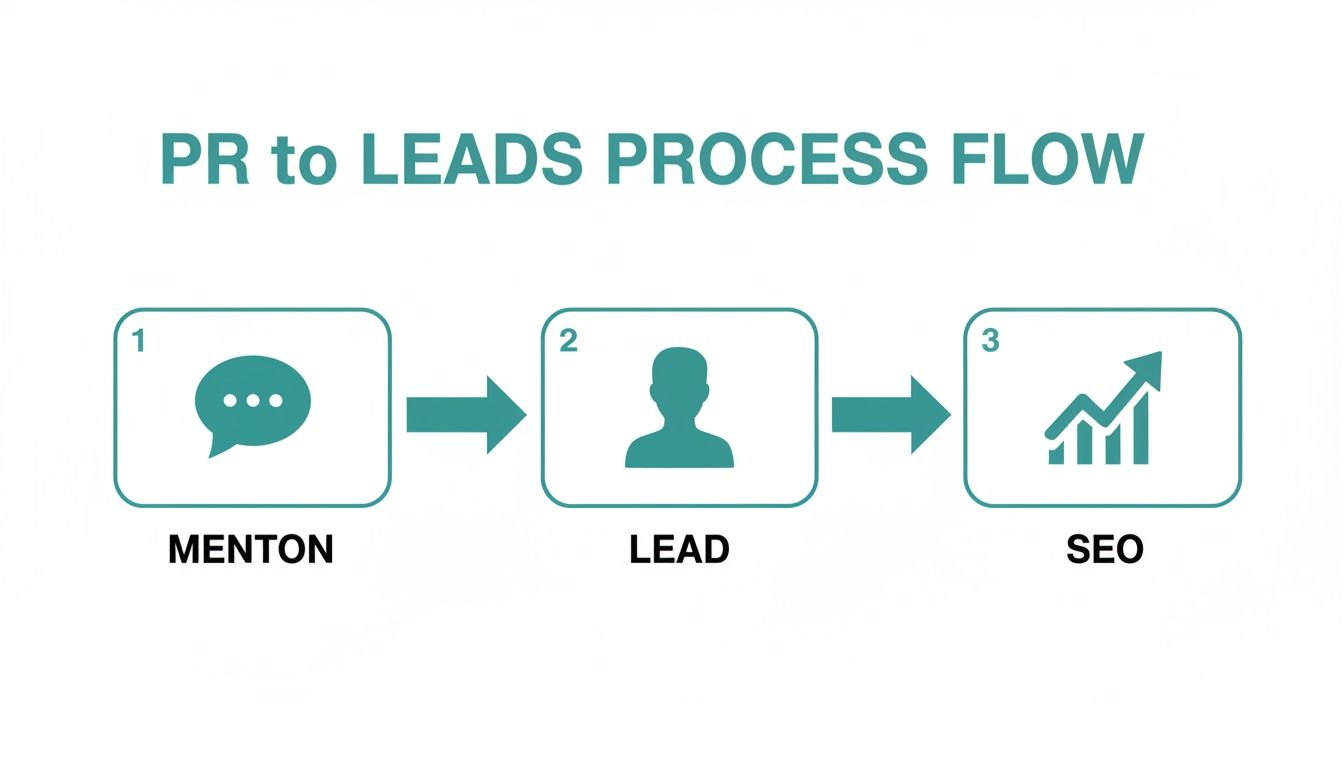
This visual cuts through the noise, focusing on how a single mention can spark a lead and contribute to long-term SEO value.
Making the Dashboard Actionable
A dashboard is only useful if it sparks action. We review ours every Monday morning, and each chart is tied to a specific question we have to answer.
If referral traffic is down, which publications should we be pitching this week? If branded search is flat, are our key messages falling flat? If we aren't getting high-DA backlinks, is our outreach strategy even targeting the right outlets?
This simple weekly check-in transforms our dashboard from a passive report into an active, strategic tool. It forces us to confront what’s working and what isn’t, letting us pivot quickly instead of waiting a full quarter to realize a campaign is off track. It's the core discipline that keeps our PR efforts lean, accountable, and laser-focused on growth. For a deeper look at this process, check out our guide on how to create custom dashboards for social media monitoring.
How AI Is Changing the PR Measurement Game
The single biggest shift in public relations measurement right now is undeniably the rise of AI. As an AI-powered company, we're not just watching this from the sidelines; we're in the trenches with it every single day. This isn't about hype—it's about the practical ways AI is making PR smarter, faster, and more effective.
The old way of monitoring relied on basic keyword matching, which honestly created more noise than signal. You'd get a firehose of irrelevant mentions just because your brand name popped up somewhere. AI changes this completely by introducing genuine contextual understanding. It’s the difference between hearing your name in a crowded room and hearing someone ask for you by name because they actually need your help.
Moving from Keywords to Context
At BillyBuzz, our entire model is built on this principle. Our tool doesn’t just find mentions of a term like ‘project management software.’ Instead, its AI relevancy scoring is trained to identify the intent behind the conversation. It surfaces discussions where users are actively expressing frustration with their current tools or asking for alternatives to a specific competitor.
This contextual layer is a game-changer. It means we're not wasting time sifting through thousands of low-value mentions. We get alerts for high-intent PR opportunities where we can step in and provide immediate value, turning a simple mention into a potential lead.
Our Internal Insight: The true power of AI in PR isn't just finding mentions; it's understanding the 'why' behind them. Identifying a user's pain point before they even know your solution exists is the ultimate competitive advantage.
Real-Time Perception and Predictive Insights
Another area where AI gives us a massive leg up is sentiment analysis. In the past, gauging brand perception was a slow, manual process involving surveys or focus groups. Now, AI-driven sentiment analysis from tools like Brandwatch gives us a real-time pulse on how people are talking about our brand, our competitors, and our industry across thousands of online conversations.
If a competitor releases a buggy update and sentiment turns negative, we know instantly. This allows us to adjust our own messaging and position BillyBuzz as a more reliable alternative. It’s proactive, not reactive.
What's more, predictive analytics are starting to help us forecast which topics or communities are about to gain traction. By analyzing conversation velocity and engagement patterns, we can get an early read on emerging trends and position ourselves as thought leaders before a topic becomes saturated.
This shift to a more data-driven strategy is a key driver in the global PR market's projected growth to USD 160.54 billion by 2031. Despite this progress, a core challenge remains. While 65% of teams use real-time dashboards and over 60% use sentiment analysis, over half still struggle to link PR to revenue. You can dig deeper into the industry's evolution in this comprehensive market report.
AI isn't a magic wand, but it is an incredible force multiplier. For a small team like ours, it automates hours of manual work, uncovers opportunities we would have otherwise missed, and provides the data we need to prove our PR efforts are contributing directly to the bottom line. It's how we ensure our measurement public relations strategy is always a step ahead.
Answering Your Top Startup PR Measurement Questions
We get a lot of questions from fellow founders about the nuts and bolts of measuring PR. It's a topic that seems to be shrouded in mystery, but honestly, the answers are usually simpler than you think. This is our no-fluff FAQ, built to tackle the most common hurdles we see startups trip over.
Our goal here is to give you direct, actionable answers. We'll pull back the curtain on the exact mindset and tactics we use at BillyBuzz to make our PR measurement effective, even with the limited resources of a growing company.
How Do I Measure PR with a Tiny Budget and No Team?
This is, without a doubt, the question we hear most. The answer? Focus. Just focus. Don't try to boil the ocean. If you’re a solo founder or have a tiny team, the name of the game is to master one channel and one metric, not to track everything poorly.
Your 'solo founder' stack should be lean and, more importantly, mostly free.
- Google Alerts: This is non-negotiable. Set it up for your brand name, founder names, and your top one or two competitors. It’s your bare-bones system for catching earned media mentions.
- Google Analytics 4 (GA4): Don't get lost in the weeds here. Zero in on the Referral Traffic report. This report is gold because it shows you which media placements are actually sending people to your website.
- BillyBuzz (Free Tier): Use it to keep an eye on a handful of hyper-relevant subreddits. Your goal isn't to be everywhere; it's to find five to ten high-quality conversations you can genuinely contribute to each month.
The single most critical piece of advice I can give you is to be consistent. Block out 30 minutes on your calendar every single Friday for a PR check-in. Log any new mentions, peek at your referral traffic, and review your Reddit conversations. That’s it. Measuring one thing well is infinitely more valuable than measuring ten things badly.
What Is the Single Most Important PR Metric for an Early-Stage Startup?
For nearly every B2B or SaaS startup out there, the answer is Attributed Sign-ups or Demo Requests. If you're a B2C app, it might be something like Direct App Store Visits from Referrals. Notice the common thread? The best metric is always the one that sits as close to revenue as you can get.
This is what we call your 'North Star' PR metric. It’s the one number that, if it goes up, you know without a doubt that your PR is contributing to business growth. Everything else—backlinks, traffic, share of voice—is just a supporting actor. They're important leading indicators, for sure, but they are not the main event.
To find your North Star metric, ask your team this one question: "If our PR efforts could only achieve one single outcome this quarter, what would have the biggest impact on our business?" The answer is your metric. Orient every press release, every pitch, and every Reddit comment around moving that specific number.
This kind of intense focus simplifies everything. It clarifies your own goals and makes it a heck of a lot easier to communicate the value of your PR work to the rest of the team and, crucially, to your investors.
How Long Does It Take to See SEO Results from PR?
Everyone wants the quick win here, but the truth is that PR-driven SEO is a long game. While seeing a significant jump in rankings for competitive keywords can easily take 6-12 months, you should start seeing positive leading indicators much, much sooner—typically within 1-3 months.
So, don't just stare at your target keyword rankings and get discouraged. Instead, track these early signals to confirm you're actually on the right path:
- Immediate Referral Traffic: The very first sign of life will be direct traffic from the article or placement itself. This is your instant feedback loop telling you the audience was a good match.
- Increase in Branded Search: Within a few weeks, you should notice a small but real uptick in people searching directly for your brand name. You can see this in Google Search Console. It's a fantastic signal that your message is sticking.
- Domain Rating (DR) Movement: A quality backlink from a reputable site will give your site's DR a small, measurable bump. Tracking this over time is how you prove you're building authority.
Patience is the secret weapon here. PR builds SEO authority brick by brick, not all at once. By monitoring these leading indicators, you can show momentum and justify the continued investment long before you hit page one for your dream keyword.
Is It Possible to Track PR from Offline Events or Podcasts?
Absolutely, but it requires a bit of clever setup. You can't just hope people remember your name and find you later—you have to give them a specific, trackable path to follow.
For podcasts, the best tool in your arsenal is a vanity URL. If you’re a guest on the "Startup Growth" podcast, for example, create a simple redirect like yoursite.com/growth. Make sure this link redirects to a landing page with full UTM parameters, which lets you isolate every visitor from that specific appearance. The key is to make the URL easy to say and even easier to remember.
For in-person events like conferences or meetups, a unique QR code on your slides or business cards works wonders. Link that QR code to a similarly tagged URL. Another tactic we love is offering an event-specific discount code, like "MEETUP20," which you can easily track on the back end to see how many people converted.
Sure, these methods aren't 100% foolproof, but they provide a strong directional sense of which offline activities are successfully driving digital engagement. It finally closes the loop between your real-world conversations and your online conversions.
Ready to stop guessing and start measuring what matters on Reddit? BillyBuzz uses AI to find high-intent conversations and customer pain points, so you can join the right discussions at the right time. Turn your community engagement into a measurable source of leads and SEO value. Discover your next customers on BillyBuzz today!