

The classic Share of Voice formula is (Your Mentions / Total Market Mentions) × 100. Frankly, that’s textbook theory. For a founder, calculating share of voice (SOV) is a gut check: are we winning the conversations that actually drive revenue? Forget the ivory tower definitions. This is about owning the narrative where it counts.
At my startup, BillyBuzz, we don't treat SOV as a passive KPI. It's an active lead-gen engine. This guide shares the exact, no-fluff playbook we use internally—the subreddits, the keywords, the alert rules, and the response templates—to find and win customers on Reddit.
What SOV Actually Means for a Founder

Let's cut the jargon. SOV is how much of the conversation you own where your customers hang out, compared to your rivals. For startups, it's not about outspending them; it’s about outsmarting them. It's about surgical focus.
The old definition of SOV was tied to ad spend. That’s irrelevant now. We define our market as a handful of strategic subreddits. Inside BillyBuzz, we’ve seen startups go from 5% to 25% SOV by engaging in just 150 high-intent Reddit threads a month. The direct result? A 3x increase in qualified leads. You can dig into broader research on share of voice measurement, but the principle is the same: targeted engagement works.
Define Your Market (The BillyBuzz Way)
The biggest mistake is tracking raw brand mentions across the whole internet. We tried that. It was a complete waste of time—all noise, no signal.
We pivoted hard to focus exclusively on Reddit. Why? The conversations are context-rich, organized into niche communities (subreddits), and full of people actively looking for solutions. It’s a goldmine for customer discovery and lead gen.
Our process starts by defining our "market" as a hand-picked list of relevant subreddits. For us, that means communities like r/SaaS, r/growmybusiness, r/marketing, and r/startups. This tight focus gives us clean, meaningful data.
Here are the actual metrics we track to get a real SOV measurement, not a vanity number.
Core SOV Metrics We Track on Reddit
| Metric | What We Actually Track | Why It Matters to Us |
|---|---|---|
| Problem & Solution Keywords | Mentions of problems we solve, like "social media scheduling is tedious" or "customer feedback tool." | This is pure purchase intent. Someone describing a problem is a hot lead. |
| Competitor Mentions | How often direct competitors are named in our target subreddits. | This is the other half of the SOV equation. It tells us who we're up against and where their advocates are. |
| "Alternative To" Queries | Comments like "is there a better tool than [Competitor X]?" or "alternatives to [Competitor X]." | This is a buying signal. It’s a direct invitation to jump in and offer a better solution. |
| Sentiment Analysis | The tone (positive, negative, neutral) of conversations around our brand and competitors. | A high SOV with negative sentiment is a fire alarm. We use negative competitor sentiment as an opportunity. |
By tracking these, we get a real-time map of our influence in the communities that can actually grow our business.
By narrowing our focus to a few key subreddits, we turn SOV from a vanity metric into a strategic compass that points directly to our next customer.
Our Internal SOV Tracking System: The Setup
At BillyBuzz, calculating Share of Voice isn't a marketing exercise; it's building a radar system. The goal is to get clean, actionable signals from the specific online spaces where our customers live. Casting a wide net is a fast track to getting buried in noise.
Our approach is surgical. We define our 'market' as a hand-picked list of 5-10 subreddits. For us, that’s r/SaaS, r/growmybusiness, r/startups, r/marketing, and r/Entrepreneur. These are the communities where founders and marketers ask for advice. This tight focus is everything.
Building Our Keyword List
Tracking your brand name is a vanity metric. It tells you nothing about the market. Our list is built to capture the entire conversation.
Here's the breakdown of our actual keyword groups inside BillyBuzz:
- Competitor Names: We track our top 5 direct competitors and 3 emerging ones.
- Pain Points: We listen for the exact language people use when they're stuck. For us, that's phrases like "how to find reddit leads," "social media monitoring is too expensive," and "manually tracking keywords."
- "Alternative to" Queries: Any comment asking for an alternative to a competitor is a high-priority alert. Keywords: "alternative to [Competitor A]," "vs [Competitor B]," "better than [Competitor C]."
- Solution Keywords: Broader terms like "Reddit monitoring tool," "social listening for startups," and "customer discovery platform."
This gives us a complete picture of the landscape. You can dive deeper into this process with our 10 Reddit monitoring tips for startup growth.
Creating Alert Rules That Filter 90% of the Noise
With our subreddits and keywords locked in, we build the alert rules inside BillyBuzz. This is where the magic happens. We don't get a notification for every mention; our AI relevancy scoring filters out over 90% of the noise.
Our actual alert rule for a high-intent lead looks like this:
- Subreddits:
r/SaaS,r/startups - Must Include Keywords: "alternative to," "better than," "competitor of"
- AND Must Include Keywords:
[Competitor A],[Competitor B] - Exclude Keywords: "hiring," "jobs," "free"
- Sentiment:
NeutralorNegative(when mentioning a competitor)
Reading up on how to analyze share of voice across platforms can offer a broader perspective, but for us, this level of granularity is non-negotiable.
A great SOV system isn't about collecting the most data; it's about collecting the right data. We turned passive monitoring into an active lead-gen engine by focusing only on high-intent conversations.
This system pipes real-time notifications into a dedicated #reddit-leads Slack channel. The moment a competitor gets mentioned or a user describes a problem we solve, we see it instantly. We can join conversations in minutes, not days.
Gathering Data and Running the Numbers
Data collection doesn't have to be a nightmare. We've streamlined our process to turn raw Reddit conversations into a clear, actionable SOV percentage.
We export conversation data from our target subreddits and categorize each mention into simple buckets: Our Brand, Competitor A, Competitor B, and Pain Points. This simple workflow—define your market, build keywords, create alerts—is the bedrock of our SOV calculation.
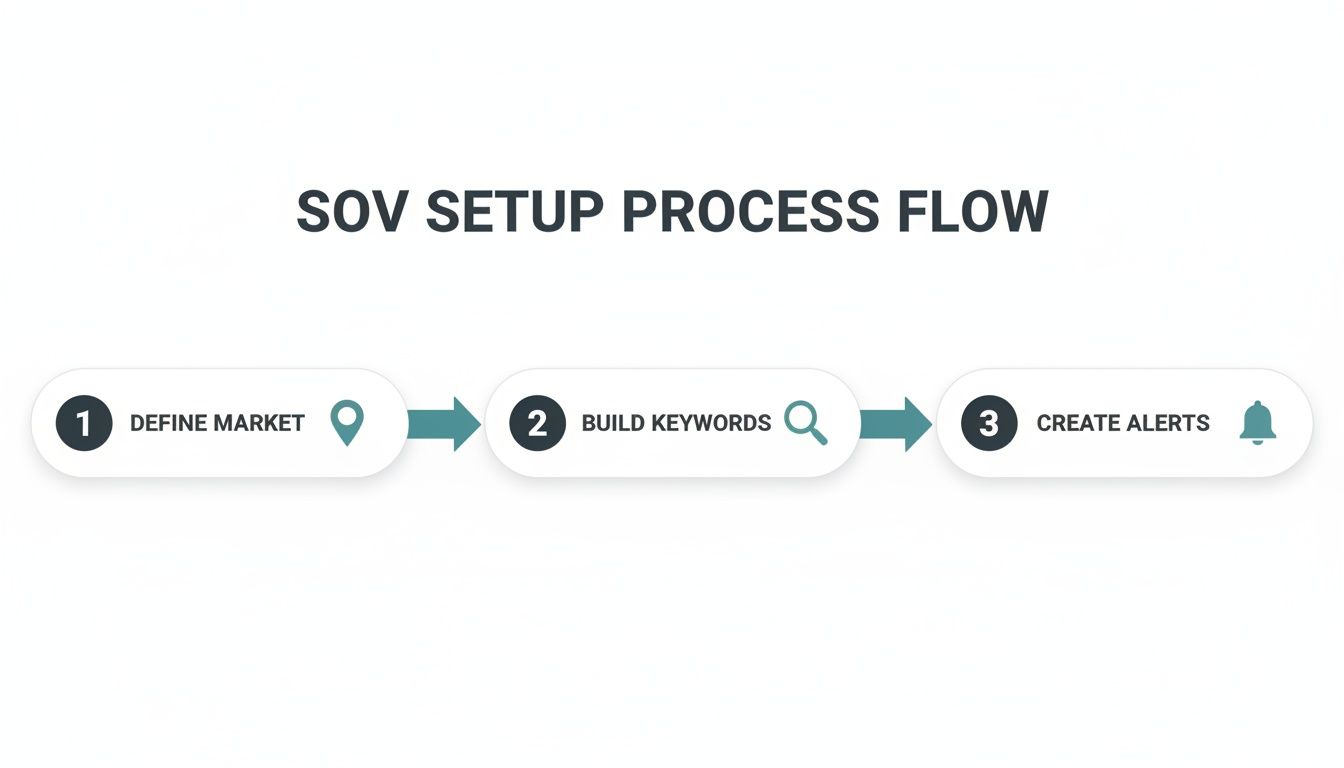
This visual shows the exact process we follow. It’s all about getting clean, focused data before we even think about the numbers.
A Real-World SaaS Example
Imagine a new SaaS tool in the project management space. After tracking r/projectmanagement, they find they have only 10% of total brand mentions. Looks discouraging, right?
But when they dig deeper, they discover they own the 'problem-solution' conversation. They're the top-voted answer on threads where users complain about a specific workflow issue their tool solves. Their effective SOV is much higher where it actually matters. This is how you turn SOV from a vanity metric into a growth lever.
The goal isn’t to count who gets mentioned most. It’s to understand who is winning the conversations that lead to a sale.
Calculating SOV on Reddit uncovers huge disparities. These communities can drive 5x more visibility than general social channels. We saw one SaaS startup in r/SaaS hit 28% SOV by proactively responding to 200 pain-point threads. The result? 450 leads and a 12% conversion rate. Brands with over 25% SOV on Reddit also tend to rank 2.1x higher in Google. Authentic engagement boosts your entire search presence.
For founders who want to get hands-on, check out this step-by-step guide to scraping Reddit. Whether you use a tool or build your own process, understanding the data source is key.
How to Interpret Your SOV Score
Getting your SOV percentage is just the start. What matters is turning that data into a strategic roadmap. A low score isn't failure; it's a signal to dig deeper and find your openings.
Benchmarking Against Competitors
First, break down your SOV by competitor. Is one rival dominating everywhere, or just on certain topics? You might find your overall score is low, but you're actually winning the discussion around a specific pain point. That's your wedge.
For example, a competitor might have a high SOV from general brand chatter. Meanwhile, you could be owning conversations in threads titled "alternative to [Competitor X]." That’s a massive win, even if your total score looks smaller. Double down there.
The Power of Sentiment Analysis
Next, layer in sentiment. A high SOV driven by negative comments is a liability—for them. A competitor's negative buzz is an open invitation for you to join the conversation.
We once saw a competitor's SOV spike in r/SaaS due to complaints about their new pricing. We didn't pitch. We offered genuine advice on budget-friendly alternatives, which naturally positioned our tool as a great option. That single insight led to a 15% increase in trial sign-ups that month.
Your competitor’s bad press is your opportunity. A high SOV fueled by negative sentiment is a weakness you can exploit by offering a better solution to their disgruntled customers.
Audience-specific SOV is the gold standard. I saw one B2B tech company gain 35% SOV among CIOs on LinkedIn, driving a 27% growth in their sales pipeline. We apply this same focus at BillyBuzz for Reddit. Our monitoring in r/entrepreneur delivered a 22% SOV uplift for our pilot users. Real-time alerts led to over 300 meaningful engagements and a 15% boost in qualified leads. These targeted strategies are shaped by new social media statistics and changing user behavior.
SOV Score Analysis and Action Plan
So, what do you do with your number? This is the framework we use to translate our SOV percentage into a concrete action plan.
| SOV Percentage | What It Means for Us | Our Next Move |
|---|---|---|
| 0-5% | The Underdog: We're new or under the radar. Awareness is low. | Focus on brand-building in 1-2 niche subreddits where we can punch above our weight. Be helpful, not salesy. |
| 6-15% | The Challenger: We're on the map but not dominant. We have some traction. | Identify our strongest channels and double down. Systematically engage in "alternative to" threads about our competitors. |
| 16-30% | The Contender: We're a known player and part of the main conversation. | Defend our core topics and start leading discussions. Host AMAs, share original research, build our authority. |
| 31%+ | The Leader: We're dominating the conversation in our market. | Maintain momentum with thought leadership and community engagement. Monitor for emerging challengers very closely. |
This isn't rigid, but it provides a solid starting point. See your SOV not as a grade, but as a compass pointing to your next best move.
Turning SOV Insights into Action

An SOV report isn't a trophy; it’s a battle plan. Knowing your score is the start, but systematically growing your presence is how you win. This is where you shift from passive monitoring to active, value-driven engagement.
At BillyBuzz, just showing up isn't enough. We have a playbook for different conversations to ensure our responses are consistently helpful, not just another sales pitch.
Our Internal Reddit Response Playbook
High-value conversations fall into three buckets. Each needs a different touch to add genuine value before mentioning our product.
- Pain Point Discussions: Someone describes a problem we solve ("Manually tracking Reddit for leads is a nightmare"). We first validate their frustration and offer a genuinely useful tip they can use immediately, even without our tool.
- Competitor Mentions: A user brings up a competitor. We never attack. We acknowledge what the competitor does well and then gently introduce a different angle or a feature where we shine.
- Recommendation Requests: Golden opportunities ("What's the best tool for Reddit monitoring?"). We first outline what to look for in any solution before we position BillyBuzz as a great option.
This structured approach is key. To sharpen it, you need to understand your rivals' positioning, which is covered well in The Ultimate Guide to Competitor Analysis for Emerging Businesses.
Our Go-To Response Templates
Authenticity is everything on Reddit. Users spot a corporate shill a mile away. We use AI suggestions as a first draft, then our team rewrites them to add a human touch and specific context from the thread.
Here’s our actual template for responding to a competitor mention:
The Situation: A user posts, "We're using [Competitor X] but find its keyword alerts are pretty noisy."
Our Response Template:
- Acknowledge & Validate: "Totally get that. [Competitor X] is solid for broad social listening, but filtering keywords can be a real challenge when you need high-fidelity signals."
- Offer a No-Pitch Tip: "One thing that helped us was using super specific long-tail keywords combined with negative keywords to cut down the noise. For example, instead of 'marketing tool,' we'd track 'SaaS marketing tool for startups' and exclude '-jobs'."
- Introduce Your Solution (Gently): "It’s actually why we built BillyBuzz with a focus on AI relevancy scoring—it analyzes the context of the conversation, not just the keyword, to deliver cleaner alerts. Might be worth a look if the noise becomes a major time sink."
This "help first, sell second" method builds trust and credibility.
Creating Your Growth Feedback Loop
Finally, action without measurement is just guesswork. We recalculate our SOV at the beginning of every month. This discipline creates a powerful feedback loop.
This regular check-in tells us which engagement strategies are moving the needle. If our SOV in r/SaaS jumped 5% after focusing on "alternative to" threads, we know to double down on that tactic next month. It's this consistent cycle of measure, act, and repeat that drives sustainable growth.
FAQs: A Founder's Quick Guide to SOV
When you start digging into SOV, practical questions pop up. You don't need academic theory; you need real-world answers. Here are the most common questions we get, with the straightforward advice we follow at BillyBuzz.
How often should I calculate this?
For most startups, monthly is the sweet spot. This is our cadence. It smooths out daily noise and gives you a clear, strategic picture of your progress.
A weekly check-in makes sense during a product launch or when a new competitor enters your key subreddits. Anything less frequent than monthly, and you're flying blind, likely missing major shifts in competitor strategy or customer sentiment.
What’s a “good” Share of Voice score?
There's no magic number. A "good" SOV is all about context. A 30% SOV in a niche subreddit is different from a 10% SOV in a massive space like r/projectmanagement.
Focus on two things instead: the trend and the quality. Is your SOV trending up? Great. More importantly, what’s the quality of those mentions? I'd take a 5% SOV of glowing reviews in high-intent discussions over a 20% SOV from random chatter any day.
The real question is, "What's my share of quality voice?" It’s better to win conversations that lead to customers than to dominate ones that go nowhere.
How can I do this on a shoestring budget?
You don't need a big budget. You can get a solid baseline for free with a spreadsheet and some elbow grease.
- Pick Your Battlefield: Choose 3-5 of the most important subreddits.
- Define Your Keywords: List your brand, your top two competitors, and 5-10 key problem phrases.
- Get Tracking: Spend 30 minutes daily searching these terms in your chosen subreddits. Log mentions in a Google Sheet.
This manual process costs nothing but time and gives you an incredible feel for the conversations in your space. Once you have a baseline and see the value, you can upgrade to an affordable tool to automate the process and get cleaner data.
Ready to stop guessing and start measuring what matters? BillyBuzz is the AI-powered monitoring tool built by founders, for founders. We cut through the noise on Reddit to deliver high-intent leads directly to your Slack or inbox. Find your next customers on BillyBuzz.