

So, what is contextual analysis, really? As a founder, think of it as the art of understanding the full story behind a piece of data. It’s about looking at all the surrounding information—the who, what, where, when, and why—that gives a comment or conversation its true meaning.
Instead of seeing a single data point in a vacuum, you get the complete picture. This is how we at BillyBuzz turn raw, messy feedback into insights we can actually build on.
Stop Guessing What Your Customers Truly Mean

As a founder, you're drowning in customer feedback. The problem is, basic sentiment analysis often misses the point entirely. It can tell you a comment is "positive" or "negative," but it almost never explains the crucial "why" behind that feeling.
This is where contextual analysis becomes a startup's secret weapon.
Imagine sentiment analysis as someone who only hears a single word, like "expensive." Contextual analysis, on the other hand, understands the entire conversation. It hears the tone, knows the setting, and picks up on the unspoken needs. At BillyBuzz, a generic "negative" mention about a competitor wasn't just a complaint. When we dug deeper, we realized it was actually a desperate plea for a specific feature integration.
That subtle shift in perspective is what turns social media noise into a genuine strategic advantage.
From Keywords to Conversations
This idea of looking beyond isolated words is nothing new. Its roots trace back to early 20th-century social sciences, where researchers quickly learned that analyzing texts or events without their surrounding context led to flawed conclusions. In fact, one review noted that over 70% of qualitative studies relied on some form of contextual analysis to capture the complete story.
As a founder, your goal isn't just to track keywords; it's to understand the intent behind them. A customer mentioning your competitor isn't just noise—it's a potential sales opportunity, a product idea, or a churn risk waiting to be understood.
This is exactly what we mean by contextual analysis in a practical sense. It’s about building a framework to decode customer conversations, not just count them. This is also related to emerging fields in AI, which you can learn more about by exploring What is Context Engineering.
By moving from simple keyword tracking to a deep contextual understanding, you can finally start making decisions based on what your customers truly mean, not just what they say.
For startups, this distinction isn't just academic—it's the difference between reacting to the market and leading it.
Keyword Tracking vs Contextual Analysis
| Aspect | Simple Keyword Tracking | Contextual Analysis |
|---|---|---|
| Focus | Finds mentions of specific words. | Understands the meaning behind the words. |
| Insight | "How many people said 'buggy'?" | "What specific bug is frustrating users the most?" |
| Output | A list of mentions or a sentiment score. | Actionable product feedback, sales leads, or churn risks. |
| Analogy | Counting trees. | Understanding the health of the entire forest. |
Ultimately, keyword tracking gives you data points, but contextual analysis gives you a roadmap.
Understanding Qualitative vs. Quantitative Analysis
Contextual analysis isn't a one-size-fits-all tool. Think of it as having two different lenses to look at your audience, each showing you something the other can't. To truly understand what people are saying, you need to know when to use each one—and how to combine them.
First up, you have qualitative analysis. This is the human side of the equation. It's like pulling up a chair and listening intently to a small group of people talk. You're not counting keywords; you're looking for the nuances, the emotions, and the stories hidden in the conversation, like in a single, meaty Reddit thread. This is how you discover the "why" behind what people do.
Then there’s quantitative analysis. This is all about scale and seeing the forest for the trees. Instead of one conversation, you’re crunching the numbers on thousands of them. It’s about spotting patterns, tracking how sentiment shifts over time, and measuring just how often people are talking about a specific problem.
The Power of a Hybrid Approach
So, which one is better? It’s a trick question. The real magic happens when you use them together.
At BillyBuzz, we’ve built our entire process around a hybrid model. We let our quantitative tools do the heavy lifting first. They’re constantly scanning massive amounts of conversations to catch things like a sudden spike in mentions about a competitor or a new feature request that’s gaining steam. This gives us the 30,000-foot view and tells us what is happening.
But we never stop there. As soon as our system flags something interesting, we switch gears and dive in manually with a qualitative eye. We’ll go straight to that specific Reddit thread or that cluster of tweets to understand why it's blowing up. That’s where you find the gold—the raw, unfiltered customer voice, the brilliant feature ideas, and the deep-seated frustrations.
The hybrid method gives you both breadth and depth. The numbers point you to where the smoke is, and the human deep-dive tells you exactly what’s causing the fire. It’s the difference between knowing that something happened and understanding why it matters.
This approach gives us the full story—the "what" and the "why"—without drowning our team in data.
From Numbers to Narratives
The quantitative side often leans on automated tech like Natural Language Processing (NLP) to make sense of all that text. NLP can categorize topics and measure sentiment across an entire subreddit in the time it takes to grab a coffee. To get a better sense of how this works, you can check out these different NLP methods for social media keyword analysis.
But automation isn't a silver bullet. An NLP model might correctly flag a comment as "negative," but it can't always tell the difference between a user reporting a show-stopping bug and someone just sarcastically asking for a new feature.
That kind of distinction requires a human touch—the qualitative piece of the puzzle. By blending scalable data collection with focused human analysis, you create a powerful feedback loop that turns broad market signals into specific, actionable insights.
Our Playbook for Finding Insights on Reddit
Reddit is an absolute goldmine of raw, unfiltered opinions, but you can’t just dive in without a plan. It’s far too noisy. At BillyBuzz, we’ve refined a step-by-step process that turns chaotic discussions into a source of clear, actionable insights. This is our playbook.
This is exactly how we move from oceans of big data to a deep, contextual understanding of what people actually want.
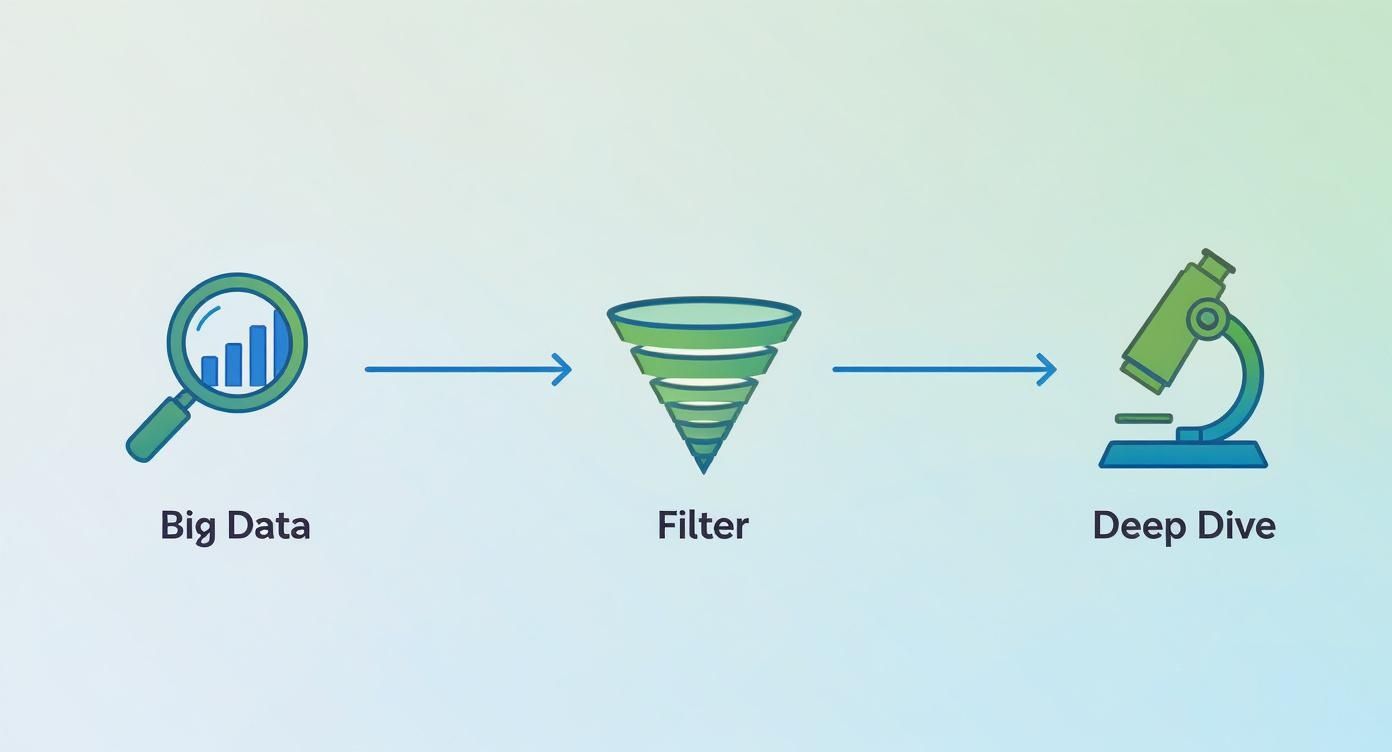
This process is a hybrid approach. It blends large-scale automated monitoring with focused human analysis to zero in on the insights that truly matter.
Step 1: Set Up Hyper-Specific Alerts
First, forget tracking just your brand name. We go on the offensive by hunting for conversations centered on problems we can solve. This means getting specific with our alert rules using boolean logic.
An actual alert rule we use at BillyBuzz looks like this:('social listening' OR 'brand monitoring' OR 'reddit alerts') AND ('recommendation' OR 'alternative to' OR 'looking for') IN subreddit:r/SaaS, r/marketing, r/startups
This setup finds people actively talking about a need, even if they've never heard of us. We're not just listening for mentions; we’re actively sourcing high-intent opportunities.
Step 2: Filter Aggressively for Engagement
Getting an alert is just the first signal. The next step is filtering out noise. Inside BillyBuzz, we have a hard rule: ignore any post with fewer than 2 comments or less than 5 upvotes. A lone comment doesn't give you enough context to work with.
We focus all our attention on threads with genuine back-and-forth discussion. These are the conversations where you find people co-creating solutions, sharing detailed personal experiences, and revealing what they really care about. High engagement is a massive sign that a topic is resonating with the community, making it a valuable place to invest your time.
A post with 20 thoughtful comments is 100x more valuable than 20 posts with one comment each. Engagement is the ultimate filter because it shows you where the real passion and pain points are.
This filtering step is all about efficiency. It makes sure we spend our time analyzing conversations that are rich with context and full of potential insights.
Step 3: Perform a Multi-Layer Contextual Analysis
Once we’ve pinpointed a high-potential thread, the real analysis begins. We don't just skim the top comment; we dissect the entire conversation, layer by layer.
Our three-point check always includes:
- The Original Post (OP): What’s the core problem or question here? What emotion is driving it—is it frustration, curiosity, or excitement?
- The Top-Voted Comments: Which solutions or opinions is the community upvoting? This is a powerful signal of collective sentiment and what the group considers a validated idea.
- The Replies and Sub-threads: Where are the disagreements popping up? What specific nuances are being debated? This is often where the best feature requests and unmet needs are hiding in plain sight.
By looking at all three layers, we can easily tell the difference between a simple complaint and a genuine feature request. We can spot a competitor’s weakness and figure out how to turn it into our strength. This multi-layered approach is what practical contextual analysis is all about—turning raw Reddit data into a clear-cut opportunity.
If you want to go even deeper, our guide on how to monitor keywords on Reddit covers more advanced strategies. This systematic process is how we make sure every insight is backed by solid evidence straight from the community.
Turning Raw Data Into Your Growth Strategy

Finding a game-changing insight is only half the battle. If that knowledge just sits in a spreadsheet or gets lost in a Slack channel, it's completely useless. The final, and most important, step is to turn what you’ve learned into real-world actions that push your startup forward.
This is the point where research stops being a passive activity and becomes an active driver of your growth strategy. For us at BillyBuzz, this isn’t just theory. We recently noticed people repeatedly mentioning a “missing integration” in a subreddit for one of our competitors. This wasn't just another complaint—it was a blinking neon sign for market demand. We took that insight straight to our product roadmap and made that feature our next priority.
Engaging Without Being Salesy
Once you’ve found a conversation where you can contribute, the key is to engage authentically. Your goal is to add value, not to drop a sales pitch. We never just jump into a thread and paste a link to our product. It’s a terrible look.
Instead, we use a simple, value-first response template. It usually goes something like this:
- Acknowledge the Problem: "Great question. Finding a tool that does [specific task] well without being overly complex is a real challenge."
- Offer a Genuinely Helpful Tip: "One thing that helped us was setting up [helpful, non-promotional suggestion]. It's a bit manual but gets the job done."
- Introduce Your Solution (Briefly & Transparently): "Full disclosure, my co-founder and I are building BillyBuzz to solve this exact problem. It might be useful if you’re looking for something more automated. Happy to answer any questions, no pressure."
This method builds trust and positions you as a helpful expert, not just another founder looking for a quick sale. For anyone trying to turn raw data into a real strategy, understanding the significance of semantic context in AI analytics is what makes these kinds of informed decisions possible.
Measuring What Matters
To make sure our contextual analysis is actually working, we track KPIs that go way beyond vanity metrics like brand mentions or upvotes. We need to connect our efforts directly to business outcomes so we can see what's truly moving the needle.
The true ROI of contextual analysis isn’t just brand awareness. It’s validated product ideas, new content topics, and genuine community relationships that you can’t buy with ads.
We focus on a handful of key performance indicators:
- Validated Product Ideas Sourced: How many feature requests or totally new product concepts did we discover this month?
- New Content Topics Generated: Did we spot any recurring questions that would make a great blog post or guide?
- Genuine Community Relationships Built: How many meaningful, non-transactional conversations did we actually have with people?
These data points paint a much clearer picture of success. According to one 2023 report, companies using contextual analysis saw an average 23% increase in customer insight accuracy compared to those relying on quantitative methods alone. That’s a massive improvement in a startup's ability to innovate and truly connect with its audience. And once you have all this information, you need to organize it. Our own custom visual templates can help simplify data overload.
Common Analysis Mistakes and How to Avoid Them
Jumping into contextual analysis without a solid plan can lead you down some very wrong paths. As founders, we learn by doing, and believe me, we’ve made our share of mistakes so you don’t have to. The lessons are simple but critical if you want to turn raw data into genuinely useful insights instead of just confirming your own assumptions.
The biggest trap of all is confirmation bias. It’s that all-too-human habit of looking for data that proves what you already think is true. In analysis, this is poison. You start seeing what you want to see, not what the market is actually trying to tell you.
Mistaking Correlation for Causation
Another classic blunder is confusing correlation with causation. Just because two things show up together doesn't mean one is causing the other. For instance, you might notice your competitor's name popping up alongside the phrase "poor customer service" in the same Reddit threads.
That doesn't automatically mean their support is the problem. Maybe the real issue is a buggy software update that’s overwhelming their support team. Before you jump to conclusions, you have to dig deeper and find explicit statements that actually link the two.
Don’t just connect the dots; make sure the lines you draw are real. A shallow analysis leads to solving the wrong problems, which is a waste of time and resources no startup can afford.
The trick is to stay objective. Go into every conversation with genuine curiosity. Ask, "What's the real problem here?" instead of, "How does this prove my theory?"
Diversifying Your Data Sources
Putting all your eggs in one basket—or in this case, one data source—is a recipe for skewed results. A single subreddit, no matter how busy, only shows you one tiny piece of the puzzle. The vibe in r/techenthusiasts is going to be wildly different from what you'll find in r/smallbusiness.
To get the full picture, you have to cross-reference what you’re hearing across multiple communities. At BillyBuzz, if we spot a trend in one subreddit, our next step is always to check two or three others for similar chatter. Only then do we consider it a validated insight. This simple habit keeps us from overreacting to niche opinions.
In fact, a 2018 study found that over 60% of successful analysis projects broke down their research into distinct parts, which led to much clearer findings. You can read the full research about these contextual methods to see how they did it.
Finally, don't shy away from negative feedback. It’s tempting to bask in the glow of praise, but the real gold is hidden in the complaints. Every piece of criticism is a free consultation pointing directly to a weakness in your product or a gap in the market. Embrace it—it's the most powerful roadmap for improvement you'll ever get.
Your Questions About Contextual Analysis, Answered
Even with a solid game plan, putting contextual analysis into practice can feel a bit fuzzy. We get it. As founders, we've navigated this learning curve ourselves. Here are some straight-up answers to the questions we hear most often, pulled directly from our own experience building BillyBuzz.
How Is Contextual Analysis Different From Sentiment Analysis?
Let's break it down with an analogy. Sentiment analysis gives you a weather report—it tells you if it's sunny (positive), stormy (negative), or just overcast (neutral). It's a quick, high-level snapshot.
Contextual analysis, on the other hand, is the full meteorological deep-dive. It explains why the storm is happening.
For example, a sentiment tool might flag a comment as "negative." That’s the weather report. But when you look at the context, you might find it's a frustrated user detailing a critical bug. That's not just a "negative" data point; it's an urgent fire you need to put out immediately. Another "negative" comment could be someone saying, "I hate that I can't do X with your product," which is actually a golden feature request.
Sentiment tells you what people feel. Context tells you why they feel it, which is where the real opportunities are hidden.
What Are the Best Free Tools to Start With?
You absolutely don't need a hefty software budget to get your feet wet. When we first started, we bootstrapped the entire process with a handful of free tools that are still fantastic for getting a feel for contextual analysis.
- Reddit's Advanced Search: This is your secret weapon. Using boolean operators like
(keyword) AND ("I wish")lets you zero in on hyper-specific conversations where people are practically begging for a solution. - Google Alerts: A classic for a reason. Set up alerts for problem-oriented keywords your ideal customers would use when searching for answers on blogs or forums.
- Google Sheets: Don't underestimate the power of a simple spreadsheet. It’s the perfect place to log interesting threads, tag them with recurring themes, and start seeing patterns in the feedback.
The goal here isn't just to gather data. It's to train your brain to spot valuable context before you ever think about bringing in more advanced tools.
How Much Time Should I Dedicate to This Weekly?
For a founder wearing a dozen different hats, the key is consistency, not intensity. If you try to boil the ocean, you'll just burn out and drop it altogether.
We always recommend blocking out a dedicated 2-3 hours every single week. Treat it like a non-negotiable meeting in your calendar. This isn't a one-off project; it's a habit.
In that focused block of time, your goal is simple: review new mentions, pick just 3-5 really interesting conversations to analyze deeply, and jot down your key takeaways. That’s it. This approach keeps you plugged into customer sentiment without derailing your entire week. As you scale, you can bring in tools to do the heavy lifting of finding the conversations, freeing you up to focus purely on analysis and strategy.
Ready to stop guessing and start understanding what customers on Reddit truly want? BillyBuzz is your AI-powered partner for finding and engaging high-intent conversations. We automate the discovery so you can focus on building relationships and growing your startup. Discover your first leads on Reddit today.