

As founders, we live and die by customer feedback. But manually sifting through Reddit, X, and support tickets is a surefire way to burn out. Sentiment analysis tools are supposed to solve this, but most are either overpriced enterprise behemoths or raw APIs requiring a dev team. This guide is different. It's a founder-to-founder breakdown of the tools we've actually used, with the exact workflows we employ at BillyBuzz to find customers and stay ahead of competitors.
We're cutting the marketing fluff to show you how to turn sentiment analysis into a lead generation and product intelligence machine. You'll see our actual alert rules, the subreddits we monitor, and the response templates that work. This isn't a theoretical overview; it's a practical playbook for founders who need results, not just another dashboard.
We’ll cover:
- Actionable Workflows: How we use these tools for brand monitoring, finding unhappy competitor customers, and sourcing product feedback.
- Founder-Focused Pros & Cons: A no-BS look at what works for a lean startup and what's just enterprise bloat.
- Real-World Setups: Specific filters, subreddits, and integrations we use to make these tools drive revenue.
This list is built to help you make a fast, informed decision. To effectively understand your audience, exploring comprehensive customer sentiment analysis tools is an essential first step. Let's get into the specifics.
1. BillyBuzz
Best for: Turning Reddit conversations into high-intent leads.
BillyBuzz is what we built when we got tired of generic sentiment tools. It's not about classifying every mention as "positive" or "negative." It's laser-focused on identifying purchase intent and competitive pain points on Reddit. We trained its AI on what a founder actually cares about: people actively looking for a solution like ours, or complaining about a competitor. The platform scans your website and your competitors' to understand context, then automatically finds relevant conversations without you having to guess keywords. For a startup, this is gold.
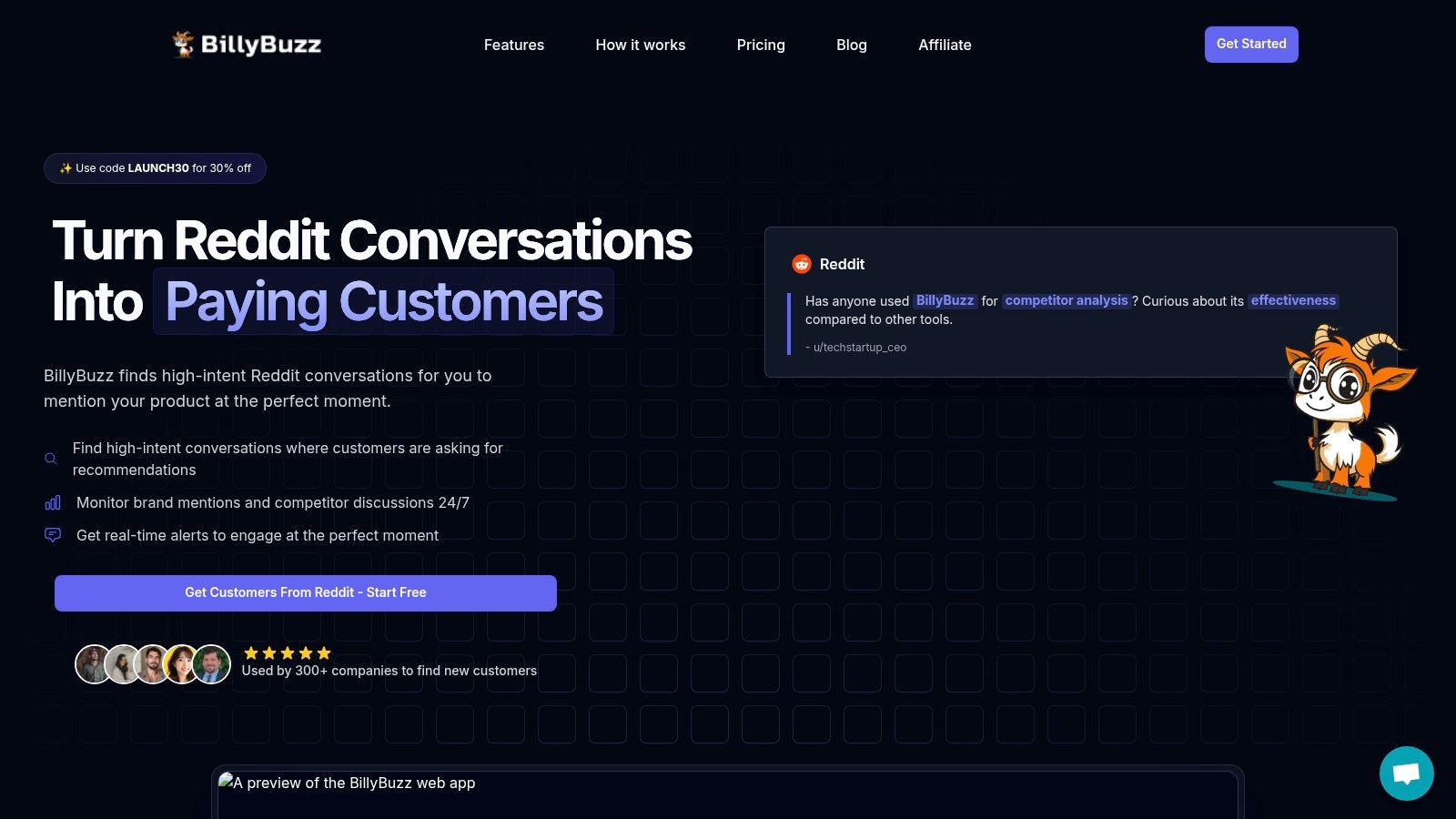
It's designed for speed. BillyBuzz scans Reddit every 15 minutes and sends alerts to Slack or Email with AI-generated reply suggestions. This means we can jump into a thread where someone's asking for an alternative to a competitor and be the first to offer a helpful, non-spammy response. This speed is a massive competitive edge. We turned this exact process into a repeatable marketing funnel, which you can read about in BillyBuzz's guide.
Key Features & Use Cases
- Context-Aware AI: Finds high-intent conversations in relevant subreddits automatically, killing the noise from manual keyword tracking.
- Real-Time Alerts: Slack, Discord, and Email alerts get you into conversations before competitors even see them.
- AI Reply Assistant: Generates authentic-sounding replies to get you started, saving time and mental energy.
- Competitive Intelligence: We monitor competitor mentions to find unhappy users we can help (and convert).
- SEO & Traffic Generation: Helpful replies on Reddit rank on Google, turning a single action into an evergreen traffic source.
How We Use BillyBuzz
We've wired BillyBuzz directly into our growth process. Here’s an actual alert rule we have active right now:
- Trigger: We track keywords like
("Mailchimp alternative" OR "SendGrid sucks")in subreddits liker/SaaS,r/marketing, andr/startups. - Action: An alert hits our
#growth-feedSlack channel. The AI suggests a reply template like:"Hey [Author Name], saw you were running into issues with [Competitor]. A lot of people struggle with [Pain Point]. We actually built [Our Product] to solve exactly that by focusing on [Our Key Differentiator]. Might be worth a look if you're still searching." - Result: A steady stream of warm leads who are actively looking for a new solution.
Pricing
Pricing is built for startups, with a 3-day free trial and a 30-day money-back guarantee.
- Starter: From $19/mo ($15/mo annually) - For solo founders.
- Growth: From $39/mo ($31/mo annually) - For small teams.
- Scale: From $99/mo ($79/mo annually) - For bigger teams needing more history.
Pros & Cons
| Pros | Cons |
|---|---|
| High-Intent Leads: The AI is tuned for purchase intent, not just sentiment, saving hours of manual digging. | Reddit-Only Focus: If your audience is on Facebook or LinkedIn, this isn't for you. |
| Speed to Respond: Real-time alerts and AI replies are a genuine competitive advantage. | Feature Roadmap: Some advanced analytics are still in development. |
| SEO Benefits: Our Reddit replies from months ago still send us qualified organic traffic from Google. | Data Retention Limits: Lower plans have shorter data history. |
| Founder-Friendly: No enterprise sales calls. Pricing is transparent, and the guarantee makes it a no-brainer to try. |
Website: https://www.billybuzz.com
2. G2
G2 isn’t a sentiment analysis tool; it's our first step for de-risking any new software purchase. It's a B2B marketplace where you can see what actual practitioners think. For a founder, reading verified user reviews is infinitely more valuable than sitting through a sales demo. Its Grid reports are a great way to quickly map out the market and find high-performers you've never heard of.
You can filter by features like "social media monitoring," but the real gold is in the unfiltered pros and cons from real users. It's where you find out about hidden limitations or terrible customer support before you've invested a dime.
How We Use G2 at BillyBuzz
When we're evaluating a new tool category, our process always starts here.
- Filter Smartly: We search for the category (e.g., "Text Analysis Software") and immediately filter for "Small Business" and user ratings of 4.5 stars or higher. This cuts 80% of the noise.
- Focus on High Performers: We skip the "Leaders" quadrant (often overpriced enterprise tools) and look at "High Performers"—tools with high satisfaction but less marketing spend.
- Read the 1-Star Reviews: This is non-negotiable. We read the worst reviews first to understand the most common deal-breakers.
This process gives us a data-backed shortlist of 3-4 tools in under an hour, saving us from countless wasted sales calls.
Why It's a Top Resource
G2 crowdsources your due diligence. It's social proof at scale. The main drawback is that categories can be overly broad, mixing complex enterprise platforms with simple APIs, so you have to use the filters aggressively.
Website: https://www.g2.com
3. Product Hunt
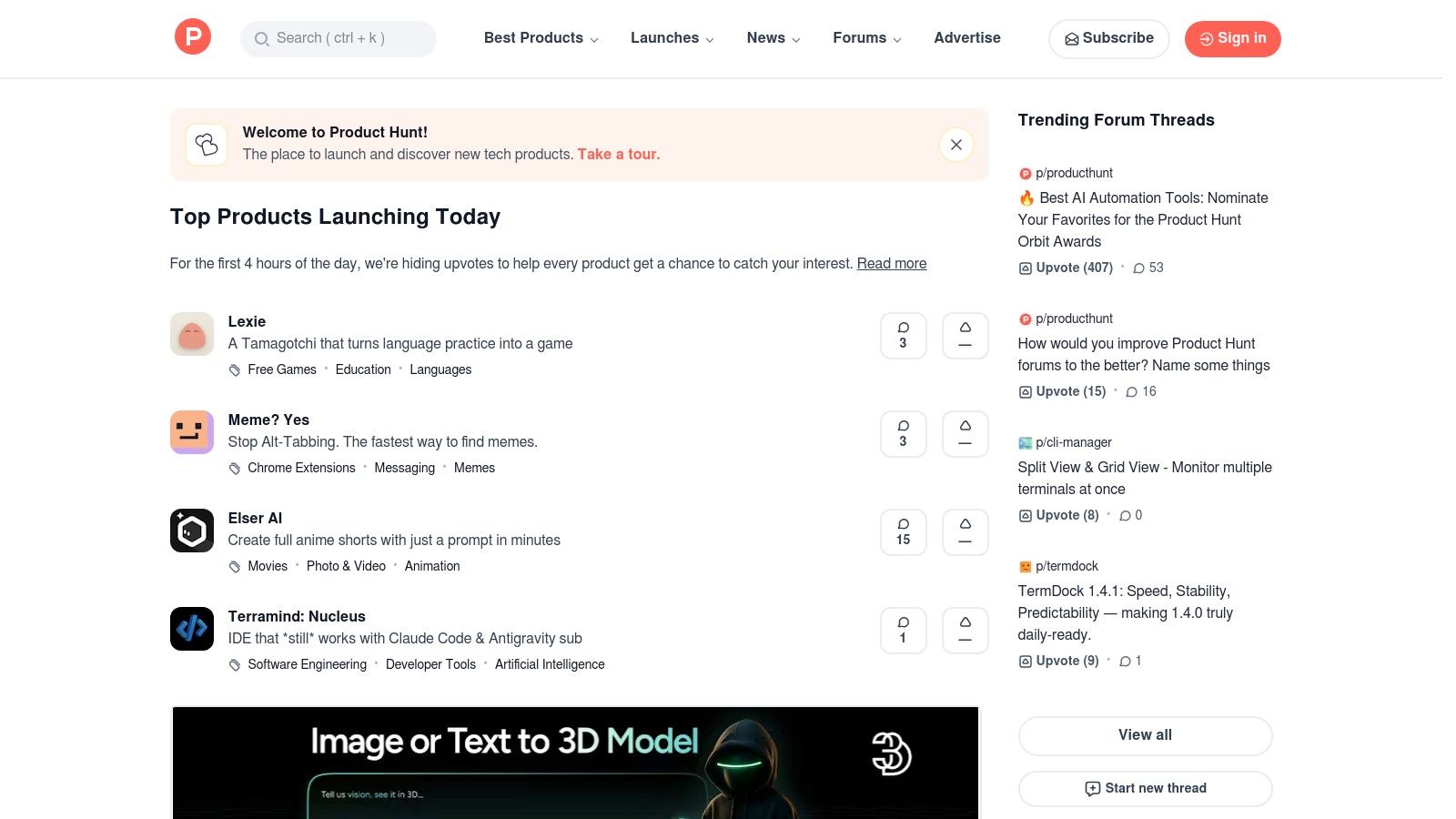
Product Hunt is where you find the next wave of sentiment analysis tools, often before they're even on G2. It's a discovery platform for new tech, and for a founder, it's a goldmine for finding lean, innovative, and often cheaper solutions. The best part is the direct access to the makers in the comments section. You can ask the founder directly about their roadmap or API limitations.
We use it to find specialized tools that solve one problem really well. The community feedback is raw and immediate, giving you a quick read on whether a new tool is a game-changer or a buggy MVP.
How We Use Product Hunt at BillyBuzz
We check Product Hunt weekly to find unique tools that give us an edge.
- Scan Relevant Categories: We quickly scan the "AI," "Analytics," and "SaaS" categories for anything related to text analysis or customer feedback.
- Read the Comments: The launch day comments are where the real diligence happens. We look for questions about data privacy, the underlying tech, and pricing.
- Engage with Makers: If a tool looks promising, we'll ask the founder directly about a specific use case or integration we need. We've had founders build features for us based on these conversations.
This approach helps us find gems and build relationships with other founders building cool stuff.
Why It's a Top Resource
Product Hunt surfaces high-value, niche tools that bigger marketplaces miss. It's the best place to find the next generation of best sentiment analysis tools. The downside is that many products are in beta, so you might trade stability for innovation.
Website: https://www.producthunt.com
4. Amazon Web Services - Amazon Comprehend
If you're already on AWS, Comprehend is the default choice for a raw sentiment analysis API. It's a developer tool, not a dashboard. It's powerful, scalable, and goes beyond sentiment to offer entity recognition and key phrase extraction. The pay-as-you-go model makes it perfect for startups that need to process text data without committing to a monthly subscription.
This is for when you need to build sentiment analysis into your own product or internal tools. You can analyze documents in batches from S3 or set up real-time endpoints for things like content moderation.
How We Use Comprehend at BillyBuzz
We use Comprehend for backend, automated analysis of large feedback datasets. Our workflow is serverless and cheap.
- S3 Trigger: When a CSV of customer feedback is dropped into a specific S3 bucket, it triggers a Lambda function.
- Comprehend Analysis: The Lambda function calls the Comprehend API to run sentiment and key phrase analysis.
- Store & Visualize: The results are dumped into DynamoDB, which then feeds a simple internal dashboard for our product team to review weekly themes.
This entire pipeline costs us pennies to process thousands of comments because we're only paying for what we use.
Why It's a Top Resource
Comprehend is reliable, enterprise-grade, and integrates seamlessly with the entire AWS ecosystem. The main drawback is that it's 100% a developer tool. You need engineering resources to make it do anything.
Website: https://aws.amazon.com/comprehend/
5. Google Cloud - Natural Language AI
Google's Natural Language AI is another excellent API-only option, and our go-to for quick prototyping. It’s a direct, no-frills endpoint for sentiment analysis. Like AWS, it's not a platform with a UI, but a powerful tool for developers to build custom solutions. Its pricing is simple (pay-as-you-go), and the free tier is generous enough to build and test a proof-of-concept without spending anything.
It's perfect for enriching your own data—like programmatically analyzing support tickets or survey responses—without the overhead of a full subscription platform.
How We Use Google Cloud AI at BillyBuzz
We use this API for quick, one-off data enrichment tasks where we don't need a persistent workflow.
- Process Survey Responses: We'll pipe open-ended survey answers from a Google Sheet through the API to automatically tag them as positive, negative, or neutral.
- Prioritize Support Tickets: New support tickets in our system get a quick sentiment analysis to flag highly negative issues for immediate review by a human.
- Cost-Effective Prototyping: We use the free tier to test new analysis ideas before deciding whether to build a more robust process with something like Comprehend.
It's our NLP swiss army knife for internal projects.
Why It's a Top Resource
Google's API is powerful, scalable, and easy to budget for. It's an ideal starting point for any developer looking to add NLP to an application. The obvious downside is that it requires a developer. It's a tool, not a solution.
Website: https://cloud.google.com/natural-language
6. IBM Watson - Natural Language Understanding
IBM Watson offers an enterprise-grade API that goes beyond basic sentiment to include emotion detection (joy, sadness, anger). For a startup, this might seem like overkill, but its ability to be trained on custom models makes it interesting for niche industries. If you operate in a space with a lot of specific jargon (like fintech or healthcare), you can train Watson to understand it, dramatically improving accuracy.
It's a powerful tool, but it's more complex than the Google or AWS offerings.
How We Use IBM Watson at BillyBuzz
We don't use Watson internally, but we've recommended it to a portfolio company in a regulated industry that needed to analyze sensitive customer feedback with high accuracy.
- Custom Model Training: We advised them to train a custom model with 5,000 of their own customer service chats. This allowed the model to distinguish between "frustration" (a product issue) and "disappointment" (a feature request).
- API Proof-of-Concept: They built a simple Python script to send new support tickets to the Watson API and store the emotion scores.
- Cost Analysis: They used IBM's pricing calculator to project costs, confirming it fit their budget before committing to full integration.
This approach let them validate the need for a high-powered, custom tool before sinking major dev resources into it.
Why It's a Top Resource
Watson is mature, reliable, and highly customizable. The emotion detection is a powerful differentiator. The main drawback is complexity. Fine-tuning models requires some data science knowledge and adds to the cost, making it a poor fit for most lean startups.
Website: https://www.ibm.com/products/natural-language-understanding
7. Brandwatch - Consumer Research
Brandwatch is an enterprise-level beast. It's one of the most powerful social listening tools on the market, with a massive dataset and sophisticated dashboards. It's what you use when you have a dedicated marketing team and a serious budget. It can track sentiment, emotion, and specific topics across X, Reddit, news, and more.
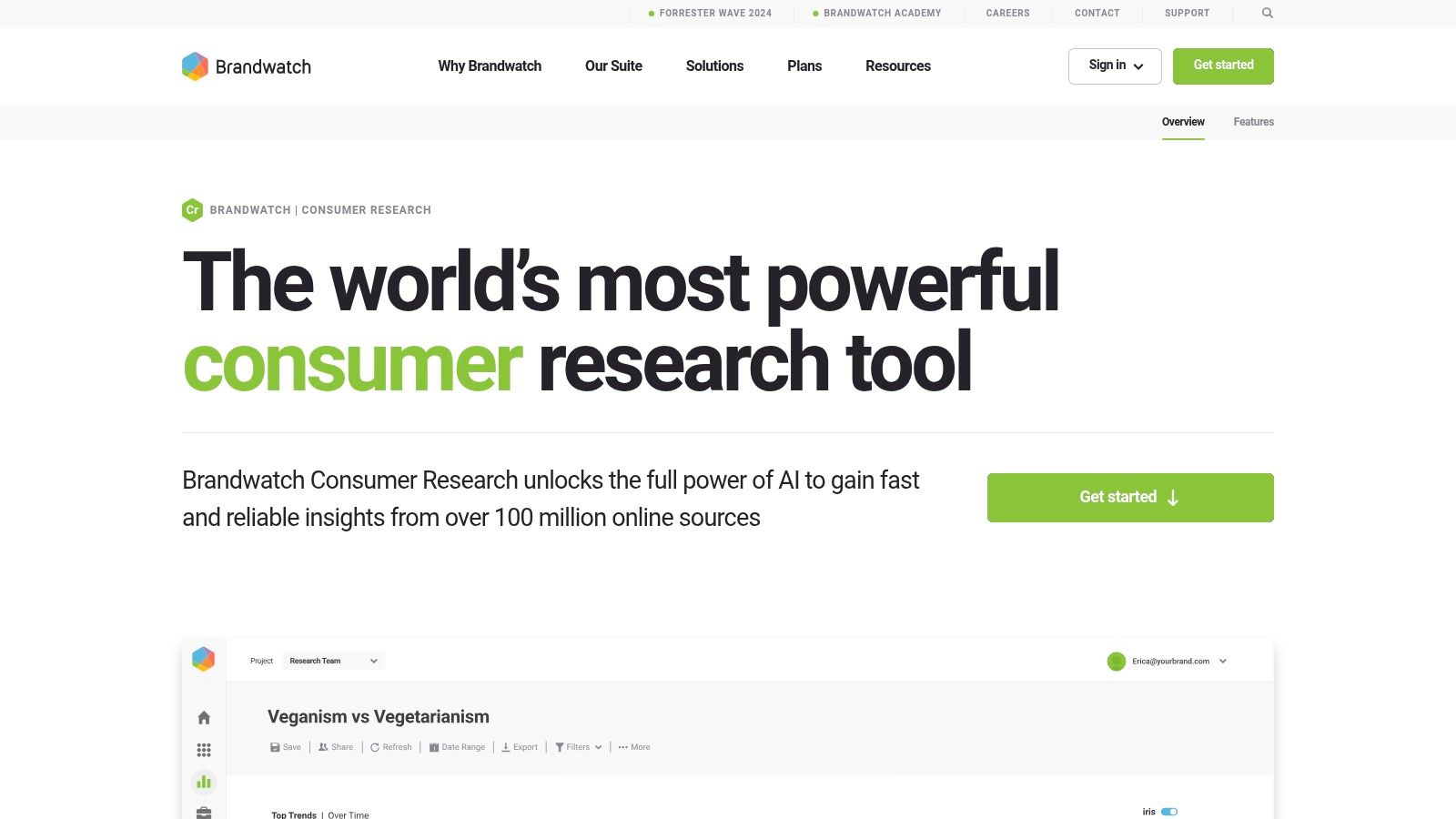
You can set up "Signals" to get alerts for unusual spikes in conversation, which is great for PR crisis management or spotting viral trends.
How We Use Brandwatch at BillyBuzz
Brandwatch is way outside a typical startup budget, but we've used it in past corporate roles. The focus was always on high-level competitive intelligence.
- Benchmark Competitors: We'd set up dashboards to track share of voice and net sentiment for our top three competitors. This helped us spot their campaign weaknesses and our opportunities.
- Track Campaign Emotion: For a major launch, we wouldn't just track sentiment. We'd track the emotional arc of the conversation to see if our messaging was hitting the right notes. Visualizing this data is key, and you can learn more about creating sentiment graphs for brand monitoring here.
- Isolate Key Topics: We used its topic analysis to filter out noise and pinpoint specific feature requests or complaints on Reddit and tech forums.
Why It's a Top Resource
Brandwatch excels at providing presentation-ready insights from a massive dataset. It’s a tool you graduate into. The primary drawback is its enterprise pricing and sales process. It's inaccessible for most small teams.
Website: https://www.brandwatch.com/products/consumer-research/
8. Sprout Social
Sprout Social is an all-in-one social media management platform, and its sentiment analysis is integrated directly into that workflow. For teams that need to handle publishing, engagement, and analytics in one place, Sprout is a strong contender. Its strength is convenience—you don't have to switch between your social media scheduler and a separate listening tool.
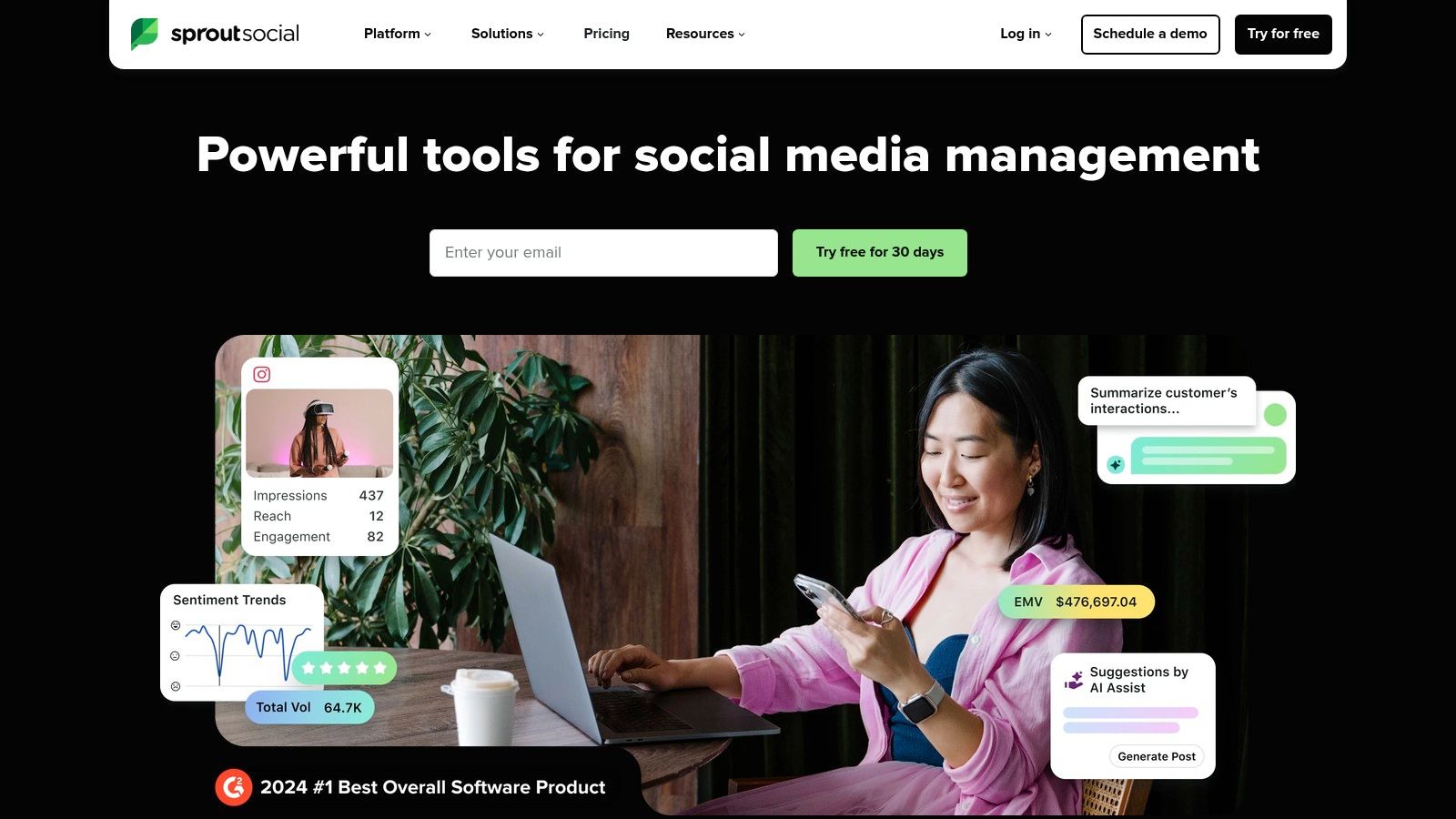
The platform shows sentiment trends over time and lets you drill down into specific posts. You can also manually correct the sentiment of a post, which helps tune the algorithm to your brand's context.
How We Use Sprout Social at BillyBuzz
We use Sprout for a real-time pulse check on our social campaign health. Its Listening feature is an add-on, but it's well-integrated.
- Campaign Monitoring: For a new campaign, we create a Listening Topic (e.g., "#NewFeatureLaunch"). We check the sentiment trend report daily to catch any negative feedback early.
- Competitor Benchmarking: We have a standing Topic tracking sentiment for our main competitors. This helps us spot their PR wins and stumbles.
- Proactive Engagement: We have a saved filter in our Smart Inbox to show only mentions with negative sentiment. This is the first thing our community manager checks each morning.
This turns sentiment from a passive metric into an operational tool.
Why It's a Top Resource
Sprout makes sentiment analysis an actionable part of your daily social media workflow. The downside is cost. The powerful Listening features are an add-on, and the price can climb quickly, especially for multiple users.
Website: https://sproutsocial.com
9. Talkwalker
Talkwalker is another enterprise-grade consumer intelligence platform. Its AI is particularly good, claiming to handle things like sarcasm detection better than most. It provides deep visual analytics and real-time alerts across social, news, blogs, and review sites. This is a tool for teams that need to manage brand health and PR on a large scale.
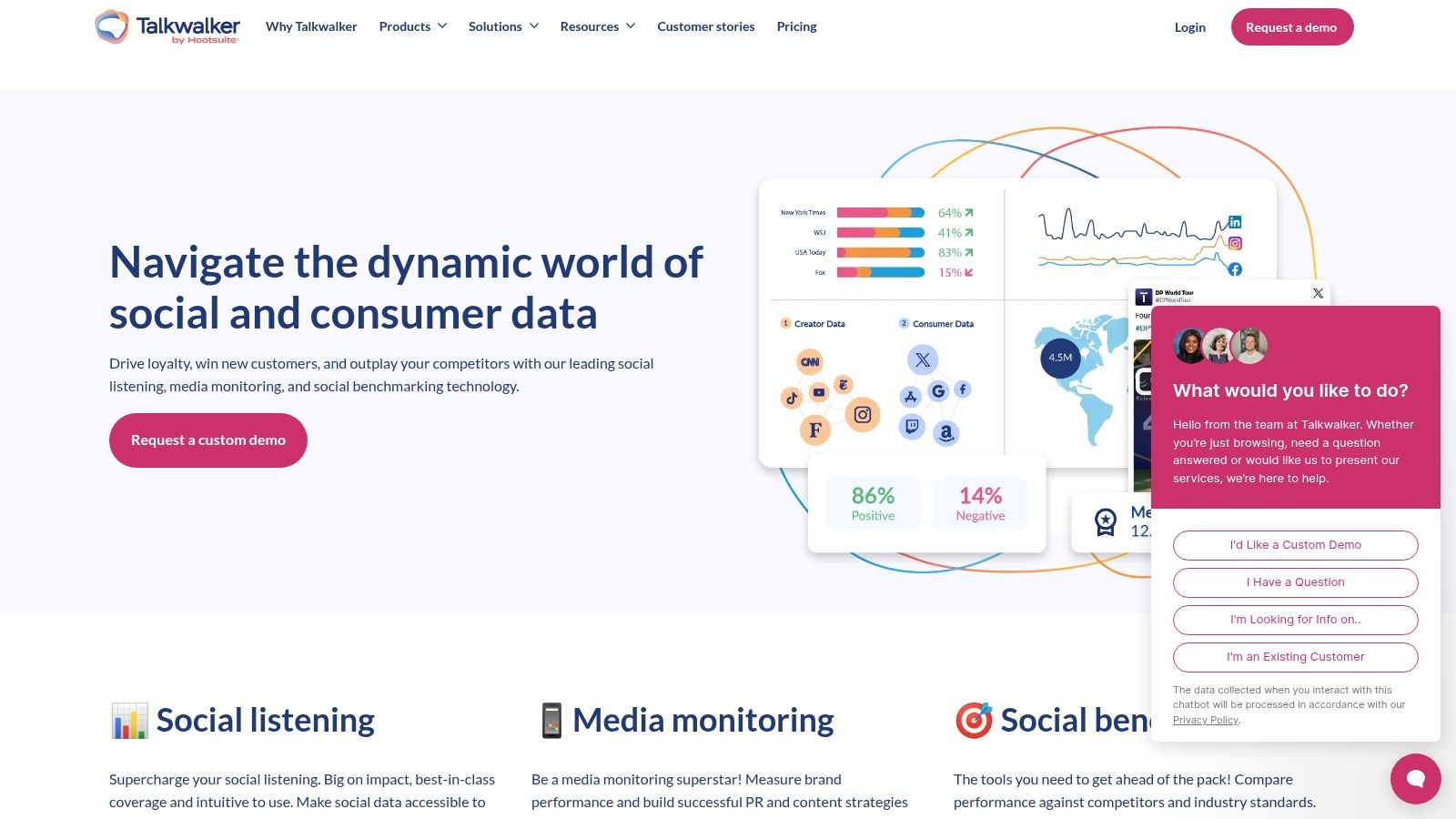
The level of detail can be overwhelming for a founder just trying to find a few customer conversations. It’s built for dedicated analysts.
How We Use Talkwalker at BillyBuzz
We don't use Talkwalker day-to-day, but we have used it on a project basis for deep competitive analysis before a major launch.
- Benchmark Brand Health: We ran a one-time report to benchmark our share of voice, net sentiment, and key conversation themes against our top three competitors over the last 90 days.
- Identify Influencer Networks: We used its network map to find key influencers and media outlets driving the conversation in our space, which informed our outreach strategy.
- Crisis Simulation: We used its alerting features to simulate how we would detect and respond to a sudden spike in negative mentions.
This gives us enterprise-level insights for critical moments without the enterprise-level contract.
Why It's a Top Resource
Talkwalker is incredibly powerful. It’s for professionals who need to understand the "why" behind the sentiment. The primary drawback is its enterprise focus. Pricing is quote-only and very high, making it inaccessible for most startups.
Website: https://www.talkwalker.com
10. Meltwater
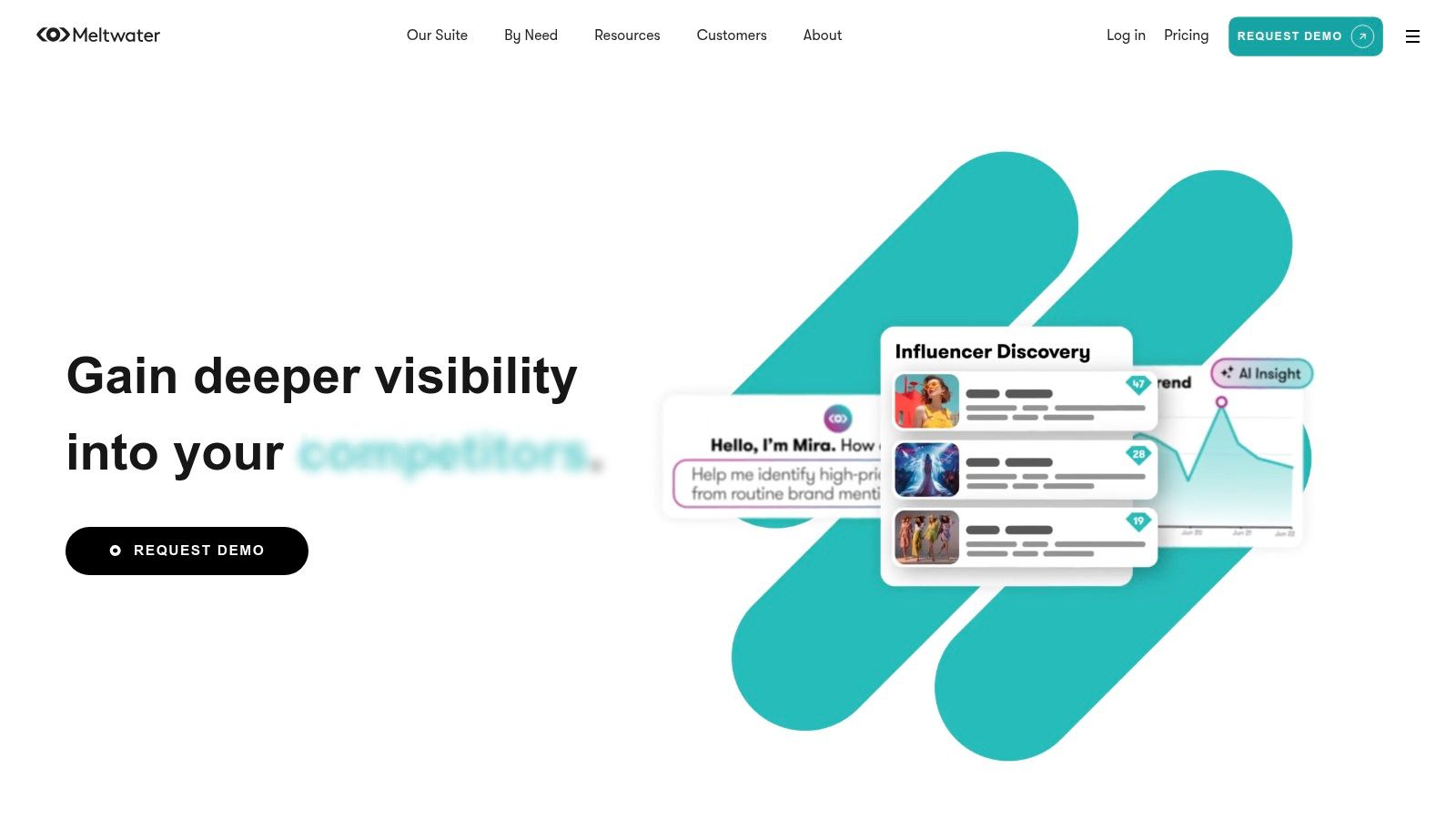
Meltwater is an enterprise media monitoring platform that’s strong on both social and traditional news sources. This makes it a favorite for PR and comms teams. It assigns sentiment scores automatically and can distinguish sentiment about your brand versus a competitor mentioned in the same article, which is a neat feature.
Its biggest strength is its comprehensive data sources, pulling in everything from Reddit to The New York Times. It's great for managing brand reputation at scale.
How We Use Meltwater at BillyBuzz
We've used Meltwater in a consulting capacity for larger clients, primarily for crisis management and PR.
- Set Up Reputation Alerts: We configure real-time alerts for any mention of the client's brand with a strong negative sentiment score. This goes directly to the PR team's Slack.
- Track Competitor Sentiment: We build dashboards tracking the Net Sentiment KPI for our client versus their top competitors, looking for industry-wide shifts.
- Identify Key Themes: We use its analysis to find recurring negative themes (e.g., "poor support," "high price") and feed that directly back to the product and support teams as a weekly report.
This links PR directly to operational improvements.
Why It's a Top Resource
Meltwater gives you a holistic view of brand perception. The drawback is its enterprise positioning. Pricing is quote-based, requires a sales call, and is not friendly for startups.
Website: https://www.meltwater.com
11. MonkeyLearn
MonkeyLearn is a no-code text analytics platform that lets you build your own custom sentiment analysis models. This is perfect for when generic models fail because they don't understand your industry's jargon. You can train a classifier on your own data (like support tickets or reviews) to get much higher accuracy.
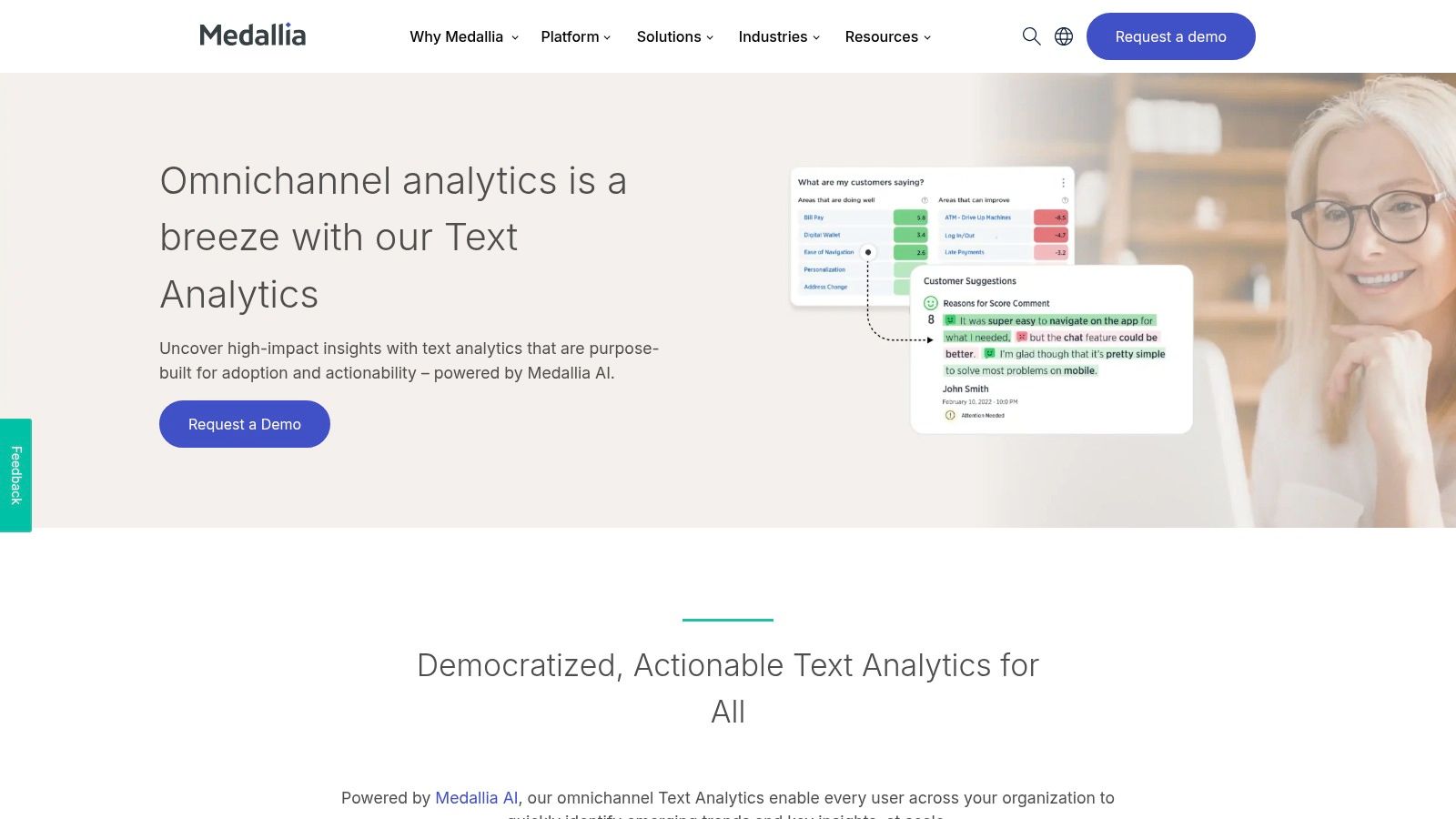
Its strength is accessibility. You can set up automated workflows with Zapier or Google Sheets without writing any code. This is a great tool for a non-technical founder who wants to move beyond spreadsheets.
How We Use MonkeyLearn at BillyBuzz
We use MonkeyLearn to process qualitative feedback from our customer surveys, turning messy text into structured data.
- Custom Model Training: We uploaded a CSV of 500 past survey responses and manually tagged them as "Positive," "Negative," or "Neutral." This trained a custom model that understands our product's terminology.
- Workflow Automation: We use the MonkeyLearn add-on for Google Sheets. Every time a new Typeform survey response comes in, it automatically runs our custom sentiment model on it.
- Keyword Extraction: We also use its keyword extractor to find recurring themes, which helps us prioritize our product roadmap.
Why It's a Top Resource
MonkeyLearn democratizes text analytics. It’s perfect for CX and product teams. The ability to build custom models is a huge advantage. The main drawback is that it can get expensive as your volume grows.
Website: https://monkeylearn.com
12. Lexalytics (by InMoment)
Lexalytics offers a highly tunable engine for teams that need more control than a standard API. It comes in both cloud and on-premise versions, which is a big deal for companies with strict data security requirements. Its key feature is "Industry Packs"—pre-trained models for verticals like finance or hospitality that dramatically improve accuracy on domain-specific language.
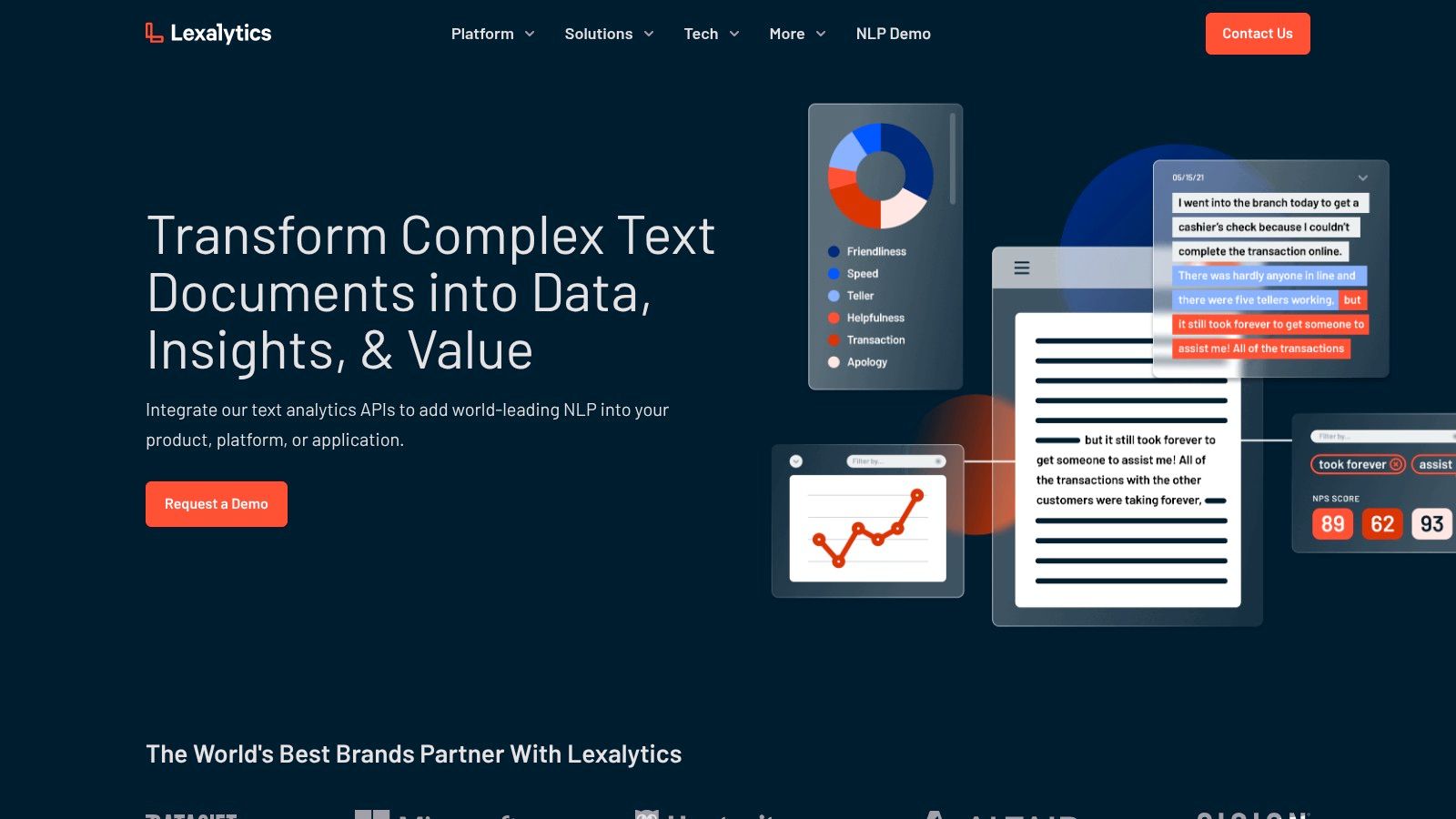
This is for when you need granular control to define custom sentiment rules and ensure the analysis aligns perfectly with your business context.
How We Use Lexalytics at BillyBuzz
We haven't implemented Lexalytics ourselves, as it's more technical than we need. However, we've recommended it to companies in regulated industries that can't use public cloud APIs.
- Deployment Assessment: We advise them to first decide between the cloud API (easier) or on-premise (more control).
- Industry Pack Evaluation: We guide them to demo the relevant Industry Pack against their own data to test its accuracy.
- Custom Tuning: We suggest they work with the Lexalytics team to build a small, custom taxonomy for brand-specific terms.
This helps them get best-in-class accuracy for specialized use cases without needing an in-house data science team.
Why It's a Top Resource
Lexalytics is for when precision and control are non-negotiable. The ability to fine-tune rules and deploy on your own infrastructure is critical for certain businesses. The drawback is its complexity and opaque pricing. It requires significant technical know-how and a sales call to even get started.
Website: https://www.lexalytics.com
Top 12 Sentiment Analysis Tools Comparison
| Product | Core features | Target audience | Integrations & UX | Price & key USP |
|---|---|---|---|---|
| BillyBuzz (Recommended) | Reddit monitoring; context-aware AI relevancy; AI reply suggestions; ~15min scans | Startups, solo founders, growth marketing teams | Email / Slack / Discord alerts; instant, actionable alerts; quick response workflow | Tiered pricing (Starter $19/mo → Scale $99+/mo); 3-day trial + 30‑day guarantee; SEO + lead-generation focus |
| G2 | Software marketplace; vetted reviews; comparison grids | Buyers researching sentiment/listening tools | Filters, category grids, vendor links; demo/trial redirects | Free to use; review-driven shortlists to de-risk purchases |
| Product Hunt | Daily launches; community feedback; maker Q&A | Early adopters; teams seeking niche or low-cost tools | Upvotes, comments, direct product links | Free discovery; find early-stage, cost-effective options |
| Amazon Comprehend (AWS) | Document & targeted sentiment; entities & key phrases; real-time endpoints | Developers, enterprises needing scale & compliance | Deep AWS integrations (S3, Lambda, Glue); provisioned inference | Pay-as-you-go; 12‑month free tier; scalable, reliable infra |
| Google Cloud Natural Language | Document/entity sentiment; syntax & classification; SDKs | Developers prototyping integrations & apps | SDKs, per-character pricing, free monthly quotas | Predictable per-character pricing; easy prototyping |
| IBM Watson NLU | Sentiment, emotion detection, custom models | Enterprises needing governance, SLAs, support | IBM Cloud integration; enterprise SLAs & docs | Enterprise-grade features & support; custom tuning available |
| Brandwatch - Consumer Research | Multi-source listening (Reddit, X, news, reviews); dashboards & alerts | Marketers & product teams at enterprise scale | Rich dashboards, alerts/signals, exports for reporting | Deep social coverage; enterprise reporting; quote-based pricing |
| Sprout Social | Publishing + Listening; sentiment widgets & reports | Marketing teams needing combined publishing/monitoring | Unified publishing, engagement, reporting; listening add‑ons | All-in-one social suite; listening features as paid add-ons |
| Talkwalker | AI sentiment (sarcasm handling); real-time alerts; visual analytics | Enterprise brand-health, crisis & competitive teams | Custom dashboards, IQ Apps, real-time alerts | Strong multi-source benchmarking; quote-only enterprise pricing |
| Meltwater | Media & social monitoring; entity-level sentiment; content cards | PR, comms & insights teams managing reputation | Content analysis cards; enterprise integrations & exports | Editorial + social mix; enterprise-focused, sales-led pricing |
| MonkeyLearn | No-code sentiment models; custom training; pipelines | Startups, CS/CX teams, non-engineers prototyping NLP | Visual studio, API, Google Sheets & Zapier integrations | Fast prototyping for non-engineers; free tier with limits |
| Lexalytics (by InMoment) | Tunable sentiment rules; cloud & on‑prem deployments; industry packs | Teams needing domain accuracy, deployment flexibility | APIs, on‑prem/hybrid support, multi-language | Fine-grained control & on‑prem options; suited for regulated/data-residency needs |
Final Thoughts
Choosing the right sentiment analysis tool as a founder comes down to one thing: what will give you actionable insights without draining your two most precious resources—time and money. We've covered everything from enterprise platforms like Brandwatch to raw developer APIs like Google Cloud Natural Language. The "best" tool is the one that fits your specific workflow, budget, and technical capabilities.
The key takeaway is that sentiment analysis isn't just a vanity metric. It's a direct line to your customers' brains. It’s the raw, unfiltered feedback you need to build a better product and a brand that resonates.
Making the Right Choice: A Founder's Checklist
Before you pull out your credit card, run through this quick checklist:
- What's Your #1 Goal? Are you trying to find sales leads on Reddit? Then a tool like BillyBuzz is purpose-built for you. Are you trying to analyze 10,000 survey responses? An API or MonkeyLearn might be better. Define the single most important job-to-be-done.
- Who Will Use It? If it's you (the founder), you need something fast and simple. If you have a developer, an API from AWS or Google is a viable option. Be honest about your team's bandwidth.
- Test with Your Own Data. Never trust a sales demo. Sign up for a trial and feed it your own data—real comments from your users. See how it handles your industry's slang and sarcasm. This is the only way to know if it will actually work for you.
- Calculate the True Cost. An API might look cheap, but factor in the developer hours needed to build a usable dashboard around it. Sometimes an all-in-one tool is cheaper in the long run.
From Insights to Action: The Real Work
Getting a tool is the easy part. The real value comes from building a process around the insights.
At BillyBuzz, we don't just track mentions. We have an alert rule for the subreddit r/SaaS that looks for negative sentiment comments containing keywords like "frustrating," "buggy," or "poor support." When it triggers, an alert fires in our #customer-feedback Slack channel. This allows us to jump into the conversation immediately, not just to solve a problem but to show we're listening. That's how you build a brand.
This proactive engagement is a superpower for startups. Ultimately, understanding and acting on sentiment is a core part of modern marketing, especially when using AI for content creation to write copy that actually connects. Your chosen tool is the engine; your process is what drives results.
Tired of complex, enterprise-focused tools that don't speak the language of startups? BillyBuzz was built by founders, for founders, to provide simple, actionable sentiment analysis and brand monitoring for communities like Reddit and Twitter. Stop guessing what your earliest users are saying and start engaging with them where it matters most by signing up for BillyBuzz today.