

As a founder, your time is your most valuable asset. The idea of "social media automation" probably sounds like another complicated system you don't have time for. But what if it wasn't about adding complexity, but about surgically reclaiming your focus?
We built our company, BillyBuzz, on one core principle: automation isn’t about replacing human connection; it’s about pinpointing the exact moments where that connection matters most. It’s a system for being the first to jump into a critical conversation, not the last.
This isn't theory. This is the exact, founder-to-founder playbook we use every single day to find customers and grow our business.
Stop Burning Founder Hours on Manual Social Media
Let's be blunt: manual social media is a black hole for your time. Trying to stay active on platforms like Reddit, LinkedIn, and X can easily burn 24+ hours a week just posting and scrolling. While you’re crafting the perfect tweet, a potential customer on Reddit is asking for the exact solution you offer. By the time you find that post—if you ever do—a competitor has already swooped in.
At BillyBuzz, we don't use automation to spam. We use it as a high-powered listening device to find high-intent conversations so we can engage with genuine, human value.
Your most limited resource isn't money; it's focus. Every hour you spend on low-impact scrolling is an hour you aren't spending on product, customers, or strategy. By using smart tools in AI-powered marketing automation, you can stop being a social media janitor and start being a strategic operator.
Our Internal BillyBuzz Automation Workflow Revealed
Theory is useless without execution. I'm pulling back the curtain on the exact social media automation system we use at BillyBuzz to find customers on Reddit. This isn't a hypothetical model—it’s our daily driver.
Our entire process is built on a simple three-step mantra: Monitor, Filter, and Engage. This framework helps us systematically find high-intent conversations, cut through the noise, and join discussions where we can genuinely add value.
The old way of doing things is a fast track to burnout. It’s a messy loop of manual tasks that eat up your time and pull you away from what really matters.
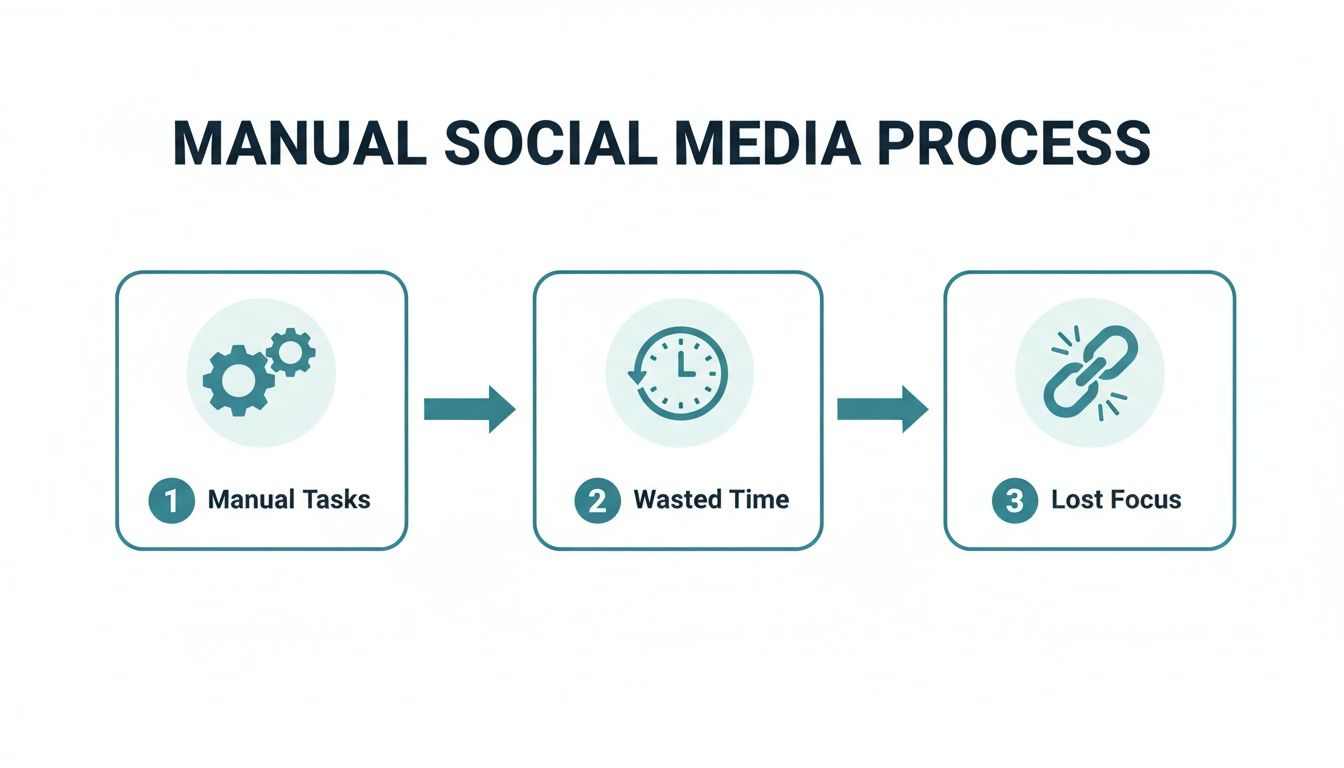
This cycle of inefficiency keeps founders stuck in the weeds. Automation is the way out.
Step 1: Monitor The Right Conversations (Our Exact Filters)
You can't find opportunities if you're not listening in the right places. For us, that means zeroing in on specific Reddit communities where our ideal customers are talking about their problems.
Our Core Subreddit Watchlist:
- r/startups: The go-to for founders sharing growth struggles.
- r/SaaS: A hub for real talk about software models and customer acquisition.
- r/marketing: A community for professionals trading strategies and tool recommendations.
- r/growmybusiness: A smaller but highly relevant subreddit for tactical business questions.
To get an idea of how granular this gets, here's a snapshot of our actual monitoring blueprint.
BillyBuzz Internal Reddit Monitoring Blueprint
This is a simplified look at how we structure our monitoring to track relevant conversations and filter out the noise from the start.
| Target Audience | Key Subreddits | High-Intent Keywords | Negative Keywords (to filter noise) |
|---|---|---|---|
| SaaS Founders | r/SaaS, r/startups |
"user acquisition", "reduce churn", "find first customers", "alternative to [Competitor]" | "hiring", "job", "free", "intern" |
| Indie Hackers | r/indiehackers, r/solopreneur |
"how to get feedback", "validate my idea", "tired of manual", "marketing automation" | "design", "no-code", "course", "portfolio" |
| Marketers | r/marketing, r/PPC |
"social listening tool", "reddit monitoring", "brand mentions", "sentiment analysis" | "SEO", "content marketing", "email", "internship" |
We use BillyBuzz to set up alerts that act as digital tripwires. We’re not just tracking a single keyword; we’re listening for specific phrases that signal intent, like "how to find customers on reddit" or "tired of manual social media." For a deep dive, see our guide to setting up real-time social media alerts.
Step 2: Filter Out The Noise (Our Alert Rules)
Monitoring alone is useless if it just drowns you in notifications. The most critical step is to filter aggressively. We use AI-powered relevancy scoring to do this. Our system doesn't just see a keyword; it understands context.
Our Internal Alert Rules:
- Rule #1: Exclude Self-Promotion. We automatically filter out any post flaired as "Showoff," "Promotion," or containing phrases like "check out my new app." This cuts 40% of the noise instantly.
- Rule #2: Prioritize Questions. Posts containing a question mark ("?") or starting with "How do I..." or "What's the best way to..." are flagged with a higher priority. This signals a user is actively seeking a solution.
- Rule #3: Sentiment Threshold. We only send alerts to our main Slack channel if the sentiment score is neutral or negative. A post saying "I hate doing X manually" is a much hotter lead than someone praising a tool.
By the time an alert hits our Slack channel, we know it’s something that needs a human's attention.
Step 3: Engage With Value (Our Response Templates)
Finally, this is where the human element comes back in. Automation finds the opening; our team provides the value. Our goal is never to just drop a link and run.
A Snippet of Our Go-To Engagement Templates:
- The "Been There" Template (for frustration): "Hey, finding your first users on Reddit can be a real grind. I've been there. A couple of things that worked for us were focusing on hyper-niche subreddits and always leading with value before mentioning our product. Happy to share more if it's helpful."
- The "Direct Advice" Template (for questions): "Great question. The best way we've found to [solve their problem] is to [provide a 2-sentence tactical tip]. It's more effective than [common mistake]. We actually built a tool to automate this listening part, but the tip above is a solid place to start."
- The "Resource Drop" Template (for tool requests): "Instead of just plugging our own tool, here are three options we've seen work well: [Tool A], [Tool B], and ours, [BillyBuzz]. The key is to find one that fits your workflow. The biggest differentiator for us is [one key feature]."
This value-first approach turns a cold interaction into a warm conversation.
Crafting Engagement That Sounds Human, Not Robotic
Automation is fantastic for getting you to the starting line. But authenticity is what wins the race. The biggest fear founders have is sounding like a spambot, and it’s a valid concern.

Our philosophy is simple: automate the discovery, humanize the response. Our system pinpoints the conversation, but a real person always crafts the reply. Over-automating engagement is a rookie mistake that can get you banned from communities.
The BillyBuzz H.E.L.P. Framework
We run every comment through a four-step framework we call H.E.L.P. It’s our internal check to ensure we're adding value and building trust before ever mentioning our product.
- H - Humanize: Acknowledge their specific problem.
- E - Empathize: Connect with their struggle. ("I've been there.")
- L - Link to Value: Give them a no-strings-attached resource or tip.
- P - Prompt a Follow-up: End with an open-ended question.
From Good to Great Responses
Imagine our system flags a post on r/startups where a founder writes, "I'm burning hours every week trying to find customers on Reddit. Is there a better way?"
A Good (But Basic) Reply:
"You should try using keyword alerts. Set up alerts for phrases your customers use. It saves a lot of time."
It’s generic and lacks a human touch.
A Better (Value-First) Reply:
"Hey, I totally get the grind of manual Reddit monitoring—it can feel like a full-time job. One thing that helped us was getting super specific with 'long-tail' keywords instead of broad terms. For example, instead of 'marketing,' we started tracking 'how to find first 100 users.' Hope that helps!"
This is much better. It provides a specific, valuable tip.
The Best (H.E.L.P. Framework) Reply:
"That's a tough spot to be in, and I've definitely been there. (H) The manual scroll is a real time-sink when you're trying to build a business. (E) One framework that works well is to monitor for problem-based keywords, not just solution-based ones. For instance, track phrases like 'tired of manual posting' or 'can't find beta testers.' (L) What's the biggest challenge you're facing with customer discovery right now? (P)"
This reply is a conversation starter, not a dead end. It’s packed with value and opens the door for a natural follow-up where we can eventually introduce BillyBuzz. For more, check our checklist for effective social media engagement.
Integrating Automation Across Your Growth Stack
A single automation tool is a good start. But the real magic happens when you treat it as part of an interconnected growth engine. At BillyBuzz, a single Reddit alert can be the first domino in a chain reaction that drives real revenue. To connect these dots effectively, it helps to understand how to implement marketing automation from the ground up.
Demystifying The Integrated Stack
Connecting your tools sounds complicated, but it isn't. Using services like Zapier or Make, you can build workflows without writing a single line of code. You just create a simple rule: "When this happens in App A, do that in App B."
Your growth stack should work like a relay race. Social media automation spots the opportunity and passes the baton. Your CRM and communication tools carry that opportunity across the finish line.
The goal is a seamless flow of information from discovery to conversion.
The BillyBuzz Alert-to-Action Workflow
Here’s the exact workflow we use to turn a Reddit mention into a qualified sales opportunity. Imagine our system detects a post in r/SaaS: "We're looking for an alternative to [Competitor Name], their pricing is too high."
Our Automated Workflow Unpacked:
- 1. Trigger (BillyBuzz): Our tool spots the phrase "alternative to [Competitor Name]" in r/SaaS and scores it high for relevancy.
- 2. Notification (Slack): An alert is instantly pushed to our
#reddit-leadsSlack channel with a direct link to the post and context. - 3. Lead Creation (HubSpot CRM): Simultaneously, Zapier creates a new "Deal" in HubSpot, assigning it to the "New Opportunity" stage of our pipeline.
- 4. Task Assignment (HubSpot): The same Zap assigns a task to our team member for Reddit engagement with a due date of 2 hours, ensuring rapid follow-up.
- 5. Content Signal (Notion): The workflow also logs this mention in our Notion database, tagged "Competitor Mention - Pricing." If we see this tag pop up a lot, it’s a signal to our content team to write a "[Competitor Name] Alternative" blog post.
This entire sequence happens in seconds. This is the power of an integrated social media automation system—it’s not just about listening; it's about acting intelligently at scale.
Measuring the Real ROI of Your Automation Efforts
If you can't measure it, you can't improve it. As founders, we live by that. We track specific KPIs that show how our automation efforts contribute to the bottom line.
Beyond Likes: The KPIs We Actually Track
We focus on three core metrics that link social media activity to real business growth:
- Conversations Joined: The number of high-intent discussions our team actively participates in after an alert.
- Website Clicks from Social Replies: We use UTM parameters in every link we share to track click-throughs from our engagements.
- Leads from Monitored Keywords: The ultimate metric. When a user we engaged with on Reddit signs up, we attribute it back to the specific keyword and conversation.
For a deeper dive, our guide on measuring social media ROI with a cost-benefit analysis offers more frameworks.
A Simple Framework for Calculating Automation ROI
Your ROI isn't just about leads gained; it's also about founder-hours reclaimed. Time saved from manual scrolling is time reinvested into product, sales, and strategy.
Manual Effort vs Automated Workflow Comparison
| Task | Manual Approach (Weekly Hours) | Automated Approach (Weekly Hours) | Key Benefit of Automation |
|---|---|---|---|
| Finding Relevant Conversations | 10-15 hours | 0 hours (real-time alerts) | Frees up 10+ hours per week of high-cost founder/employee time. |
| Filtering Out Noise/Spam | 5-7 hours | < 1 hour (reviewing filtered alerts) | Drastically reduces context-switching and mental fatigue. |
| Engaging with Potential Leads | 3-5 hours | 3-5 hours | Time is refocused exclusively on high-value, strategic conversations. |
| Total Weekly Time Investment | 18-27 hours | ~4-6 hours | Reclaims ~15-20 hours of productive time every single week. |
The numbers speak for themselves. Automation shifts your energy from low-value searching to high-value engagement.
1. The Investment (The Costs):
- Tool Costs: Let’s say it’s $150/month.
- Time Cost: 5 hours/week on engagement at a founder's rate of $100/hour is $2,000/month.
- Total Monthly Investment: $2,150.
2. The Return (The Value):
- Value of Leads: If automation generates 5 qualified leads per month, and each lead has a lifetime value (LTV) of $2,000, the total lead value is $10,000.
- Value of Time Saved: Reclaiming 15 hours/week (60 hours/month) at $100/hour is $6,000 in reclaimed founder time.
- Total Monthly Return: $10,000 (leads) + $6,000 (time) = $16,000.
With these numbers, your monthly ROI is $13,850. Smart social media automation isn't an expense—it’s a high-leverage investment in growth.
Common Automation Pitfalls and How to Avoid Them
Automation can backfire if you're not careful. Here are some hard-won lessons from our journey at BillyBuzz.
Pitfall 1: Sounding Inhuman and Spammy
The fastest way to kill your credibility is over-automating engagement with auto-replies or auto-follows. They have zero context and scream "I'm a bot!"
Our Battle-Tested Solution: A simple rule: Automate discovery, not engagement. Our system finds the conversations, but a real person always crafts the reply using our H.E.L.P. framework.
Pitfall 2: The "Set It and Forget It" Mentality
Setting up your monitoring tools once and never looking at them again is a huge mistake. Language evolves, new competitors pop up, and your keywords become stale.
Our Battle-Tested Solution: We perform a quarterly keyword audit. Every three months, we review all our alert rules, negative keywords, and target subreddits to keep our alerts sharp and relevant.
Pitfall 3: Focusing on the Wrong Platforms
Spreading your efforts too thin is a recipe for failure. Just because you can monitor a platform doesn't mean you should.
Our Battle-Tested Solution: Go deep, not wide. We consciously decided to master Reddit first because that’s where our ideal customers were having unfiltered conversations. Focus your social media automation efforts where your customers are most active.
Founder FAQs on Social Media Automation
Let's tackle the most common questions we hear about bringing social media automation into a startup.
Is Social Media Automation Too Expensive for a Startup?
The real question isn't the cost of the tool—it's the cost of not using it. The founder time you save from manual scrolling is worth thousands. Many tools have startup-friendly pricing that scales as you grow. The return is reclaiming your most valuable asset: your focus.
How Long Does It Take to Set Up an Effective Workflow?
You can get a basic monitoring workflow running in under an hour. Define your core keywords, pick a few key subreddits, and connect alerts to Slack. The real work is spending about 30 minutes a week for the first month fine-tuning your filters. After that, a quick quarterly check-in is all you need.
Can Automation Hurt My Brand's Authenticity?
It absolutely can, if you do it wrong. The mistake is automating the engagement itself—using bots to auto-reply.
The rule we live by is simple: Automate discovery, not engagement. Use tools to find the right conversations, but always have a real human write the response.
Automation's job is to get you to the human moment faster, scaling your reach without sacrificing the connection that builds a loyal customer base.
Stop missing opportunities on Reddit. BillyBuzz uses AI to find your next customers in relevant conversations, so you can focus on engaging and growing your business. Start your free trial today.