

For a lean startup, social media customer relationship management isn't some complex corporate theory. It's our day-to-day system for turning online chatter on Reddit and Twitter into revenue. At my company, BillyBuzz, this means proactively finding conversations about our brand, our competitors, or the problems we solve—long before a support ticket ever lands in our inbox.
What Social CRM Means for a Lean Startup

Forget enterprise software that costs a fortune. As a founder, you don't need that bloat. You need a nimble, active listening machine you can build with simple tools. This is our playbook.
The approach is about flipping from reactive to proactive. Stop waiting for DMs and tags. Start hunting for opportunities. This is where we engage potential customers, solve problems for existing ones, and gather incredibly honest feedback in real-time. This isn’t just marketing; it’s a direct pipeline into product development, sales, and genuine brand building.
And it's not a niche strategy. The global social CRM market is already valued at a staggering $150.17 billion in 2024 and is expected to rocket up by over 53% in the next year alone.
The 'Listen, Engage, Track' Framework
At BillyBuzz, we built our entire social media customer relationship management system on a dead-simple, three-part framework. It’s a practical workflow that any founder can implement.
Here's a quick look at the three pillars that hold up our entire strategy.
| Pillar | What It Means | Key Outcome |
|---|---|---|
| Listen | Setting up alerts for keywords, competitor names, and problem-based questions across social channels. | We hear the conversations that actually matter. |
| Engage | Jumping into relevant conversations with a founder-to-founder voice. We help, we don't pitch. | We build authentic trust and establish ourselves as experts. |
| Track | Treating every interaction as a data point: a lead, a support issue, or product feedback. | We turn social noise into measurable business intelligence. |
This isn't just theory; it's our exact playbook for turning the chaos of social media into tangible business results. It’s designed to be lean, actionable, and focused on outcomes that move the needle, not just vanity metrics.
For startups stretched thin, exploring options like outsourced customer relationship management services can be a smart move. It allows you to manage customer relationships effectively without the overhead of a large in-house team. This frees you up to focus on high-level strategy, confident that no customer interaction is falling through the cracks. The goal is to build a system that punches far above its weight, creating the meaningful connections that truly drive growth.
So, Why Does Your Startup Really Need This?
Look, if you're an early-stage founder, ignoring what people are saying about your space on social media is like setting up a huge focus group and then walking out before anyone speaks. You're consciously letting potential customers drift away and giving your competitors free rein. A solid social media customer relationship management system isn't a "nice-to-have." For a team running on fumes and a tight budget, it’s an engine for growth.
I'm not talking theory here. This is about real ROI. At BillyBuzz, this approach directly hits the bottom line. It’s about finding golden opportunities you'd otherwise completely miss.
Find Sales Leads Hiding in Plain Sight
Your perfect customer probably isn't Googling your brand name. They're on Reddit or Twitter right now, asking things like, "What's the best tool for solving X?" or venting, "My current software for Y is awful." These are buying signals, flashing in bright neon, happening out in the open.
A social CRM is our radar for these exact conversations. By monitoring keywords related to the problems we solve—and our competitors' names—we swoop into these discussions at the right moment. This isn't cold outreach. It's showing up with a solution at the precise second someone is asking for it.
Build a Reputation That's Damn Near Bulletproof
Every negative comment is a chance for a masterclass in customer service, right out in public. It’s tempting to hide, but tackling criticism head-on builds a rock-solid reputation. When others see you actively fixing problems, it builds incredible trust.
It proves you're a founder who actually listens and gives a damn. This public problem-solving becomes powerful social proof, reassuring prospects that if something goes wrong, you'll be there to make it right. It’s how we turn frustrated users into our biggest fans.
A BillyBuzz Story: An alert popped up for a thread in a niche subreddit. Someone was venting about a workflow frustration—a problem our tool was built to solve. We didn't jump in with a sales pitch. We just commented, explaining how we ran into a similar issue ourselves. That one comment turned into a DM, then a demo. Better yet, that user's feedback became the inspiration for a new feature that's now a massive selling point.
Get Your Hands on Raw, Unfiltered Product Feedback
Let's be honest, insights from social media are a million times more valuable than a structured user interview. It's raw, unbiased, and completely unfiltered. People don't sugarcoat things when they think a brand isn't listening. This is where you find out what users genuinely love, what they can't stand, and what they desperately wish your product could do.
This direct pipeline to your users' brains is gold for your product roadmap. That Reddit story is a prime example—we didn't have to guess what to build next. Our users told us. When you plug that feedback loop straight into your development process, you're building a product people will actually pay for.
The numbers back this up, too. Customers who get responses on social media tend to spend 20%–40% more with those brands. On top of that, putting a CRM system in place is tied to a 27% jump in customer retention. The path from engagement to revenue is crystal clear.
Our Playbook for Finding Customers on Reddit and Twitter
Theory is one thing, but making it work is what matters. A killer social media customer relationship management strategy doesn't need a huge budget. As founders, we built our system at BillyBuzz from the ground up with affordable tools, smart filtering, and a repeatable process.
This is the exact playbook we use to turn conversations on Reddit and Twitter into business opportunities.
It all starts with listening. From there, we manage our reputation and scoop up valuable feedback to make our product better.
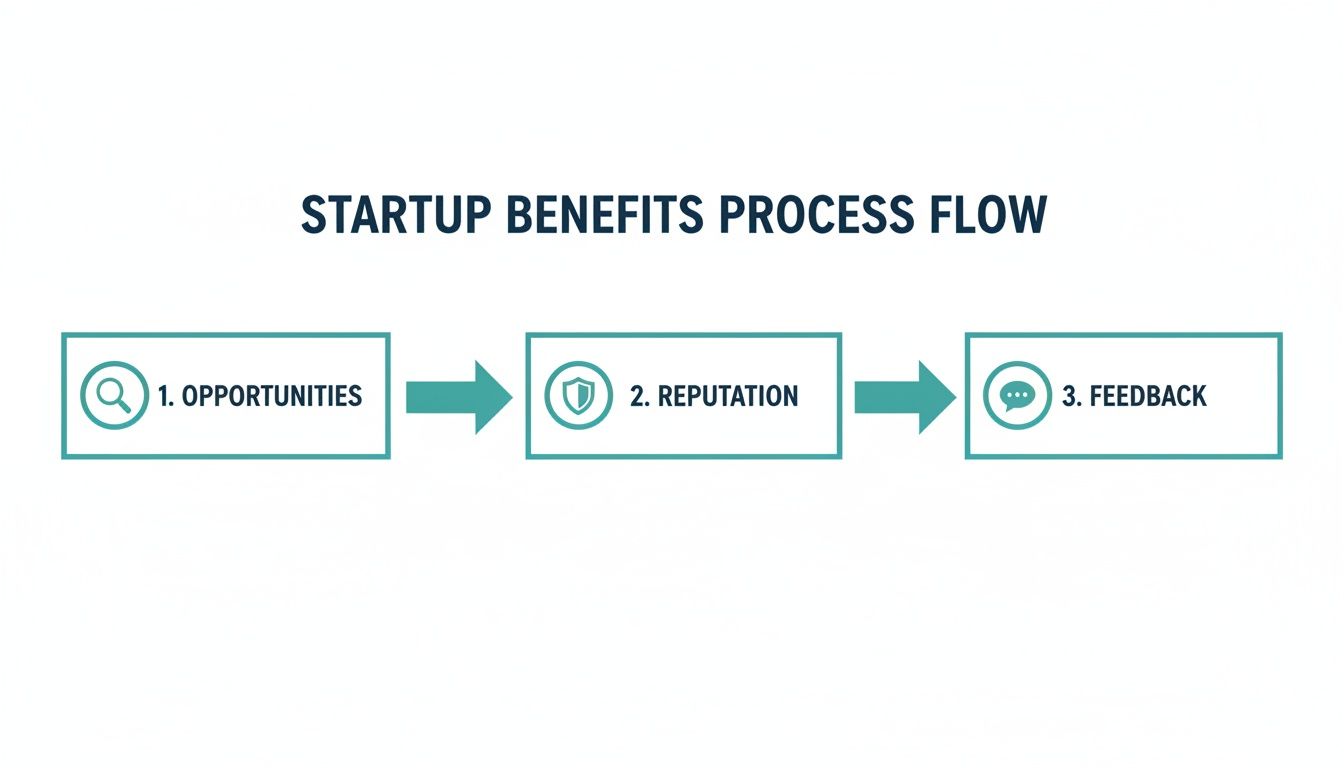
The idea is simple: we proactively listen for leads, then shift into protecting our brand and gathering insights that feed directly back into our development cycle.
Setting Up Your Listening Dashboard
First, build your "listening dashboard." This isn’t a single tool; it's a system that funnels important conversations into a place you already live. For us, that’s a dedicated Slack channel. The goal is to stop wasting time scrolling and start getting targeted alerts you can act on.
We use tools like Syften or F5Bot for Reddit alerts and lean on X Pro (formerly TweetDeck) for Twitter. These let us set up specific rules that cut through the noise and deliver only the good stuff straight to our team.
The Keywords We Actually Monitor
Your keyword strategy is the engine. Sure, monitor your brand name. But the real gold is in tracking problem-based questions and competitor mentions. This is how you find people ready to buy before they know you exist.
Our keywords fall into a few key categories:
- Brand Keywords:
BillyBuzz,billybuzz.com, and common misspellings. Basic brand hygiene. - Competitor Keywords: We track our top 2-3 direct competitors. We look for posts where their users are frustrated or searching for an alternative.
- Problem-Based Keywords: This is where the magic happens. We listen for phrases like
"how to track reddit mentions","best tool for finding leads on reddit", or"alternative to [Competitor Name]". These are pure buying signals. - Integration Keywords: We track tools we integrate with, like Slack or Zapier, combined with terms like
"reddit alerts". This helps us find potential users already in our ecosystem.
This layered approach means we catch conversations at every stage of the buyer's journey.
Filtering the Noise on Reddit and Twitter
Just tracking keywords will get you nowhere—you’ll be buried in chatter. The skill is in using filters to sharpen your alerts.
Our Reddit Subreddit Watchlist:
We don't monitor all of Reddit. We focus only on communities where our ideal customers hang out. Our core list includes:
r/startupsr/SaaSr/marketingr/growmybusiness- Niche subreddits tied to our customers' industries (e.g.,
r/b2bmarketing,r/indiehackers)
Our Go-To Twitter Search Operators:
On Twitter, advanced search operators are our secret weapon. Here are combinations we use in X Pro all the time:
"looking for a tool" AND "reddit": Finds people literally asking for a solution.[Competitor Name] -from:[Competitor Handle] "frustrated" OR "issue": Brings up competitor complaints, filtering out posts from the competitors themselves."how do you" OR "recommendation" AND "social listening": Helps us jump into conversations where people are asking for advice.
These filters are the difference between spending hours sifting through junk and minutes engaging with qualified leads.
The BillyBuzz Triage Matrix
When an alert hits our Slack channel, every mention gets quickly categorized using our simple "Triage Matrix." It’s how we assign priority and decide on the right response.
Here’s how we sort everything:
| Mention Type | Description | Our Action | Priority |
|---|---|---|---|
| Sales Lead | User asking for a solution we solve or is unhappy with a competitor. | Engage with a value-first response, offer help, gently introduce our solution. | High |
| Support Ticket | Existing customer has a question, issue, or bug. | Acknowledge immediately, offer to move to a private channel (DM/email), tag support lead. | Critical |
| Feature Request | User wishes our tool could do something new. | Thank them, ask clarifying questions, log it in our product feedback tracker. | Medium |
| Brand Advocacy | Someone positively mentions or recommends BillyBuzz. | Thank them sincerely, amplify their message (retweet/share). | Medium |
This simple matrix turns social listening into a structured, repeatable process. It empowers anyone on our team to know exactly what to do with any mention.
How to Respond to Build Real Relationships
Finding the conversation is the start. The real magic of social media customer relationship management happens in the reply. As founders, we can't afford to sound like a faceless corporation.
At BillyBuzz, every response is filtered through one principle: a founder-to-founder tone. We talk to people as peers, as if we're in the trenches together. No corporate jargon, no stiff language, no generic replies. It’s about being human, helpful, and genuine. This isn't just about being nice; it's a strategy. It turns a fleeting interaction into a real relationship.
Our Response Templates
We don't use copy-paste templates, but we do follow frameworks. Here are a few we rely on.
Template for a Sales Lead:
"Hey [Username], saw you were looking for a way to [solve specific problem]. It's a tough one. We ran into that a lot when we were building [Your Product]. What worked for us was [offer genuine, non-product advice].
If you're looking to automate it, our tool [Your Tool Name] was built for exactly that. Happy to answer any questions if you have them, but hope the tip helps either way!"
Template for a Competitor Complaint:
"Ugh, that sounds frustrating. Dealing with [specific issue] can really kill your workflow.
Not to pile on, but if you do decide to look for an alternative, many of our users switched from [Competitor] because they wanted [Key Feature You Have]. No pressure at all, just wanted to offer another option. Hope you get it sorted!"
Template for Negative Feedback:
"Hey [Username], founder here. Thanks for the honest feedback, and I'm genuinely sorry we missed the mark on this. [Acknowledge specific pain point] is not the experience we want for our users.
I'm sending you a DM right now to get your details so I can personally look into this and make it right."
These frameworks ensure our responses are consistently helpful and on-brand, while still leaving room for personalization.
De-escalating Negative Feedback Publicly
Negative comments aren't a crisis. They're a public opportunity to show you care. We stick to a simple three-step process:
- Acknowledge Publicly: Your first reply must be public. Thank them for the feedback and validate their frustration. "I'm really sorry to hear you're running into this" goes a long way.
- Empathize Sincerely: Show them you understand. "That sounds incredibly frustrating, and I can see why you're upset" proves you're actually listening.
- Move to a Private Channel: Immediately after, take the conversation offline. "I'm sending you a DM right now to get your account details so we can fix this for you personally."
This strategy shows everyone watching that you take feedback seriously, while preventing a messy public back-and-forth.
You can discover more strategies on how to scale these kinds of interactions in our guide on 5 ways AI enhances customer engagement on Reddit. This is all about giving you the tools to engage with confidence, turning every reply into a chance to build another strong relationship.
Automating Social CRM Without Losing the Human Touch

As you scale, manually refreshing feeds isn't an option. The conversation firehose becomes too much. This is where most teams either give up or hire a big team. We chose a third way: smart, lightweight automation.
The point of our social media customer relationship management automation isn’t to replace humans—it's to make our small team operate like one five times its size. We automate the repetitive work, freeing us up to focus on the conversations that matter.
Building Our Automated Alert-to-Action Workflow
Our core automation connects our listening tools directly to our workspace. We live in Slack, so that's where every important mention lands. To build this bridge, we use Zapier.
When a tool like Syften or F5Bot finds a high-priority mention on Reddit, it triggers a "Zap" that instantly pipes the alert into our dedicated #social-mentions channel in Slack.
But we don't stop there.
The Zap doesn't just drop a link; it formats a message with all the critical context we need. It pulls in the user's comment, a direct link to the thread, and gives us buttons for immediate action, like "Claim & Reply" or "Archive."
This setup means we're not constantly switching tabs. Everything we need is delivered right to us. If you want to see the nuts and bolts, you can check out our guide on how to set up Slack alerts for Reddit mentions in about 10 minutes.
Our Alert Rules for Slack
To avoid alert fatigue, we configure our tools to only send mentions that meet specific criteria. For example, in Syften, we set up rules like:
- Topic: "SaaS" or "Marketing Tools"
- AND Keyword: "recommendation", "alternative to", "how do I"
- AND Subreddit:
r/SaaS,r/startups - AND Negative Keywords:
-job,-hiring,-free tool(to filter out irrelevant posts)
This ensures that by the time an alert hits Slack, it's already highly qualified and worth our attention.
When done right, smart automation allows digital channels to handle 70%–80% of service interactions. And the numbers show that companies embracing AI in their customer service see 17% higher customer satisfaction. It's proof that the right blend of technology and human touch really works.
Measuring the ROI of Your Social CRM
You can't improve what you don't measure. In social media, it's easy to get caught up in vanity metrics—likes, shares, followers. But as a founder, those numbers don't pay the bills. A real social media customer relationship management strategy has to be tied directly to results.
At BillyBuzz, we built a simple dashboard that answers one critical question: is this working? That means cutting through the noise and zeroing in on the KPIs that signal growth.
The Metrics That Actually Matter
Forget about drowning in spreadsheets. We obsess over just four core metrics.
Here’s what we keep on our radar:
- Leads Generated from Social: Our north star. We track exactly how many qualified sales conversations or demo requests started with a social media interaction. This draws a straight line from social activity to revenue.
- Average Response Time: Speed is a competitive advantage. We measure how quickly we jump on a high-priority mention. A fast response shows you're paying attention.
- Support Tickets Deflected: Every time we solve a customer's problem publicly on Reddit or X, it’s a huge win. We track these because each one prevents a formal support ticket, saving our team time.
- Sentiment Shift: We keep a close eye on the overall tone of conversations about our brand. The goal is a steady shift from neutral or negative mentions toward a more positive vibe.
A simple system for tracking these KPIs is non-negotiable. We use a basic spreadsheet that any founder can replicate. Each row represents a significant interaction, with columns for the metric it impacts (Lead, Ticket Deflected), the platform, a link to the conversation, and the outcome.
For a detailed look at the financial benefits of automating these kinds of processes, check out this comprehensive analysis on CRM Automation vs. Manual Data Entry: ROI Comparison. Understanding the numbers behind it really helps justify the time you invest.
Ultimately, tracking these focused metrics elevates social media from just another marketing channel into a core business function. To go deeper, you can learn more about measuring social media ROI with a cost-benefit analysis, which will help you build a rock-solid case for your efforts.
Common Social CRM Questions for Founders
Getting started with social media CRM can feel like just another thing on a founder's never-ending to-do list. I get it. Here are some no-nonsense answers to the questions we hear most often from other founders, based on how we’ve made this work at BillyBuzz.
What Are the Best Low-Cost Tools to Start With?
You do not need to drop a ton of cash on a fancy, all-in-one suite. The goal is to build the habit of listening, not to master complex software.
We recommend starting with free or nearly-free tools. For Twitter monitoring, X Pro (formerly TweetDeck) gets the job done. For Reddit, which is a goldmine for honest feedback, a tool like F5Bot or Syften is perfect. They give you super-targeted keyword alerts for a small monthly fee.
The real magic happens when you connect these alerts to a place you already live. For us, that's a dedicated Slack channel. This transforms social listening from a chore into a natural part of your team's daily flow.
How Much Time Should I Dedicate to This Daily?
Forget about spending hours scrolling. Consistency crushes intensity. All you need is a focused 20-30 minute block each day to review your alerts and jump on the conversations that matter.
Because you have an automated system feeding you opportunities, this isn't mindless browsing. It's a focused, strategic session where you triage mentions, answer questions, and connect with people. In the early stages, having the founder personally involved sets a genuine, helpful tone that builds a real community.
Our rule is simple: 'Acknowledge, Empathize, and Move Private.' First, publicly acknowledge the user's frustration. Second, show you understand their pain. Third, immediately take it private by saying something like, 'I'm sending you a DM right now to get the details and fix this for you.'
This approach shows everyone you’re listening and you care, but it moves the messy details of problem-solving offline. The one thing you should never, ever do is get into a public argument. It's a fight you can't win. This method not only protects your brand's reputation but often turns an unhappy user into one of your biggest fans.
Ready to stop missing out on customer conversations happening on Reddit? BillyBuzz uses AI to find high-intent leads and brand mentions, sending them directly to your Slack so you can engage at the perfect moment. Start finding your next customers today.