

Forget the fluff. A social media content strategy is a founder's battle plan for turning online chatter into customers. It's not a fancy document you write once and forget; it's the system that stops you from wasting time posting into the void and starts generating real business results.
As a founder, I live this every day. Our strategy is what separates random, hopeful posting from building a genuine growth machine. This is our playbook, founder-to-founder—no theory, just what we actually do.
Why A Documented Strategy Is Non-Negotiable
Time is your most valuable asset. Without a plan, social media is a black hole that will suck up hours with nothing to show for it. A documented strategy is your blueprint for turning that time into a growth lever.
At BillyBuzz, we went from throwing content at the wall to a structured approach we can trace back to our bottom line. Instead of waking up and asking, "What should I post today?", your strategy gives you a clear path.
It’s about building a predictable system that consistently attracts the right people for your business.
From Chaos to Cohesion
Posting without a strategy is like navigating a new city without a map. You're moving, but you have no idea if you're getting closer to your destination. A documented plan is your GPS.
It forces you to answer the essential questions upfront:
- Who are we actually talking to? Pinpointing your ideal customer ensures your content hits the mark.
- What's the end goal here? Clear, measurable goals turn your efforts from a guessing game into a science.
- How can we genuinely help them? This flips the script from "What can we sell?" to "What value can we provide?"
Answering these transforms social media from a reactive chore into a proactive growth tool. This structured approach is fundamental for any founder. For a deeper dive, this guide to building a strong social media presence covers more of these foundational steps.
The Power of Intentional Action
A written strategy aligns your entire team. It becomes the single source of truth for your brand's voice, content topics, and the metrics that truly matter. As you grow, this alignment is critical.
The internet is noisy. By 2025, a staggering 65.7% of the world's population will be on social media, with ad spending hitting $276.72 billion. Just showing up isn't enough. You have to show up with a purpose.
A great strategy doesn't just tell you what to do; it tells you what not to do. It gives you the confidence to say no to distracting trends and focus on activities that drive real business results.
The Seven Core Components of Our Winning Strategy
A solid social media strategy has seven essential gears. If one is off, the whole thing grinds to a halt. At BillyBuzz, we built our approach around seven core components that work together to turn social media into a predictable growth engine.
This isn't theory—it's the exact blueprint we follow. Any founder can use this system to ensure every post has a purpose.
1. Setting Smart Goals
Before we write a single post, we define what success looks like. Vague goals like "increase brand awareness" are useless. We stick to the SMART framework: Specific, Measurable, Attainable, Relevant, and Time-bound.
A real goal for us is: "Increase website referral traffic from Reddit by 15% in Q3 by engaging in five relevant conversations daily." This gives us a clear target and tells us instantly if we're winning.
2. Deep Audience Research
You can't create content that hits home if you don't know who you're talking to. We go beyond basic demographics to understand our audience's pain points and the actual words they use to describe their problems.
Our secret weapon is Reddit. We use BillyBuzz to monitor subreddits like r/saas and r/startups for phrases like "customer feedback tool" or "how to find first users." This gives us a direct line into our customers' struggles, which fuels our entire content plan.
Your best content ideas won't come from a brainstorming session; they'll come directly from listening to the struggles of your target audience.
3. Identifying Content Pillars
Once we know our audience, we set up content pillars. These are the 3-5 core topics our brand will own. We live by the 'Educate, Entertain, Convert' model.
- Educate: Actionable tips on social listening and finding customers on Reddit. This builds authority.
- Entertain: Founder stories, wins, and failures. This makes our brand human.
- Convert: Case studies, testimonials, and product updates. We keep this to a minimum—sticking to the 80/20 rule.
This framework ensures we're always giving more than we ask for, which is key to building trust.
4. Choosing Platforms And Formats
We don't try to be everywhere. As a startup, our resources are finite, so we focus where our audience is most engaged. For us, that’s primarily Reddit and LinkedIn.
Then, we tailor the format. A detailed text post about product-market fit does great in r/startups, but a short video summarizing the key takeaways performs better on LinkedIn. The right format on the right platform makes all the difference.
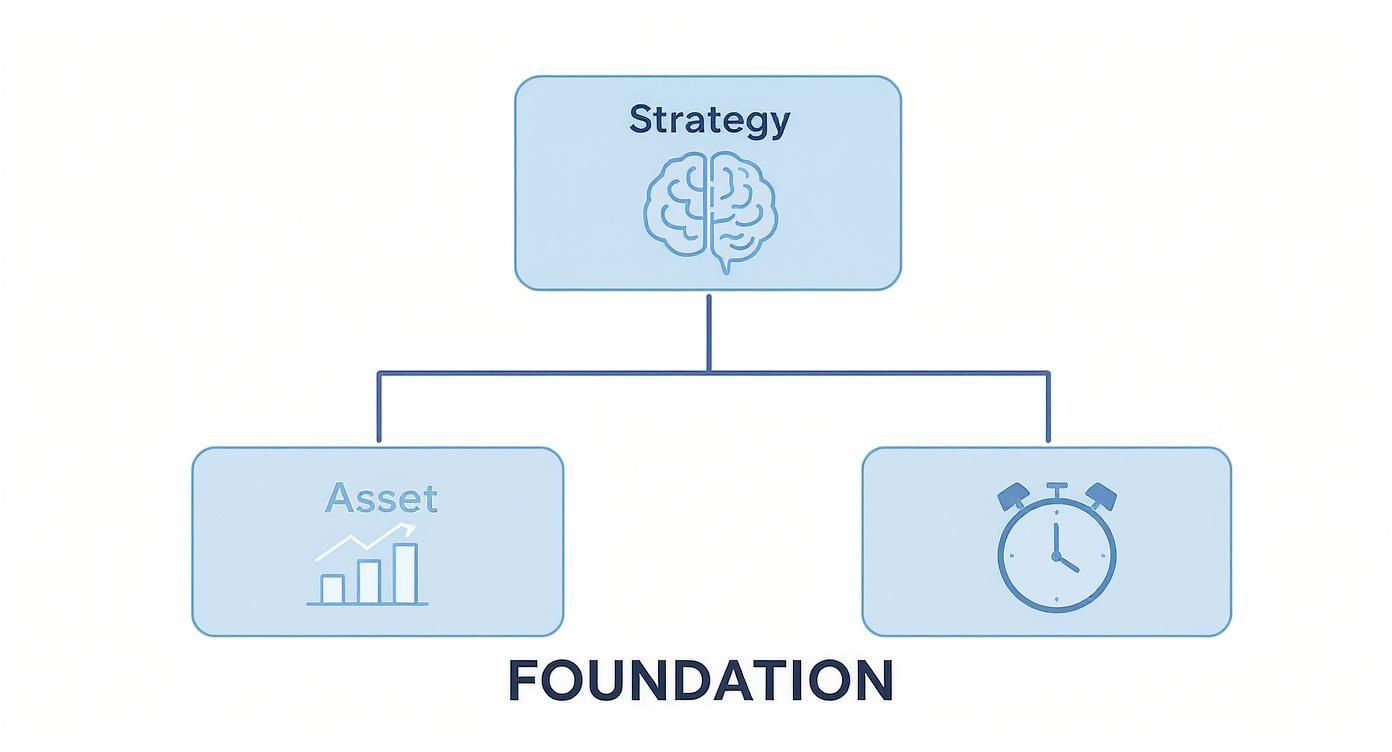
This visual shows how we think about it: a real strategy turns social media from a time sink into a tangible business asset.
5. Building A Content Calendar
The content calendar is our single source of truth. It's where we map out posts, align them with our pillars, and maintain a consistent rhythm. It's non-negotiable. For LinkedIn, check out this guide on creating a LinkedIn content calendar.
Our calendar isn't just a schedule; it’s a strategic tool that stops us from scrambling and keeps our messaging tight.
6. Smart Distribution And Engagement
Creating content is half the job. We spend just as much time getting it in front of the right people. For us, that means using BillyBuzz to find relevant conversations where we can add value.
We never just drop links. We answer questions, offer advice, and engage like real people. This "comment-first" approach builds our reputation and naturally pulls people to our website.
7. Measuring Kpis That Matter
Finally, we measure everything. We ignore vanity metrics like follower counts and focus on Key Performance Indicators (KPIs) that connect to our SMART goals.
Our go-to metrics:
- Engagement Rate: Are people interacting with our posts?
- Click-Through Rate (CTR): Are our posts convincing people to click links?
- Website Referral Traffic: How many visitors are coming from our social channels?
Tracking these KPIs tells us what's working so we can double down and constantly refine our strategy.
This framework might seem like a lot, but each component builds on the last. Here’s a quick summary.
Our 7-Component Strategy Framework
This table breaks down the seven components, showing the key question each one answers and our action at BillyBuzz.
| Component | Key Question It Answers | Our Action at BillyBuzz |
|---|---|---|
| 1. SMART Goals | What do we want to achieve and how will we measure it? | Set quarterly goals for website referrals from social media. |
| 2. Audience Research | Who are we talking to and what do they care about? | Monitor keywords in r/saas and r/startups with BillyBuzz. |
| 3. Content Pillars | What core topics will we consistently talk about? | Focus on Educate (social listening), Entertain (founder journey), and Convert (case studies). |
| 4. Platforms & Formats | Where will we post and what will the content look like? | Prioritize text-based content for Reddit and visual carousels for LinkedIn. |
| 5. Content Calendar | When and what are we posting to stay consistent? | Use a shared calendar to plan posts two weeks in advance. |
| 6. Distribution & Engagement | How will we get our content in front of the right people? | Dedicate 1 hour daily to finding and joining relevant conversations. |
| 7. KPIs & Measurement | Is our strategy working and how do we know? | Track engagement rate, CTR, and referral traffic in a monthly report. |
By systematically addressing these seven areas, we ensure our social media is a focused, effective driver of business growth.
Building Your Content Engine Inside BillyBuzz
A great social media content strategy isn’t a static document. It's a living machine that finds opportunities and turns online chatter into customers.
Let's get out of theory and into the trenches. Here’s a founder-to-founder look at how we run our entire strategy using our own tool, BillyBuzz. This is our real, day-to-day workflow.
A plan is useless without execution. For us, that means building a powerful listening system that works 24/7.
Setting Up Our Keyword Alert System
The heart of our engine is a set of specific alerts designed to surface conversations that signal real problems we can solve. Here are the exact alert rules we have running inside BillyBuzz right now:
- Brand Mentions: We track "BillyBuzz" and common misspellings. This is our first line of defense for support and the best way to find authentic testimonials.
- Competitor Activity: We monitor mentions of main competitors. This helps us find their dissatisfied customers who might be looking for an alternative.
- Pain Point Keywords: This is our goldmine. We track phrases like "find customers on Reddit," "social listening tool for startups," and "how to get feedback." These are the literal problems our product solves.
This simple system takes the guesswork out of content creation. We're hearing what our audience wants directly from them.
Our High-Intent Social Listening Filters
Just getting alerts isn't enough—you'll drown. The key is to cut through the noise. We apply a few powerful filters to every alert. Our go-to filters inside BillyBuzz include:
- Subreddit Targeting: We focus exclusively on
r/startups,r/saas, andr/growmybusinessto ensure we're talking to a hyper-relevant audience. - Negative Keywords: We filter out irrelevant terms like "free," "jobs," or "hiring" to eliminate noise.
- Sentiment Analysis: We prioritize conversations with negative sentiment around our competitors (a churn opportunity) and question-based sentiment for our pain point keywords (a chance to be helpful).
This filtering means when we get an alert, it’s almost always actionable. That's the difference between passive monitoring and active listening.

This screenshot shows our dashboard where we build these precise rules, making sure every notification is a high-value signal. For a deeper dive, check out our guide on how BillyBuzz can maximize your startup's growth.
Our Go-To Response Templates
When you find a great conversation, speed and consistency are everything. We use a handful of battle-tested response templates that we customize for every interaction. We never just copy and paste.
Template 1: The Helpful Expert (Pain Point Response)
"Hey [Name], saw you were asking about [Pain Point]. A lot of founders struggle with this. One thing that helped us was focusing on [Actionable Tip]. We built a tool to automate this, but the core principle is the same. Hope that helps!"
This template positions us as helpful, not salesy. We introduce our product naturally as a solution instead of leading with a hard pitch.
Social listening has become a cornerstone of modern content strategy. The market for these tools is projected to grow from $9.61 billion in 2025 to $18.43 billion by 2030. By building an engine like this, you’re creating a sustainable system for growth.
Platform-Specific Tactics We Actually Use
The biggest mistake a founder can make is posting the same content everywhere. Every platform has its own culture. To win, you have to speak like a native.
LinkedIn is for professional insights, while TikTok runs on authentic, short videos. A staggering 77% of its largely Gen Z user base find new products there. You can't drop a text-heavy LinkedIn post into that world and expect it to land. For a deeper dive, check out these social media demographics from Sprout Social.
At BillyBuzz, we don’t try to be everywhere. We go deep, not wide. We focus on platforms where founders are looking for answers. This means specific, repeatable playbooks for LinkedIn, X, and our goldmine: Reddit.
Our LinkedIn Comment-First Strategy
On LinkedIn, our goal is to build authority. We do this with a "Comment-First" strategy.
We spend 80% of our time leaving insightful comments on posts from other leaders in the SaaS and startup world. A good comment is like a mini-essay—it offers a unique take or shares a relevant story. This positions us as experts.
The other 20% of our time is for creating one high-value post per week, usually a carousel that pulls together lessons we've learned from those conversations.
Our X Thread Ripping Technique
X is about speed and information density. We use a technique called "Thread Ripping."
We find a high-performing thread from an expert in our niche. Then, we "rip" the core idea and reframe it through the lens of social listening. We're not plagiarizing; we're adding our unique spin.
For instance, if a thread is "10 ways to find your first 100 customers," we'll write one titled: "You're trying to find your first 100 customers the hard way. Here’s how to use social listening to have them come to you." This gives us a proven format and injects our value into a conversation that already has momentum.
The Reddit Playbook For Authentic Engagement
Reddit is our highest-value channel. It's also the most unforgiving. Our strategy is built on one principle: be a member first, marketer second.
We never drop promotional links. Instead, we use BillyBuzz to monitor specific subreddits for conversations where we can genuinely help.
Our rule is simple: if our product isn't the absolute best solution to the user's problem, we don't mention it. We just offer helpful advice and move on. This builds immense trust.
These are the subreddits we live in:
- r/saas: Perfect for discussions on SaaS metrics and growth challenges.
- r/startups: Essential for tapping into the pain points of early-stage founders.
- r/growmybusiness: Great for finding tactical questions about lead generation.
- r/Entrepreneur: A broader community for engaging with founders on strategy.
Every interaction is manual and personal. This approach has generated more high-intent leads for BillyBuzz than all other channels combined. To go deeper, check out our guide on how to get customers from Reddit.
Choosing Content Formats That Drive Engagement

The best message will fall flat if it’s in the wrong package. For a solid social media content strategy, how you say something is as critical as what you say.
As founders, we don't have time for content that doesn't work. We’ve learned that a diverse mix of formats is key. It’s not about mastering every format, but about knowing which tool to use for which job.
At BillyBuzz, our format selection is a deliberate choice based on the platform, the message, and the action we want someone to take.
Our 80/20 Rule for Content Formats
We apply the 80/20 rule to our content: 80% is pure value (educate, entertain, solve a problem) and only 20% is directly promotional.
The data shows video is king. By leaning into educational and tutorial-style videos, we build authenticity. You can see how much video dominates in this breakdown of social media demographics.
When we map out a video script, the first 80% is dedicated entirely to solving a problem. Only in the last 20% might we mention how BillyBuzz can help.
By front-loading the value, we earn the right to make a brief promotional ask. This respects our audience's time and has transformed our engagement rates.
The BillyBuzz Content Format Playbook
We focus on a handful of core formats that work for other founders. Each has a specific job.
- Short-Form Video (Reels/Shorts): Our top-of-funnel workhorse for quick, actionable tips. The goal is education and brand discovery.
- Carousels (LinkedIn): Our mini-guides. We use them to break down complex topics into digestible slides, encouraging saves and shares.
- Long-Form Text (Reddit/Blog): This is where we go deep. On Reddit, we write detailed, helpful comments that often become the raw material for longer blog posts.
- Ephemeral Stories (Instagram): Used for the raw, behind-the-scenes stuff like polls and Q&As to build a human connection.
Repurposing One Idea into Four Formats
To stay efficient, we repurpose every core idea.
- Start with a long-form blog post: A detailed guide like "Finding Your First 10 Customers on Reddit."
- Break it into a carousel: Pull out the 5-7 key steps for a LinkedIn carousel.
- Script a short-form video: Take the single most impactful tip and create a 30-second Reel.
- Create a Story poll: Ask a related question in our Instagram Stories, like "What's your biggest struggle with Reddit?"
This workflow turns one idea into a week’s worth of content, each piece perfectly tailored to its platform.
Measuring Success with Reports That Actually Matter

If you can’t measure it, you can’t improve it. This is where most social media strategies fall apart. Founders get caught up chasing vanity metrics—a huge follower count looks great but is just noise if no one is clicking, engaging, or buying.
We learned this the hard way. We had to ignore the ego-boosting numbers and zero in on Key Performance Indicators (KPIs) that showed a business impact.
Making this mindset shift lets you have real conversations about ROI and make decisions based on data, not gut feelings.
Moving Beyond Vanity Metrics
The first step is to get clear on what success looks like. For us, it meant prioritizing metrics that prove our content is pushing people to take action.
These are the three KPIs we live by:
- Engagement Rate: The percentage of people who saw a post and interacted with it (comments, shares, saves). This is our clearest signal of content quality.
- Click-Through Rate (CTR): How many people clicked a link in our post. It’s a direct measure of how compelling our call-to-action is.
- Conversion Rate: The ultimate proof. It tracks how many clicks turned into a desired outcome, like a newsletter sign-up or demo request.
Tracking these metrics connects your social media activity directly to business goals. For a deeper dive, our guide on measuring social media ROI breaks down how to connect these numbers to your finances.
Our Simple Monthly Report Template
We use a dead-simple monthly report to keep ourselves focused. It’s a basic spreadsheet that gives us a clear snapshot of what’s working.
Your report shouldn't just be numbers. It should tell a story: "We tried X, which led to Y, so next month we will do more of Z."
Here’s a peek at our template:
BillyBuzz Monthly Social Media Report
| Metric | Last Month | This Month | Change (%) | Key Takeaway |
|---|---|---|---|---|
| Engagement Rate | 2.5% | 3.1% | +24% | Posts about founder struggles drove the highest engagement. |
| Click-Through Rate | 1.8% | 2.2% | +22% | Carousel formats on LinkedIn had the best CTR. |
| Website Referrals | 150 | 195 | +30% | Reddit comments generated the most qualified referral traffic. |
| Leads Generated | 8 | 12 | +50% | Our "Comment-First" strategy is converting well. |
This format forces us to analyze the why behind the numbers, turning metrics into actionable insights for the next month.
Founder FAQs on Social Media Strategy
As founders, we get the same questions from others in the trenches. Trying to build a solid social media content strategy can feel like another mountain to climb, so we wanted to answer the most common questions with what works for us at BillyBuzz.
How Much Time Should a Founder Dedicate to Social Media Each Week?
There's no magic number, but a great strategy makes every minute count. A good starting point is 3-5 hours per week. The trick is to work smart. Using a tool like BillyBuzz to schedule posts and monitor keywords is a game-changer.
Consistency is everything. A focused 30 minutes every day is more powerful than 4 hours once a week. Let your strategy guide you, and social media stops being a time-suck and becomes a growth channel.
What’s the Biggest Mistake Startups Make with Content Strategy?
Hands down, focusing on selling instead of serving. So many startups treat social media like a megaphone, shouting about their product. A winning strategy flips that—provide value first to build the trust needed to make a sale later.
At BillyBuzz, we live by the 80/20 rule. A full 80% of our content is designed to educate, entertain, or solve a problem. Only 20% is about our product.
This mindset shift is huge. It turns your social presence from another ad into a go-to resource, pulling in the right people for the right reasons.
How Soon Can I Expect to See Results from a New Strategy?
This is a marathon, not a sprint. You might see encouraging engagement wins in the first 1-2 months. But seeing meaningful results that impact your bottom line—like a steady stream of leads—usually takes 3-6 months of consistent effort.
It's easy to get discouraged, so don't. Instead, watch the leading indicators that tell you you're on the right track. These are the signals we obsess over:
- Growing engagement rates: Are more people interacting with our stuff over time?
- Increased follower velocity: Is our audience growing faster this month than last?
- More website referral traffic: Are people clicking through from social to our site?
Nailing these proves your strategy is working long before the first big lead comes in. Focus on them, stick with the plan, and the results will follow.
Ready to stop guessing and start listening? BillyBuzz is your AI-powered engine for finding real customers on Reddit. Get real-time alerts for high-intent conversations and turn online chatter into your next big win. Find out more at BillyBuzz.