

Picking a social listening tool feels like a trap. Most comparisons are packed with enterprise features a startup founder will never use. What you actually need is a tool that finds real leads, not just brand mentions for a report.
At BillyBuzz, it comes down to two things: signal quality and workflow efficiency. Everything else is just noise.
Why Your Social Listening Tool Is Failing You
As a founder, you're not just monitoring sentiment; you're hunting for your next customer. The problem with most social listening tool comparisons is they miss the point for startups: finding conversations where people are practically begging for your solution.
So many platforms are bloated with dashboards and vanity metrics. They look impressive, but they don't help your bottom line. We learned the hard way that a tool's worth isn't in how many mentions it finds, but in the quality of the opportunities it surfaces.
We got tired of overpaying for features with no impact. Instead, we built our own framework on three simple pillars:
- Signal Quality: How good is the tool at finding people asking for help right now? It's about filtering out spam and finding genuine buying intent.
- Workflow Efficiency: How fast can you go from an alert to a helpful reply? Every extra click is a lost customer.
- Scalability: Can the tool grow with you without a massive price hike? Predictable costs are non-negotiable when you're bootstrapped.
Our Top Contenders at a Glance
Think of this as a playbook from one founder to another. I'm sharing the exact criteria we use, focusing on practical outcomes. Forget endless feature lists; we're diving into what actually moves the needle when every dollar has a job.
If you want an even deeper dive, check out our guide on the top social monitoring tools for startups in 2024.

To start, here’s a high-level look at the tools we stand by. This isn't a list of features; it’s how we actually use them to get results.
Quick Comparison of Top Social Listening Tools for Founders
This table summarizes our top recommendations based on the core needs of a startup founder, focusing on practical use cases.
| Tool | Best For | Key BillyBuzz Use Case | Starting Price |
|---|---|---|---|
| Brand24 | All-Around Brand Monitoring & Lead Gen | Catching high-value mentions on Twitter and news sites that require a quick PR response. | $79/mo |
| Mention | Real-Time Alerts & Competitor Tracking | Setting up instant alerts for competitor feature launches to inform our own product roadmap. | $49/mo |
| Syften | High-Signal Reddit & Forum Monitoring | Finding users in niche subreddits asking for a "BillyBuzz alternative" or describing a pain point we solve. | $19/mo |
Each of these tools has earned its spot by proving its value. Now, let's break down what makes each one tick.
Core Features That Actually Drive Growth
When you're shopping for a social listening tool, it's easy to get bogged down in feature lists that sound fancy but don't actually move the needle. As founders, we have to cut through the marketing jargon and zero in on what really helps find customers and protect our brand. These are the make-or-break features we demand at BillyBuzz.
A tool's real value isn't measured by how complex its dashboard looks. It's about the quality of the signal it pulls from all the noise. Think of it as the difference between getting blasted with a firehose of irrelevant mentions versus receiving a handful of high-intent leads every single day.
Advanced Search and Filtering
Honestly, this is the most important feature. If you can't build precise, targeted queries, you're just wasting time. Basic keyword tracking is practically useless. You need advanced boolean search to slice through the chatter and pinpoint real buying signals. This is something we live and breathe at BillyBuzz.
For instance, here’s a query structure we actually use to find early-stage SaaS buyers on places like Reddit:
("looking for a tool" OR "recommendation for" OR "alternative to [competitor name]") AND ("project management" OR "CRM" OR "automation") NOT ("free" OR "internship" OR "student project")
This level of granular control is what turns a random mention into a genuine sales opportunity. You need a tool that lets you combine keywords, toss out junk with negative keywords, and even target specific sources like the r/saas or r/marketing subreddits.
Real-Time, Intelligent Alerting
Finding a mention two days after it was posted is a missed opportunity, plain and simple. Real-time alerts are crucial, but they have to be smart, otherwise you'll just be buried in notifications. The point isn't just speed; it's relevance. Your tool should let you build rules that trigger instant alerts for things that actually matter, like a scathing review or a direct question about buying your product.
We set up our alerts to escalate based on the sentiment and the source. A negative comment on a big tech blog? That triggers an instant Slack notification. A neutral mention on a tiny forum? That can wait for the daily email digest. You need a system that helps you prioritize, not just adds to the noise. For a deeper dive, we wrote a post on how AI can rank social media alerts by importance to make this process even sharper.
Data Sources and Historical Access
A lot of tools brag about monitoring millions of sources, but for a startup, quality beats quantity every time. Getting good data from high-signal communities like Reddit, Quora, and niche industry forums is far more valuable than scraping thousands of no-name blogs. We always look for tools with strong, native integrations with these platforms because that's where people have honest, unfiltered conversations.
Access to historical data is just as important. When you're testing a tool, see if you can look back at least three to six months. This lets you spot trends in brand sentiment, measure the real impact of a product launch, or identify customer pain points that keep popping up. Without that history, you're flying blind.
At BillyBuzz, our internal checklist for evaluating a tool’s core functionality weighs data quality from Reddit and niche forums at 40% of the total score. If a tool can't find high-intent conversations there, it's a non-starter for us, regardless of its other features.
The market is crowded with big names like Meltwater, Brandwatch, and Sprout Social, but don't get distracted. Your job is to find the tool whose data best reflects where your target customers hang out. The entire market is shifting toward customer experience management, which is expected to make up 25.3% of the application segment by 2025. This just proves why listening to customers on the right platforms is so critical. You can learn more by checking out the latest social listening market research.
A Side-by-Side Comparison From Our Daily Use
Theory is one thing, but how a tool performs day-to-day is where the rubber really meets the road. At BillyBuzz, we don't just review these platforms; we depend on them to find new customers. This comparison comes directly from our hands-on experience, focusing on the three things that actually matter to a startup: the quality of lead signals, how fast we see negative feedback, and how smooth the overall workflow is.
We aren't hung up on endless feature lists. What we care about is how many clicks it takes to find a real person asking for help and how quickly we can get back to them. So, here’s our honest, founder-to-founder breakdown of Brand24, Mention, and our favorite budget-friendly workhorse, Syften.
Lead Generation Signal Quality
For any founder, the number one job of a social listening tool is finding high-intent leads. This is all about cutting through the internet noise to find posts from people actively looking for a solution just like yours.
- Brand24: This tool is excellent for casting a wide net, especially across Twitter (X) and news sites. Its real strength is catching mentions from high-authority domains. We use it to spot journalists or established companies talking about our industry, which often points to a higher-value opportunity. The filtering is powerful, but you have to be disciplined with your "excluded keywords" to avoid drowning in low-quality alerts.
- Mention: Mention excels at real-time alerts from a massive range of sources, including blogs and forums. We’ve found its lead-gen signal to be solid, but it definitely requires some careful tuning. A great tactic for us has been tracking competitor names alongside words like "alternative" or "recommendation" to jump into conversations where people are ready to make a switch.
- Syften: This one is our specialist for high-signal, low-volume communities. Syften is hyper-focused on Reddit, Hacker News, and very specific forums. For finding developers, marketers, and other founders talking about niche pain points, the signal quality is simply unmatched. Because the sources are so well-curated, the mentions are almost always relevant. It has become our go-to for laser-focused lead generation.
Based on our daily grind, Syften consistently delivers the highest signal-to-noise ratio for finding actionable leads on Reddit. While Brand24 finds more mentions overall, Syften finds the conversations most likely to become a new customer for BillyBuzz.
Negative Feedback Alert Speed
When a customer is upset, every single minute counts. The speed at which you learn about negative feedback can be the difference between a resolved issue and a public relations fire.
- Mention: This is where Mention really stands out. Its real-time alerting is arguably the fastest of the three. We have a dedicated Slack channel that gets instant pings from Mention for any mention of "BillyBuzz" combined with keywords like "bug," "issue," "problem," or "broken." This setup has let us solve a customer's problem in under five minutes.
- Brand24: The alerts are quick, but not quite instantaneous like Mention's. We typically see them within 15-30 minutes, which is still fantastic. Where Brand24 adds real value is with its "Storm Alerts," which notify you of a sudden spike in mentions. This is a lifesaver for spotting a potential crisis before it blows up.
- Syften: Since Syften focuses on less "real-time" platforms like forums and Reddit, its speed is geared toward flagging new posts and comments, not minute-by-minute updates. It's perfect for what it does, but it's not the tool we rely on for instant crisis management.
This visual summary highlights the core functions that drive our evaluation process, from initial search capabilities to data analysis.
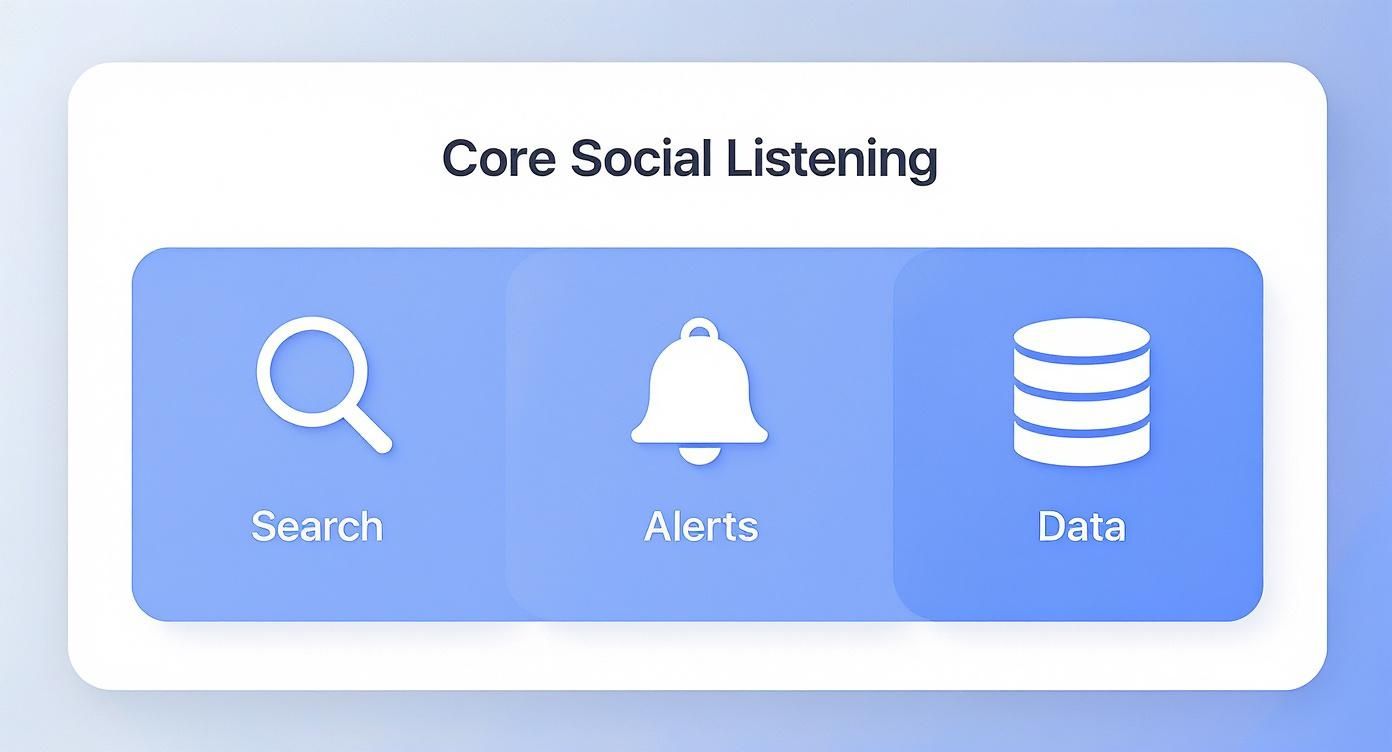
Ultimately, each of these features—searching, alerting, and data handling—must work together seamlessly to create an efficient workflow. For a comprehensive look at how various platforms stack up, exploring the capabilities of the best social media management tools can provide additional context.
Workflow Efficiency
How many steps does it take to get from an alert to an actual response? An inefficient workflow is a time vampire and a productivity killer—a death sentence for a small team. We measure this in clicks and context-switching.
- Brand24: The dashboard is clean and has great filtering, but it can sometimes feel a bit click-heavy just to get to the source and reply. Its integrations with tools like Slack do help streamline the initial notification, though. We find it’s at its best when we're analyzing trends over time rather than engaging in rapid-fire conversations.
- Mention: Mention’s entire workflow is built for speed. The ability to reply directly from the dashboard for some platforms and the easy "mark as complete" or "assign to team member" features make it incredibly efficient for collaboration. Plus, the mobile app is fantastic for handling mentions when you’re not at your desk.
- Syften: With its direct email and Slack alerts, Syften gives us the most streamlined workflow for our Reddit monitoring. An alert hits our Slack, we click the link, and we're dropped right into the Reddit thread. There’s no clunky dashboard to navigate, which we see as a feature, not a bug. It’s built to do one job—find and act on mentions—and it does it with almost zero friction.
Feature Showdown Brand24 vs Mention vs Syften
To put it all in perspective, here's a quick, task-oriented look at how these tools perform on the jobs that matter most to us at BillyBuzz.
| Feature/Task | Brand24 Performance | Mention Performance | Syften Performance |
|---|---|---|---|
| Finding Niche Leads | Good for broad topics on Twitter/news, but requires heavy keyword exclusion. | Solid, especially for finding users looking for competitor alternatives on blogs and forums. | Excellent. Unbeatable signal-to-noise ratio for Reddit, Hacker News, and targeted communities. |
| Crisis Management Speed | Very good (15-30 min alerts). "Storm Alerts" are a unique plus for spotting viral issues. | Excellent. The fastest real-time alerts of the three, perfect for immediate damage control. | Not its primary function. Better for monitoring community sentiment over time. |
| Team Workflow | Okay. Good for analysis but can be click-heavy for rapid response. | Excellent. Built for team collaboration with assignments and direct replies. Mobile app is a huge win. | Excellent. Dead simple. Slack alert -> click -> reply. Zero friction for a solo founder or small team. |
| Ease of Setup | Requires some initial work to set up projects and fine-tune keyword filters. | Straightforward setup, but requires ongoing tuning of alerts to reduce noise. | The simplest of the three. You can be up and running with high-quality alerts in minutes. |
At the end of the day, there's no single "best" tool—only the best tool for the job at hand.
Choosing the right platform comes down entirely to your immediate goals. If you need a comprehensive view of the web with powerful analytics, Brand24 is a strong contender. If your priority is lightning-fast alerts and a workflow built for team response, Mention is hard to beat. And for targeted, high-quality lead generation in niche communities with zero friction, Syften is an indispensable part of our stack.
Our Internal Social Listening Workflow and Templates
A good tool is only half the battle. You need a process to turn alerts into leads. At BillyBuzz, we’ve refined our process to be lean and effective. The goal: find high-signal conversations without drowning in noise.
This isn’t theory. This is our exact, day-to-day Standard Operating Procedure (SOP). I'm sharing it so other founders can copy our system and start finding customers. It’s about building a repeatable growth engine that just works.

Nailing Our High-Intent Alert Rules
The whole workflow depends on the quality of our alerts. We spend a lot of time tweaking Boolean queries to filter out spam and find conversations with real buying intent. Sloppy rules create a firehose of noise, leading to burnout and missed opportunities.
Our rules catch three types of conversations: direct buying signals, competitor mentions, and general pain points.
1. Lead Generation Alerts (High-Intent)
This is our bread and butter. It’s tuned to find people actively looking for a solution like ours.
- Keywords:
"looking for a tool","recommendation for","any suggestions for","how do you manage" - Required Words:
social,Reddit,monitoring,listening,alerts - Excluded Words:
free,internship,student,course,job
This setup filters out low-quality posts from people who aren't in a position to buy.
2. Competitor "Alternative" Alerts
This is our secret weapon for finding users who are fed up with a competitor.
- Keywords:
"[Competitor A] alternative","alternative to [Competitor B]","frustrated with [Competitor C]" - Required Words:
tool,software,app - Excluded Words:
review,comparison article,news
We jump into these conversations because the user already understands the need and has a budget. The sales cycle is much shorter.
The Subreddits We Live In
For a B2B SaaS company like ours, Reddit is a goldmine. But monitoring the whole site is a mistake. We focus exclusively on the subreddits where our ideal customers—founders, marketers, and product managers—hang out.
Our primary targets are:
- /r/saas: Perfect for conversations about growing a software business.
- /r/marketing: A hub for marketers talking about tools and strategies.
- /r/startups: Where founders share challenges and look for solutions.
- /r/ProductManagement: Great for insights into the tools product teams use.
By focusing on a handful of high-value subreddits, we avoid the noise. This targeted approach means almost every alert is from a potential customer.
Our Copy-Paste Response Templates
When an alert hits, speed and tone matter. We use templates to be consistent and efficient, not to sound like robots. We customize each one. The golden rule is always: be helpful first, salesperson second.
Template 1: Engaging a Potential Lead
- Goal: Provide value before mentioning our product.
- Template: "Hey [Name], great question. When we were looking for a tool to solve [Pain Point], we found that most platforms struggled with [Specific Issue]. We ended up building BillyBuzz to focus specifically on [Our Key Differentiator]. It might be a good fit for what you're doing. Either way, hope you find the right solution!"
Template 2: Handling Negative Feedback (About Us or a Competitor)
- Goal: Acknowledge their frustration and offer a path forward.
- Template: "That sounds incredibly frustrating. I've definitely been there with [Pain Point]. We actually built BillyBuzz to help with that exact problem by [How We Solve It]. No pressure at all, but happy to answer any questions if you're exploring other options."
Template 3: Thanking a Happy Customer
- Goal: Amplify positive mentions and show appreciation.
- Template: "Wow, [Name], this just made our day! So glad to hear BillyBuzz is helping you with [Specific Use Case]. Thanks so much for the kind words!"
This structured workflow—precise alerts, targeted communities, and thoughtful responses—is the engine that powers our customer acquisition. It’s a system built for action, not just observation.
Breaking Down the True Cost and ROI
The pricing page for a social listening tool is really just the starting point. As a founder, you have to dig deeper than the monthly fee to figure out the true cost of ownership. A tool's sticker price is meaningless if it doesn't bring back a real return on your investment.
The actual costs are usually buried in the fine print. Things like limits on mentions, users, and keywords are where most startups get into trouble. A plan with a 10,000-mention limit might seem like plenty, but if you're tracking a big competitor or a hot industry topic, you can blow through that in a week. Suddenly, you're facing an expensive, unplanned upgrade.
We learned this the hard way at BillyBuzz. In our early days, we started tracking broad terms like "social media marketing" and hit our plan's cap almost instantly. It forced us to get laser-focused with our alert rules, using tight boolean logic and negative keywords to make sure every mention we captured was valuable. This is a critical step for anyone comparing social listening tools.
Beyond the Monthly Subscription Fee
Here’s a secret: the biggest hidden cost isn't money—it's your time. A complicated tool can easily eat up 10-15 hours just for setup, configuration, and constant tweaking to filter out the junk. For a founder, that time is worth far more than the subscription price. This is where the ROI calculation gets real.
Think of it like this: if a $99/month tool saves you 10 hours of manual searching and helps you land even one new customer paying $50/month, it has paid for itself many times over. On the flip side, a $29/month tool that only finds spam is a complete waste of money and time. You can get more insight on this in our guide to measuring social media ROI.
The fundamental question for any founder is simple: does this tool generate more value than it costs? At BillyBuzz, if a tool can't find us at least one qualified lead per week, it doesn't justify its cost, regardless of how low the price is.
The Scalability of Cloud-Based Platforms
Thankfully, most of the industry has moved toward flexible, scalable tools. Today's cloud-based social listening platforms dominate the market because they're affordable and easy to integrate. This trend holds true for huge companies and small businesses alike, letting teams grow their monitoring efforts without a massive upfront investment. You can find more data on this global trend in social listening tool adoption.
This cloud-first approach is perfect for startups. You can begin with an entry-level plan and then scale up your keyword tracking and user seats as your revenue and team expand. This pay-as-you-go model eliminates the risk of sinking too much cash into a platform you might not fully use. The trick is to find a provider with a clear, predictable upgrade path, so you don't get slammed with a 5x price jump just because you need to add one more person to the team. It’s a practical financial gut-check every founder needs to make.
So, Which Social Listening Tool is Right for Your Startup?
After spending countless hours digging into these platforms, here’s our final take: there's no single "best" tool. It really boils down to your startup's current stage and what you need to accomplish right now. Founders often make the mistake of paying for features they don't use, and that's a cash drain we want to help you avoid.
We've broken down our recommendation into two clear scenarios. This is the straight-up, founder-to-founder advice we wish someone had given us back when we were starting BillyBuzz.
For the Bootstrapped Founder
If you're in the trenches, bootstrapping your way to your first 10, 20, or 50 customers, your world revolves around one thing: finding high-intent leads. You don't need fancy analytics or a global monitoring dashboard. You just need a direct line to people who are actively looking for a solution like yours.
For this specific job, we wholeheartedly recommend Syften. It’s laser-focused on high-signal communities like Reddit, and its workflow is brilliantly simple: you get a Slack alert, you click, and you reply. It’s the most efficient lead-gen engine we've seen for a solo founder or a tiny team, with the highest signal-to-noise ratio and absolutely zero feature bloat.
For the Funded, Scaling Startup
Once you've found product-market fit and you're scaling your team, your needs change. Now you're thinking bigger. You need a tool that can handle broad brand monitoring, keep an eye on competitor launches, and help your customer service team manage your reputation in real time.
In this situation, we recommend Brand24. It gives you the comprehensive coverage and solid analytics you need to manage a growing brand's footprint across news sites, blogs, and social media. Their Storm Alerts are a lifesaver for crisis management, and the reporting features make it easy to show investors where their marketing dollars are going.
Our final piece of advice? Be brutally honest about what you need today. A tool that finds you one paying customer is infinitely more valuable than a tool with a hundred features you never touch.
Making the right choice here is a big deal. The global social listening tools market is projected to hit as high as $10.46 billion by 2025, a clear sign that businesses are doubling down on real-time customer insights. You can find more details on the social listening tools market growth on wkinformation.com.
Investing in the right tool isn't just a small tactical decision; it's a strategic move that builds a solid foundation for growth. Pick the tool that solves today's problem, and you’ll be in a much better position to win tomorrow.
Frequently Asked Questions
When we talk to other founders, they always want to know how we handle social listening at BillyBuzz. It's a common pain point. So, here are some straight answers to the questions that come up most often, based on what we've learned firsthand.
How Much Should a Startup Budget for Social Listening?
This is a big one. It's tempting to go for the big, flashy tool, but our advice is to start small. Don't jump straight into a $250/month plan. Instead, find a solid tool in the $50-$100 range and prove its value first.
The real question is, can you show a clear return on that investment? If the tool helps you land enough qualified leads or saves you hours of manual searching, then it's paying for itself. Once you've proven the ROI, you can feel confident about scaling up your spending.
How Long Does It Take to Set Up a New Tool?
Honestly, it depends on the tool. A simple, laser-focused tool like Syften can be up and running with quality alerts in less than 30 minutes. You can get in, set it up, and start seeing results quickly.
On the other hand, more complex platforms like Brand24 or Mention require a bit more TLC. Expect to spend a few hours fine-tuning your projects, keywords, and alert rules. You really have to dial it in to cut through the noise. At BillyBuzz, we block out about half a day for any new tool. That initial time investment saves us from drowning in irrelevant mentions for weeks to come.
How Do You Actually Measure the Effectiveness of a Tool?
We keep it simple and focus on what actually moves the needle for the business. For us, it boils down to two key metrics: Leads Generated and Time Saved.
Here's how we track them:
- Leads Generated: Every time we respond to a mention found by a tool, we use a unique UTM link. This lets us see exactly how many demo sign-ups came from that specific source. No guesswork involved.
- Time Saved: We calculated how many hours we used to sink into manually searching for mentions. Now, we just compare that to the tool's cost. If a $99/month tool saves a founder 10 hours of work, that’s an easy win.
This approach keeps us grounded. We're not interested in vanity metrics; we want to see how these tools directly contribute to our growth. It ensures every dollar we spend is working for us.
Ready to stop missing high-intent leads on Reddit? BillyBuzz uses AI to find relevant conversations and sends them directly to your Slack, so you can engage customers at the perfect moment. Start your free trial today and see the difference.