

Public relations measurement is all about tracking your PR efforts to see how they’re actually helping your business grow. It’s the difference between just counting how many times your company gets mentioned and connecting every article, tweet, and Reddit comment to real results like more website traffic, new leads, and ultimately, sales.

Ditching the PR Guesswork for Good
As a founder, you live and die by your metrics. You obsess over customer acquisition cost, churn rates, and monthly recurring revenue. So why does public relations so often get a pass, tossed into the vague bucket of "brand awareness"?
The truth is, it doesn't have to. Measuring PR isn't just about justifying an expense; it’s about turning what feels like a cost center into a predictable engine for growth.
Forget the old-school approach of stacking up press clippings or calculating what the "ad value" of an article would be. That’s like judging a developer's performance by how many lines of code they write—it's a vanity metric that says nothing about the quality or impact of their work. For a startup, every dollar and every hour matters. You need to know if that feature in a major tech blog actually drove sign-ups, or if that viral Reddit thread brought in qualified leads.
This guide is a founder-to-founder playbook on PR measurement, cutting right through the academic fluff. I'm going to show you exactly how we do it inside BillyBuzz—no abstract theories, just what works in the real world. We’ll walk you through the mindset shift you need to make to tie your PR directly to business outcomes.
At BillyBuzz, we stopped asking, "How many mentions did we get?" and started asking, "How many qualified conversations did this mention start?" This single change transformed our entire approach to PR and growth.
That shift is everything. It’s the difference between chasing fleeting headlines and building a sustainable system that proves your PR is actually moving the needle. We’ll explore how to set up simple yet powerful tracking that gives you complete confidence in your strategy.
Here’s what this guide will help you do:
- Connect PR to real goals: Stop tracking outputs (like articles) and start tracking outcomes (like new customers).
- Build a simple dashboard: Create a clear system to monitor what truly matters without getting buried in data.
- Prove ROI with confidence: Show your team, board, and investors exactly how PR contributes to the bottom line.
This is your blueprint for a measurement system that doesn't just report on the past but actively shapes your future growth. Let's dive in.
Moving Beyond Vanity Metrics in PR
If you want to get PR measurement right, you have to start by understanding what not to do. It’s incredibly easy to get hooked on flashy numbers that look great in a report but do absolutely nothing for your business. These are vanity metrics, and they’re the junk food of modern PR.
Measuring your success in column inches or just counting the number of articles you land is a classic example. It's like judging a software developer's skill by the number of lines of code they write—it's a totally misleading practice that completely misses the point about quality, context, and real-world impact.
The Old Guard of PR Measurement
Back in the early 2000s, PR measurement was a bit of a guessing game. The go-to metric was Advertising Value Equivalency (AVE), which tried to put a dollar value on earned media by calculating what it would have cost to buy that same space as an ad. By 2010, the industry finally started to see how broken this approach was.
Fast forward to today, and things look very different. Now, 76% of PR pros say reach is their most important metric, and 70% focus on engagement—things like shares, comments, and clicks. These are numbers that actually start to connect the dots back to real business goals.
The problem with AVE is that it gives you a false sense of accomplishment. Sure, that feature in a glossy magazine might have a huge "ad value," but if it doesn't drive a single qualified lead to your startup, what was the point? It’s a number that pads a slide deck but has zero connection to growth.
Outputs vs. Outcomes: The Core Shift
The single biggest change in how we measure PR is the move away from tracking outputs and toward focusing on outcomes. At BillyBuzz, making this one distinction completely changed our entire approach.
Here’s a simple way to think about it:
- Outputs: These are the direct results of your PR work. It's the "what you did." Think press releases sent, articles published, or pitches emailed.
- Outtakes: This is what your audience actually absorbs from your PR. It's the "what they thought." This is where you see brand awareness climb or perceptions start to shift.
- Outcomes: This is the big one—it's the "what they did." Outcomes are the concrete actions people take because of your PR, like visiting your website, signing up for a demo, or buying your product.
For us, the lightbulb moment was realizing we were celebrating outputs (a big article!) without ever checking for outcomes (did anyone actually sign up?). Now, an un-clicked article is just noise, no matter how prestigious the publication.
This framework forces you to tie every single PR activity to a real business result. It changes the conversation from, "Look at all the press we got!" to, "Look at how much pipeline this press generated." For a deeper dive into showing this kind of impact across all marketing efforts, this guide on how to measure marketing performance and prove its value is a fantastic resource.
Adopting this mindset is the first step. It helps you build a measurement system that actually fuels your startup’s growth instead of just stroking your ego.
The Startup PR Metrics That Actually Matter
Once you decide to stop chasing vanity metrics and start tracking real business outcomes, the next question is obvious: which outcomes should you actually be watching? In the startup world, you can't afford to get lost in a sea of data. You need a handful of public relations metrics that draw a straight line from your efforts to your growth.
This is our playbook. As a founder, I live and die by these numbers because they tell a clear story—from building top-of-funnel awareness all the way down to driving bottom-of-funnel conversions. We’re going to skip the high-level theory and jump right into how we track this stuff inside BillyBuzz.
This pyramid is a great way to visualize how PR metrics build on each other. You start with the basics at the bottom and work your way up to what really moves the needle.
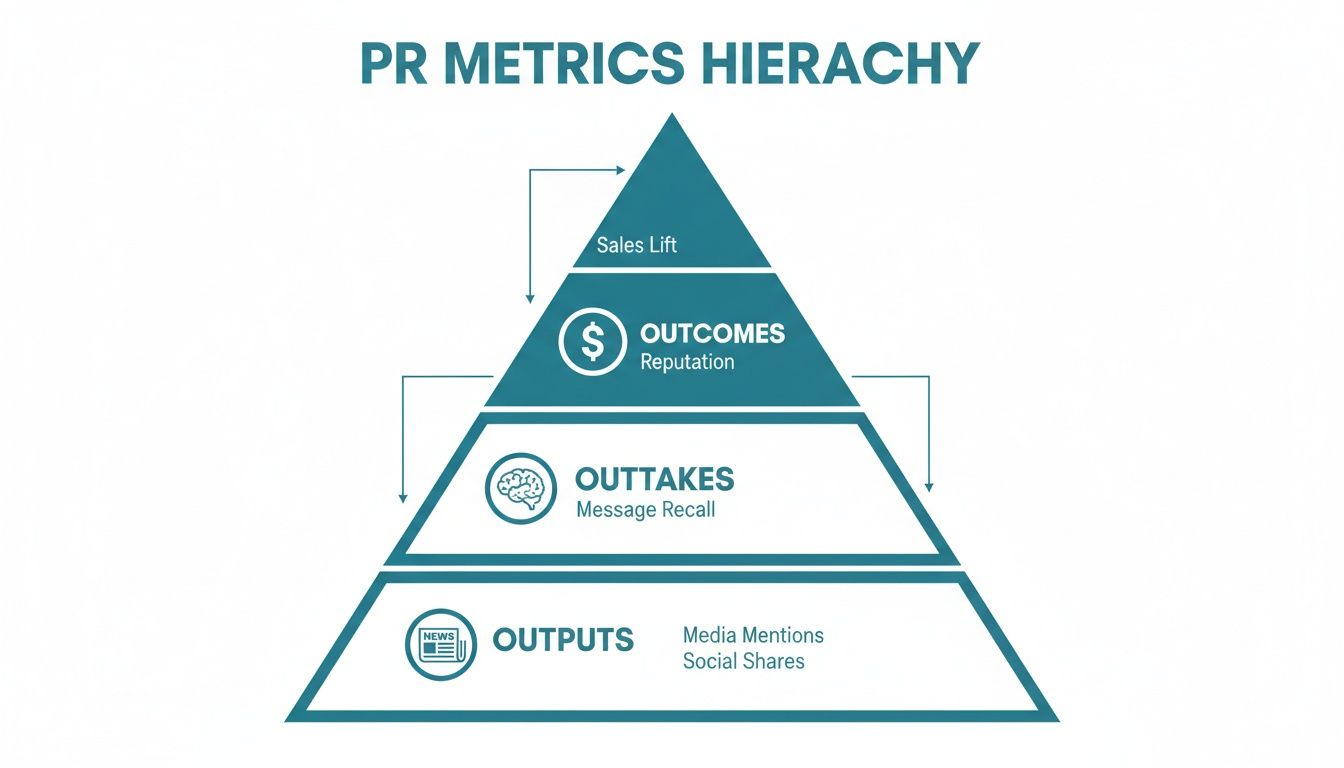
As you can see, outputs like media mentions are just the foundation. The real value comes from the outtakes (how your audience thinks and feels) and, most importantly, the outcomes (the impact on your business).
To bring this to life, we've put together a framework that contrasts the old, misleading metrics with the actionable ones we use every day. It’s a simple shift in mindset, but it makes all the difference.
The Startup PR Measurement Framework
| Metric Category | The Old Way (Vanity Metric) | The BillyBuzz Way (Actionable Metric) | Why It Matters for Founders |
|---|---|---|---|
| Awareness | Counting Media Mentions | Measuring Share of Voice (SOV) | It's not about how many times you're mentioned; it's about owning the conversation against your competitors. |
| Perception | Basic Mention Count | Sentiment Analysis | A single glowing review can be worth more than 100 neutral mentions. Context is everything. |
| Action | Total Website Visits | Referral Traffic Quality | You need to know which articles and posts send visitors who actually stick around and explore your product. |
| Conversion | Vague "Brand Lift" | PR-Influenced Leads & Conversions | This is the ultimate proof. It connects a specific PR hit directly to a new customer or trial sign-up. |
This framework isn't just about tracking different things; it's about asking better questions. Instead of "How many clips did we get?" you start asking, "How did that TechCrunch article influence our demo requests this month?"
Brand Mentions and Share of Voice
At the most basic level, you have to know when and where people are talking about you. But just counting your mentions is a rookie mistake. The real goal is to understand your presence within the entire industry conversation.
That's where Share of Voice (SOV) comes in.
SOV tracks your brand’s visibility against your direct competitors. Think of it as your slice of the conversational pie. If there are 100 total mentions for your industry’s key topics and your brand snags 25 of them, your Share of Voice is 25%.
We treat Share of Voice as our "awareness pulse." If our SOV starts to drop, it's an early warning sign that a competitor is out-marketing us or our messaging just isn't cutting through the noise. It's a leading indicator for future pipeline problems.
Inside BillyBuzz, we set up alerts for our brand name, our key features, and the names of our top three competitors. This gives us a real-time feed of the whole conversation, making it easy to calculate our SOV every single week.
Sentiment Analysis
Let's be honest: not all press is good press. A glowing review tucked away in a niche subreddit can be infinitely more valuable than a flat, neutral mention in a major publication.
This is exactly why Sentiment Analysis is so important. It lets you sort mentions into positive, negative, or neutral buckets, adding a much-needed layer of qualitative insight to your raw numbers.
We use sentiment scoring to prioritize where we spend our time. A negative mention isn't a crisis—it's an opportunity. We immediately flag angry comments for a direct, human response. On the flip side, we amplify positive mentions across our own social channels to squeeze every drop of value out of them. Suddenly, a simple tracking metric becomes an active reputation management tool.
Website Referral Traffic
Okay, here’s where PR starts to feel real. Website Referral Traffic shows you how many people are actually clicking through to your site from a media mention, a Reddit thread, or a social media share. It’s a hard, undeniable number that proves your PR is driving action.
We practically live inside Google Analytics 4 for this. We obsessively track which publications and online conversations are sending us the most traffic. But we don't stop there. We dig deeper to analyze the quality of that traffic:
- Time on Page: Are people actually reading our content, or are they bouncing immediately?
- Pages per Session: Are they curious enough to explore other parts of our site?
- Conversion Rate: Are these visitors signing up for a trial or booking a demo?
This tells us which sources send visitors who are genuinely interested in what we're building, helping us double down on the channels that deliver real results.
PR-Influenced Leads
This is the holy grail. For a startup, this is everything. A PR-influenced lead is someone who entered your sales pipeline after interacting with your earned media. Tracking this is how you prove ROI with cold, hard certainty.
Attribution can be a little tricky, but it's far from impossible. We use a combination of simple methods:
- UTM Parameters: We create unique UTM links for any content we have a hand in, like a guest post or a strategic comment on Reddit.
- "How Did You Hear About Us?" Field: It’s just an optional field in our sign-up form, but the qualitative data we get from it is priceless for connecting the dots.
- CRM Integration: We tag new leads in our CRM based on their referral source, which lets us track their entire journey from that first touchpoint to a closed deal.
When you bring all these metrics together, you get a complete picture of your PR impact. You can finally stop hoping your efforts are working and start knowing exactly how, where, and why they’re fueling your growth.
How to Build Your PR Measurement Dashboard
All this theory is great, but it’s worthless if you can’t put it into action. Now that you know what to measure, let's roll up our sleeves and build the system that actually does the tracking. This isn't about sinking your budget into expensive, complicated software; it’s about creating a simple, functional dashboard that ties your PR work directly to your startup’s growth.

Here at BillyBuzz, our "dashboard" isn't just one tool—it's an integrated system. We run everything through a souped-up Google Sheet that pulls in data from Google Analytics 4, our CRM, and our own social listening alerts. This simple setup gives us a complete, real-time picture of our PR performance, from top-of-funnel mentions all the way down to bottom-of-funnel conversions.
I'll show you exactly how we built it.
Step 1: Start with a Simple Google Sheet
Before you get fancy, start with a spreadsheet. Seriously. This will be your command center for manual tracking and high-level analysis. You can whip this up in less than an hour, and it immediately forces you to be disciplined about what you track.
Create a Google Sheet with these columns:
- Date: When the mention or activity happened.
- Source: The publication, website, or subreddit.
- Link: The direct URL to the mention.
- Sentiment: A quick judgment call: Positive, Neutral, or Negative.
- Key Message Pull-Through: Did the article actually include your key talking points? (Yes/No).
- Referral Traffic (7 Days): How many visitors did it send to your site in the first week? (You'll pull this from GA4).
- Leads/Sign-ups: How many direct conversions can you trace back to it? (This comes from your CRM).
The simple act of logging every significant mention forces you to stop and evaluate its real impact. It turns measurement from a passive chore into an active analysis.
Step 2: Integrate Your Key Data Sources
With your spreadsheet ready to go, it’s time to pipe in the automated data. This is where you connect the dots between a press hit and its real-world effect on your business. You’ll need to hook up three key sources.
1. Google Analytics 4 (GA4) for Referral Traffic:
GA4 is your ground truth for website traffic. Just head to Reports > Acquisition > Traffic acquisition. From there, you can filter the report by Session source / medium to see exactly which publications or social threads are sending people your way. This is how you'll fill in that "Referral Traffic" column.
2. Your CRM for Lead Tracking:
Connect your sign-up forms or demo requests to your CRM, and make sure you’re capturing referral source data. When a new lead comes in from a specific article you've tracked, you can log it right in your dashboard. This creates a direct, undeniable link between PR activity and pipeline.
3. BillyBuzz for Earned Media and Social Listening:
This is the secret to automating discovery. Manually searching for your brand name is a terrible use of a founder’s time. We use our own tool to get instant alerts so we never miss a thing.
At BillyBuzz, we have a dedicated Slack channel called
#buzz-alertsthat’s fed directly by our monitoring tool. Every time our brand, a competitor, or a key industry term is mentioned on Reddit, we know instantly. It's our early warning system and opportunity radar, all in one.
This kind of setup is crucial because so many PR pros struggle to prove their value. While 89% say proving impact is their top goal, half feel unsure about the data they report. To close this confidence gap, teams are adopting better tools: 46% now use social listening and 29% create executive dashboards to get the C-suite on board. It’s a clear move toward more robust, defensible reporting.
Step 3: Configure Your BillyBuzz Monitoring Rules
Want a peek inside our actual BillyBuzz setup? We use a combination of rules and filters to cut through the noise and find the conversations that truly matter.
Our internal alerts are set up to track:
- Brand Mentions: We track "BillyBuzz" and common misspellings to catch every single conversation.
- Competitor Mentions: We keep a close eye on our top three competitors. This helps us calculate our Share of Voice and spot opportunities where their customers are complaining.
- Problem-Based Keywords: We don’t just track brand names. We track phrases like "how to track Reddit mentions" or "social listening for startups." This helps us find potential customers who have the right problem but don’t know our solution exists yet.
The real magic, though, is in our AI filters. We set the relevancy filter to "High" to screen out passing mentions. This ensures we only get alerted to conversations with genuine purchase intent or strong sentiment, turning a firehose of data into a manageable trickle of high-value opportunities.
By combining a simple spreadsheet with automated data from GA4, your CRM, and a tool like BillyBuzz, you create a powerful, low-cost PR measurement dashboard. This system gives you a clear, quantifiable view of your PR impact, turning a "nice-to-have" into a measurable growth driver.
For more inspiration, check out our guide on 10 real-time dashboard examples and use cases to see how other teams visualize their data.
Tracking the Impact of Reddit and Earned Media
Measuring traditional media is one thing, but what about the wild, untamed world of earned media on platforms like Reddit? This is usually where founders throw their hands up, filing it under the "too hard to measure" category. But this is our secret sauce at BillyBuzz—we turn what looks like chaotic chatter into a predictable and measurable growth channel.
Make no mistake: tracking earned media, especially on Reddit, isn't just possible; it's a goldmine. You're tapping into unfiltered conversations where potential customers are actively looking for solutions and, more often than not, complaining about your competitors' biggest flaws. Capturing this impact is a non-negotiable part of modern PR measurement.
Our Internal Reddit Monitoring Playbook
Most people think monitoring Reddit just means searching for keywords. That’s a recipe for disaster—you’ll drown in noise. We use a much smarter, context-aware system designed to find high-intent conversations, moving past simple brand mentions to pinpoint genuine purchase intent.
Here’s a look inside the actual setup we use at BillyBuzz to monitor relevant subreddits:
- Targeted Subreddits: We don’t try to boil the ocean. We focus exclusively on the specific communities where our ideal customers congregate. For us, that means places like
r/SaaS,r/marketing, andr/growmybusiness. - Problem-Aware Keywords: We don't just track our brand name. We listen for the problems we solve. Think phrases like "track Reddit mentions," "social listening for startups," or "competitor is mentioned." This helps us find people who desperately need our solution but have never even heard of us.
- Competitor Weakness Alerts: This is our single best source of high-quality leads. We set up specific alerts for our competitors' names paired with negative keywords like "frustrating," "doesn't work," or "alternative to."
Inside BillyBuzz, we use our own AI Relevancy Filter and crank it up to "High." This immediately cuts out 90% of the low-value mentions, ensuring our Slack alerts are only for conversations that represent a real opportunity. It’s the difference between drowning in data and getting a curated feed of potential customers.
This methodical approach turns Reddit from a potential time-waster into a strategic asset. If you want to build this yourself, our guide on how to set up Slack alerts for Reddit mentions in 10 minutes breaks down the entire process.
Engaging Authentically with Response Templates
Okay, so you've found the perfect conversation. How you engage is everything. Reddit users can smell a corporate shill from a mile away, so authenticity is the only currency that matters. We use flexible response templates—not to sound robotic, but to make sure we hit our key points without ever sounding like a sales pitch.
Here's a simplified version of a template we might use when someone's fed up with a competitor:
"Hey [Username], saw you were having trouble with [Competitor's Pain Point]. That sounds incredibly frustrating. I've been there. A few other folks in this sub have found success by [Helpful, Non-Promotional Advice]. If you're looking for a different approach, we built our tool to solve that exact problem. No pressure at all, but thought it might help."
This template is designed to do three things, in order:
- Validate their frustration.
- Offer genuine value first.
- Introduce our product gently.
Attributing Revenue from 'Dark Social'
Now for the million-dollar question: how do you actually attribute sign-ups and revenue to these conversations? This is the final frontier for PR measurement, especially for channels like Reddit that fall into the "dark social" bucket.
While attribution is more of an art than a perfect science, we connect the dots using a few key methods:
- Unique UTM Parameters: When we share a link, it always has a unique UTM code (e.g.,
utm_source=reddit&utm_campaign=r-saas-response). This tells us in plain terms who clicked through from that specific conversation. - "How Did You Hear About Us?" Field: Don't underestimate this simple, optional field on your sign-up form. It's pure gold. You’d be amazed how many people will simply write, "saw you on Reddit."
- Correlating Timestamps: If we suddenly see a spike in sign-ups right after a Reddit comment of ours takes off, we can make a pretty strong, data-informed inference.
The PR landscape has evolved dramatically to demand this kind of tangible proof. Today, a full 89% of PR case studies are expected to demonstrate measurable impact. To get there, PR teams are tracking key metrics like reach (76%), engagement (70%), and ongoing conversations (49%). And to tie it all back to business goals, 61% are using tools like GA4 for traffic attribution, proving that sustained buzz can be directly linked to ROI. You can discover more insights about these PR statistics on prlab.co.
By putting a system like this in place, you can finally prove the value of your earned media efforts, turning random subreddit chatter into a measurable and repeatable engine for growth.
Turning PR Data into a Growth Strategy
Your PR measurement dashboard isn’t just a report card—it’s a strategic map. There's no point in collecting all this great data if you don't use it to make smarter decisions. This is where you close the loop, turning raw numbers into a proactive growth engine that guides everything from your content calendar to your product roadmap.
Instead of just reacting to mentions as they pop up, a data-driven approach helps you see what's coming. By digging into your dashboard, you can build a powerful feedback system that answers the tough questions about your business. This shifts PR measurement from a backward-looking chore into a forward-looking strategic weapon.
At BillyBuzz, we run a formal PR performance review every single month. It’s not just about looking at charts; it's a real strategy session where we pull apart the data to find actionable gold.
Conducting Your Monthly PR Performance Review
This monthly check-in is our founder-to-founder secret for making sure PR is always pulling its weight and hitting our growth targets. We pull up our dashboard and ask ourselves a handful of direct questions to challenge our assumptions and sharpen our plan for the month ahead.
Here are the exact questions we ask internally at BillyBuzz:
- Which stories and angles drove the most high-quality referral traffic? We pinpoint the top-performing content and figure out how to recreate that magic with similar themes or formats.
- Which subreddits or communities sent us the most qualified leads? This tells us exactly where we need to double down on our engagement.
- What was the sentiment around our competitor mentions this month? We're looking for patterns here, like customer complaints that expose a weakness we can target in our own marketing.
- Did our Share of Voice go up or down, and why? This helps us see if a competitor’s campaign is hitting home or if our own message is cutting through the noise.
The goal of our monthly review isn't just to report on what happened. It’s to decide what we will do differently next month based on what the data is telling us. This simple discipline is what transforms PR from an art into a science.
Answering these questions month after month builds an incredible knowledge base. You start to see which journalists are friendly to your space, which Reddit communities actually listen, and which product features create the most organic buzz. This is how you build real, long-term brand equity. To truly understand how all these pieces contribute to sales, it's worth exploring how multi-touch attribution models can help connect the dots.
Ultimately, this process turns your PR data into a compass for your entire strategy. You stop chasing every shiny new mention and start pouring your energy into the activities proven to move the needle. That’s how you accelerate your startup’s success. For a closer look at connecting these efforts to financial returns, our guide to measuring social media ROI offers a detailed cost-benefit analysis.
Your Top PR Measurement Questions, Answered
As a founder, you're always short on time and need answers that cut straight to the chase. I get it. Here are the most common questions I hear about measuring public relations, with no-fluff advice to get you started.
How Can I Measure PR with a Very Small Budget?
You don't need a massive budget to get started; you just need to be smart about it. Begin with the free tools already at your disposal.
First, set up Google Alerts for your brand name, key people, and your closest competitors. It's a free, basic way to see who's talking about you. Then, dive into your Google Analytics 4 account to track referral traffic. This tells you exactly which articles are actually sending people to your website—that’s your proof right there.
For tracking social conversations on platforms like Reddit, you could try searching manually, but that gets old fast. A tool like BillyBuzz has an affordable starter plan that automates this. The key is not to track everything. Just pick two or three metrics that matter, like high-quality referral traffic and your Share of Voice. You're not looking for perfect data at this stage, just solid evidence that your efforts are making a difference.
What Is the Single Most Important PR Metric for a Startup?
If I had to pick just one, it would be high-quality referral traffic that converts.
Sure, building broad brand awareness is the long-term dream, but early on, you need to show that PR drives real business outcomes—like demo requests, trial sign-ups, or sales.
Focus on which articles, posts, or online discussions send visitors to your website who then take that next critical step. This metric draws a direct line from a specific PR hit to actual business growth. It's the kind of undeniable data that gets your team and your investors excited.
How Do I Measure the ROI of PR for Indirect Sales?
This is a great question because PR rarely works in a straight line. It’s not always about a reader clicking an article and buying something on the spot. You have to look at how PR influences the entire customer journey.
Think about assigning value to top-of-funnel metrics. For instance, a growing Share of Voice shows you're becoming a bigger player in your market. Positive Sentiment Analysis proves you're building a reputation people trust. Both of these grease the wheels for sales down the road.
You can also look at the SEO boost. Tracking the domain authority of the sites that link back to you is a solid way to measure long-term value. But honestly, one of the most powerful things you can do is simply ask new customers, "How did you hear about us?" That little piece of qualitative feedback is often the missing puzzle piece that connects a media mention to a paying customer.
Ready to stop guessing and start measuring the real impact of your earned media? BillyBuzz gives you the tools to automatically track brand mentions on Reddit, find high-intent conversations, and turn online chatter into a measurable growth channel.