
Let's get one thing straight—most startups are chasing the wrong things. They get obsessed with vanity metrics like follower counts instead of building something that actually matters. A true social media community isn't just an audience you blast content at; it's a living, breathing space where your ideal customers connect with you and with each other. This is our founder-to-founder guide on how we stopped chasing followers and started building a real asset.
Your Social Media Community Is Not a Follower Count

As a founder, I get it. It’s tempting to fixate on numbers that look impressive on a slide deck. Followers, likes, and impressions feel like you're making progress. But honestly? They often just represent passive consumption, not real engagement. A big audience is a group of people listening; a community is a group of people talking.
Here’s an analogy: an audience is the crowd watching a street performer from a distance. A community is the small group that sticks around after the show to talk about what they saw, share their own stories, and make plans to come back tomorrow. They're invested.
The Power of an Invested Community
That investment is where the real value lies for a young company. A genuine community can completely change a startup's trajectory by creating a powerful, self-sustaining ecosystem. It stops being just another acquisition channel and becomes your most valuable asset.
When you successfully build a space for real connection, you unlock some critical advantages:
- A Defensible Moat: Your competitors can rip off your features, but they can't replicate the trust and shared identity of an engaged community. It becomes part of your brand that’s almost impossible to challenge.
- Unfiltered Product Feedback: Your community is the most honest focus group you'll ever have. Members will tell you exactly what they love, what they hate, and what they wish you'd build—often without you even having to ask.
- A Volunteer Sales Team: The most passionate members become your biggest advocates. They’ll jump in to answer questions for newcomers, share their great experiences, and refer new customers organically.
For us at BillyBuzz, the real shift happened when we stopped asking, "How many followers can we get?" and started asking, "How many meaningful conversations can we start?" It forced us to listen more than we talked, which is the foundation of any strong relationship.
To grasp why this is so powerful, it helps to understand the fundamental differences between email marketing and social media. While both have their place, a community fosters a level of interaction and peer-to-peer validation that a one-way channel like email just can't touch. That authentic connection is the core of modern, capital-efficient brand building, and it's what this entire guide is about.
Why Reddit Is a Goldmine for Early-Stage Startups
Most founders are busy burning cash on Instagram ads or fighting for a sliver of attention on LinkedIn. Meanwhile, a massive opportunity is hiding in plain sight. Here at BillyBuzz, we’ve seen it time and again: Reddit is an absolute goldmine for building a true social media community, especially for small, scrappy teams just starting out.
The magic is in how it's built. Reddit isn’t organized around personal brands; it’s built around interests, problems, and passions.
Unlike other platforms where you have to interrupt someone’s feed to get noticed, Reddit is where your ideal customers are already gathered. They’re hanging out in niche subreddits, openly discussing the very pain points your product solves. This structure is a total game-changer. Instead of shouting into a void, you can slide right into existing conversations where your expertise is genuinely needed and appreciated.
Reddit's Edge Over the usual Suspects
Let's be blunt. For a startup laser-focused on customer discovery and real connection, Reddit often blows traditional platforms out of the water. Take Facebook Groups, for example. They're usually closed-off ecosystems, making it tough for new people to find you. Reddit, on the other hand, is mostly public. That means valuable conversations can rank on Google, bringing you long-tail SEO benefits for years.
The entire culture is different, too. Redditors have a built-in, highly-sensitive BS detector for slick marketing and spammy self-promotion. They reward genuine value, deep expertise, and transparent communication. For a founder, this is a huge plus. You don’t need a big budget; you just need to be helpful.
Reddit is the ultimate listening tool. It’s a real-time, unfiltered focus group where you can learn the exact language your customers use to describe their problems. This insight is invaluable for shaping your messaging, product roadmap, and overall go-to-market strategy.
The sheer number of people online has changed marketing forever. We're looking at a projected 5.41 billion social media users worldwide by mid-2025—a staggering jump from 2.07 billion back in 2015. With so many platforms out there, the audience is fragmented. While giants like YouTube and Facebook still lead in the U.S., platforms like Reddit now have 26% adoption, a number that keeps climbing. As explored in these shifting social media demographics, this specialization creates concentrated pockets of opportunity—perfect for startups solving specific problems.
Platform Comparison for Startup Community Building
Choosing where to invest your limited time is a make-or-break decision. You're not just looking for an audience; you're looking for a home for your first true fans. This table breaks down the key players from a community-building perspective.
| Platform | Best For | Key Challenge | BillyBuzz's Take |
|---|---|---|---|
| Niche interests, problem-solving, and honest feedback. | Steep learning curve with strict self-promotion rules. | The best place to find your first 100 true fans if you lead with value. | |
| Facebook Groups | Building a private, controlled space for existing customers. | Poor discoverability; it's a "walled garden." | Great for post-purchase community, but not for finding new users. |
| LinkedIn Groups | B2B networking and professional industry discussions. | Often feels corporate, with low engagement and lots of spam. | Can work for very specific B2B niches, but conversations are rarely deep. |
| Slack/Discord | Real-time, highly engaged chat for dedicated super-users. | Requires a critical mass of users to feel alive; high maintenance. | The end goal for a mature community, not the starting point. |
Ultimately, while platforms like Slack or Discord are great for managing an existing community, Reddit is unmatched for discovering and building one from scratch.
Built for Problems, Not Personalities
Think about why people use these platforms. On Instagram, users follow people. On LinkedIn, they follow professionals and companies. But on Reddit, users follow topics and interests—think r/SaaS, r/startups, or r/growmybusiness.
This distinction matters more than you might think. Here’s why:
- Hyper-Targeted Engagement: You can find the exact subreddits where your ideal customers live, making every interaction incredibly relevant.
- Intent-Driven Conversations: People on Reddit are often actively looking for solutions or advice, which means they’re far more open to helpful input.
- Authenticity Wins: The platform’s emphasis on anonymity encourages honest, unfiltered discussions you just won’t find anywhere else.
This problem-first approach makes Reddit the ideal training ground for customer discovery and finding those first 100 fans who will champion your product. By consistently showing up and providing real value in these niche forums, you build trust and authority in a way that feels organic, not forced.
If you're ready to go all-in, our complete guide on leveraging Reddit for effective marketing is the perfect next step. In the next section, we’ll break down the exact playbook for turning these conversations into a thriving community.
Our Exact Playbook for Finding the First 100 Members on Reddit
Let's get tactical. Forget the high-level theory. This is the exact, founder-to-founder playbook we use at BillyBuzz to find high-intent users on Reddit. It's a straight-up, no-fluff guide you can use to build the core of your social media community.
Our entire strategy is brutally simple: find where our ideal customers are already talking about their problems, and show up to help. This isn't about blasting promotions; it's about providing precision-guided value.
This whole process is a growth loop. It starts with a conversation in a tiny Reddit niche and, over time, builds into something much bigger.
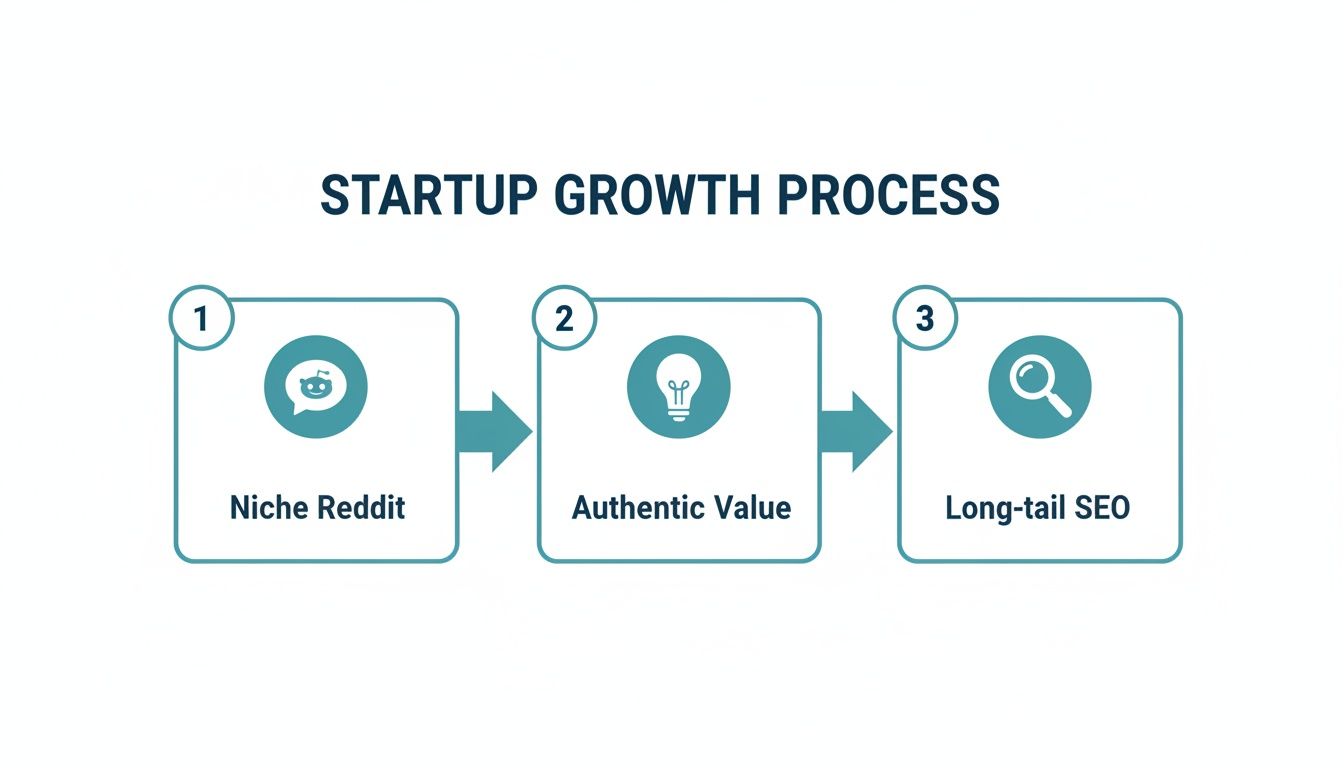
As you can see, jumping into these niche Reddit threads with real, authentic value doesn't just win you a user today. It creates long-tail SEO assets that keep attracting the right people for months or even years to come.
Step 1: Find Pain-Point Keywords
Everything starts with knowing who you're talking to. Stop searching for your product category. Start searching for the pain points that keep your ideal customers up at night.
Get inside their head. What specific words and phrases do they use when they're frustrated, stuck, or desperately looking for a better way? Those are your keywords.
Here’s exactly how we translate our own ICP’s struggles into keywords at BillyBuzz:
- ICP Pain Point: "I'm wasting hours manually searching Reddit for leads."
- Keywords:
"find leads on Reddit","reddit monitoring tool","track mentions reddit","how to find clients on reddit"
- Keywords:
- ICP Pain Point: "My competitors are getting mentioned, and I'm missing the conversation."
- Keywords:
"[Competitor A] alternative","tools like [Competitor B]","review of [Competitor C]"
- Keywords:
- ICP Pain Point: "I need a better way to get alerts for relevant keywords."
- Keywords:
"reddit keyword alerts","social listening for reddit","get notified of reddit posts"
- Keywords:
This one shift changes everything. You stop selling and start solving.
Step 2: Curate Your Target Subreddits
Not all subreddits are created equal. Your job is to find the active, well-moderated communities where your ICP actually spends their time. Spraying and praying is the fastest way to get your account banned.
We keep a tightly curated list of subreddits that we watch like a hawk. Here’s our current monitoring list:
- r/SaaS
- r/startups
- r/growmybusiness
- r/marketing
- r/Entrepreneur
- r/sales
Our Vetting Criteria: A subreddit has to pass a three-point check. We look for high-quality discussions (not just memes), active moderation (to keep the spam out), and a recent history of conversations that match our pain-point keywords. If it fails even one, we skip it.
Step 3: Set Up High-Intent Alert Rules
Okay, this is where the magic really happens. Searching for these conversations manually is a soul-crushing waste of time. We built BillyBuzz to automate this whole process, using hyper-specific rules that filter out the noise and drop high-intent conversations right into our Slack.
These aren't just basic keyword alerts. We use context-aware filters that signal someone is actively looking for a solution right now.
Here are some actual alert rules we have running inside BillyBuzz:
- Alert 1 (Tool Request): Monitor for keywords like
"any tool for","how do you track","recommend a tool"within our target subreddits. This finds people actively shopping for a solution. - Alert 2 (Competitor Mention): Track mentions of our top three competitors, but exclude any posts that contain words like
"pricing"or"jobs"to filter out irrelevant noise. - Alert 3 (Problem Description): Monitor for phrases that describe the problem we solve, such as
"tired of searching reddit manually"or"missed a lead on reddit". This surfaces users who are feeling the pain but don't know a solution exists yet.
This is how a tiny team can have a massive impact, engaging with dozens of high-potential users every single week without living on Reddit 24/7. This is how you find your first 100 members.
How to Engage Authentically Without Getting Banned
Let's be blunt: Redditors have a finely tuned radar for spam. One wrong move—one comment that feels even slightly like a sales pitch—and you’ll get downvoted into oblivion or, worse, banned from the subreddit entirely.
Building a genuine social media community on Reddit isn't about marketing; it’s about becoming a respected and trusted member. As founders, our most limited resource is time, and wasting it by getting banned just isn't an option.
The core principle is simple: solve the user's problem first, last, and always.
The 90/10 Rule for Sustainable Engagement
At BillyBuzz, we live by a strict internal guideline we call the 90/10 Rule. It’s the bedrock of every single comment we post.
- 90% Pure Value: The vast majority of your comment has to be dedicated to directly and thoroughly answering the user's question or solving their problem. No fluff, no hints, just pure, actionable help.
- 10% Soft Promotion: If—and only if—your product is a direct solution to their problem, you can tack on a single, non-pushy sentence at the very end mentioning it. Think of it as a helpful footnote, not a call to action.
This approach flips the traditional marketing script on its head. Instead of leading with your product, you lead with generosity. Over time, consistently providing genuine help is what drives inbound DMs and leads—not clever sales copy. It's how you become a pillar of the community, not just another marketer passing through.
Of course, this principle extends beyond just avoiding bans. Understanding broader strategies for lasting social media engagement is key to building a community that actually sticks around.
Our Battle-Tested Response Templates
To put this into practice, we’ve developed response templates for the most common scenarios we run into. These aren't rigid scripts but flexible frameworks designed to deliver value first.
Here are three we use every week.
Template 1: Answering a Direct Technical Question
This is for when a user has a specific, nitty-gritty problem and needs a "how-to" answer. Your goal is to be the most helpful, detailed response in the entire thread.
Template:Hey, that's a common issue. I've found the best way to handle [Problem] is to: 1. [Clear Step 1], 2. [Clear Step 2], 3. [Clear Step 3]. I used to do this manually, which was a pain. Full disclosure, I ended up building a tool (BillyBuzz) to automate this exact process for myself. Might be helpful if you find yourself doing this often.
Template 2: Offering High-Level Strategic Advice
Use this when someone asks a broader, open-ended question like, "What's the best way to approach X?" Here, the aim is to provide a framework for thinking, not just a single answer.
Template:Great question. I'd frame it in two ways: [Option A] and [Option B]. Option A is great if your goal is [Goal A], but Option B is better for [Goal B] because [Reason]. What outcome are you optimizing for? For what it's worth, most of our users who are focused on [Goal A] use our platform to monitor for those kinds of discussions and get ahead of them.
The moment a user feels like they're being sold to, you've lost. The goal is to be so genuinely helpful that they ask you about your product. This is the difference between pushing a message and pulling in a lead.
Template 3: Responding to a Competitor Mention
This is a delicate one and requires a careful touch. The goal is to be factual and helpful, not to bash another company's product.
Template:[Competitor] is a solid tool, especially for [Use Case they are good at]. A key difference is how they handle [Specific Feature]. They do it [Competitor's way], which is good for [Benefit]. We took a different approach and focused on [Your unique value prop], which is designed specifically for founders who need to [Solve a specific pain point]. Just depends on what you're prioritizing.
By sticking to these value-first frameworks, you build a reputation for being a problem-solver. This is the most sustainable way to build a community and is a core part of our own playbook.
Measuring Community Success Beyond Vanity Metrics
Likes and upvotes feel good, but they don't keep the lights on. I learned this the hard way: a thriving social media community isn't measured by surface-level stats. It's measured by the real business outcomes it drives. Chasing vanity metrics is the fastest way to burn your most precious resource—time.
The real goal is to draw a straight line from your community activity to the numbers that actually matter. At BillyBuzz, we don't even bother tracking follower counts. Instead, we zero in on KPIs that prove the tangible ROI of the hours we pour into Reddit.
The BillyBuzz Community ROI Dashboard
We track just a handful of core metrics that tell a clear, honest story about our community's impact. This isn't some complex setup; you can build the same simple dashboard in a spreadsheet. It’s all about shifting your mindset from "engagement" to tangible business value.
Here's exactly what we measure, no fluff:
- Qualified Leads from Reddit: This is our north-star metric. We track every single DM or sign-up that comes directly from a specific Reddit conversation.
- Referral Traffic to Website: Using UTM parameters, we can see exactly how many people click through from our Reddit comments to our site. This tells us which subreddits and conversations are actually sparking interest.
- Brand Mentions in Relevant Threads: We use our own tool, of course, to see how often "BillyBuzz" gets mentioned when we aren't even in the conversation. It’s a powerful signal of organic, word-of-mouth growth.
- Actionable Product Insights: Every piece of user feedback, every feature request, every pain point mentioned in our target communities gets logged. This data is gold—it feeds directly into our product roadmap.
As a founder, your time is everything. If you can't draw a straight line from your community efforts to customer acquisition, product improvement, or brand authority, you need to change your strategy. Metrics are what separate busy work from real work.
Connecting Actions to Outcomes
This data-first approach is crucial, especially when you step back and see the sheer scale of the opportunity. Think about it: over 5.66 billion people, which is nearly 69% of the entire global population, are active in social communities every single day. The average user is juggling around seven platforms a month, spending over two hours daily scrolling and connecting. For a closer look, you can check out the full breakdown of social media usage.
For a startup, this translates into countless opportunities hidden inside hyper-targeted communities, but only if you know how to measure what’s actually working.
To do this right, you need a simple but effective way to track the entire funnel. We’ve found that having a solid framework for measuring social media ROI with a cost-benefit analysis is the key to justifying the time investment.
In the end, your dashboard should answer one simple question: "Is the time we're spending in these communities creating measurable value for the business?" When you can confidently say "yes" and point to the numbers, you've officially moved beyond just managing a community and started building a true business asset. That's how you prove the value of your work—to yourself, your team, and any future investors.
Your 30-Day Action Plan for Community Growth
Great ideas are just that—ideas. What really separates a buzzing social media community from a digital ghost town is execution. This isn't just theory; it's a practical, week-by-week playbook. It’s the same sprint we’d use at BillyBuzz to get a founder from zero to a fully functioning community-building machine in about a month.
This is your roadmap for building real momentum, and fast. The point isn’t to just stay busy. It’s to build a sustainable habit that actually gets results.
Week 1: Laying the Foundation
Your first week is all about reconnaissance. You can't just barge into a conversation without knowing where it's happening or who's in it. The goal here is simple: map out your territory and set up your listening posts.
- Action 1 - Find 10 Target Subreddits: Think about your ideal customer. Now, go find ten subreddits where they’re already talking about their problems. You’re looking for places with smart discussions and active mods, like r/SaaS or r/startups.
- Action 2 - Set Up Your Monitoring Alerts: This is non-negotiable. Use a tool like BillyBuzz to create alerts for specific pain-point keywords and mentions of your competitors inside those subreddits. Think of it as your early-warning system for conversations that matter.
Doing this upfront work means you stop guessing. You’re building a system that brings the best opportunities right to you, which will save you from endless hours of manual searching.
Week 2: Listen First, Talk Later
Fight the urge to jump in and start pitching or commenting. Week two is all about observation. Your goal is to become a silent expert on the community's culture—the inside jokes, the lingo, the unwritten rules. You need to feel the rhythm of the room before you start dancing.
As a founder, your best asset in a new community isn’t your product. It’s your ability to listen. The intelligence you gather just by observing—the slang they use, the complaints that keep popping up, who the respected voices are—is what will make your engagement stick later on.
Spend 15-20 minutes every day this week just reading. Go through the new posts and top comments in your target subreddits. Get a feel for the tone. Jot down notes on the most common frustrations you see. This patient approach is what separates a future community leader from just another spammer.
Week 3: Start Adding Value
Okay, now you’re ready to get in the game. With a full week of listening behind you, it's time to contribute. But your goal isn't to promote your startup; it's to be genuinely, unbelievably helpful. Your only mission is to solve other people's problems.
- Action 1 - Make Your First 10-15 Comments: Check the alerts you set up and find places where you can provide real value. Did someone ask a technical question you can answer? Can you offer a bit of strategic advice or share a relevant story from your own experience? Do that.
- Action 2 - Lean on Proven Frameworks: Don’t overthink it. Use a simple rule like the 90/10 Rule—90% of your comment should be pure value, with only a 10% soft mention of your work if it feels natural. The focus is always on solving the original poster's problem right there in the comment.
Every helpful comment you leave is like a deposit in your trust account with that community. By the end of this week, you’ll have built a small but solid reputation as someone who knows their stuff and is there to help.
Week 4: Refine, Repeat, and Build the Habit
The final week is all about figuring out what worked and turning this entire process into a routine you can actually stick with. Real growth comes from consistency, not a single burst of effort.
Look back at your comments from week three. Which ones got the most upvotes or positive replies? What kinds of topics sparked the best conversations? Use that feedback to fine-tune the keywords you’re monitoring. Maybe you stumbled upon a new pain point you hadn't thought of—add it to your alerts.
The ultimate goal here is to bake this listen-and-engage loop into your daily workflow. Set aside 30 minutes every single day to check your alerts and add value. It’s this steady, consistent effort that turns a 30-day sprint into a powerful, long-term engine for building your community.
Frequently Asked Questions
When you're building a startup from the ground up, you're bound to have questions. We've been there. Here are some straight-up answers to the questions we get asked most often about jumping into social media communities.
How Much Time Do I Really Need to Spend on This Every Day?
Look, as a founder, you don't have time to waste. Forget endless scrolling. The goal is focused, high-impact engagement.
Set aside 30 minutes a day. That's it. In that time, your mission is to check your monitoring alerts, find 2-3 conversations where you can genuinely help, and write thoughtful replies. Consistency is so much more powerful than intensity. A dedicated half-hour every single day will beat a chaotic four-hour session once a week, every time.
What’s the Quickest Way to Get Myself Banned on Reddit?
Easy. Treat it like just another place to blast your ads.
If you want to get booted fast, just drop a link to your product with a generic "Check us out!" message. Redditors have a finely tuned radar for spam and self-promotion. They value authentic contribution, not sales pitches. Always lead by adding to the conversation, not by asking for a click.
Should I Start My Own Subreddit From Day One?
Absolutely not. This is one of the most common missteps we see founders make.
Creating your own subreddit before you have an audience is like throwing a party and not inviting anyone. It's just an empty room. You need to build your reputation first in established communities where your target users are already hanging out.
Become a known, trusted voice in those spaces. Once you've earned a following and people value your input, then you can invite them over to a community you own. Build the crowd before you build the venue.
Ready to stop searching and start engaging? Let BillyBuzz bring high-intent conversations from Reddit directly to you. Find your first 100 community members by automating your social monitoring.