

Look, effective startup marketing isn't about having the deepest pockets or the most complicated strategy. It's about knowing exactly who you serve and hitting them with a message that makes them feel like you've read their mind. Before you even think about spending a single dollar on ads, your entire world should revolve around defining that perfect customer and positioning your product as the only solution that makes sense for them.
Build Your Foundation Before Spending a Dollar

As founders, our DNA is coded to build and ship. That urge to dive headfirst into tactics—running Facebook ads, chasing PR, you name it—is powerful. But I’ve seen it time and time again: this is the single biggest mistake early-stage companies make. Without that solid foundation, you’re not marketing; you're just setting your budget on fire.
The real work, the stuff that makes every other marketing activity ten times easier, boils down to two things: your Ideal Customer Profile (ICP) and your positioning. Nail these, and you create a kind of gravitational pull for the right customers.
Define Your Ideal Customer Profile
Your ICP is not a flimsy demographic sketch like "35-year-old marketing manager." That's lazy. A real ICP gets into the psychology and behavior of the person who not only gets the most value from what you've built but is also the easiest to sell to. It’s about understanding their world so deeply that your product feels like it was custom-made for them.
When we started BillyBuzz, we didn't just guess. We got on calls with dozens of founders and marketers and asked questions designed to get past the surface-level needs and into their real, nagging pain points.
These are the exact questions we used to get inside their heads:
- What does a "good day" at work look like for you? What about a "bad day"? This question cracks open their core motivations and frustrations.
- What tools are you currently using to solve [the problem we address]? This tells you who you're really competing against. Spoiler: it's often a messy spreadsheet or just the inertia of doing nothing.
- If you had a magic wand to fix one thing about your job, what would it be? This is where you uncover their deepest desires and unarticulated needs.
- What are you currently trying to achieve that our product could help with? This gets them to frame their goals in their own words—which is pure gold for your messaging.
To really get started on this, it's worth exploring different strategies for identifying your target audience. This whole process is about making sure you’re not just shouting into the void but speaking directly to the people who will become your champions.
Craft a Positioning Statement That Clicks
Once you truly know your ICP, positioning gets a whole lot simpler. This isn't about some clever tagline for a t-shirt; it's about clearly explaining your unique value in a way that connects directly with their specific problems. Your positioning statement should instantly answer three questions from your customer's perspective:
- What is this? (The category you belong in)
- Why should I care? (The main benefit you offer)
- Why should I choose you? (Your unique differentiator)
We used a simple template to get started: For [your ICP], who struggle with [problem], our product is a [category] that provides [key benefit] by [unique differentiator].
For us at BillyBuzz, it looked like this: "For early-stage startup founders who struggle to find customers in online communities, BillyBuzz is an AI monitoring tool that finds relevant conversations on Reddit so you can engage with leads directly, unlike generic keyword alerts that create too much noise."
This statement is more than just marketing copy for your website. It becomes your internal North Star for every piece of content, every sales email, and every product decision you make. It gets the entire team telling the exact same story.
Finally, before you go all-in, test your message. Don't build an entire website based on a hunch. Put up a simple landing page, run a tiny $50 LinkedIn ad campaign aimed squarely at your ICP, and see if the message actually gets them to click. This one small, cheap experiment can save you months of work and validate that you're heading in the right direction.
How to Find Your First Customers in the Wild

Let's get one thing straight: your first 100 customers won't come from a clever ad campaign or a slick marketing funnel. Forget about that for now. They'll come from rolling up your sleeves and doing things that simply don't scale. This is the hand-to-hand combat of early-stage growth, where you win over users one conversation at a time.
This isn’t just theory. I’m going to walk you through the exact, unglamorous process we use at BillyBuzz to find people who need our product. We hang out where our Ideal Customer Profile (ICP) lives, breathes, and—most importantly—complains about the problems we can solve.
Go Where Your Customers Already Are
The single biggest mistake I see founders make is trying to drag people over to their shiny new website. It’s so much easier to meet them on their own turf. For us, that means getting deep into niche subreddits and private Slack communities where founders and marketers are already asking for help.
The goal here is to become a helpful, familiar face, not a drive-by spammer. You do this by listening 90% of the time and contributing 10% of the time. Give value, give more value, and then give a little more.
Here are the actual subreddits we monitor daily:
- r/SaaS: The single best place for raw conversations about growth, churn, and the tools people are using (and hating).
- r/startups: Broader, but perfect for spotting the unfiltered pain points of founders just starting their journey.
- r/marketing: Great for finding marketers looking for new tools and strategies to get an edge.
- r/growmybusiness: A high-intent community where people are explicitly asking for help with customer acquisition.
Set Up Your Digital Listening Posts
You'll go absolutely nuts trying to manually refresh subreddits all day. You need a system that brings the right conversations to you. This is literally why we built BillyBuzz in the first place—to act as our eyes and ears across Reddit so we can jump into a conversation at just the right moment.
Instead of just tracking our brand name, we track our customers' pain points. That’s a game-changing distinction.
Here are some of the actual alert rules and filters we have running inside BillyBuzz right now:
- Pain Point Alerts: We track keyword combos like
"how to get first customers","find beta users","market research tools", and"customer feedback". - Competitor Alerts: We monitor mentions of tools like "Brand24" or "Mention," but we filter for posts with negative sentiment. This shows us users who are actively looking for an alternative.
- "Looking For" Alerts: We track phrases like
"looking for a tool","recommend a tool", or"alternatives to"combined with keywords relevant to our space, like "social listening" or "brand monitoring."
This entire approach is about finding moments of need. When someone posts, "I'm spending hours looking for mentions of my startup on Reddit, does anyone have a better way?"—that's a softball pitch right over the plate for us. A timely, genuinely helpful response to a post like that converts at a rate that blows any cold outreach out of the water.
Engage Without Pitching
Okay, so an alert fires and you've found the perfect conversation. Your first instinct might be to drop a link to your landing page and run. Don't. That’s the fastest way to get downvoted into oblivion. Your goal is to be helpful first.
We use a simple, repeatable template for our first response. It's designed to build trust before ever mentioning our product.
Our "Help, Don't Sell" Response Template:
- Validate: Start by acknowledging their pain. "Ugh, that's a huge pain. Manually tracking mentions is a massive time sink."
- Give Actionable Advice (Product-Agnostic): Offer a tip they can use right now, for free. "One trick that helped us early on was setting up super-specific Google Alerts, like
site:reddit.com/r/SaaS "your keyword here"." - Make the Soft Pivot (Optional): Only after you've provided value, you can gently introduce your solution. "Full disclosure, we actually built a tool, BillyBuzz, to automate this exact process because we were so frustrated with it. Might be useful for you, might not be."
- End with an Open-Ended Question: Keep the conversation going. "Happy to share the filters we use if you're curious. What's been the most frustrating part for you so far?"
This changes the entire dynamic. You're no longer a salesperson; you're an expert peer offering a helping hand. This is the heart of community-led growth, a strategy we cover in-depth in our guide on how to get customers from Reddit in 2025. It’s not about a quick win; it's about building a reputation that draws the right people to you.
Building a Repeatable Growth Engine
All that manual outreach and community monitoring? That’s what gets your first few customers in the door. It’s the proof that your product has a pulse.
But you can’t hustle your way to a million in ARR. The real goal is to turn those early, hard-won successes into a predictable system for customer acquisition. You need to build a growth engine that starts to run on its own.
This is the critical shift from one-off tactics to building a sustainable machine. It’s all about creating systems that consistently bring in new users without you having to hand-crank the engine every single morning.
Moving from Tactics to Growth Loops
At the heart of any scalable engine is the growth loop. Think of it as a closed system where the actions of one user naturally lead to acquiring new users. This is fundamentally different from a traditional funnel, which constantly demands you pour new leads in at the top. A loop, on the other hand, is self-sustaining and compounds over time.
You've seen these in the wild. The most common types are:
- Referral Loops: Users get value from your product and are incentivized to invite others. Dropbox’s classic "invite a friend for more free space" is the poster child for this.
- Content Loops: Your product or its users generate content that gets discovered through channels like SEO. That discovery brings in new users, who then create even more content. It’s the magic behind platforms like Reddit and Quora.
- Viral Loops: The product itself is inherently social and spreads simply through its use. When someone sends you a Calendly link to book a meeting, you’re instantly exposed to the product. That’s a viral loop in action.
Here at BillyBuzz, our engine is a bit of a hybrid. We use content to attract founders, but our core loop is built around the social proof of community engagement. As our users find success with our alerts and share their wins, it shows other founders that we can solve their problems, too.
Prioritizing Your Experiments
You can’t build every loop at once. As a startup founder, your most precious resource is focus. You have to place small, smart bets on the one or two channels with the highest potential impact right now.
Forget trying to be everywhere. Your job is to find one repeatable channel and absolutely master it before even thinking about the next one.
So how do you choose between, say, SEO and paid social? We use a simple internal framework to score potential channels against three core factors:
- Potential Impact: How many of our ideal customers can we realistically reach here?
- Confidence: Based on our team's skills and what we already know, how confident are we that we can actually make this work?
- Ease of Implementation: How much time and money will it take to run a meaningful test?
We rate each factor on a scale of 1-10 and ruthlessly prioritize the channel with the highest total score. This simple exercise forces an honest conversation and keeps us from chasing every shiny new object. For us, targeted SEO content scored way higher early on than paid ads because it was cheaper to implement and we were confident we understood the founder's mindset. For more ideas on where to start, check out these strategies to boost your startup's visibility online.
Tracking Your Experiments Like a Pro
Ideas are worthless without execution and measurement. The goal isn't to find a magic bullet on your first try; it's to build a system of continuous learning. Every single marketing activity should be treated like a scientific experiment with a clear hypothesis, a defined test, and measurable results.
To keep ourselves honest, we use a dead-simple Google Sheet to track every experiment. It’s not fancy, but it forces clarity.
These are the exact columns we use internally:
| Column | Purpose | Example |
|---|---|---|
| Experiment Name | A clear, descriptive title. | "Guest Post on SaaS Founder Blog" |
| Hypothesis | Your "If we do X, then Y will happen" statement. | "If we publish a guest post on Reddit monitoring, we'll get 50 qualified signups." |
| Channel | The platform you're testing (e.g., SEO, Paid Social). | "SEO / Content Marketing" |
| Budget | The total cost in time and money. | "$0 (8 hours of founder time)" |
| Key Metric | The one number that defines success or failure. | "New Trial Signups" |
| Result | The actual outcome of the experiment. | "23 new signups." |
| Learnings | What did you learn? Should you iterate or kill this idea? | "Topic resonated, but the CTA was weak. Next time, offer a specific template." |
This structured approach transforms marketing from a guessing game into a methodical process of discovery. You’re no longer just "doing marketing"—you're building a knowledge base about what works for your specific business, one small, disciplined experiment at a time.
Measuring What Matters and Ignoring Vanity Metrics
When you're just starting out, marketing can feel like shouting into the void. You're pushing out content, engaging on social media, maybe even dipping a toe into paid ads, but it’s tough to tell what's actually making a difference. It's way too easy to get hooked on the dopamine hit of vanity metrics—likes, follower counts, website visits. They look great on a chart, but they don't keep the lights on.
As a founder, your job is to slice through that noise. You need to focus on the numbers that signal the real health of your business. This isn't about becoming a data guru overnight; it's about having the right information to make smart, strategic decisions. Forget the fluff. The only three metrics that truly matter are Customer Acquisition Cost (CAC), Lifetime Value (LTV), and churn.
The Three Metrics That Actually Matter
These aren't just acronyms to impress investors. They are the vital signs of your startup. Getting a handle on how they interact is the secret to building a business that lasts, not just one that looks popular for a few months.
Customer Acquisition Cost (CAC): This is the total price you pay—in both time and money—to get one new customer. Be brutally honest with yourself here. This includes everything: ad spend, your marketing person's salary, subscriptions for your tools. If you spend $500 on marketing in a month and get one new paying customer, your CAC is $500. Simple as that.
Lifetime Value (LTV): Think of this as the total amount of money you can realistically expect a customer to spend with you before they leave. A high LTV is a fantastic sign. It means customers love your product, stick around, and keep paying you, which is the dream for any subscription business.
Churn: This is the rate at which your customers cancel. High churn is the silent startup killer. It's like trying to fill a bucket that has a giant hole in it—no matter how much water you pour in (new customers), you’ll never fill it up. A leaky product can't be fixed with more marketing.
The real insight comes when you look at these metrics together. The golden ratio here is LTV to CAC. For a healthy SaaS startup, you’re aiming for at least a 3:1 ratio. This means for every dollar you spend to get a customer, you're getting at least three dollars back over their lifetime.
Let's say your LTV is $1,500 and your CAC is $500. You've got a solid 3:1 ratio. You're building a sustainable business. But if your LTV is only $600 with that same $500 CAC, your ratio is a grim 1.2:1. You're essentially spending all your cash just to tread water. That's a massive red flag telling you that something needs to change, and fast.
Building Your Simple Analytics Dashboard
You don’t need an expensive, overly complicated business intelligence tool to start tracking what counts. When we started BillyBuzz, we used a simple combo of free tools that gave us a surprisingly clear picture of our entire marketing funnel.
You can do the same with this basic setup:
- Google Analytics: This is your go-to for understanding where your traffic comes from (organic search, social media, etc.). The trick is to set up conversion goals. You need to tell it what an "action" is, like a free trial signup or a demo request.
- A Simple Spreadsheet: Seriously, a Google Sheet is perfect for this. Manually track your CAC, LTV, and churn every month. The act of plugging in the numbers yourself forces you to truly understand what's driving them up or down.
This lean setup is more than enough to start. For example, if you see that organic search traffic is bringing in customers with the highest LTV, that's a powerful signal. It tells you exactly where to invest more time and energy: your SEO strategy. Our guide to measuring social media ROI can help you connect these kinds of activities to real business results.
And as you grow, don't shy away from smarter tools. AI, for example, can give you a serious analytical edge. In fact, 83% of sales teams using AI have seen revenue growth, which is a big leap from the 66% of teams who aren't. As a small team, using AI-powered analysis can help you spot trends and opportunities you’d otherwise miss, leveling the playing field. You can read more about this and discover other insightful marketing statistics from Salesforce.
Ultimately, tracking the right metrics isn't about making pretty charts. It’s about finding the truth in your data so you can build a business that actually lasts.
Your First 90 Days: A Practical Marketing Roadmap
Alright, let's put all this theory into practice. Startup marketing can feel like you're trying to boil the ocean, so let's break it down into a tangible, week-by-week roadmap for your first three months. This isn't just a list of tasks; it's a focused plan designed to take you from zero to a repeatable growth system.
We'll move from the messy, manual work of getting your first users to building systems that can actually scale. Each phase has a single, clear goal, a handful of key activities, and the one metric that matters most. This is how you build real momentum without getting lost in the noise.
Month 1 (Days 1-30): Foundation and Manual Outreach
The first month is all about rolling up your sleeves and doing things that don't scale. Forget automation for now. This phase is about direct, one-on-one engagement to prove that people actually want what you’ve built. It’s the unglamorous but absolutely critical groundwork.
Primary Goal: Land your first 10 paying customers.
What to Do:
- Lock In Your ICP & Positioning: Spend the very first week finalizing your Ideal Customer Profile and messaging. Base this on real conversations, not assumptions. Don't move on until this is sharp.
- Engage in Communities Daily: Dedicate at least one hour every single day to participating in the communities you identified earlier. Your job is to be helpful and build trust, not to drop links.
- Set Up Keyword Alerts: Use a tool like BillyBuzz to create alerts for pain-point keywords and competitor mentions. This automates the discovery process, letting you jump into relevant conversations immediately.
- Track Every Single Conversation: A simple spreadsheet is your best friend here. Log every interaction, follow-up, and piece of feedback. This data is pure gold for refining your product and marketing down the line.
Success Metric: The only number that matters this month is new paying customers. That's it.
Month 2 (Days 31-60): Experimentation and First Systems
You’ve got a few customers and some real-world feedback. Great. Now, Month 2 is about finding your first repeatable acquisition channel. You’re making the crucial shift from pure manual hustling to running structured experiments designed to find a scalable growth lever.
This is the point where your focus on metrics needs to evolve. You move from early vanity numbers to the economic engine of your business.
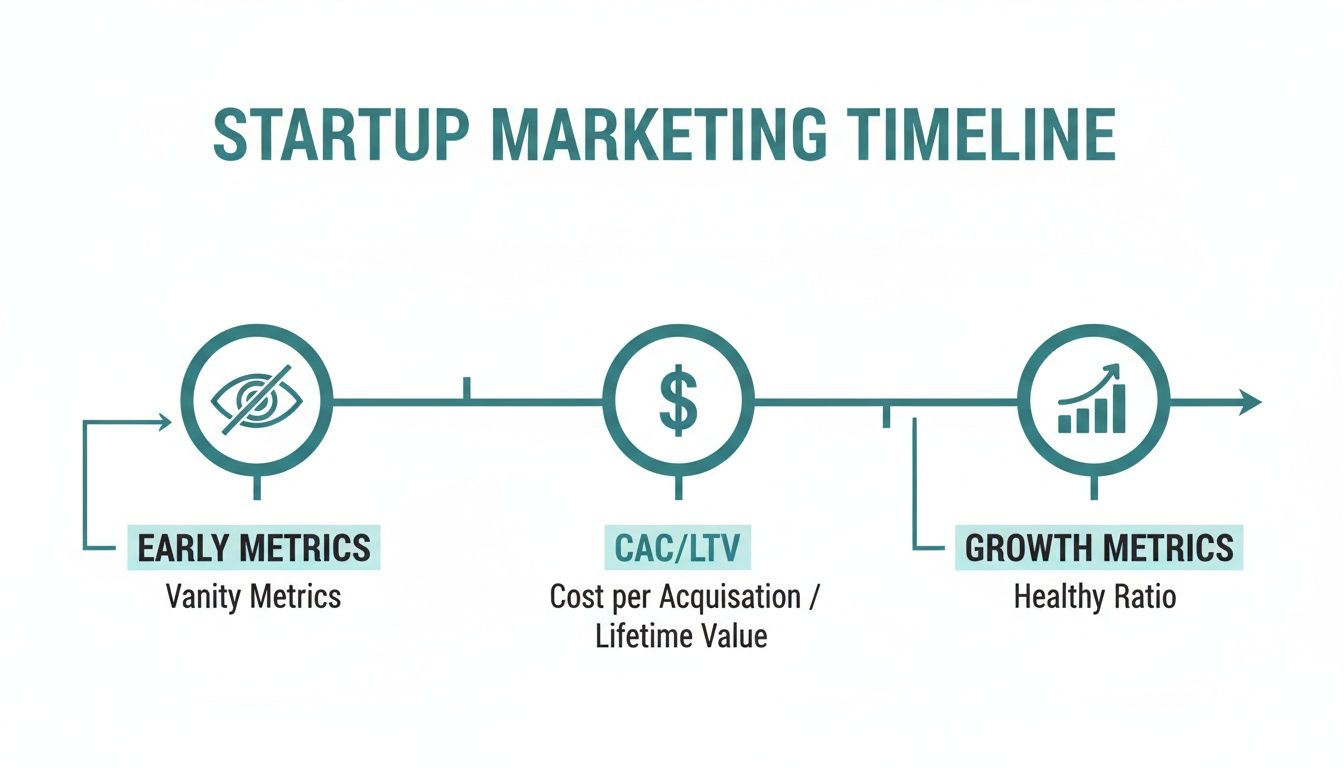
As you can see, you need to start understanding your Customer Acquisition Cost (CAC) and Lifetime Value (LTV). These are the numbers that will tell you if you have a sustainable business.
Primary Goal: Validate one acquisition channel you can pour gas on.
What to Do:
- Launch Two Channel Experiments: Based on your channel prioritization framework, pick your top two contenders and run with them. Maybe it's SEO-driven content versus a small, targeted LinkedIn ad campaign. Get them live.
- Publish Your First Core Content: Write two or three incredibly helpful blog posts that directly solve the pain points you uncovered in Month 1. This is the first step in your long-term content and SEO strategy.
- Get Your Analytics Right: Make sure Google Analytics is set up correctly with conversion tracking for signups. You can't improve what you don't measure.
- Talk to Your New Customers: Get on a call with at least five of your new customers. Ask them why they signed up, how they found you, and what words they use to describe the problem you solve.
Success Metric: Identify one channel that produces a predictable number of qualified leads or signups.
Month 3 (Days 61-90): Optimization and Scaling
By now, you should have identified at least one channel that shows real promise. Month 3 is about doubling down on what’s working and building a simple, repeatable process around it. The focus shifts from discovery to efficiency.
Primary Goal: Double the customers you acquired through your validated channel.
What to Do:
- Scale the Winning Channel: If SEO is working, it's time to ramp up content production. If paid ads are the winner, you can start carefully increasing the budget while keeping a close eye on your Customer Acquisition Cost (CAC).
- Build a Basic Onboarding Flow: Create a simple email sequence for new signups. The goal is to guide them to that "aha!" moment in your product as quickly as possible to boost activation and reduce churn.
- Create a Content Calendar: Get organized. Plan your content for the next month based on what has already resonated with your audience and the keywords you're targeting. Consistency is everything.
- Start Refining Your LTV/CAC Ratio: With a couple of months of data, you can get a clearer picture of your unit economics. You need to ensure your acquisition efforts are profitable and setting you up for long-term, sustainable growth.
Success Metric: A measurable improvement in your LTV:CAC ratio, getting you closer to that healthy 3:1 benchmark.
90-Day Startup Marketing Roadmap
To make this even more concrete, here’s a table that breaks down the roadmap phase by phase. Think of it as your cheat sheet for the first quarter.
| Phase | Primary Goal | Key Activities | Success Metric |
|---|---|---|---|
| Month 1 (Foundation) | Get your first 10 paying customers | ICP & positioning, daily community engagement, keyword monitoring, conversation tracking | New paying customers |
| Month 2 (Experimentation) | Validate one scalable acquisition channel | Launch 2 channel experiments, publish core content, set up analytics, conduct customer interviews | One channel with predictable signups |
| Month 3 (Scaling) | Double customers from your validated channel | Scale winning channel, build onboarding flow, create content calendar, refine LTV/CAC | Improved LTV:CAC ratio (aiming for 3:1) |
This roadmap gives you a clear path from launch to a functioning growth engine.
Remember, this 90-day plan isn't meant to be rigid. It's a living document. The real key is to maintain momentum and make every decision based on data, not just gut feelings. By breaking down the monumental task of startup marketing into these focused sprints, you create clarity and build a foundation for real, scalable growth.
Common Questions I Hear from Founders
When you're just getting started, you're buried in questions and conflicting advice about marketing. I've been there. Let's cut through the noise and get straight to what actually works, based on our own journey building BillyBuzz.
When Should I Make My First Marketing Hire?
Honestly? Probably later than you think.
Your first marketing hire shouldn’t be a high-level strategist; you need a doer. Someone who can take a process and run with it. The golden rule is this: don't hire anyone until you, the founder, have personally figured out at least one repeatable way to get customers.
It doesn't have to be pretty. It can be a messy, manual process. But you need something that works, even at a small scale. Only then can you hand it off to someone to refine, optimize, and scale up.
If you hire too early, you're just paying someone to do your most important job: learning who your customers are and where to find them. Once you have that spark, bring in a marketer to pour gasoline on the fire.
How Much Should We Budget for Early Experiments?
In the beginning, your most valuable resource is time, not money. For your first 90 days, a budget of $500 to $1,000 per month for pure experimentation is plenty. The goal isn't to spend big; it's to learn fast.
A simple $100 LinkedIn ad campaign can give you a signal on whether your core message hits home with your ideal customer. A $0 guest post on a niche blog can prove whether your content angle has any traction. Keep your bets small and your learning cycles tight.
This forces you to get scrappy and focus on what truly moves the needle, rather than just throwing cash at paid channels and hoping for the best. Once you find a channel that delivers a consistent, positive return, you can open up the wallet with confidence.
Should I Hire a Consultant or Agency?
This can be a really smart move, but only for specific, well-defined projects.
Let's say you've proven that SEO is going to be your winning channel, but you don't have the deep technical chops in-house. This is the perfect time to bring in an expert. Many founders in this position start by finding a fractional SEO consultant for startups to get a massive boost without the full-time cost.
What you should never do is outsource your core marketing strategy. No agency or consultant will ever care about your mission or understand your customer as deeply as you do. Use them for expert execution, not for setting the vision.
How Do I Know When a Channel Isn't Working?
This is a big one. It's so tempting to kill an experiment after a week if you don't see a flood of sign-ups. Resist that urge.
Give any serious test at least 30-60 days to show a real signal. Before you even start, define what success looks like. Be specific. For a content experiment, it might be "generate 10 qualified demo requests within 60 days."
If you get to the end of that period and you're not even close to your goal—and you don't have a clear idea of what to tweak to get there—it's time to cut your losses. Write down what you learned, and move on to the next hypothesis. Ruthless prioritization is your superpower here.
At BillyBuzz, we're obsessed with solving this puzzle of finding those first crucial customers. Our AI-powered tool was born from our own struggle. It monitors conversations across Reddit, so you can find people who are actively searching for a solution just like yours. Ready to stop guessing and start engaging with real customers? Find them at https://www.billybuzz.com.