

Forget generic advice. As a founder, your most precious resource is time, and wasting it on cold leads is a fast track to burnout. At BillyBuzz, we live and breathe lead qualification because our growth depends on it. This isn't another high-level guide; it's a look under the hood at our exact lead scoring best practices, designed to help you focus your energy where it counts: on prospects genuinely ready to buy.
We built our system from the ground up, moving beyond vanity metrics to create a predictable pipeline. This playbook is a practitioner-led, founder-to-founder breakdown of that system. I'll share the specific filters we use, how we leverage unconventional social signals from places like Reddit to uncover buying intent, and the precise alert rules that tell our team who to talk to right now. You'll get an actionable framework you can implement tomorrow.
This listicle covers everything from aligning sales and marketing to setting up negative scoring rules that weed out tire-kickers. To truly "Stop Guessing, Start Scoring," it helps to first understand the foundational data models. For a deeper dive into building that core data-driven approach, you can explore a comprehensive modern B2B SaaS lead scoring guide that complements the hands-on tactics we'll cover here. Let's get started.
1. Unify Sales and Marketing on a Single Definition of 'Ready'
The single biggest failure point in any lead scoring system isn't the technology or the data points; it’s a fundamental disconnect between Sales and Marketing on what a "good lead" actually is. Before assigning a single point, the most critical best practice is to get both teams to agree on a unified definition of a sales-ready lead. This alignment prevents the classic friction where marketing sends over leads that sales deems unqualified, wasting everyone's time and resources.
This process culminates in a formal Service Level Agreement (SLA), a documented contract that outlines the specific criteria for a lead to pass from a Marketing Qualified Lead (MQL) to a Sales Qualified Lead (SQL). It’s the foundational step that ensures marketing’s efforts are directly tied to feeding sales quotas.

Why It's a Top Priority
Without a shared definition, your lead scoring model operates in a vacuum. Marketing might celebrate hitting MQL targets, while the sales team struggles with low-quality conversations and missed quotas. An SLA makes the handoff objective, data-driven, and accountable. At BillyBuzz, this alignment was non-negotiable; our SLA clearly defines MQL criteria (e.g., downloaded two guides, visited the pricing page) and the exact process for sales acceptance and rejection, creating a feedback loop that continuously refines our scoring.
How We Do It at BillyBuzz
- Formal SLA Document: We have a live document defining the precise attributes of an MQL. It includes lead routing rules (e.g., "all SQLs must be contacted within 4 hours") and the process for sales to provide feedback on lead quality.
- Monthly Alignment Meetings: We review the data every month. Are MQL-to-SQL conversion rates improving? What feedback does sales have? This regular check-in keeps our scoring model sharp.
- Shared HubSpot Dashboard: Both teams see the same dashboard, tracking leads as they move through the funnel. This radical transparency eliminates finger-pointing.
2. Implement Behavioral Scoring Models
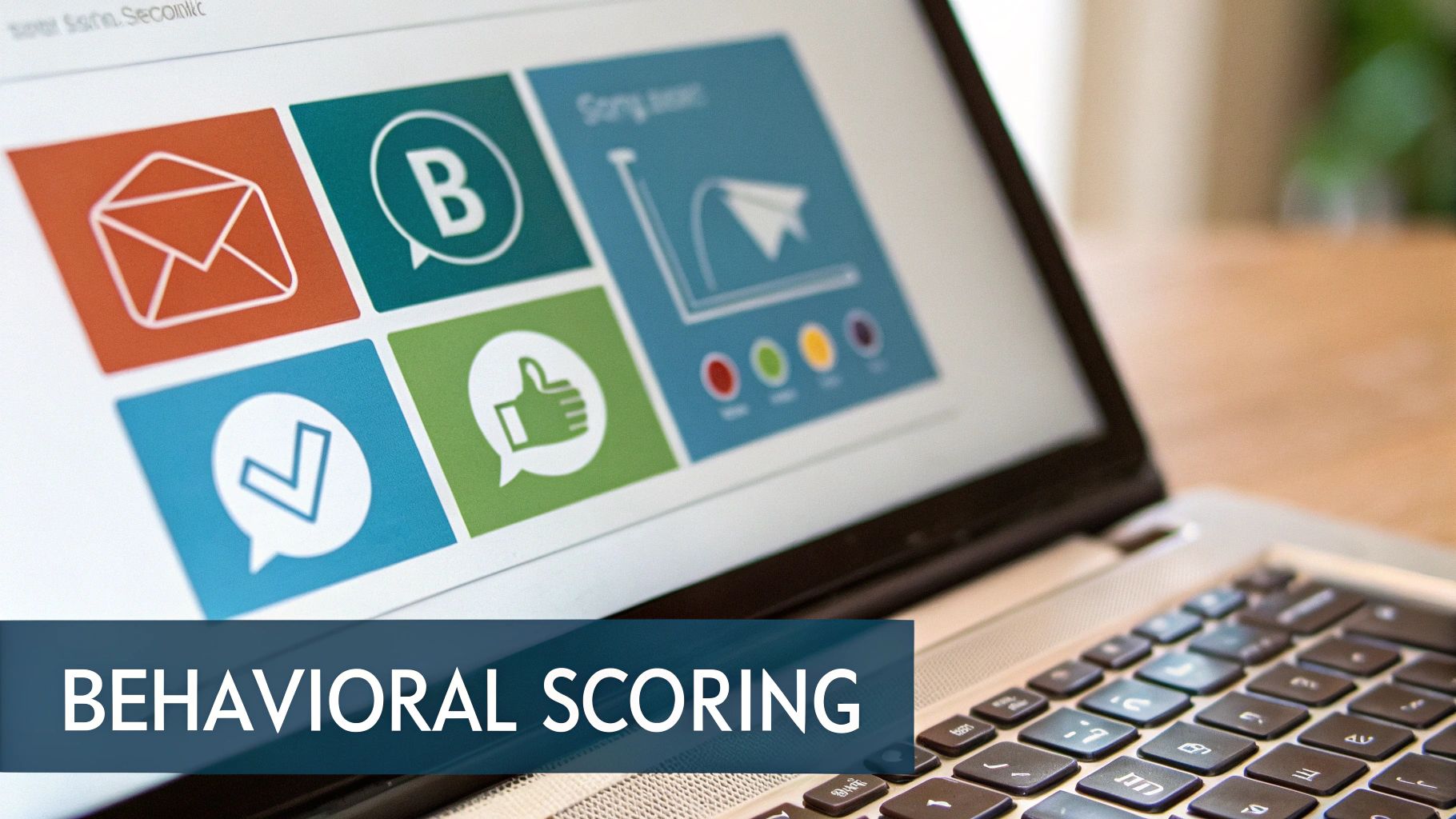
While static data like job titles and company size are important, they don't tell you who is actively engaged and moving toward a purchase. Behavioral scoring models solve this by assigning point values to specific actions a lead takes, such as visiting your pricing page, downloading a whitepaper, or requesting a demo. This dynamic approach focuses on intent, capturing real-time engagement signals that are often the strongest indicators of sales readiness.
This practice is central to how modern marketing automation platforms like HubSpot and Marketo operate, transforming marketing from a passive to an active, responsive function. A lead's score should rise and fall based on their digital body language, giving your sales team a clear, prioritized list of who to contact right now.
Why It's a Top Priority
A lead's behavior is the most direct signal of their intent and interest level. A Director of Engineering from a target company is a good lead, but one who just watched your entire product demo webinar is a hot lead. Behavioral scoring allows you to differentiate between passive prospects and active buyers, focusing sales efforts where they'll have the most impact. At BillyBuzz, we assign a high value (+15 points) to a pricing page visit but an even higher value (+25) to a demo request, ensuring our sales team prioritizes leads who explicitly raise their hands.
How We Do It at BillyBuzz
- Weight High-Intent Actions Heavily: A demo request gets 25 points, while a blog view gets 2. We reverse-engineered this from our closed-won deals to see which actions correlated most with a sale.
- Implement Score Decay: Interest fades. Our system automatically subtracts 5 points for every 30 days of inactivity. This keeps our MQL list fresh.
- Start Small and Iterate: We started with just 5 core signals (form submission, webinar attendance, pricing page view, case study download, contact us page). We analyze how leads with these behaviors convert and adjust the model based on real data. Understanding how to predict user behavior with event sequences provides the framework for this.
3. Incorporate Firmographic and Intent Data
Behavioral scoring tells you what a lead is doing, but it doesn’t tell you who they are or what they’re researching outside your website. A truly effective lead scoring system layers firmographic data (company size, industry, revenue) and third-party intent data (topic searches, competitor site visits) on top of engagement. This creates a multi-dimensional view, ensuring you prioritize leads who not only show interest but also fit our Ideal Customer Profile (ICP).
This layered approach prevents your sales team from wasting cycles on enthusiastic but unqualified leads, like a student from a non-target country. It focuses resources on accounts that have both the demonstrated need and the organizational characteristics to become high-value customers.

Why It's a Top Priority
Relying solely on on-site behavior is like trying to solve a puzzle with half the pieces. A lead might download three ebooks, but if they work for a two-person startup and your solution is enterprise-grade, they aren't a qualified lead. At BillyBuzz, we pipe in signals from Reddit and other communities. When we see someone from a target account asking, "Any recommendations for a social listening tool?" in a relevant subreddit, that's a massive intent signal that triggers an immediate alert and a high score.
How We Do It at BillyBuzz
- Define Strict Firmographic Tiers: We have specific point values. A company with 50-250 employees gets +15 points. Over 1,000 gets +30. We do the same for our key industries.
- Track Reddit & Social Signals: We use our own tool, BillyBuzz, to set up alerts. Our exact rule is: "If (Keyword = 'competitor name' OR 'social listening tool') AND (Subreddit = r/marketing OR r/SaaS) -> Send Slack alert to #sales-intel".
- Combine Intent with Engagement: A raw intent signal is just a spark. The real magic happens when an account shows intent and an employee from that account visits our pricing page. This combination is a five-alarm fire that triggers an immediate alert and the highest score possible. For a deeper dive, learn more about how AI can identify purchase intent on BillyBuzz.com.
4. Establish Explicit and Implicit Scoring Criteria
An effective lead scoring model requires a holistic view of your prospect, combining what they tell you directly with what their actions show you. This is the core principle behind using both explicit and implicit scoring criteria. Explicit scoring is based on the direct, factual information a lead provides (job title, company size, industry), while implicit scoring is based on their observed behaviors (pages visited, emails opened, content downloaded). Blending these two creates a comprehensive, nuanced profile that accurately reflects both fit and intent.
This dual-criteria approach prevents over-reliance on one set of signals. A lead with a perfect firmographic profile who shows zero engagement is likely not ready, just as a highly engaged lead from an unqualified industry is not a good fit. The magic happens when you combine both data sets to identify leads who match your ideal customer profile and are actively demonstrating buying intent.
Why It's a Top Priority
Relying solely on explicit data ignores buying signals, while focusing only on implicit data can lead you to chase prospects who can never become customers. A balanced model is one of the most crucial lead scoring best practices because it ensures efficiency, sending sales only those leads that are both a good fit and actively interested. At BillyBuzz, we found that weighting implicit (behavioral) signals higher, around 65%, and explicit (fit) signals at 35%, gave us the most accurate predictor of MQL-to-SQL conversion. This ensures that active engagement is the primary driver for a sales handoff.
How We Do It at BillyBuzz
- Prioritize Deal-Critical Explicit Data: Our forms use progressive profiling. We ask for company size first because it’s a non-negotiable deal-breaker for us.
- Weight High-Intent Behaviors Heavily: A pricing page visit (+15 points) is worth 5x a blog post read (+3 points). This simple weighting makes a huge difference.
- Combine Criteria for Qualification: We have a rule in HubSpot: an MQL must have a minimum firmographic score of 30 and a minimum behavioral score of 50. This dual-gate system is our secret weapon for quality control.
5. Implement Dynamic Lead Scoring with Machine Learning
While manual, rule-based scoring is a powerful starting point, the next evolution in lead scoring best practices is to leverage artificial intelligence. Dynamic lead scoring uses machine learning (ML) algorithms to analyze historical sales data, identify complex patterns in customer behavior, and automatically predict a lead's likelihood to convert. This approach moves beyond static point values to a fluid, self-optimizing model that adapts as your business and customers evolve.
This advanced method is no longer exclusive to enterprise giants. Platforms like Salesforce Einstein and HubSpot’s Predictive Lead Scoring make it accessible to growing businesses. The system learns what a "good lead" truly looks like based on past wins and losses, often uncovering subtle correlations that a human-led process would miss. It’s about letting data, not just intuition, define lead priority.
Why It's a Top Priority
Manual scoring models can become outdated quickly and require constant maintenance. A machine learning model, on the other hand, continuously refines its understanding of conversion signals, ensuring your sales team always focuses on the highest-potential leads. This data-driven approach removes bias and significantly improves forecast accuracy. To dive deeper into the mechanics, you can learn more about understanding AI-powered relevancy scoring in digital marketing.
How We Do It at BillyBuzz
- Gather Sufficient Training Data: An ML model is only as good as the data it learns from. We didn't turn on HubSpot's predictive model until we had over 200 closed-won and closed-lost deals in the system.
- Monitor and Validate Model Performance: We don't just "set and forget." We have a quarterly review to ensure the model's predictions align with our real-world outcomes.
- Combine ML with Explicit Rules: We use a hybrid approach. The ML model generates a score, but we layer on explicit rules, like "always route a lead from a Fortune 500 company to a senior AE," to maintain control.
6. Create Segment-Specific Lead Scoring Models
Applying a single, universal scoring model to your entire lead database is a common mistake that treats a startup founder the same as an enterprise CTO. The reality is that different buyer personas, industries, and product lines have distinct buying journeys. Creating segment-specific lead scoring models acknowledges these differences, allowing for far more accurate and relevant lead qualification. This targeted approach is a cornerstone of advanced lead scoring best practices.
This practice means that an action, like downloading a whitepaper, might be worth 10 points for an SMB prospect but only 3 points for an enterprise lead who is expected to engage with more in-depth content. This nuance ensures that each segment is measured against a benchmark that reflects its typical path to purchase, dramatically improving the quality of MQLs sent to sales.
Why It's a Top Priority
A one-size-fits-all model inevitably over-scores some segments while under-scoring others. This leads to sales receiving MQLs from a segment they aren't targeting or, worse, missing high-value leads from a key segment because their behavior doesn't fit the generic mold. At BillyBuzz, we have separate models for our "Early-Stage Founder" and "Scale-Up Marketing Lead" personas because their pain points, content consumption habits, and buying signals are completely different. The founder model heavily weights engagement with our free tools, while the marketing lead model prioritizes webinar attendance on scaling strategies.
How We Do It at BillyBuzz
- Identify 2-3 Core Segments: We started with just two: "SMB" and "Mid-Market/Enterprise." Don't overcomplicate it.
- Document Model Variations: We have a simple document: "Enterprise Model: +15 for 'Request a Demo,' +5 for 'Case Study Download.' SMB Model: +10 for 'Pricing Page Visit,' +10 for 'Free Trial Sign-up.'"
- Leverage Platform Capabilities: Modern marketing automation platforms are built for this. For instance, creating these models is a core function in many CRMs; to effectively leverage advanced algorithms, consult this comprehensive guide to HubSpot AI lead scoring for implementing predictive models.
- Review and Compare Performance: We review MQL-to-SQL conversion rates for each model quarterly. This helps us decide if we need to refine the scoring or even merge models.
7. Establish Clear MQL-to-SQL Conversion Criteria and Handoff Process
A high lead score is meaningless if the transition from marketing to sales is clumsy or ill-defined. The moment a lead meets the score threshold to become a Marketing Qualified Lead (MQL), a precise, automated handoff process must trigger its evaluation for Sales Qualified Lead (SQL) status. This operationalizes your scoring model, ensuring that momentum is never lost and sales receives genuinely ready-to-engage prospects, not just a list of high-scorers.
This documented process eliminates ambiguity and prevents valuable leads from languishing in a CRM queue. It defines the exact criteria for the handoff, the automation that powers it, and the service-level agreement (SLA) that governs sales follow-up. It's the essential plumbing that connects marketing's lead generation engine to the sales team's closing power.
Why It's a Top Priority
Without a clear handoff, even the most accurate lead scoring best practices fail. Marketing generates interest, the score rises, and then... nothing. The lead goes cold waiting for manual assignment, or it gets routed to the wrong rep. At BillyBuzz, our HubSpot workflow automatically changes a lead's lifecycle stage to "SQL" and assigns it to a sales rep the instant it meets three criteria: a score over 85, a job title containing "Manager" or "Director," and a recent visit to our pricing page. This ensures zero lag time.
How We Do It at BillyBuzz
- Define Multi-Factor SQL Criteria: We don't just use the score. Our criteria is: Score > 80 AND Company Size > 50 employees AND Action = 'Demo Request'.
- Automate Lead Routing and Notifications: Our workflow instantly assigns the lead to the right rep and sends a real-time Slack notification to our
#hot-leadschannel. - Establish a Response Time SLA: We enforce a 1-hour response time for any demo request and a 4-hour window for all other SQLs. This is non-negotiable.
- Enrich Data During Handoff: The workflow triggers Clearbit to enrich the contact, giving the sales rep a complete profile with social links right in the CRM.
8. Monitor and Optimize Lead Scoring Performance Metrics
A lead scoring model is not a "set it and forget it" tool. The market shifts, your ideal customer profile evolves, and your product changes. The most effective lead scoring best practices involve creating a continuous feedback loop where you rigorously monitor key performance metrics and use that data to refine your model. This turns your scoring from a static rulebook into a dynamic, intelligent system that improves over time.
This process involves tracking how well your predicted scores align with actual sales outcomes. By analyzing conversion rates across different score ranges, you can identify which signals are truly indicative of buying intent and which are just noise. This data-driven approach ensures your sales team consistently receives the highest-quality leads.
Why It's a Top Priority
Without ongoing monitoring, your lead scoring model will inevitably degrade in accuracy. You'll start seeing high-scoring leads that never convert and low-scoring leads that turn into major customers, causing sales to lose faith in the system. Continuous optimization ensures the model remains a reliable predictor of sales success, directly impacting revenue and marketing ROI. At BillyBuzz, we live in a shared HubSpot dashboard that tracks our MQL-to-SQL conversion rate by lead score. If we see scores of 80-100 converting at a lower rate than scores of 60-79, we know it's time to re-evaluate our scoring criteria immediately.
How We Do It at BillyBuzz
- Create a Lead Score Performance Dashboard: Our HubSpot dashboard visualizes the conversion rate for each 10-point score range (e.g., 50-59, 60-69, 70-79). This instantly shows us if our scoring logic is working.
- Conduct Monthly Performance Reviews: We have a recurring meeting with sales and marketing to analyze the data and agree on adjustments.
- Track Cost-Per-SQL Over Time: This is the metric we show our board. As our model improves, our cost-per-SQL decreases, proving the ROI of our efforts.
9. Implement Account-Based Lead Scoring for ABM Programs
Traditional lead scoring focuses on the individual, but this model breaks down in an Account-Based Marketing (ABM) strategy where the buying decision is made by a committee. Account-based lead scoring shifts the focus from an individual lead's actions to the collective engagement of an entire target account. Instead of asking "Is this person ready?", you ask, "Is this account showing buying intent?".
This approach aggregates engagement signals from multiple contacts within a target company, providing a holistic view of the account's interest. It's a fundamental shift required for ABM success, ensuring sales and marketing efforts are synchronized to engage high-value accounts, not just scattered individuals.
Why It's a Top Priority
An ABM strategy without account-level scoring is like trying to assemble a puzzle by looking at one piece at a time. You miss the bigger picture. By scoring the account, you can identify when a target company is heating up, even if no single contact has reached the MQL threshold. At BillyBuzz, for our enterprise targets, we don't just score leads; we track the "Account Engagement Score." This score increases when multiple people from a target account, especially those on our pre-researched buying committee list, interact with our content. This model has proven to be one of the most effective lead scoring best practices for our high-value targets.
How We Do It at BillyBuzz
- Define Your Target Account List (TAL): We started with a focused list of 100 ideal-fit companies.
- Map the Buying Committee: For each target account, we identify key personas (Economic Buyer, Champion, Influencer) and assign higher point values to their engagement.
- Aggregate Engagement Data: We use HubSpot's account-level properties to roll up individual activities. A surge in activity from multiple contacts at one company is a powerful buying signal.
- Set Account-Level Thresholds: Our rule is: once an account score hits 150, an alert is sent to the assigned AE with a summary of recent engagement from all contacts.
10. Integrate Negative Scoring and Lead Disqualification Rules
Just as important as identifying good leads is actively filtering out the bad ones. Integrating negative scoring and disqualification rules is a crucial best practice that protects your sales team's most valuable asset: their time. This strategy involves subtracting points for actions or attributes that indicate a poor fit, preventing sales from wasting cycles on leads with no real conversion potential.
This isn't just about cleaning your pipeline; it's about focusing your resources where they will generate revenue. A lead with a high engagement score is useless if they are a student, a competitor, or from a non-target industry. Negative scoring acts as an automated gatekeeper, ensuring that only genuinely viable prospects reach your sales reps.
Why It's a Top Priority
Without negative scoring, your system is prone to false positives. A competitor researching your content or a student using your resources for a project might rack up a high positive score, triggering a handoff to sales. This creates noise, frustrates the sales team, and skews your conversion metrics. Platforms like HubSpot and Marketo build this logic directly into their systems, allowing you to automatically demote or disqualify leads based on predefined rules, ensuring a cleaner, more efficient funnel.
How We Do It at BillyBuzz
- Define Clear Disqualification Criteria: We automatically disqualify leads with personal email domains (@gmail.com, @yahoo.com), anyone from a known competitor's domain, and anyone with "Student" or "Intern" in their job title.
- Use Negative Scores for "Warning Signs": A visit to our "Careers" page gets -20 points. A lead from a non-target country gets -10.
- Automate Lead Pruning: Our workflow automatically moves disqualified leads to a "Nurture - Low Priority" list. We don't delete them, as this data is still useful.
- Document and Review: We have a shared document of every negative scoring rule and its justification. We review it quarterly with sales to make sure we're not being too aggressive.
Top 10 Lead Scoring Best Practices Comparison
| Approach | Implementation complexity | Resource requirements | Expected outcomes | Ideal use cases | Key advantages |
|---|---|---|---|---|---|
| Align Sales and Marketing on Lead Definition | Low–Moderate | Cross-functional time, documentation, shared dashboards | Consistent lead definitions and fewer disputes | Teams with misaligned sales and marketing processes | Prevents rework, increases accountability |
| Implement Behavioral Scoring Models | Moderate–High | Tracking tools, analytics, ongoing tuning | Prioritizes leads by real-time engagement | Digital-first funnels with measurable user actions | Captures intent, enables rapid follow-up |
| Incorporate Firmographic and Intent Data | Moderate | Third‑party data subscriptions, integrations | Identifies best‑fit accounts and early buying signals | B2B targeting and account selection | Targets company-level fit and early intent |
| Establish Explicit and Implicit Scoring Criteria | Moderate | Forms/surveys, behavior tracking, calibration | Holistic lead quality assessment | Organizations needing both profile and behavior signals | Balances stated fit with demonstrated interest |
| Implement Dynamic Lead Scoring with Machine Learning | High | Historical conversion data, ML expertise, platforms | Adaptive, high‑accuracy propensity scores | Mature organizations with large datasets | Automated pattern detection and scalable accuracy |
| Create Segment‑Specific Lead Scoring Models | Moderate–High | Segment data, multiple model maintenance | Improved accuracy per persona or market | Companies with diverse buyer personas or products | Tailored scoring and better personalization |
| Establish Clear MQL→SQL Conversion Criteria & Handoff | Low–Moderate | Workflow automation, SLA docs, enrichment tools | Cleaner handoffs and faster sales response | Teams needing formal lead handoff governance | Ensures sales readiness and timely follow-up |
| Monitor and Optimize Lead Scoring Performance Metrics | Moderate | Analytics, attribution tracking, dashboards | Continuous model improvement and ROI visibility | Organizations running active scoring programs | Data‑driven adjustments and drift detection |
| Implement Account‑Based Lead Scoring for ABM Programs | High | ABM platforms, account research, integration | Prioritizes high‑value accounts and coordinated outreach | Enterprise ABM initiatives and strategic accounts | Account‑level visibility and multi‑threaded coordination |
| Integrate Negative Scoring and Lead Disqualification Rules | Low–Moderate | Defined rules, automation, review processes | Reduces wasted sales effort and cleans pipeline | High lead volumes with many poor‑fit leads | Automates pruning and protects sales time |
Your Turn: Build a Scoring System That Drives Real Growth
Building a robust lead scoring system can feel like a monumental task, but it doesn't have to be. As we’ve explored, the journey from chaotic lead management to a streamlined, revenue-driving engine is paved with intentional, iterative steps. It's not about implementing a flawless, complex algorithm on day one. Instead, it’s about establishing a solid foundation built on clarity, alignment, and a commitment to continuous improvement.
The most powerful takeaway from these lead scoring best practices is the principle of starting simple and building intelligently. At BillyBuzz, our initial model was nothing more than a shared spreadsheet with sales, defining what a "good" lead looked like based on a handful of behavioral and firmographic signals. We focused intently on the alignment between marketing and sales, ensuring our definition of a Marketing Qualified Lead (MQL) was not just an internal metric but a genuine signal of sales-readiness. This single step prevented countless hours of wasted effort and built a culture of trust between our teams.
From Blueprint to Actionable Growth
Think of the practices detailed in this guide as your strategic blueprint. Your immediate next steps are not to implement all ten at once. Instead, choose your starting point based on your most significant pain point.
- If you're drowning in unqualified leads: Start with negative scoring and stricter disqualification rules. Aggressively filter out the noise so your team can focus. For us, this meant automatically disqualifying leads from specific email domains or those who only downloaded a single, top-of-funnel resource without further engagement.
- If your sales team rejects your MQLs: Your first priority is aligning on a lead definition. Schedule a workshop, get everyone in a room (virtual or physical), and don't leave until you have a concrete, mutually agreed-upon profile of an ideal customer.
- If your pipeline feels stagnant: It's time to incorporate richer data. Begin layering in intent data and social signals. Set up alerts for Reddit mentions or track competitors' keywords. This is how you uncover the hidden gems-the leads who are actively in-market but haven't found you yet.
The core purpose of lead scoring is to create focus and efficiency. It’s a mechanism for systematically identifying your highest-potential customers and ensuring they receive the attention they deserve, precisely when they need it. By implementing these lead scoring best practices, you transform your marketing efforts from a broad-net operation into a precision-guided system. You stop chasing every glimmer of interest and start concentrating your valuable resources on the relationships most likely to fuel your growth. This isn't just about better marketing; it's about building a smarter, more sustainable business.
Ready to stop guessing and start targeting the right leads? BillyBuzz helps you monitor social platforms like Reddit to uncover high-intent conversations and identify potential customers before your competitors do. See how our real-time social listening and engagement tools can supercharge your lead scoring model at BillyBuzz.