
Social media is a colossal waste of time for most founders. You post, you hope, you get a few vanity likes, and your pipeline stays empty. Sound familiar?
That’s because you’re treating it like a branding exercise. For us, platforms like LinkedIn and Reddit aren't for brand. They're lead generation machines. But you have to treat them with surgical precision.
Turning Social Media into a Predictable Lead Engine
This isn't theory. This is the exact playbook we use at BillyBuzz to find, engage, and convert prospects who are actively looking for a solution right now. The entire strategy is a mindset shift: stop broadcasting, start listening.
Our founder-to-founder approach is built on three pillars:
- Precision Targeting: We don’t care about job titles alone. We hunt for real-time problems and buying signals.
- Authentic Interaction: Value first. Always. Earn the right to have a sales conversation by being genuinely helpful.
- Perfect Timing: Engage the moment a prospect talks about a problem you solve. Not a week later. Now.
This is how you turn social media from a time-sink into a revenue stream.
Forget Vanity Metrics. Focus on Intent.
Data shows this works. 66% of marketers pull leads from social media. Many do it in just six hours a week. This isn't about volume; it's about having a smart, targeted strategy. 68% of marketers confirm social media helps them generate more leads.
The goal isn't to be everywhere. It's to be in the right place at the right time. Your ideal customers are already online complaining about their problems. Your job is to find those conversations.
Tools like the best social media scrapers can help you gather intelligence, but the real work is in the execution. Stop shouting into the void. Start listening for whispers of intent and respond with real value. That's how you build a system that brings in high-quality leads, consistently.
The BillyBuzz Playbook: How We Mine High-Value Leads from LinkedIn
Most LinkedIn outreach is garbage. It’s a volume game of connection requests and copy-pasted pitches. We don't play that game. For us, LinkedIn is a surgical tool for landing high-value B2B leads. It's a patient process built on value and timing.
Our flow is simple: Target, Engage, Convert.
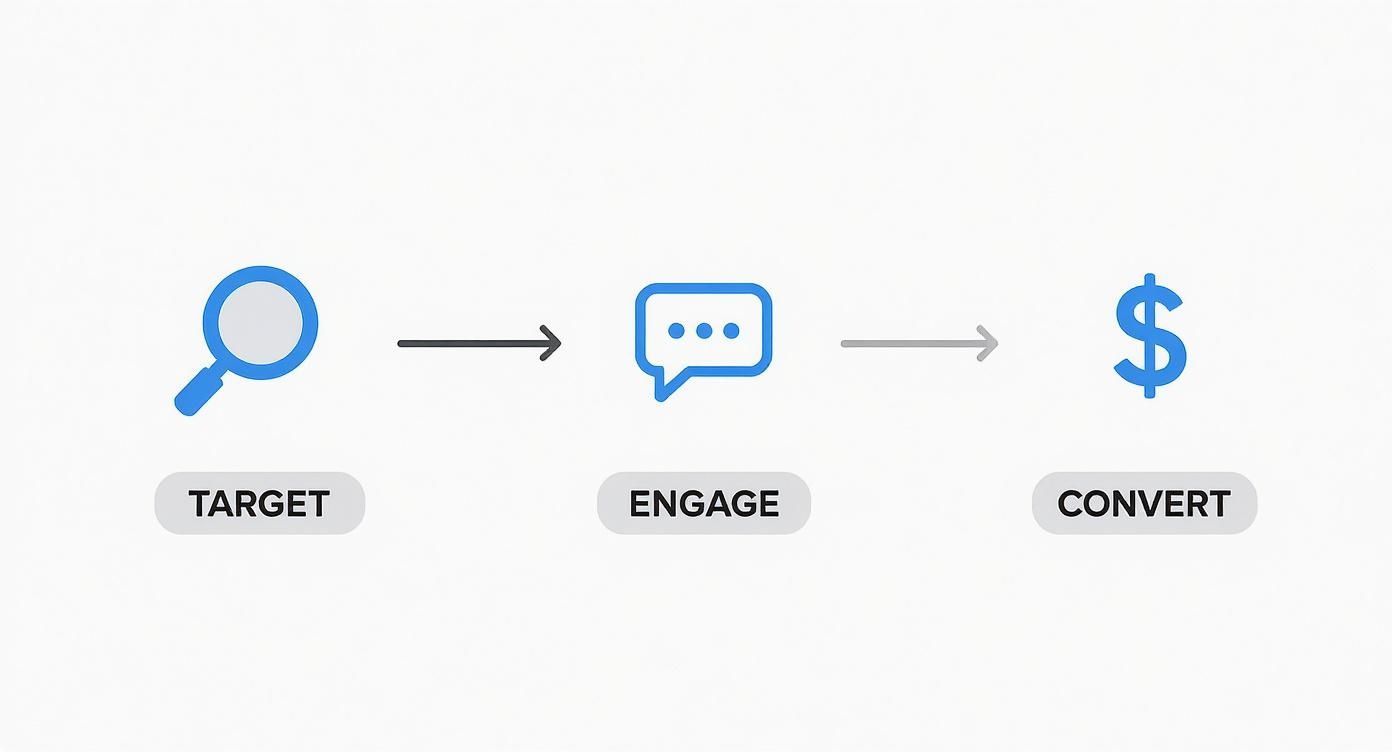
You move from precision targeting to authentic engagement before you even think about a sales pitch. Trust comes first. The data backs this up: LinkedIn is 277% more effective for lead gen than Facebook and X. Around 62% of marketers generate leads there, and 40% of B2B marketers call it their most effective channel. If you care about stats, Dreamgrow has some great insights.
Our Exact Sales Navigator Filters
Our process starts and ends in Sales Navigator. We're not looking for job titles; we're hunting for buying signals. These are the filter combinations we use every single day to build our target lists.
- Posted Content Keywords: This is our secret weapon. We use the "Posted on LinkedIn in past 30 days" filter and combine it with keywords that signal pain. For BillyBuzz, that means searching for people who have posted about "frustrated with Slack notifications" or are looking for "Reddit monitoring tools."
- Company Headcount Growth: We target companies on an upward trajectory. We set the filter to "Company headcount growth > 10%" to find businesses with budget and a need for new solutions.
- Recent Job Changes: A new role means a new budget and a desire to make a quick impact. We filter for "Changed jobs in past 90 days" to find decision-makers eager to bring in new tools.
We never send a connection request to this initial list. The goal is to build a highly curated list of prospects to watch. We’re playing the long game here.
This is about identifying the right people, not just more people.
The "Warm-Up Week" Engagement Sequence
Once we have our list, we start a simple, week-long engagement sequence. The goal is to get on their radar in a non-salesy way before we ever reach out.
Here’s our team's daily checklist for each prospect:
- Follow Them. No connection request. Just a simple follow. It’s a low-pressure way to get their content in our feed.
- Engage with Their Content. For the next 5-7 days, we add thoughtful comments to their posts. The rule is: no pitching, just contributing. We ask a question or share a relevant experience.
- Like and Share. If they post something relevant, we’ll like it. If it’s great, we’ll share it, tagging them with a comment praising their insight.
By the end of the week, they’ve seen our name a few times. We're no longer a stranger.
Our Connection Request & First DM Templates
Only after the warm-up do we send the connection request. The message is critical. It's never about us; it's about them.
Here's the exact template we use that gets an 80%+ acceptance rate:
Connection Request Template
"Hi [First Name], really enjoyed your recent post on [Topic of their post]. Your point about [Specific insight from their post] was spot on. Would love to connect and follow your work."
It’s short, personalized, and genuine. Once they accept, we don’t pitch. We send a follow-up DM that continues to provide value.
Initial DM Template (After Connection)
"Thanks for connecting, [First Name]! That discussion around [Same Topic] got me thinking. We actually put together a short guide on [Related valuable topic] that you might find interesting. No strings attached, just thought it was relevant. Here it is: [Link to ungated content]."
No ask for a meeting. We’re just offering free value. This positions us as helpful experts, not just another vendor. This is how you turn a cold contact into a warm, qualified lead.
Finding Untapped Real-Time Leads on Reddit
While everyone fights over scraps on LinkedIn, we're pulling a steady stream of high-intent leads from a place most B2B founders ignore: Reddit.
The beauty of Reddit is its raw honesty. People go there to ask for help, complain about their current tools, and actively look for solutions. It’s a real-time goldmine for leads.
This isn’t about spamming. It’s about surgically finding conversations where people are literally raising their hands asking for what you sell. This is our exact system at BillyBuzz.
Here's a look at our internal dashboard where real-time alerts come in, letting us jump on conversations the moment they happen.
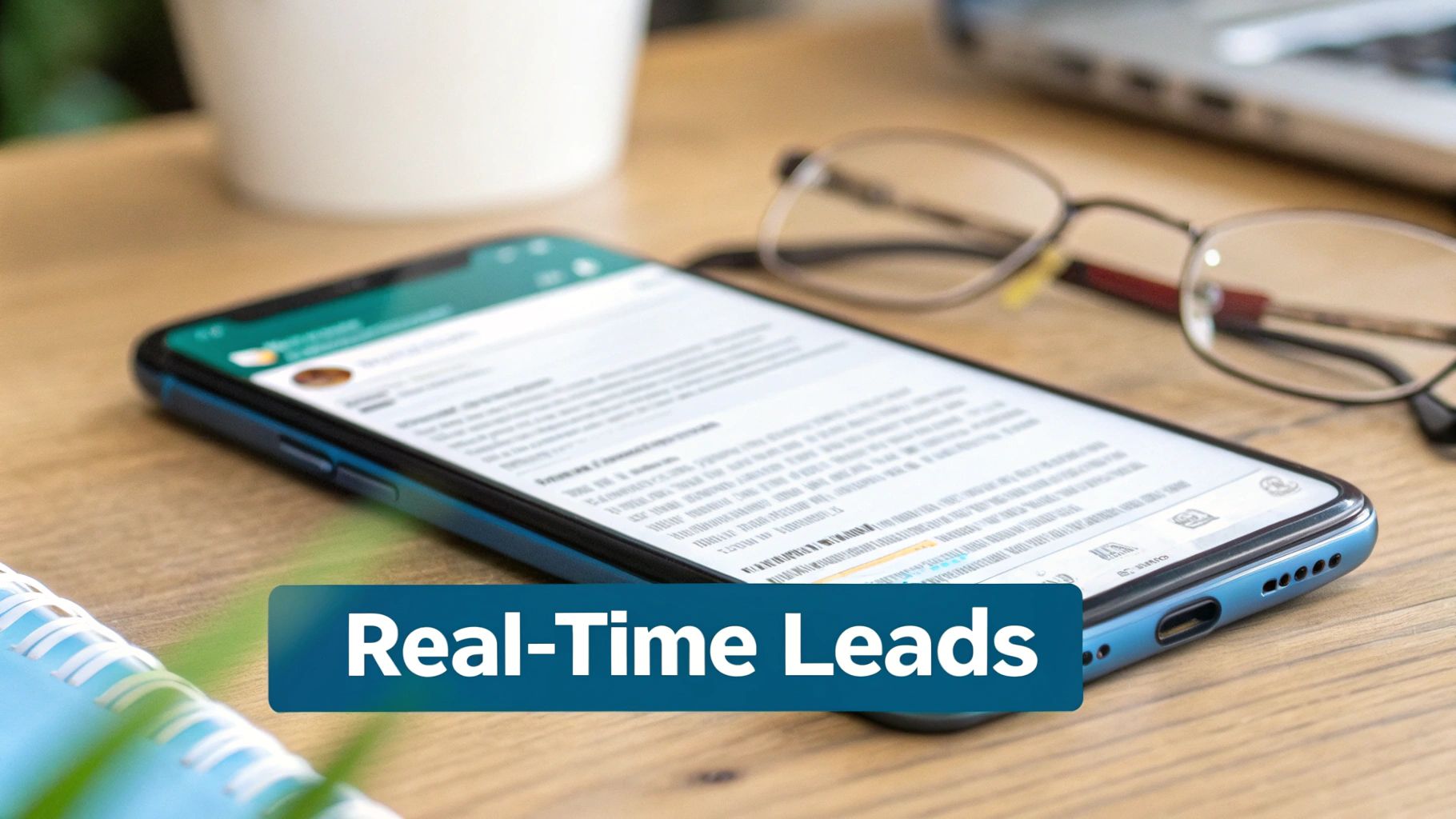
Perfect timing is everything.
The Subreddits We Live In
First, you need to find where your customers hang out. For our social monitoring SaaS, we spend our time in communities where tech pros discuss their daily problems.
Our core monitoring list includes:
- r/sysadmin: A hub for system administrators discussing monitoring, alerting, and automation.
- r/msp: For managed service providers talking about client management and software stacks.
- r/devops: Where developers and operations pros discuss toolchains and monitoring.
- r/saas: For fellow SaaS founders and operators sharing growth tactics and tool recommendations.
Find your subreddits by searching for your industry, competitors, and customer job titles. Look for active communities where people are open about their business challenges.
The Exact Keyword Alerts We Use
Once you know where to look, you need to know what to listen for. We don’t just track our brand name. We track buying-intent keywords.
Here are the alert rules we have running 24/7 inside BillyBuzz, sending notifications straight to our Slack:
Competitor Frustration Alerts:
"frustrated with [Competitor A]""any alternatives to [Competitor B]""[Competitor C] is too expensive"
Problem-Aware Alerts:
"how do you monitor keywords on reddit""best way to track brand mentions""manual social listening"
Solution-Seeking Alerts:
"recommend a social listening tool""tool for reddit alerts""software to find leads"
These are direct signals of need. An alert for "any alternatives to [Competitor A]" is a lead on a silver platter. For more on this, see our guide on how to monitor keywords on Reddit.
The goal is to be the first helpful reply. On Reddit, if you show up a day late, you’ve already lost.
Our "Always Help, Never Pitch" Response Template
Redditors will destroy you if they smell a sales pitch. Our #1 rule: never sell in the comments, always help. Your goal is to be the most helpful person in the thread.
When an alert fires for someone saying, "I'm so frustrated with [Competitor Tool], it keeps missing important mentions," our response is never "Hey, try BillyBuzz!"
Instead, we use this template:
Value-First Comment Template:
"That's a common issue with tools that rely only on basic keyword matching. A couple things that might help you get better results, regardless of what you use:
- Try using boolean operators like
("keyword phrase") AND ("another phrase") NOT ("exclude this"). It narrows the focus significantly.- See if your tool lets you limit searches to specific subreddits. That's usually where the highest-quality conversations are.
Hope that helps cut through some of the noise!"
Zero mention of our product. We provide expert advice that solves their problem. This builds instant credibility and prompts the original poster (and others) to click our profile, see what we do, and slide into our DMs asking for more info. That's when helpfulness turns into a demo.
Crafting Outreach That Actually Gets a Response
The moment of truth isn't finding the lead; it's the first message you send. Generic outreach is dead.
At BillyBuzz, our philosophy is simple: give before you ask. This disarms people and positions you as a helpful expert, not just another vendor.
Here are the word-for-word templates we use to start conversations. They aren't just scripts; they're designed to focus entirely on the other person, which is why they get replies.
Our Proven LinkedIn Outreach Sequence
We use a simple, three-part sequence designed to feel natural and build rapport.
Template 1: The Personalized Connection Request
This is your first impression. The only goal is to give a genuine, non-salesy reason for connecting. We send this after our "warm-up week."
Subject: Your post on [Topic]
"Hi [First Name], really enjoyed your recent post on [Topic of their post]. Your point about [Specific insight from their post] was spot on. Would love to connect and follow your work."
Why it works: It’s 100% about them. It proves you paid attention and makes accepting a no-brainer.
Template 2: The Content-Based Follow-Up (Post-Connection)
Once they accept, don't pivot to a pitch. That kills the trust you just built. Instead, follow up with helpful, ungated content.
"Thanks for connecting, [First Name]! That discussion around [Same Topic] got me thinking. We actually put together a short guide on [Related valuable topic] that you might find interesting. No strings attached, just thought it was relevant. Here it is: [Link to blog post or guide]."
Why it works: You're reinforcing your role as a helpful resource, building trust and reciprocity.
Template 3: The Pivot to a Business Discussion
Only send this after a positive response to the previous message, or a few days later. It's a soft pivot from their interest to a potential solution.
"Glad you found that helpful, [First Name]. Given your interest in [Topic], I was curious how you're currently handling [Problem your product solves]? We specialize in helping companies like yours [Achieve specific outcome]. No pressure at all, but would you be open to a brief chat next week to see if we could help?"
Why it works: It's a consultative question about their problem, not your product. This feels like a natural next step. For more advanced tactics, check out our guide on personalized outreach with AI segmentation.
Our High-Value Reddit Response Templates
Reddit is a community-first platform. Overt selling is a death sentence. The entire strategy is to be the most helpful person in the thread, which pulls people into DMs.
Template 1: The Public "Value-First" Comment
When a BillyBuzz alert hits, our first move is a public comment offering pure help. We never mention our product here.
"That's a tough problem. I've run into that before, and a couple of things that helped were:
- Tactic A: [Provide a specific, actionable tip they can implement immediately.]
- Tactic B: [Offer another distinct, helpful piece of advice related to their problem.]
Hope that helps you get it sorted out!"
Why it works: Instant credibility. Other Redditors upvote it, boosting visibility. The original poster sees you as an expert, making them likely to check your profile or start a DM.
Template 2: The Soft Private Message Follow-Up
We use this sparingly, only if the user replies to our public comment.
"Hey [Username], saw your reply to my comment in the [Subreddit Name] thread. Glad that advice was helpful! It looked like you were really trying to solve [Specific Problem]. Just a heads up, my company actually builds a tool for that. No pressure to check it out, but thought it might be relevant given your situation. Feel free to ask any other questions!"
Why it works: It's low-pressure and transparent. You connect the dots from their problem to your solution without being pushy, respecting the Reddit culture. For scaling this, learning about automated direct messages on Twitter can offer insights for other platforms.
Measure What Matters to Optimize Your System
You can't improve what you don't measure. As a founder, you have to be ruthless about tracking numbers that impact revenue, not vanity metrics like likes or followers.
We've ditched complex dashboards for a handful of KPIs that tell us if our efforts are actually working. This is how we turned random activity into a predictable system.
The KPIs We Actually Live By
If you only track three things, make them these. They create a simple funnel from touchpoint to opportunity.
Conversations Started (Per Platform): How many new, meaningful two-way conversations did we start this week on LinkedIn and Reddit? A "conversation" is a real reply, not just a connection acceptance.
Positive Reply Rate: Does our messaging work? We divide the number of positive/neutral replies by the total outreach messages sent. A low rate means our templates or targeting are wrong.
Meetings Booked from Social: The bottom-line number. How many conversations turned into a scheduled demo? This ties social activity directly to potential revenue.
Chasing likes is a founder's trap. Tracking conversations, positive replies, and booked meetings is how you build a real lead generation engine. Everything else is just noise.
This simple framework tells us where our best leads come from and how efficiently we're moving them down the funnel. Properly measuring social media ROI is the only way to know where to double down.
Setting Up Your Tracking System
You don't need a fancy tool. We still use a basic Google Sheet. It’s simple, fast, and forces focus.
Here’s a template you can copy.
Social Lead Gen KPI Tracking Template
| Metric | Weekly Goal | How to Track | Optimization Notes |
|---|---|---|---|
| Conversations Started | 15 (LinkedIn), 10 (Reddit) | Manually tally new DM conversations in a spreadsheet at the end of each day. | If this number is low, we need to increase our initial engagement or outreach volume. |
| Positive Reply Rate | >30% | Divide positive replies by total new messages sent that week. | A rate below 30% triggers a review of our outreach templates. Are they too salesy? Not personalized enough? |
| Meetings Booked | 5 | Track the source of every meeting in your calendar or CRM. Add a "Source: Social" tag. | If this is lagging, we analyze the middle of our funnel. Are we failing to pivot the conversation? |
This takes 15 minutes a day to maintain. The clarity is worth it.
The Monthly Review That Drives Improvement
At the end of each month, we block 30 minutes to review the numbers and ask tough questions.
Our agenda:
- Which outreach templates won? The winners become the new control for next month.
- Which subreddits delivered quality? We look at which communities led to the most meetings booked, not just conversations.
- What on LinkedIn moved the needle? Which Sales Navigator filters produced the most valuable leads? We shift our focus accordingly.
This disciplined process of measuring, reviewing, and acting is what turns social media effort into a reliable stream of new business.
Your Top Questions About Social Lead Gen, Answered
Let's be real. Building this system can feel like a massive project. Here are straight answers to the questions we always get at BillyBuzz.
How Much Time Does This Really Take Each Day?
When we started, it was a grind—hours of searching. Now that our process is dialed in, our team spends about 45-60 minutes per day on active outreach.
Here’s the breakdown:
- 15 minutes: Responding to real-time Reddit alerts from BillyBuzz.
- 20 minutes: "Warm-up week" engagement on LinkedIn (likes and comments).
- 15 minutes: Sending a small batch of personalized LinkedIn connection requests and DMs.
The secret is using tools that bring conversations to you. Our keyword alerts for Reddit eliminate mindless scrolling and let us focus only on high-intent interactions.
Should I Start with LinkedIn or Reddit?
Don't try to do both at once. Pick one and master it.
Ask yourself this: Where does my ideal customer go to complain about their problems or ask for advice? The answer is your starting point.
Here’s how we decide:
- Go with LinkedIn if: Your buyers are defined by job titles and company profiles (e.g., "Head of Marketing at SaaS companies with 50-200 employees"). LinkedIn's filters are built for this.
- Go with Reddit if: Your buyers are defined by a shared problem (e.g., "people frustrated with their current monitoring tool"). Reddit is a goldmine for finding these problem-aware folks who are actively looking for a solution.
For us, both are crucial. But our highest-intent leads almost always come from Reddit, because they start the conversation by stating their pain.
How Do I Scale This Without Sounding Like a Spam Bot?
The trick is to systematize the process, not the personalization.
We use templates as a starting point, but our one non-negotiable rule is: every single message must include one unique, specific bit of personalization.
On LinkedIn, that’s referencing a specific point from their recent post. On Reddit, it’s acknowledging a particular frustration they mentioned. That extra 30 seconds of research is what makes this entire system work. You cannot automate empathy.
Ready to stop hunting and start engaging? BillyBuzz is the founder's secret weapon for finding high-intent leads on Reddit in real-time. Ditch the manual searching and get targeted opportunities sent straight to your Slack or email. Start your free trial today and find your next customer on BillyBuzz.