

Figuring out your target market is about identifying the specific group of people who are most likely to want what you’re selling. It starts with a smart guess—a testable hypothesis—about who they are and what problem you solve for them. This isn't about appealing to everyone; it's about focusing on a precise audience. This is the exact process we use at BillyBuzz before we build anything.
Define Your Customer Before Spending a Dime
Before you write a single line of code or drop a dollar on ads, you need a sharp, clear idea of who your customer is. So many founders fall into the trap of building for "everyone" or a vague demographic like "small business owners." That’s a fast track to wasting a ton of time and money.
At BillyBuzz, we kick off every single project by figuring out who feels a specific pain point most acutely. We don't start with demographics. We start with psychographics and problems. The whole point is to build a foundational assumption that guides all the research that comes next.
Start with a Problem-Audience Framework
Your first move is to nail down a simple "Problem-Audience" statement. This isn't some deep, complex persona document—it’s a one-sentence hypothesis that’s specific, measurable, and, most importantly, testable. Think of it as your North Star for this initial discovery phase.
We build ours using a few core components:
- The Audience: Who are they? Describe them by their role or a key behavior.
- The Problem: What specific, painful problem are they dealing with?
- The Negative Outcome: What’s the consequence of this problem going unsolved?
For example, a weak hypothesis is: "We help marketers get more leads." It’s just too broad to be useful.
A much stronger hypothesis is: "We help B2B SaaS founders with no marketing team who struggle with manual Reddit monitoring (the problem) and miss out on high-intent leads as a result (the negative outcome)." Now that is something you can actually go out and validate.
I’ve learned the hard way that a fuzzy customer definition leads to a fuzzy product and zero traction. Your initial hypothesis needs to be sharp enough to be proven wrong. That's its real purpose—to give you a starting point to test against reality.
This simple diagram breaks down how we structure this initial thinking. We focus first on mindset and problems before we even try to define the audience.
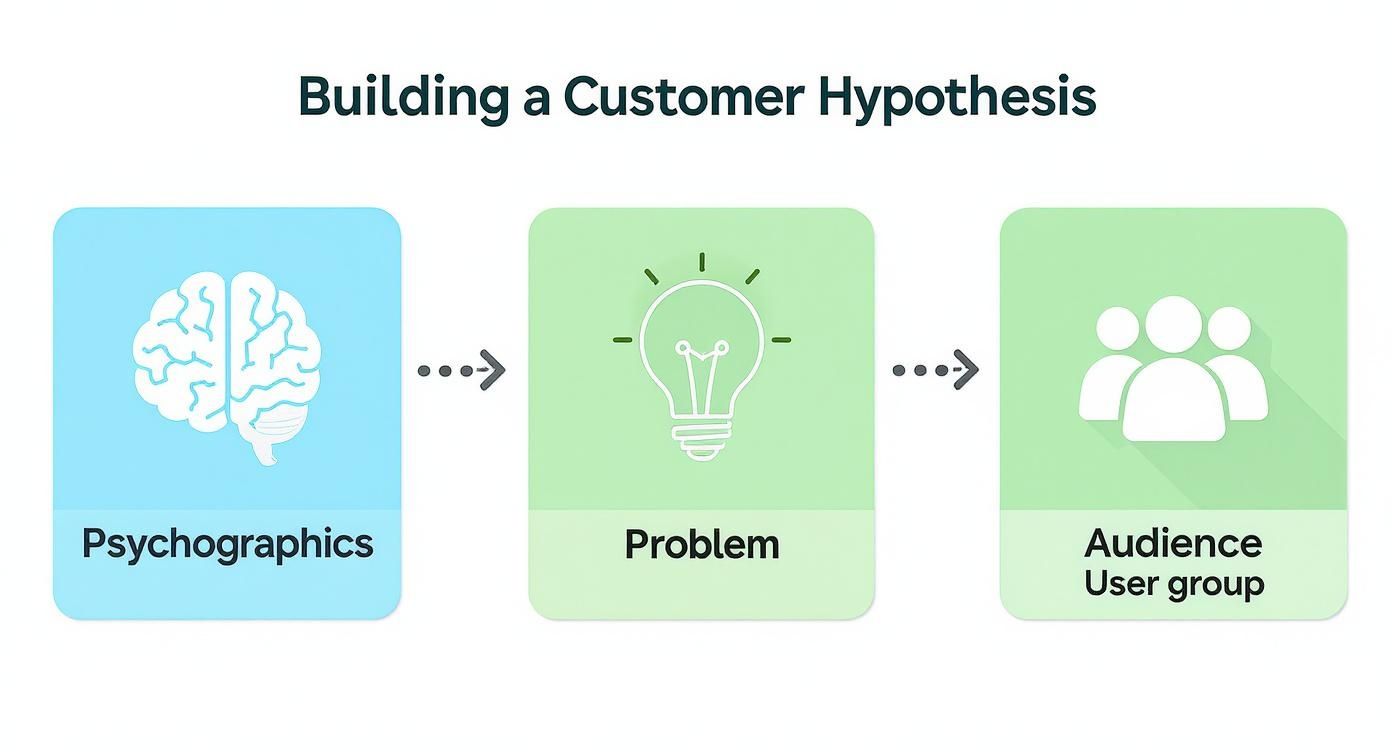
As you can see, the flow is from understanding your audience's internal world (psychographics) to the tangible issue they face (the problem), which then helps you zero in on the right user group.
Build Your Initial Hypothesis Framework
To give this process some structure, we use a simple table to organize our thoughts. It forces you to get specific right from the start.
| Initial Target Market Hypothesis Framework |
| :--- | :--- | :--- |
| Hypothesis Component | Guiding Question | Our Actual BillyBuzz Example |
| User Group | Who is experiencing this problem most intensely? | B2B SaaS founders with small teams (<10 people). |
| Psychographics | What are their goals, fears, and motivations? | They are ambitious, time-poor, and fear missing growth opportunities. |
| Problem | What specific, recurring pain point do they have? | Manually tracking brand mentions on Reddit is time-consuming. |
| Current Behavior | How are they trying to solve this now (or not)? | Using simple keyword searches or just ignoring Reddit completely. |
| Negative Consequence | What happens if the problem isn’t solved? | They miss out on customer feedback and high-intent sales leads. |
| Trigger Event | What event makes them suddenly need a solution? | A competitor gets mentioned in a popular subreddit, driving new signups. |
Laying out your assumptions like this makes it clear what you need to go out and prove—or disprove.
To really nail this, you have to get comfortable with the basics of what is segmentation in marketing, which is all about breaking a large market into smaller, more manageable groups. Your initial hypothesis is really just your first, educated guess at defining that perfect segment.
Uncover Early Demand with Digital Signals
Your initial customer hypothesis is a fantastic starting point, but it's still just an educated guess. Before we invest time talking to potential customers, we look for real, measurable demand. This is where we dig into the digital breadcrumbs people leave behind when they're actively trying to solve a problem.
Think of it as market validation before the first conversation. We use keyword research not just for SEO, but as a powerful lens to gauge audience size and commercial intent. Analyzing what people search for, how often they search for it, and what advertisers are willing to pay to show up for those terms gives you a quick, quantitative pulse check.

Go Beyond Basic Keyword Research
The real gold isn’t in the vanity metrics like raw search volume. It’s in understanding the language your potential customers use when they're feeling a pain point. At BillyBuzz, for example, we didn’t just look up "social media tools." That's way too broad. We got specific, focusing on queries that scream "I have a problem!"
Here are the kinds of keywords that actually tell you something meaningful:
- Problem-Based: Queries like "how to track mentions on reddit" or "find customers on reddit."
- "Alternative to" Queries: Searches such as "hootsuite alternative for reddit" or "mentionlytics vs."
- Job-to-be-Done: Terms focused on an outcome, like "automate reddit lead generation" or "monitor subreddit for keywords."
A high Cost-Per-Click (CPC) on these long-tail, specific phrases is a fantastic sign. It tells you that other companies are already bidding money to reach these people, confirming that the market sees this as a problem worth paying to solve.
Reverse-Engineer Your Competitors
Why start from scratch when your competitors have already blazed a trail? They've spent their marketing budgets figuring out who to target, and you can learn a ton just by looking at their digital footprint. Dissecting competitor ad copy and, more importantly, their backlink profiles is one of my favorite ways to reverse-engineer a market.
Looking at who links to your competitors is like getting a free map of your market's watering holes. If a niche industry blog or a popular forum consistently links to them, that’s a strong signal that your target audience is active there.
We hunt for patterns in their backlinks. Are they getting coverage from SaaS review sites? Are specific industry bloggers mentioning them? Are they active in certain community forums? Every link tells a story about where their audience hangs out online. This exercise doesn't just give you ideas; it gives you a data-backed list of channels to explore. It's the perfect preliminary step before you get into more granular tactics like tracking trends in Reddit conversations.
By piecing together these digital signals—search data and competitor activity—you build a strong layer of quantitative validation. You’re confirming that the problem you think exists is one people are actively trying to solve online. With this data-driven foundation in place, your next steps in qualitative research will be far more focused and effective, ensuring you’re not just taking a shot in the dark.
Tapping into the Unfiltered Truth of Niche Communities
https://www.youtube.com/embed/OMJQPqG2Uas
Quantitative data tells you what is happening. Qualitative data from real conversations tells you why.
That "why" is where the real gold is buried. You find it in raw, unfiltered conversations with real people. Forget about sterile, generic surveys. We've found so much more value by becoming a fly on the wall in the digital spaces where our ideal customers already hang out. At BillyBuzz, we spend our time in specific subreddits, niche Facebook groups, and industry forums to get a ground-level view of the problems founders are actually dealing with.
Setting Up Your Digital Listening Posts
Your objective here is to capture the exact language people use to describe their frustrations. It's about understanding them in their natural habitat. We don't just browse casually; we have a system.
Here's our internal BillyBuzz setup for finding early customers:
- Subreddits we monitor:
r/SaaS,r/smallbusiness,r/Entrepreneur,r/startups. - Alert rules we use: We set up alerts in a tool like Syften for problem keywords like "find customers," "user acquisition," and "how to track mentions." We also monitor our competitors' names. This creates a real-time feed of conversations where people are actively looking for solutions.
- Keywords to look for: "anyone know a tool for," "looking for recommendations," "how do you solve." These phrases are direct buying signals.
For more community ideas, check out our guide on the top 5 subreddits for small business insights.
Take a look at this. It's a pretty typical discussion you’d see over on r/SaaS, where founders are getting real about their challenges.
Threads like this are pure gold. They reveal real-time pain points—from user acquisition struggles to pricing strategy confusion—all described in the authentic language of the community.
Moving from Listening to Engaging
Just monitoring is a good start, but the real value comes from turning those passive insights into active conversations. When we spot a relevant post, we don’t just jump in with a sales pitch. That’s the quickest way to get yourself ignored. Our goal is simply to start a conversation and learn.
Here’s our actual DM template that gets a surprisingly high response rate:
"Hey [Name], saw your post in r/SaaS about finding your first users. I'm building something in that space and would love to hear more about your experience. No sales pitch, I promise. Just a founder trying to learn. Got 15 mins next week?"
This approach just plain works because it’s genuine. We aren't selling; we're learning. These 15-minute "problem discovery" interviews are where the most valuable insights come from. We hear how they describe their pain, what they've already tried, and what a perfect solution would look like, all in their own words.
This kind of direct community engagement is more important than ever. The global ecommerce market is a huge space, expected to hit $4.8 trillion in 2025. And within that, social commerce is on track to reach $1.2 trillion by 2025, which just goes to show how vital these online communities have become. You can dig into more global ecommerce trends from Shopify to see the bigger picture.
By combining passive social listening with active, respectful outreach, you stop making assumptions. You start gathering the rich, qualitative data that will inform every part of your business. This is how you find your target market—not by guessing, but by listening.
Build a Customer Profile That Actually Drives Decisions
All that research you've done? It's completely worthless if it just sits in a spreadsheet gathering digital dust. The goal is to take everything you’ve learned and turn it into a practical, one-page tool that actually steers your business.
We're not talking about those fluffy, academic personas full of demographic data that nobody ever looks at again. You need a living document that guides your marketing, sharpens your sales pitch, and helps shape your product roadmap.
At BillyBuzz, we build our Ideal Customer Profiles (ICPs) around what people do, not just who they are. We're obsessed with the "why" behind their actions because that's what helps us make smarter decisions.

Ditch Demographics for Actionable Insights
Let's be honest: traditional personas are often packed with useless information. Does knowing your B2B buyer's marital status or age really help you sell software? Probably not. It's time to zero in on the factors that genuinely drive behavior and purchase decisions.
Our one-page ICP template at BillyBuzz is built on these four pillars:
- Jobs-to-be-Done (JTBD): Forget features. What is the fundamental outcome this person is trying to achieve? What "job" are they trying to hire your product to do for them?
- Buying Triggers: What just happened? What event, frustration, or new priority has suddenly forced them to start looking for a solution today?
- Watering Holes: Where do they really hang out online? We list the specific subreddits, private Slack groups, and niche newsletters they actually read and trust.
- Objections & Hesitations: What are their biggest doubts? What's the number one reason they'd tell you "no" or "not right now"?
An effective ICP isn't a biography; it's a playbook. It should tell you exactly what message will resonate, where to deliver it, and what roadblocks to anticipate. This is how you stop guessing and start executing with precision.
Prioritize Segments with a Scoring Matrix
It’s pretty common for research to uncover several promising customer segments. But trying to be everything to everyone is a classic startup mistake. You need a simple, logical system to decide where to place your bets first.
We use a straightforward scoring matrix to force an honest conversation about where the best immediate opportunity lies. We rank each potential segment from 1 (low) to 5 (high) across three simple but critical criteria:
- Pain Level: Just how bad is their problem? Is it a mild annoyance or a hair-on-fire, urgent crisis?
- Budget: Can they actually afford a solution? Are they willing to pay to make this problem go away?
- Market Size: How many of them are out there? Is this a small, niche group or a massive, untapped market?
This simple exercise brings so much clarity. It’s also where looking at broader industry trends can give you an edge. For instance, the global AI market is a great indicator of where growth is happening, with a value expected to hit around $294.16 billion in 2025—that's a 26% jump from 2024. Layering macro data like this from sources like ExplodingTopics.com on top of your own research helps validate your market-sizing estimates.
Once you’ve scored your segments and picked a winner, you can build out a laser-focused ICP. This single document becomes the source of truth for your entire go-to-market strategy, including how you approach personalized outreach with AI segmentation.
Test Your Message Before You Build Your Product
An idea is just a theory until the market proves it right. I've seen too many founders sink countless hours and dollars into a product only to launch to crickets. Before you write a single line of code, you need real, tangible proof that people actually care about what you're planning to build.
This is where we run small, cheap experiments to get that crucial real-world feedback.
At BillyBuzz, our mantra is to test the value proposition first, develop second. The goal here isn't to make sales—it's to gather data. We're looking for proof that the people we identified in our research will actually click a button or enter an email address based on our proposed solution. It’s about gauging intent.
Create a Simple Validation Landing Page
Your first experiment is a simple landing page. Seriously, you don't need a full website. All you need is a single page that clearly lays out the problem you're solving and how you plan to solve it.
We spin these up in an afternoon using tools like Carrd. It’s perfect—fast, cheap, and you don’t need to be a developer. Your page only needs three things:
- A Killer Headline: Get straight to the point. What's the core value?
- Problem-Agitate-Solve: Quickly describe the pain point, twist the knife a little by explaining why it sucks, and then present your idea as the solution.
- A Single Call-to-Action (CTA): Keep the ask small. Something like "Join the waitlist" or "Get early access" is perfect.
The entire point of this page is to see if your message resonates enough to capture leads from genuinely interested people. Think of it as a smoke test—is there any fire here?
Your North Star metric at this stage is the sign-up conversion rate. A high conversion rate from the right traffic is the strongest signal you can get that you’re onto something. Ignore vanity metrics like page views.
Run a Micro-Budget Ad Campaign
Okay, your landing page is live. Now you need to get the right eyeballs on it. This is where you put that customer profile to the test with a tiny, targeted ad campaign. We usually set aside just $50-$100 for this initial validation.
We run these small campaigns where we can get super specific with targeting. Platforms like Reddit or LinkedIn are great for this. For example, if we think our ideal customer is a B2B SaaS founder, we’ll run ads directly in the r/SaaS subreddit or target LinkedIn users with "Founder" in their job title.
The numbers you're watching are click-through rates (CTR) and, most importantly, the conversion rate on your landing page. These data points give you concrete evidence that you're hitting the mark.
This isn't just about validating an idea in a vacuum, either. We look at broader economic trends to inform these tests. For instance, with global growth projected at 3.2% for 2025 but emerging markets expected to grow over 4%, we might test a campaign in a high-growth region to see if there's international demand from day one. You can dig into these trends yourself in the latest IMF economic outlook. This is how you find your target market with real data, not just a hunch.
Common Questions About Finding Your Target Market
We get a lot of questions from other founders who are in the trenches trying to nail down their audience. Here are a few of the most common ones, along with some straight-to-the-point answers based on our own experiences building BillyBuzz.

How Specific Should My Initial Target Be?
It should be almost uncomfortably specific. If it feels too broad, it definitely is. Founders often get scared of niching down, worried they're leaving money on the table. But in the early days, a laser focus is your biggest advantage.
When we started BillyBuzz, our first hypothesis wasn't just "SaaS companies." It was "B2B SaaS founders with teams under 10 who are not active on Twitter but believe their audience is on Reddit." That level of detail creates a crystal-clear profile you can actually go out and find, talk to, and test.
You can always broaden your scope later. First, you need to win over a small, passionate group that desperately needs what you're building.
The goal of your first target market isn't to define your entire future customer base. It's to find the smallest possible group of people who feel a specific pain point so acutely that they'll take a chance on an early-stage solution.
What if My Research Points to Multiple Audiences?
This happens all the time. You’ll likely uncover a few promising segments. The absolute worst thing you can do is try to chase them all at once. Your messaging becomes diluted, your resources get stretched thin, and you end up resonating with no one.
When we face this, we get ruthless with prioritization. We use a simple scoring matrix to rank each potential audience based on three key factors: pain level, budget, and market size. The group with the highest combined score becomes our primary focus.
Any other promising segments? They go into a "Phase Two" doc. We don't forget them, but we put them on ice until we’ve nailed our initial market.
How Often Should I Revisit My Customer Profiles?
Your Ideal Customer Profile (ICP) is a living document, not a stone tablet. Markets shift, your product evolves, and your own understanding of your customers gets deeper with every conversation.
We have a standing quarterly review for our core ICPs. This isn’t a huge research project every three months. It's more of a quick check-in. We look at recent customer calls, product usage data, and any market trends to see if our core assumptions still hold up.
Minor tweaks happen often. A complete overhaul only happens if we see a major shift in customer behavior or if we’re launching a significant new product line.
Ready to stop guessing where your customers are and start finding them in real-time? BillyBuzz uses AI to monitor Reddit for high-intent conversations, delivering qualified leads directly to your inbox or Slack. See how BillyBuzz can automate your customer discovery today.