

As founders, we're told to "obsess over your customers." It's good advice, but it's only half the story. If you're ignoring your competitors, you're making decisions in a vacuum. We learned this the hard way.
At BillyBuzz, we don't just "monitor" the competition. We've built a system to find high-intent signals—the moments a competitor's customer becomes our potential customer. This isn't about drowning in data; it's about finding specific, actionable triggers. This guide isn't theory. It's exactly what we do.
Why We Stopped Manually Tracking Competitors
Early on, my co-founder and I spent hours a day manually checking websites, scrolling Twitter, and searching Reddit. It was a soul-crushing time suck, and we still missed the most important conversations.
Competitor monitoring software isn't a luxury; it's leverage. It automates the grunt work and acts as our early-warning system. Instead of reacting to a competitor's new feature launch, we see the signals weeks in advance—like a sudden spike in their job postings for mobile developers. That heads-up gives us time to plan, not just panic.
At BillyBuzz, our core philosophy is simple: proactive awareness beats reactive panic every time. We built our growth strategy on the principle that knowing what's coming is the ultimate competitive advantage. This mindset is crucial for any startup aiming for market leadership.
From Raw Data to Revenue
Good software gives you concrete answers to the questions that keep founders up at night:
- Where are they winning customers? We track their brand mentions and ad campaigns to find their most effective channels.
- What are their biggest weaknesses? We live in forums and Reddit threads to find customer frustrations we can solve.
- How are they positioning themselves? We monitor their website copy to see the story they're telling the market.
This constant flow of intelligence shapes our product roadmap, sharpens our marketing, and helps us find our unique spot in the market. Understanding these dynamics is one of the many essential tools and strategies for maximizing startup growth. For us, these tools are a flat-out necessity.
The BillyBuzz Playbook for Tracking Competitors
Alright, let's open up the playbook. This isn’t generic advice. These are the specific, battle-tested tactics we use at BillyBuzz every day to turn market chatter into new customers.
Our approach is built on one idea: find the signal in the noise. We don’t track every single move our competitors make. We zero in on triggers that signal a strategic shift, a product weakness, or a marketing opportunity. The global competitive intelligence software market is expected to rocket from US$ 26.6 million in 2025 to US$ 51.5 million by 2032—that's because founders are tired of noise and want actionable signals.
Our Exact Alert and Keyword Setup
The foundation of our system is hyper-specific keyword alerts. Just tracking a competitor's brand name is a firehose of useless information. We get granular.
Here are the actual alert rules we have running 24/7 inside BillyBuzz:
- Feature & Launch Alerts:
"[Competitor Name]" + "new feature" OR "launches" OR "announces" - Pricing Change Alerts:
"[Competitor Name]" + "pricing" OR "plans" OR "new tier" OR "price increase" - Negative Sentiment Alerts:
"[Competitor Name]" + "is slow" OR "buggy" OR "customer service issue" OR "frustrating" OR "downside" - Comparison & Switching Alerts:
"alternative to [Competitor Name]" OR "[Our Name] vs [Competitor Name]" OR "switching from [Competitor Name]"
The last two are our highest priority. They’re direct buying signals from people who are actively looking for a better solution.
Monitoring Unfiltered Feedback on Reddit
Corporate review sites are fine, but the raw, unfiltered truth lives on Reddit. It’s where users share their real frustrations and honest opinions. We practically live in a few key subreddits for pure, unadulterated competitive intelligence.
Our primary hunting grounds:
- r/SaaS: The go-to for candid feedback on tools.
- r/startups: To hear what other founders are struggling with and which tools they’re complaining about.
- r/marketing: A goldmine for seeing how marketers are failing with competitive tools.
- Niche Subreddits: We also monitor smaller subreddits specific to our customers' industries.
We don't just scroll. We have a saved filter inside BillyBuzz that is our holy grail:
Competitor Name MENTIONED in r/SaaS OR r/startups+NEGATIVE Sentiment+CONTAINS "alternative" OR "recommendation" OR "switch". This is our highest-priority alert. It’s a direct line to a competitor's unhappy customer.
Our Response Template for Turning Weakness Into Opportunity
When we spot an unhappy customer in a public forum, we don't drop a sales pitch. We use a templated—but highly customizable—response that adds value first.
Here’s our go-to template:
"Hey [Username], saw you're running into issues with [Competitor's specific problem]. That's a super common frustration—especially [add a bit of validation, e.g., when you're trying to scale your outreach].
A lot of folks in this sub have found that focusing on [a different approach, e.g., real-time alerts instead of weekly reports] helps solve that exact problem.
Full transparency, I'm one of the founders of BillyBuzz, and we actually built our tool specifically to fix [the pain point]. No pressure at all, but thought it might be helpful context. Happy to answer any questions if you have them."
This works because it validates their frustration, offers a helpful perspective, and introduces our brand without being pushy. Gaining a deeper understanding of practical competitive intelligence by learning how to monitor website changes can also add another powerful layer to your strategy.
BillyBuzz's Internal Competitor Monitoring Setup
To give you a clearer picture, here’s a simplified look at the actual system we have running internally. This table breaks down the specific alerts, sources, and response triggers we use to stay ahead.
| Monitoring Category | Tools We Use | Specific Keywords/Alerts | Action Trigger |
|---|---|---|---|
| Pricing Changes | BillyBuzz, Google Alerts | "[Competitor]" + "pricing", "new plan", "price increase" |
Internal pricing team is notified via Slack to analyze the change and our positioning. |
| Feature Launches | BillyBuzz, Feedly | "[Competitor]" + "launches", "new feature", "announces" |
Product team reviews the feature. Is it a threat? An opportunity? A nothing-burger? |
| Negative Sentiment | BillyBuzz (for Reddit/Twitter), Brand24 | "[Competitor]" + "sucks", "is slow", "buggy", "bad support" |
Marketing team is alerted to engage if appropriate, offering helpful advice (not a hard sell). |
| Comparison Keywords | BillyBuzz, Ahrefs | "alternative to [Competitor]", "[Our Brand] vs [Competitor]" |
Content team is flagged to see if we have (or need) a comparison page for this query. |
| Key Employee Moves | LinkedIn Sales Navigator, Google Alerts | "[Competitor]" + "hires [job title]", "[Exec Name]" + "joins" |
Leadership team gets an email digest to track talent flow and potential strategy shifts. |
This setup ensures that we're not just collecting data; we're routing actionable intelligence to the right people in real time. It's a living system that we tweak constantly, but it's the engine that keeps us agile and deeply connected to what's happening in our market.
Must-Have Software Features That Actually Matter

The market for these tools is crowded. Most features are just noise. As founders, we need tools that give us a clear, immediate edge. After years in the trenches, here's what actually moves the needle. The global competitor analysis market is projected to hit US$ 6.6 billion by 2025 because founders are realizing how critical these specific features are.
Real-Time Alerts That Cut Through the Noise
A weekly email digest is a week too late. Real-time alerts are non-negotiable. Opportunities and threats have a short shelf life.
When a potential customer complains about your competitor on Reddit, a five-hour delay means five other companies already replied. You need alerts delivered instantly to Slack or email, fine-tuned to trigger only on events worth your time.
At BillyBuzz, our most valuable alert is for "negative sentiment + competitor mention" in specific subreddits. That real-time ping is the difference between winning a new customer and never even knowing they existed.
Sentiment Analysis That Understands Nuance
Just tracking mentions is a rookie mistake. A mention tells you a conversation is happening; sentiment analysis tells you how it’s happening. Is the customer delighted, furious, or just confused?
Modern competitor monitoring software uses AI to see beyond positive/negative. It can pick up on sarcasm, frustration, and purchase intent. This is how you prioritize your energy.
BillyBuzz in Action: A few months back, our sentiment alerts flagged a massive spike in frustration around a competitor's new UI update. We saw dozens of posts using words like "confusing," "slow," and "unusable." We immediately pivoted our ad copy for two weeks to highlight BillyBuzz's simplicity. The result was a 22% increase in demo sign-ups from that campaign—a move we never would have made without nuanced sentiment data.
Deep SEO and Content Tracking
Your competitor's marketing engine runs on their content and SEO. The right software lets you see exactly how it works.
You need a tool that can deconstruct their entire content funnel. What topics are they writing about? Which articles are earning the most valuable backlinks? This lays their go-to-market strategy bare.
- Keyword Gap Analysis: Shows you which keywords your competitors rank for that you don't. It's a content roadmap on a silver platter.
- Backlink Monitoring: Alerts you when a competitor earns a high-authority link, giving you a peek into their PR and outreach strategy.
- Content Performance: Tracks which of their blog posts get the most social shares and traffic, so you can learn from their biggest wins.
By tracking these, you stop guessing what content to create. Visualizing this data is key. We've written about building custom dashboards for social media monitoring to turn complex data into a clear, actionable picture. This approach transforms raw SEO data into a strategic compass.
Choosing The Right Tool For Your Company Stage
The best software for a Fortune 500 company is overkill for a bootstrapped startup. As a founder, your biggest constraints are time and money. Pick a tool that fits your current reality.
We learned this the hard way. Early on, we nearly got locked into an expensive, enterprise-level contract loaded with features we didn't need. It taught us to align our tools with our stage, not our ambitions.
Scrappy Startup Tier
When you're starting, your mission is validation. Your budget is tight. You need tools that are free or very low-cost.
This is the DIY phase. Your "stack" is a collection of smart, manual processes. Think Google Alerts, Feedly, and religiously monitoring specific subreddits.
- Key Focus: Identifying customer pain points and spotting early market trends.
- Budget: $0 - $50 per month.
- Example "Tools": A well-organized system of Google Alerts, manual Reddit searches for competitor complaints, and signing up for rival newsletters with a burner email.
At BillyBuzz, we started right here. My co-founder and I had a shared spreadsheet where we'd paste links to relevant Reddit threads every morning. It was tedious, but it gave us the raw feedback we needed to build our MVP. For a more focused approach, you can explore some of the top social monitoring tools for startups that offer powerful features without the enterprise price tag.
Growth Stage Tier
Once you have product-market fit, the manual approach breaks. You need a dedicated competitor monitoring software that automates data collection and surfaces insights.
Here, you invest in a mid-tier platform that offers robust analytics, sentiment analysis, and real-time alerts delivered to Slack. The focus shifts from just listening to actively turning insights into better marketing and product improvements.
- Key Focus: Automating data collection, tracking sentiment at scale, and turning insights into action.
- Budget: $100 - $500 per month.
- Example Tool Types: Platforms like BillyBuzz that specialize in community monitoring or broader social listening tools with strong filtering.
This image shows the fundamental workflow that tools in this tier (and above) should have absolutely mastered.
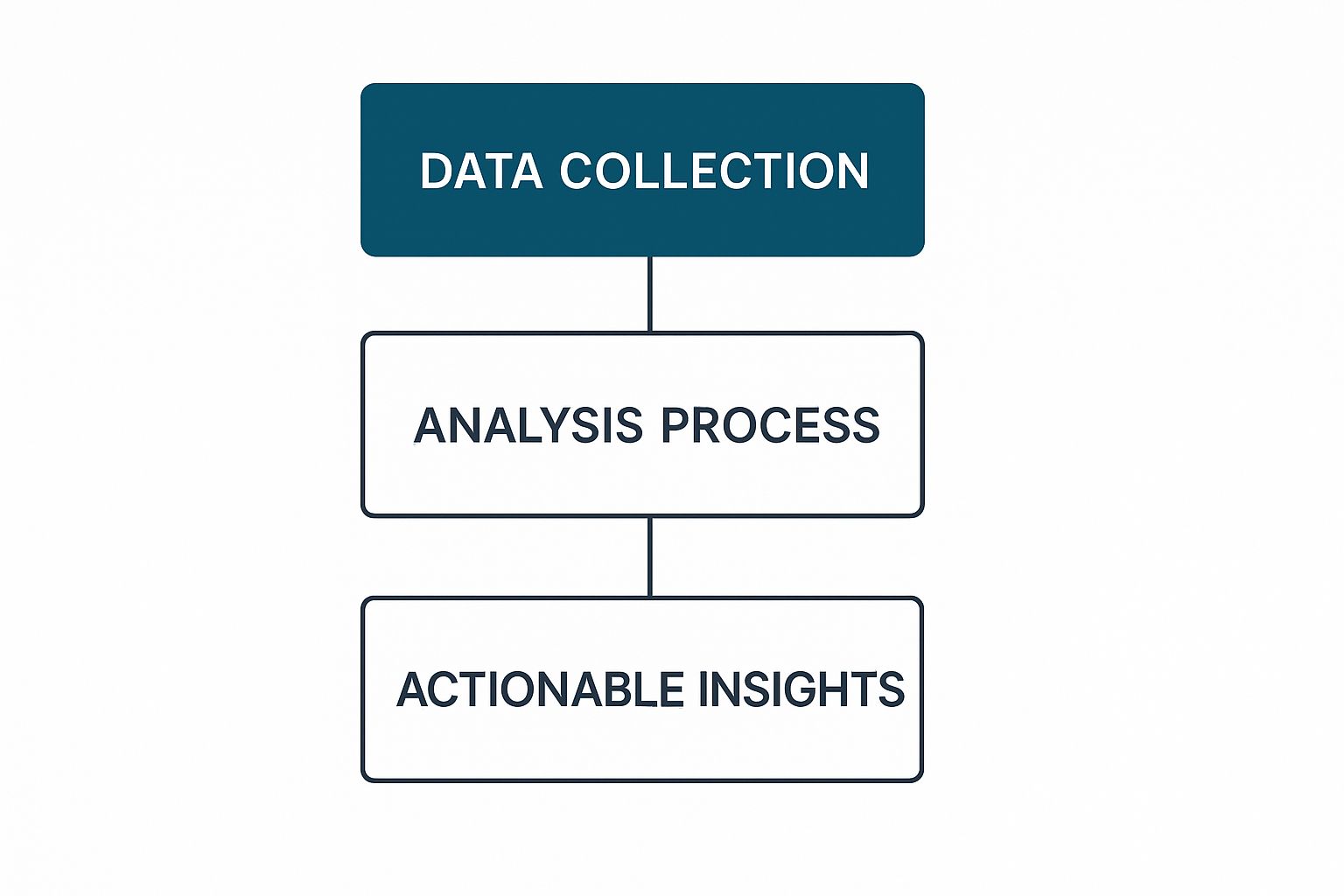
It really clarifies how the whole process is designed to turn raw market noise into strategic business decisions.
Market Leader Tier
As an established player, you're monitoring the entire market, not just a few rivals. This requires an enterprise-grade solution with deep market intelligence and predictive analytics.
You’re looking at platforms that can analyze market share, track ad spend, and provide insights from sales call transcripts. These tools are expensive and require a dedicated analyst, but they provide a panoramic view of the competitive landscape.
- Key Focus: Gaining a comprehensive market overview, predictive analytics, and tracking competitor marketing spend.
- Budget: $1,000+ per month.
- Example Tool Types: Enterprise market intelligence platforms like Gartner or advanced competitive intelligence suites.
To make this even clearer, here's a simple table to help you find your fit.
Competitor Monitoring Software Tiers For Founders
| Company Stage | Budget Range (Annual) | Key Focus | Example Tool Types |
|---|---|---|---|
| Scrappy Startup | $0 - $600 | Problem validation, identifying pain points, spotting early trends. | Google Alerts, Feedly, manual social media searches. |
| Growth Stage | $1,200 - $6,000 | Automating data collection, tracking brand sentiment, converting insights. | Community monitoring platforms, mid-tier social listening tools. |
| Market Leader | $12,000+ | Deep market analysis, predictive insights, ad spend tracking. | Enterprise market intelligence platforms, full competitive suites. |
Ultimately, it comes down to being honest about your current needs and resources.
The most critical question to ask during any demo, regardless of the tier, is this: "How does this tool help my team make a decision faster?" If the answer is vague or focuses on vanity metrics, it's the wrong tool for you.
Avoid getting dazzled by a long list of features. Focus on the core job you need the software to do for you right now, and choose a solution that excels at that one thing. You can always graduate to a more powerful platform later—we certainly did.
How to Turn Monitoring Data Into Decisive Action

Collecting data is easy. Any decent competitor monitoring software can flood you with alerts. The real challenge—where most founders drop the ball—is turning that information into a competitive advantage.
Data sitting in a Slack channel is noise. It only matters when it triggers an intelligent action. Early on, we had insights but no system. We were informed but not actually doing anything. That’s why we built a non-negotiable process for triaging every piece of competitive intel. The entire monitoring software market, valued at US$ 314.9 million in 2025, is built on this promise: delivering data you can act on.
Creating a Triage System for Intelligence
The first problem we solved was alert fatigue. When everyone sees every alert, nobody sees any of them. To fix this, we created specific routing rules inside Slack.
Product & Feature Alerts: Competitor launches a new feature.
- Who Sees It: #product-intel channel (Head of Product, lead engineer).
- The Question We Ask: Does this solve a customer problem we're ignoring?
Marketing & SEO Alerts: Competitor ranks for a new high-intent keyword.
- Who Sees It: #marketing-intel channel (marketing lead, content strategist).
- The Question We Ask: Is there a gap in their strategy we can exploit?
Negative Sentiment & Complaint Alerts: Users complain about a competitor on Reddit.
- Who Sees It: #customer-intel channel (community manager and a founder—yes, we still read these).
- The Question We Ask: Can we jump in and offer genuine help? Is this a pain point our product already solves?
This routing ensures the right information gets to the right person without overwhelming the team.
A Simple Framework for Categorizing Insights
Once an alert reaches the right person, they need a quick way to decide what to do. We use a simple framework to categorize every piece of intel and force a quick decision.
Every significant alert gets tagged with one of three labels: Immediate Threat, Future Opportunity, or Tactic to Copy. This forces us to move beyond just acknowledging the data and decide what it actually means for our business today.
An "Immediate Threat," like a competitor launching a feature our customers have begged for, triggers an urgent product meeting. A "Future Opportunity," like a trend in customer complaints our roadmap could address in six months, gets added to the backlog. A "Tactic to Copy"—like clever ad copy—gets dropped into our marketing swipe file.
Building a Lasting Feedback Loop
The final piece is closing the loop. Insights can’t die in Slack; they have to inform your high-level strategy.
We do two things:
- Weekly Intelligence Huddle: Every Monday, our product and marketing leads spend 15 minutes reviewing the critical alerts from the past week.
- Quarterly Roadmap Review: Before finalizing quarterly goals, we review a summary of all tagged competitor insights. This ensures our long-term planning is grounded in market reality, not just internal assumptions.
This feedback loop ensures the daily alerts from our competitor monitoring software continuously shape our biggest strategic bets. After all, once you've analyzed competitor activity, turning that data into action might mean refining your own search presence. To sharpen that skill, check out a comprehensive guide on SEO for SaaS companies to help boost your ranking. It’s this disciplined process that transforms a simple tool into a powerful engine for sustainable growth.
Common Monitoring Mistakes Most Founders Make
We've made every mistake so you don't have to. When you first get a powerful competitor monitoring software, it's easy to fall into traps that turn a game-changing tool into a source of frustration. These are the exact pitfalls we stumbled into building BillyBuzz.
The All-Too-Common Trap of Analysis Paralysis
The biggest mistake is analysis paralysis. You suddenly have a firehose of data, and it feels productive just to watch it all flow in. But watching isn't doing. We once spent two weeks tracking a rival's every move. We made beautiful reports but never made a single decision. Data without action is expensive noise.
Ignoring the Threats Hiding in Plain Sight
Another classic mistake is tunnel vision. It's easy to obsess over your one or two main rivals while ignoring the scrappy startup quietly solving a niche problem better than anyone else.
We were so focused on a big, established player that we missed an indie dev who built a simple Reddit monitoring tool. It gained a cult following before we even knew it existed. The lesson: monitor the problem you solve, not just the companies you know.
We learned that the most dangerous competitor is the one your customers are switching to, not the one your investors are asking about. Your monitoring setup must be wide enough to catch these signals from the periphery.
Setting Up Alerts That Are Way Too Broad
This will kill your team's enthusiasm. Early on, we set up a Slack alert for "[Competitor Name]". The channel was instantly flooded with hundreds of useless notifications.
Within a week, everyone muted the channel. We missed critical conversations because of the noise.
The fix was to get hyper-specific. Instead of just their brand name, our alerts became "[Competitor Name]" + "is slow" or "alternative to [Competitor Name]". This simple change reduced our alert volume by over 90% and made sure every notification was something that actually required our attention.
A Few Common Questions, Answered
Let's tackle some of the questions that pop up most often when founders start thinking seriously about using competitor monitoring software to get ahead.
How Often Should I Check Up On My Competitors?
You shouldn't. Your software should be on the job 24/7, watching for you. Your role is to act on the alerts that matter. We glance at our alerts daily, but the system never sleeps. A real-time ping about a competitor's frustrated customer on Reddit is a golden opportunity that disappears in hours, not days.
What’s the Biggest Mistake People Make With This?
Drowning in data but never doing anything with it. It’s easy to get mesmerized by every little update your competitors make. You have to focus on the intelligence that forces a decision.
We learned this the hard way. The most effective filter we ever built wasn't based on a keyword, but on intent. We asked: does this alert signal a customer is unhappy and actively looking for a new solution? If the answer is no, it's probably just noise.
Can This Kind of Software Really Help With My Pricing Strategy?
Absolutely. A good competitor monitoring software will notify you the second their pricing page is updated. This isn't about copying their prices. It's about understanding the why behind their moves. Did they introduce a new premium tier? Did they strip a feature from their cheapest plan? These actions tell a story about who they're targeting and can give you a clear signal on how to position your own pricing to be the better choice.
Ready to stop guessing what your competitors are up to and start winning over their unhappy customers? BillyBuzz uses AI to find high-intent conversations on Reddit, so you can jump in at just the right moment. Start monitoring the competition today.