

As a founder, you're in a constant battle for market share, and flying blind just isn't an option. This is where competition tracking software comes in. Think of it as your strategic co-pilot, turning the overwhelming firehose of competitor data into intelligence you can actually use. It’s not just about knowing who your rivals are; it’s about understanding their every move, almost as it happens.
At BillyBuzz, we don't treat this as a passive "check the box" exercise. We treat it as an active part of our growth strategy. This guide shares our internal playbook—no fluff, just what we actually do to find and act on competitive intel.
What Is Competition Tracking Software
At its core, competition tracking software is a tool that automatically monitors, gathers, and analyzes what your competitors are doing across all their online channels. It's like having a dedicated intelligence agent working for you 24/7, flagging crucial updates you’d almost certainly miss otherwise.
Instead of you or your team manually slogging through websites, forums, and social media feeds, this software automates the entire process. The result? You get a live, consolidated view of your market, freeing you up to focus on strategy instead of grunt work. This automated vigilance lets you shift from being reactive to proactive, so you're never caught off guard by a competitor's new feature or a sudden price drop.
Gaining A Decisive Advantage
For founders and small teams, the biggest win is gaining clarity and a strategic edge without pouring hundreds of hours into manual research. The market for these tools is exploding for a reason. In fact, the competitive intelligence tools market is projected to surge by USD 27.95 billion from 2025 to 2029. That's a clear signal that businesses are banking on data-driven strategy to win.
This is the kind of clarity we're talking about:

The whole point of a good tracking tool is to take messy, complex market data and turn it into a picture that makes sense—one you can act on.
At BillyBuzz, our philosophy is grounded in this exact principle. We built our tool to turn raw, unstructured conversations from places like Reddit into strategic assets for your business. A truly effective competition tracking tool gives you a few key advantages:
- Spotting Opportunities: Pinpoint what customers are complaining about with rival products. That's your opening.
- Mitigating Threats: Get instant alerts when a competitor launches a new marketing campaign or product update so you can respond quickly.
- Informing Strategy: Use real competitor insights to sharpen your own product roadmap, pricing, and messaging.
Ultimately, this isn't just about spying. It’s about understanding the entire market ecosystem to carve out your unique path to success.
To really stop flying blind and get that strategic edge, you need a solid process. This guide on how to do SEO competitor analysis that wins is a great place to start. And for a deeper dive into the fundamentals, check out our own guide on https://www.billybuzz.com/blog/the-ultimate-guide-to-competitor-analysis-for-emerging-businesses.
Core Features That Actually Drive Growth
When you start looking at competition tracking software, it’s easy to get lost in a sea of bloated dashboards and flashy charts. As a founder, you don't have time for noise; you need a clear signal. The best features don't just spit out data—they deliver insights you can actually use to move faster and smarter than everyone else.
A lot of tools are built to look impressive, but the complex visuals often tell you nothing useful. We learned this the hard way at BillyBuzz, which is why we're laser-focused on the handful of functions that give you a real edge.
Multi-Source Monitoring Beyond The Obvious
Your competitors aren't just on Twitter or in press releases. Some of the most valuable, unfiltered conversations are happening in niche communities, and a great tool has to look beyond the usual suspects.
- Social Media and News: This is the baseline. You absolutely need to track major platforms and news outlets for official announcements and brand mentions.
- Forums and Communities: This is where the real gold is. Monitoring forums like Reddit gives you raw, honest customer feedback, feature requests, and complaints about your competitors. It's a direct, unvarnished look into their biggest weaknesses.
At BillyBuzz, we practically live on Reddit. We track specific subreddits where our target customers hang out and discuss their pain points. This gives us a direct line into conversations that most monitoring tools completely miss and helps us spot an underserved customer segment before anyone else does.
As a founder, your competitive advantage often comes from seeing what others overlook. Unfiltered conversations on platforms like Reddit are a goldmine for understanding what customers really think about your competitors, warts and all.
Silencing The Noise With Smart Filters
Getting a firehose of mentions is useless. The most critical feature of any competition tracking software is its ability to filter the signal from all that noise. You need context-aware relevance, not just basic keyword matching that flags every mention of "Apple," whether it's about the tech giant or the fruit.
This is where AI is making a huge difference. AI-powered features are essential for making sense of massive datasets to spot market trends and figure out what rivals are planning. The industrial software market, which includes these platforms, is expected to hit USD 355 billion by 2030, largely because of this shift toward intelligent, automated analysis.
Essential Vs Vanity Features In Tracking Software
For a small team, distinguishing between features that drive decisions and those that just create noise is critical. Here’s a quick breakdown to help you focus on what truly matters.
| Feature Type | Essential Capability That Drives Action | Vanity Metric That Is Often Misleading |
|---|---|---|
| Mention Volume | Tracking a sudden spike in competitor complaints after a bad update. | A giant "total mentions" number without any context. |
| Sentiment Analysis | Identifying the specific reasons for negative sentiment (e.g., "slow support," "buggy feature"). | A simple "80% positive" score that hides critical negative feedback. |
| Source Monitoring | Focusing on mentions from a specific, high-value Reddit community. | A fancy world map showing where mentions come from, with no actionable detail. |
| Reporting | A concise, automated report highlighting the top three competitive threats this week. | A 50-page PDF filled with charts that no one has time to read or act on. |
Focusing on the "essential" column keeps your team zeroed in on insights that lead to better product decisions, smarter marketing, and faster growth.
Real-Time Alerts And Easy Integrations
Opportunities and threats don't stick to a 9-to-5 schedule. Critical insights need to land where your team already works, which is why real-time alerts are non-negotiable. When a competitor changes their pricing page or a key influencer mentions them, you need to know right now.
These alerts are most powerful when they plug directly into your workflow. A tool that can pipe urgent updates into a dedicated Slack or Microsoft Teams channel means your team can react in minutes, not days. This transforms competitive intelligence from a passive research task into an active, real-time strategic advantage.
If you're looking for practical ways to use AI for this, check out our guide on the 10 AI tools for competitor analysis in 2024.
How We Track Competitors On Reddit At BillyBuzz
Theory is great, but seeing how the sausage is made is even better. So, let’s pull back the curtain on exactly how we use our own competition tracking software here at BillyBuzz to find raw, unfiltered competitor intelligence on Reddit. This isn't a high-level overview; this is our ground-level playbook for turning community chatter into a real strategic asset.
Forget stale market reports. We go straight to the source where customers are brutally honest—niche subreddits. Most traditional monitoring tools fly right over these conversations, but for us, they're the entire game.
This diagram breaks down how we think about the core functions. Monitoring, analysis, and alerts are the three pillars that hold up our entire growth engine.
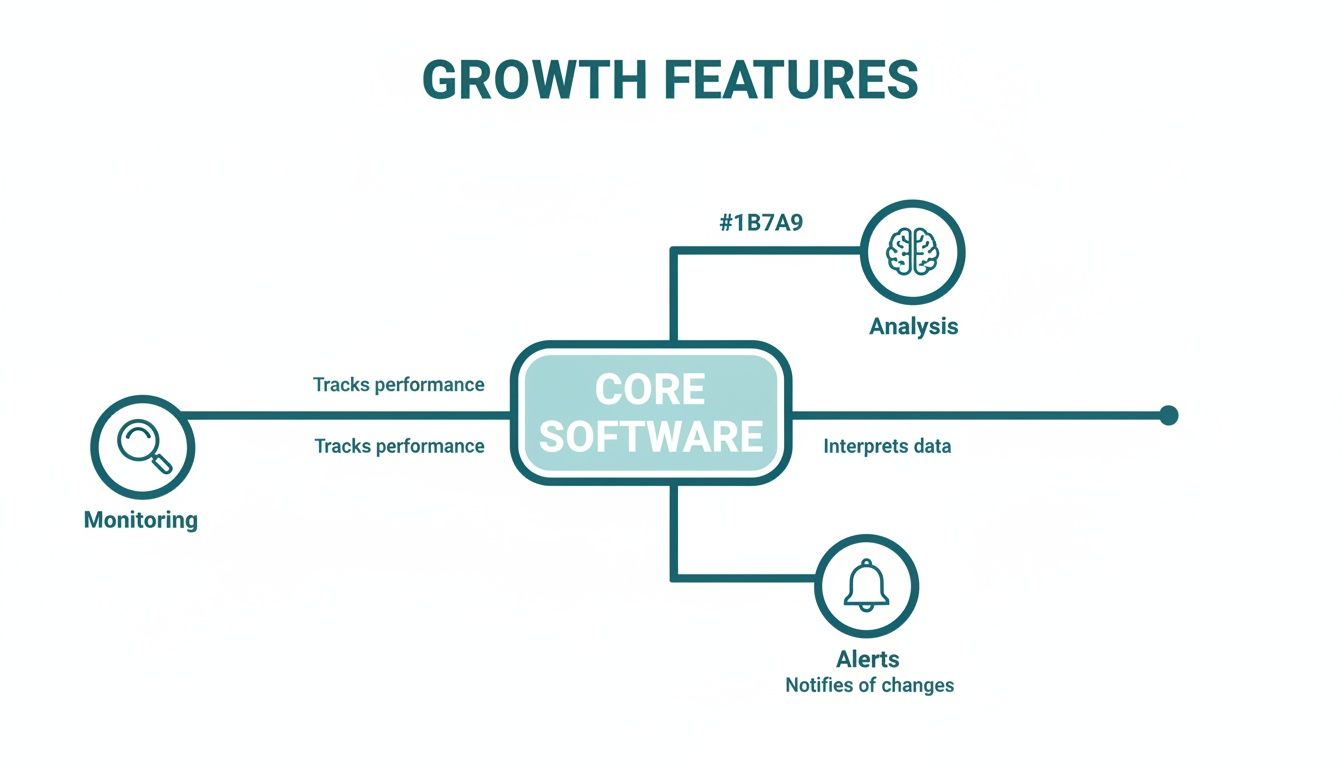
Each piece feeds the others, creating a nonstop loop of insight that keeps our strategy sharp and on point.
Our Subreddit Monitoring List
First things first: you have to know where to listen. We don’t try to monitor all of Reddit—that would be like drinking from a firehose. Instead, we keep a hand-picked, curated list of subreddits relevant to our industry.
For instance, when we’re tracking competitors in the MarTech space, our list looks something like this:
- r/marketing: A broad but essential hub for general marketing chatter.
- r/PPC: Perfect for monitoring conversations around paid acquisition tools and strategies.
- r/SEO: Where we find discussions about search engine optimization platforms.
- r/saas: A goldmine for honest feedback on software-as-a-service products.
But if we were tracking an IT management tool, we'd swap that list out for communities like r/sysadmin and r/devops. This laser-focused approach is what makes sure every alert we get is actually relevant.
Setting Up Granular Keyword Alerts
Next, we get specific with our alert rules. Just tracking a competitor's brand name is table stakes. The real magic happens when you start monitoring for buying signals and customer pain points.
We build our alert rules using boolean logic to pinpoint the exact conversations we care about:
- Brand Mentions:
("Competitor A" OR "Competitor B")— This is our baseline monitor, the simplest form of tracking. - Customer Complaints:
("Competitor A" AND ("slow" OR "buggy" OR "crashed"))— This rule is our secret weapon for flagging technical issues users are having. - Pricing Concerns:
("Competitor B" AND ("pricing" OR "expensive" OR "cost"))— This helps us get a feel for how sensitive the market is to price points. - Feature Requests:
("Competitor A" AND ("wish" OR "feature" OR "integrate"))— This is how we uncover gaps in their product that we might be able to fill.
We treat every single alert as a potential opportunity. A competitor's frustrated customer is just one helpful conversation away from becoming our new lead. The key is to always respond with genuine help, not a hard sales pitch.
These alerts get piped directly into a dedicated Slack channel. If you're curious, we wrote a whole guide on setting up Slack alerts for Reddit mentions in 10 minutes.
Engaging Authentically With Response Templates
Finally, when we spot a conversation where we can add value, we don't just dive in with a sales pitch. That’s a fast track to getting downvoted into oblivion. Instead, we have a simple, helpful response template that we customize for each situation.
Here’s a basic version we might adapt:
"Hey [Username], I saw you were having trouble with [Pain Point] while using [Competitor Product]. We actually faced a similar challenge, which is why we built [Feature] into our tool to solve it specifically. Not trying to sell you anything, but thought it might be helpful to know there's another approach out there. Happy to answer any questions if you have them!"
This founder-to-founder approach helps build trust and positions us as a helpful resource, not just another vendor trying to make a sale. It’s how we turn simple monitoring into meaningful conversations and, ultimately, real growth.
Choosing The Right Competition Tracking Software
Picking the right competition tracking software can feel like navigating a minefield. The market is flooded with options, and it’s way too easy to lose weeks in demos that lead absolutely nowhere. As a founder, you don't have time for that. You need a simple way to find a tool that gives you clear, actionable insights, not just another mountain of data to climb.
The software market is exploding, projected to reach USD 2,248.33 billion by 2034. North America alone accounts for over 44% of that. Competitive intelligence platforms are a big piece of that pie, which tells you just how seriously other businesses are taking this. If you want to dig deeper, you can read the full research on the software market.
This huge market gives you plenty of choices, which generally boil down to three main types.
Comparing The Main Types Of Tools
Not all tracking platforms are built the same, and what works for a huge corporation will likely be a disaster for a startup. Understanding the core differences is your first step toward a smart decision.
All-in-One Enterprise Suites: These are the giants of the industry. They're packed with every feature imaginable but come with a price tag to match and a learning curve that could take weeks. For a small team, it’s often like buying a cruise ship when you just need a speedboat—too much power, too much complexity.
Specialized Social Listening Tools: These tools are laser-focused on tracking brand mentions across big social platforms like Twitter and Facebook. They're great for that, but they have a massive blind spot: the raw, unfiltered conversations happening in niche communities and forums like Reddit.
Niche-Specific Monitors: This is where tools like ours, BillyBuzz, come in. We picked one source—Reddit—and decided to go incredibly deep. This approach uncovers highly relevant, context-rich insights that the broader, more generic tools completely miss.
Your Founder-Focused Buyer Checklist
When you're sitting through a demo or kicking the tires on a free trial, you need to cut through the sales fluff. Your time is your most precious resource, so you have to focus on what actually matters. The goal is to find a tool that simplifies your life, not one that adds another complicated task to your plate.
The best competition tracking software doesn't just show you data; it tells you a story. It should surface the why behind a competitor's success or failure, giving you a clear path to action.
Here are the critical questions to ask to get straight to the point:
- How good is the signal-to-noise ratio? Will I be able to set up super-specific alerts that filter out the junk, or am I going to be drowning in irrelevant notifications all day?
- How flexible are the alerts? Can I use boolean logic (think AND/OR/NOT) to combine keywords and really zero in on the conversations that matter to my business?
- Does it plug into my team's workflow? Can I push important updates directly into a Slack or Microsoft Teams channel so my team can see them and act on them instantly?
As you evaluate your options, also look for tools that can integrate other useful capabilities. For instance, being able to automatically capture visual proof of a competitor's website changes can be a game-changer. You can Unlock the power of a Website Screenshot API for monitoring by connecting it to your tracking workflow.
Ultimately, this is about finding a solution that fits your budget, your team's size, and most importantly, your core strategic goals.
From Setup To Strategy In Under An Hour
Getting started with competitive intelligence shouldn't be a multi-week project that drains your resources. The right tool delivers real value from day one. In fact, you can go from signing up to uncovering your first actionable insight in less time than it takes to watch a movie.
I'll walk you through the exact, no-fluff process we use with our own tool, BillyBuzz. The goal here is to show you just how simple and immediate powerful competitive tracking can be.

Step 1: Define Your Core Competitors
First thing's first: resist the temptation to track every single company in your space. That's a surefire way to get overwhelmed. Instead, start small and stay focused. Identify 3-5 direct and indirect competitors who are really fighting for the same customer's attention.
At BillyBuzz, our starting list always has a specific mix:
- The Market Leader: The big, established player everyone recognizes.
- The Scrappy Upstart: The new kid on the block who's making noise and moving fast.
- The Indirect Solution: The company solving the same core problem, but in a totally different way.
This trio gives you a balanced view of the field, from the Goliaths to the emerging Davids.
Step 2: Pinpoint Customer Pain Points
This is where the magic happens. Instead of just tracking brand names, you need to listen for opportunities. Come up with 5-10 keywords that signal your target customer is frustrated or has an unmet need.
Here are a few keyword templates we lean on all the time:
"[Competitor] alternative""is [Competitor] pricing worth it""wish [Competitor] could integrate with"
Phrases like these are gold. They're direct signals from people actively looking for a better solution. Tapping into these conversations is the fastest way to find warm leads and get killer ideas for your product roadmap.
Your first big "aha!" moment won't come from just knowing a competitor launched a new feature. It'll come when you see a potential customer post, "I wish [Competitor] did this," and you realize your product already does. That's when tracking becomes strategy.
Step 3: Target High-Value Sources
Now, where are you going to listen? A classic mistake is trying to monitor the entire internet—it’s like trying to drink from a firehose. You need to be surgical. Pick a handful of high-signal communities where people have authentic conversations.
For a SaaS tool like ours, that means zeroing in on specific subreddits like r/saas or r/marketing, where our ideal customers hang out. We'll also throw in a couple of key tech news sites and relevant Twitter hashtags to catch any major announcements. By narrowing the focus, we guarantee the alerts we get are actually worth reading.
Step 4: Configure Your First Alert
Last step: bring it all together. Set up your first alert to send a daily digest right into a dedicated Slack channel. This simple step transforms monitoring from a chore you have to remember into a seamless part of your team's daily huddle.
Our internal #competitor-intel channel is basically our team's morning newspaper. It’s a quick, scannable summary of every important competitor mention from the past 24 hours. Follow these four steps, and you'll have a fully automated intelligence feed up and running in under an hour.
Got Questions About Competition Tracking? We’ve Got Answers.
Jumping into the world of competition tracking software always brings up a few questions. As a founder or marketer, you need quick, practical answers to make the right call without getting bogged down in jargon. Let’s tackle the most common ones we hear.
What’s This Going to Cost Me?
Pricing for these tools is all over the place, which can be a real headache. You’ll see massive enterprise platforms that cost thousands a month, but for a startup or a small marketing team, that's like buying a battleship when you just need a speedboat.
A more realistic budget for a powerful, focused tool is somewhere in the $50 to $300 per month range.
The number on the price tag isn't the whole story, though. Think about the ROI. If the intel you get helps you close just one more deal or sidestep a single costly mistake, the software has likely paid for itself several times over. Look for tools with flexible pricing that can scale with your business, so you're not paying for a bunch of features you don't need yet.
Can’t I Just Do This Manually?
You could, but it’s like trying to build a house with just a screwdriver. You can get a few things done, but you’ll hit a hard limit fast. Sticking with free methods like Google Alerts seems smart at first, but it comes with some serious blind spots.
- You'll Miss the Real Conversations: Google Alerts is great for news articles and blog posts, but it’s almost entirely blind to the unfiltered, honest-to-goodness conversations happening on forums like Reddit or deep within social media groups.
- You Get Zero Context: A manual alert just gives you a link. Was the mention good or bad? A frustrated customer or just a passing comment? You have no idea. Proper software tells you the sentiment behind the mention, which is where the real insight lies.
- It’s a Massive Time Suck: Manually digging through sources, filtering out the junk, and trying to piece together a report is a huge drain on your time. As a founder or team lead, your time is your most valuable resource. Automation gives that time back.
A dedicated tool is built to catch the critical, real-time chatter that manual tracking will always miss.
Relying on manual tracking is like watching the scoreboard but never seeing the actual game. You see the final outcome, but you miss the plays, the fumbles, and the strategies that determined the winner.
How Do I Avoid Drowning in Data?
This is the big one. The wrong tool will blast you with a firehose of irrelevant data, creating more noise and more work. The whole point is to find a tool that delivers a clear signal, not a chaotic mess.
The best competition tracking software solves this problem with smart, highly specific filtering. Before you sign up for anything, make sure it lets you do this:
- Use Boolean Logic: This is your secret weapon. Set up precise rules using
AND,OR, andNOTto get exactly what you want (e.g.,"Competitor A" AND ("bug" OR "slow") NOT "hiring"). - Filter by Source: Zero in on the specific subreddits, websites, or social media accounts where you know your target audience hangs out.
- Set Sentiment Triggers: Tell the tool to only ping you when a mention has a strongly negative or positive tone. This lets you focus on the comments that actually require your attention.
A tool that sends you a hundred useless mentions a day is a distraction. A tool that sends you three truly actionable insights a week is a strategic weapon. Choose the weapon.
Ready to turn raw community chatter into your most powerful strategic asset? BillyBuzz is the AI-powered Reddit monitoring tool built for founders who need signal, not noise. Start uncovering hidden leads and competitor weaknesses today.