
Competitor analysis isn't some corporate busywork. It’s figuring out who you’re up against and understanding their playbook—what they do well, where they're dropping the ball, and how that stacks up against your own business.
As a founder, this is about gathering real-world intelligence. It’s how you find gaps in the market, sharpen your messaging, and make smarter strategic bets. Frankly, it's the difference between guessing what to do next and knowing.
Stop Flying Blind—Your Competitors Aren't
You're constantly told to be product-obsessed and customer-focused. Solid advice, but tuning out the competition completely is like trying to navigate a maze with a blindfold on. The point isn't to copy them; it's to position yourself strategically against them.
At BillyBuzz, we see how fast things change. One day you’re leading the conversation, and the next, a rival swoops in with a new message that just clicks with your audience. That’s why we treat competitor analysis as a core survival tactic, not a "nice-to-have" task.
Forget the complex theories and dense spreadsheets that just collect dust. Real, effective competitor analysis is about finding actionable intelligence that helps you decide what to do right now.
The Mindset Shift: From Noise to Signal
The goal is not to track every single move your competitors make. That's a one-way ticket to analysis paralysis. The critical mindset shift is learning to filter for the signals—the specific pieces of information that reveal a genuine opportunity or a looming threat.
Adopting this practical approach turns the overwhelming flood of competitive data into a clear guide for your next moves. At BillyBuzz, this means we focus relentlessly on a few key areas:
- Messaging Gaps: What customer pain points are they completely ignoring in their marketing copy?
- Channel Opportunities: Where are they winning that we haven't even tried? And, just as importantly, where are they pouring money with little to show for it?
- Customer Frustrations: What are people publicly complaining about? Those complaints often point directly to a weakness in their product or service.
We've learned that the most valuable insights rarely come from a 50-page report. They come from a single, well-timed piece of information, like spotting a Reddit thread where a competitor's customers are up in arms about a recent price hike.
To truly stop flying blind, the first step is often rigorously comparing alternatives and other solutions available in your market. This process sharpens your understanding of where you fit, how you can stand out, and ultimately, how you can win. It sets the stage for the practical, actionable framework we use every day to stay ahead.
Building Your Competitor Analysis Framework
Before you dig for data, you need a plan. An unfocused competitor analysis is a founder's worst enemy—it burns time and delivers zero actionable insights. I'm going to walk you through the exact, no-fluff framework we developed to make sure our efforts always hit the mark. Think of it as creating a focused 'competitor radar' that gives you 80% of the value with 20% of the effort.
It starts with defining what you actually want to learn. Are you trying to pinpoint gaps in a rival's messaging, deconstruct their pricing, or find untapped marketing channels they’re ignoring? Without a clear goal, you’ll just end up with another spreadsheet that collects digital dust.
The diagram below really shows how this shifts your mindset from "flying blind" to carving out a clear, strategic position in your market.
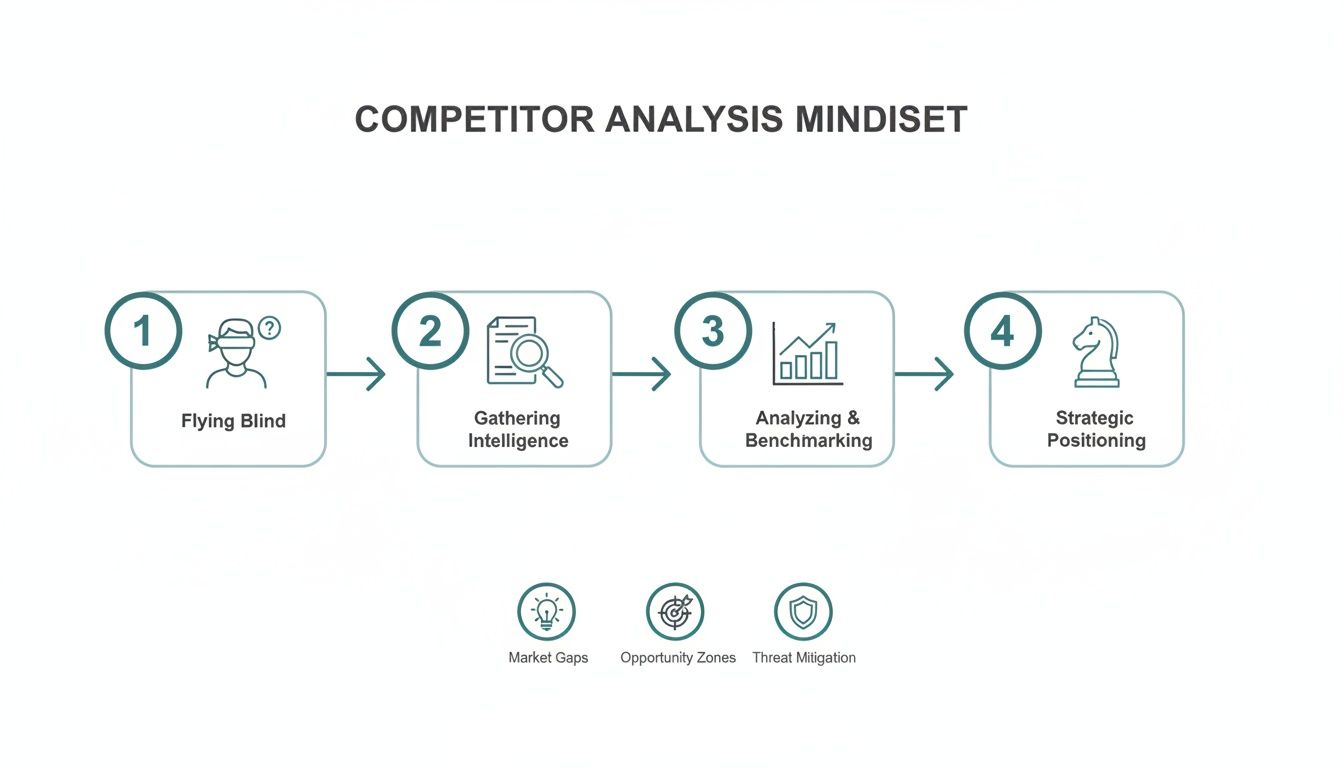
This process is all about moving from reactive observation to proactive, insight-driven action. That’s the entire point of a good framework.
Defining Your Competitor Tiers
First, identify who truly matters. Hint: it’s not just the big names. We categorize competitors into three tiers, which helps us focus our energy where it counts.
- Direct Competitors: These are the companies offering a very similar product to the exact same audience. Think Coca-Cola vs. Pepsi. For a business like ours, it would be another Reddit monitoring tool targeting startups.
- Indirect Competitors: These companies solve the same core problem but with a completely different solution. For instance, a general social listening platform that can monitor Reddit but isn't specialized for it. They're still fighting for the same customer budget.
- Aspirational Competitors: These are the market leaders you look up to, even if they aren't in your direct space. We might study a company like HubSpot to understand how they built their content engine, even though they don’t directly compete with our product.
This structured approach keeps you from getting distracted by irrelevant players while making sure you don't miss threats coming from unexpected directions. You’re building a map of your entire competitive landscape, not just your immediate neighborhood.
Creating a Targeted Analysis Matrix
Consider this for a moment: 90% of Fortune 500 companies use competitive intelligence to secure a massive market edge. This isn't just talk; it's a proven strategy. In 2023, these giants dedicated over 73% of their resources to these efforts, with more than 20% of enterprise budgets funneled directly into competitive intelligence. This allows them to dissect rivals' moves on everything from pricing and product launches to marketing campaigns. You can dig deeper into these competitive intelligence statistics to see how they drive success.
So, how can you apply that same focused mindset without a Fortune 500 budget? We use a simple matrix to map out exactly what we track for each competitor type. It ensures our data collection is always purposeful.
Your goal isn't to know everything about everyone. It's to know the few specific things that will actually inform your next marketing move, product feature, or pricing adjustment.
The table below is a simplified version of what we use. It forces you to connect every piece of data you gather to a potential action, turning your analysis from a passive report into an active strategy document.
Your Competitor Analysis Focus Matrix
Use this table to map your competitors and define the key data points to track for each category, ensuring your analysis is targeted and actionable.
| Competitor Type | Example | Primary Data to Track | Actionable Insight Goal |
|---|---|---|---|
| Direct | A direct rival Reddit monitoring tool | Pricing tiers, website messaging, customer reviews (especially complaints), top-ranking SEO keywords | Identify messaging gaps we can exploit or find feature weaknesses that cause customer churn. |
| Indirect | A broad social listening platform | Their Reddit-related marketing content, pricing for their "social listening" package, feature set limitations for Reddit | Understand how they position against specialized tools like ours; find opportunities to highlight our unique value. |
| Aspirational | A market-leading SaaS company | Content strategy (e.g., blog topics, webinar formats), community-building tactics, brand voice and tone | Learn from their success to improve our own content and community engagement strategies for long-term growth. |
By using this kind of framework, you define the mission before you ever start collecting data. This simple but powerful discipline is what separates a time-wasting academic exercise from a competitor analysis in marketing that genuinely moves your business forward.
The Data Toolkit We Actually Use
Alright, let's get into the weeds. Data collection is where founders get stuck, staring at an ocean of potential metrics. You could track everything, but you'd drown in data without a single good decision to show for it.
At BillyBuzz, we’ve boiled it down to a lean, focused toolkit. It’s all about getting the sharpest insights with the least amount of noise. Here’s our founder-to-founder breakdown of what we actually monitor, why it matters, and the tools we use to get it done.

To keep things from spiraling out of control, we organize our data gathering around four core marketing pillars. This keeps us focused and ensures we aren't just collecting numbers for the sake of it. Each pillar is designed to answer a critical strategic question.
Deconstructing Their Website and Messaging
A competitor's website is their 24/7 sales pitch. We dissect it to get to the heart of their value proposition and figure out which pain points they’re constantly hammering home. This isn't about judging their design; it's about reverse-engineering their strategy.
Here’s our checklist:
- Homepage Hero Section: What's the one big promise they make right at the top? Who is that headline written for? This tells you their primary target audience and what they believe is their single biggest selling point.
- Feature/Solution Pages: How do they talk about what their product actually does? We obsess over the specific verbs and outcomes they use. It's the difference between selling features ("our tool has X") and selling solutions ("you'll achieve Y").
- Pricing Page: This page is a goldmine. Look at their pricing tiers, the features they use to nudge people into higher plans, and the specific language they use to frame the cost (e.g., "for growing teams," "for enterprise scale"). It tells you exactly who their most valued customer is.
We screenshot and document this language every quarter. Why? Because it helps us spot subtle but important shifts in their positioning. If a competitor suddenly adds a "For Startups" tier, you can bet they’re making a play for our core market.
Mapping Their SEO and Content Footprint
Your competitor's SEO strategy is a treasure map showing where they're winning traffic. When you understand their top-performing content, you can see their entire inbound strategy laid bare—from how they attract strangers to how they turn them into customers.
You don't need a massive budget for this. You can get a solid high-level overview just by plugging a competitor’s domain into a free backlink checker or keyword tool.
We zero in on these two areas:
- Top Organic Keywords: We hunt for the ones with commercial intent, like "[competitor] alternative" or "best software for X." These are the terms that capture people who are actively looking to make a purchase.
- Highest Traffic Blog Posts: Find their single most popular blog post. I guarantee it’s a broad, top-of-funnel article answering a common industry question. Look closer. Pay attention to the internal links and the CTAs inside that post. It will show you the exact journey they've designed for a brand-new visitor.
A single top-performing blog post can reveal an entire content funnel. You see the initial hook, the educational piece, and the call-to-action that nudges readers closer to their product. It's a complete strategic blueprint hiding in plain sight.
Analyzing Social Media and Ad Strategy
Social media is more than a vanity contest of follower counts. It’s about where your rivals are choosing to invest their time and, more importantly, their money. We want to know which channels they’re betting on.
The Meta Ad Library is a fantastic, and free, place to start. You can see the exact ads a competitor is currently running on Facebook and Instagram. We break down their ad copy to find their core hooks. Are they leading with a customer pain point, a key benefit, or a limited-time discount?
This simple analysis tells us:
- Their Primary Channel Focus: Are they all-in on LinkedIn conversations, or are they nurturing a thriving community on X (formerly Twitter)?
- Their Value Proposition in Ads: Ad copy is messaging under pressure. It’s their elevator pitch, refined and tested with real dollars.
- Their Offer Strategy: Are they pushing free trials, live demos, or content downloads? This shows us exactly how they’re filling their lead pipeline.
To really build out your data toolkit, you can explore various competitive intelligence tools that help gather these crucial insights across different channels. Many of them can automate the manual work we start with. This practical toolkit is the foundation for turning abstract data into a clear map of the competitive landscape.
Finding Gold in Unfiltered Community Signals
This is where we share our secret sauce. While most marketers are busy scraping website copy and tallying social media followers, the real action is happening elsewhere. The most honest, unfiltered, and valuable conversations are tucked away in communities like Reddit. Think of it as the digital town square—where people praise, complain, and compare products with brutal honesty.
At BillyBuzz, we don't just see this as another channel to monitor; we see it as our primary hunting ground for high-impact opportunities. The insights here are raw, immediate, and often predictive. A complaint about a competitor's confusing UI in r/saas today could be the very reason they lose a dozen customers next month. This isn't just monitoring; it's opportunity hunting.

Our Internal Alert and Filtering System
We've learned that simple keyword matching doesn't cut it. Generic alerts for a competitor’s brand name create a firehose of noise with very few actionable signals. So, we developed a tiered system of context-aware alerts inside BillyBuzz to zero in on conversations that actually matter.
Here's a peek at the exact alert rules we have running 24/7 for our top three direct competitors:
High-Intent "Switching Trigger" Alerts: These are our top priority. They signal a customer is actively looking for an alternative, and our goal is to catch them at that exact moment of frustration.
- Keywords:
"[Competitor A] alternative," "moving from [Competitor B]," "cheaper than [Competitor C]" - Subreddits: r/saas, r/marketing, r/startups, r/growmybusiness
- Sentiment Filter: Negative or Neutral (neutral often captures genuine questions).
- Keywords:
Pain Point & Feature Complaint Alerts: This is basically our product intelligence feed. It tells us where our competitors are failing their customers and helps inform what features we should prioritize.
- Keywords:
"[Competitor A] sucks," "frustrated with [Competitor B]," "[Competitor C] pricing" - Subreddits: r/customerservice, r/ProductManagement, specific industry subreddits.
- Sentiment Filter: Strongly Negative.
- Keywords:
Positive Mention & Praise Alerts: It's just as important to know what competitors do well. This helps us understand their core strengths straight from the customer's perspective.
- Keywords:
"love [Competitor A]," "impressed by [Competitor B]," "[Competitor C] feature is amazing" - Subreddits: General business and niche communities.
- Sentiment Filter: Positive.
- Keywords:
This tiered approach ensures we can prioritize our responses effectively. A "switching trigger" alert gets an immediate, personalized response, while a feature complaint might get logged for our product team. If you want to dive deeper, you might find our guide on how to monitor competitors on social media useful.
Real-World Example: From Pricing Complaints to Demos
Let me share a quick story. A few months back, our "Pain Point" alert for a direct competitor fired off. The keyword was simple: "[Competitor Name] pricing". The alert flagged a new thread in r/saas titled, "Did anyone else get hit with [Competitor Name]'s new pricing? It's insane."
The thread absolutely exploded. Within hours, dozens of small business owners were venting about an unexpected 40% price hike. They felt betrayed and were actively asking for alternatives.
This wasn't just a complaint; it was a mass 'switching trigger' event happening in real-time. For us, this was a goldmine.
Instead of just watching from the sidelines, we took action. We didn't jump in with a hard sell—that never works. Instead, we used a soft-touch response template we've honed over time. One of our team members commented:
"Wow, that's a tough surprise. We faced similar pricing challenges with tools as we were scaling. We actually built BillyBuzz to offer more transparent, founder-friendly pricing for Reddit monitoring. No hard sell, but if you're exploring options, happy to answer any questions about how we're different."
That single, empathetic response led to three new customer demos that week. This is the power of listening to unfiltered community signals. It transforms competitor analysis from a passive research task into an active, lead-generation engine.
The Bigger Picture on Competitor Monitoring
This approach isn't just for scrappy startups. Just look at the giants. Ever wondered why Amazon crushed it with 37.6% of the U.S. e-commerce market in 2023? Obsessive competitor analysis was their secret weapon, tracking rivals' every move from pricing to customer reviews. This mirrors what we do on Reddit—spotting competitor mentions in conversations to fuel our sales pipeline.
Relentless monitoring has propelled Amazon's dominance since 2015 when they first hit a 30% share, and they've kept growing by analyzing everything, including competitor traffic sources. When you use this kind of intel, you see massive wins. You can discover more insights on Amazon's market share at Statista.com.
By moving your focus from polished corporate websites to the messy, honest world of online communities, you uncover the truth about your market. You find out what customers really think, what drives them away from your competitors, and exactly what they're looking for in a better solution.
Turning Your Competitive Data Into Winning Actions
You've done the digging. You have spreadsheets, notes, and a head full of your competitors' tactics. Now what? All that data is just trivia until you decide what to do with it. This is where the real work begins—translating those observations into a concrete strategy.
At BillyBuzz, we don't believe in creating massive, 50-page reports that just gather dust. Our entire goal is to distill everything down into a single, one-page action plan. It needs to be sharp, prioritized, and have clear ownership.
From Raw Data To a Simple SWOT
The fastest way to get from messy data to a clear plan is a quick-and-dirty SWOT analysis. Don't think of this as some stuffy corporate exercise. It’s a practical framework for sorting your findings into four simple buckets: Strengths, Weaknesses, Opportunities, and Threats.
This simple act of categorizing what you've learned is the first step toward making smart decisions.
Here's how we map our competitive research onto a SWOT matrix:
- Strengths: Where are you clearly winning? Maybe your customer support is getting rave reviews in Reddit threads, or you have a killer feature no one else can touch.
- Weaknesses: Time for some brutal honesty. Where are competitors eating your lunch? Perhaps their SEO game is stronger, or their pricing model is resonating better with a specific audience.
- Opportunities: These are the gold nuggets you've been digging for. An opportunity might be a keyword a competitor ranks for with terrible content, or a feature customers are practically begging for in forums that you know you can build faster.
- Threats: What’s on the horizon that could cause problems? This could be a new, well-funded startup entering the space or a major competitor suddenly slashing their prices.
This process quickly turns a chaotic pile of information into a clear strategic picture.
The goal isn't to create a perfect, exhaustive matrix. It's to force a focused conversation about where to spend your limited time and resources for the biggest possible impact.
Identifying Quick Wins and Long-Term Plays
With your SWOT laid out, you can start separating your ideas into two categories: high-impact, low-effort quick wins and more involved long-term strategic shifts. This prioritization is absolutely critical, especially for founders who need to show immediate progress while still building for the long haul.
Examples of Quick Wins:
- Target a weak keyword: You spot a competitor clinging to the #3 spot for a high-intent keyword with a thin, outdated blog post. The action is obvious: create a vastly superior piece of content, point a few internal links at it, and go after that ranking.
- Jump into the conversation: Your Reddit alerts ping you about a user complaining about a competitor's terrible customer service. Your quick win? Get into that thread with a genuinely helpful, non-salesy response. We break down exactly how to do this in our guide on social listening for B2B lead generation.
Examples of Long-Term Plays:
- Build a must-have feature: You notice a pattern across multiple Reddit threads: customers of three different competitors are all griping about the same missing integration. That’s a powerful signal to get that feature on your product roadmap, stat.
- Overhaul your messaging: Your top competitors are all hammering the "save time" message. But your community listening reveals that what customers really care about is "reducing errors." This insight could kick off a major project to reposition your entire brand.
The One-Page Action Plan Template
We bring it all home with a dead-simple action plan. It isn't fancy, but it enforces accountability. Back in the digital marketing boom of 2023, this kind of analysis became the secret weapon for startups trying to sidestep common pitfalls. We see it every day with BillyBuzz users who analyze rivals on Reddit to find SEO gold.
It’s a proven model. Monitoring competitor KPIs reveals what works, with top performers generating 57% more site visitors through their optimized campaigns. For a deeper dive into that data, you can read the full WASK report. This just goes to show how vital it is to turn raw data into decisive action.
Here’s the simple table we use to make it happen:
| Insight | Action/Task | Owner | Deadline | Priority |
|---|---|---|---|---|
| Competitor X ranks #4 for "best tool for X" with a weak article. | Write a 2,000-word definitive guide to crush their post. | Sarah | Nov 30 | High |
| Users in r/saas are complaining about Competitor Y's confusing UI. | Draft a blog post: "5 UI Mistakes SaaS Tools Keep Making". | Mike | Dec 5 | Medium |
| Customers of Competitor Z are begging for a Zapier integration. | Scope the engineering effort for building a Zapier integration. | Jen | Dec 15 | High |
This simple document is what transforms your competitor analysis from an "interesting research project" into a genuine growth engine for your business. It connects every insight to a tangible task, making sure all your hard work translates directly into real-world results.
Questions We Hear All the Time About Competitor Analysis
As you start digging into your competitors, a few questions always come up. It's one thing to know the theory, but it's another thing entirely to make this a regular, useful part of your marketing rhythm. We’ve asked these exact same questions ourselves at BillyBuzz, so let's get into some real talk.
How Often Should We Actually Be Doing This?
This is probably the most common question, and the honest answer is: it’s an ongoing process, not a one-and-done project. At BillyBuzz, we’ve landed on a two-track system that works really well for us.
Once a quarter, we do a “deep dive.” This is our time to really zoom out and look at the big picture. We’ll formally review our main competitors’ messaging, pricing changes, and any significant feature updates. Think of it as a strategic check-in to make sure we haven't missed a major pivot on their part.
But the real magic, where the most valuable insights come from, is our “always-on” monitoring. We have alerts running 24/7, especially on Reddit, for mentions of our competitors, specific feature requests, and customer pain points. This is what lets us jump on high-signal opportunities in a matter of hours, not wait until the next quarterly review.
My advice, especially for a startup, is to combine a quarterly deep dive with continuous, automated monitoring. Pick the channels where your customers are loudest—like online communities and review sites—and listen intently. Don't ever let your analysis become an annual report that just gathers dust.
What Are the Biggest Mistakes People Make?
Oh, we've made a few of these ourselves. The number one trap is what I call “analysis paralysis.” It’s that feeling of being so swamped with collecting data that you never actually do anything with it. You don't need a 100-page dossier on every company in your space. Just pick 2-3 key competitors and focus on the handful of metrics that will genuinely shape your next decision.
The second pitfall is treating this as a copy-paste exercise. The point isn’t to mimic your competitor’s pricing or clone their latest feature. It’s about understanding their strategy so you can find a different, better way to serve your customers. Look for their weaknesses—that’s the roadmap for your strengths.
Lastly, people often get blindsided by not looking beyond their direct rivals. Don't ignore the indirect or up-and-coming players. The company that disrupts your market might not look anything like you today. We keep a small "watch list" of companies solving the same core problem in a completely different way. It helps us see what might be around the corner.
How Can I Pull This Off With a Small Team and Zero Budget?
This is the reality for most founders, isn't it? The good news is you absolutely do not need a suite of expensive enterprise tools to get started. You just have to be scrappy and smart with your time.
- Lean on free tools: Google Alerts is a fantastic, no-cost way to track brand mentions. The free tier of a tool like Similarweb can give you a decent overview of where your competitors' traffic is coming from.
- Do it by hand (for a bit): Set aside 30 minutes a week to manually browse their main subreddits or social media pages. You’d be surprised what you can uncover just by paying attention to their content and engagement.
- Focus your listening: Instead of trying to hear everything, everywhere, all at once, just pick one channel where your customers are the most candid. For us, that was Reddit.
The most powerful, low-budget strategy is targeted listening. Don't just track their brand name. Set up highly specific, context-aware alerts for high-intent phrases like "looking for a [Competitor Name] alternative" or "so frustrated with [Competitor Feature]". This laser focus delivers actionable insights and even potential leads without boiling the ocean. It’s all about working smarter, not harder.
Ready to stop guessing and start winning on Reddit? BillyBuzz gives you the power to find high-intent customer conversations and competitor weaknesses in real-time. Turn community signals into your next big opportunity. Get started today at https://www.billybuzz.com.