

Social reputation management is tuning into the conversations happening about your brand online. It’s the art of listening, influencing, and participating in those discussions to shape how people see you.
Think of it less as damage control and more as proactive strategy. For a founder, this isn't another marketing task—it's a direct line to your market's brain.
Your Reputation Is Built in Public Conversations
Let’s be honest: your brand isn’t what you say it is on your polished website. Your real brand identity is forged in thousands of raw, unscripted conversations on platforms like Reddit and niche forums. For a startup, social reputation management isn't nice to have; it's your company's immune system.
Here at BillyBuzz, we built our company around one idea: proactive listening is the most powerful growth lever an early-stage company has. Your reputation is a dialogue with your market. If you’re not in the room, you’re letting everyone else tell your story for you.
This mindset flips reputation management from a defensive chore into an offensive play. It's about systematically tuning into what people are saying about your brand, your competitors, and the real-world problems your customers are struggling with.
The Shift from Traditional Marketing to Active Reputation Management
The old playbook was broadcasting a message. The new game is pulling insights from genuine conversations. This isn't just a trend; it's a critical evolution for any business that wants to grow.
| Focus Area | Traditional Marketing (Broadcasting) | Social Reputation Management (Dialogue) |
|---|---|---|
| Primary Goal | Push a one-way message to a mass audience. | Engage in two-way conversations and build relationships. |
| Source of Truth | Internal marketing and brand guidelines. | External customer feedback and public sentiment. |
| KPIs | Impressions, reach, and ad spend efficiency. | Engagement rate, sentiment analysis, and response time. |
| Tone | Polished, corporate, and carefully controlled. | Authentic, human, and empathetic. |
| Strategy | Campaign-based and episodic. | Continuous, real-time listening and participation. |
Embracing this dialogue-driven approach unlocks incredible advantages.
- Uncover Hidden Sales Opportunities: You’ll find potential customers asking for a solution you offer or complaining about a competitor's weakness.
- Identify Critical Product Gaps: The feedback you get in the wild is brutally honest. It shines a light on bugs, missing features, and user frustrations your roadmap might have missed.
- Build Authentic Relationships: When you jump into a conversation to genuinely help someone—without a sales pitch—you build trust that turns lurkers into advocates.
As a founder, you can't afford to be insulated from your market. The raw, unfiltered conversations on platforms like Reddit are your most valuable source of truth. They tell you what’s working, what’s broken, and where your next big opportunity lies.
To get this right, you have to understand the strategies behind building an effective online presence that genuinely connects with people. With search engines prioritizing authentic user conversations, showing up in these forums is no longer optional.
In fact, our own research highlights how you can turn these threads into long-term SEO assets, which we break down in our guide on how Reddit posts now rank on Google. The market gets it, too. The global online reputation management software market is expected to rocket past $14 billion by 2031. It’s a clear signal of just how critical this work has become.
The Unfiltered BillyBuzz Reputation Playbook
Theory is great, but a battle-tested playbook is better. As founders, we know execution is everything. This is the exact social reputation management system we use every day at BillyBuzz. No fluff—just a plug-and-play system for managing your brand's reputation where it actually matters.
Our process is a simple, repeatable framework focused on action. It's about a consistent operational rhythm that drives results.
This visual shows our core process for reputation management, breaking it down into three actionable stages.
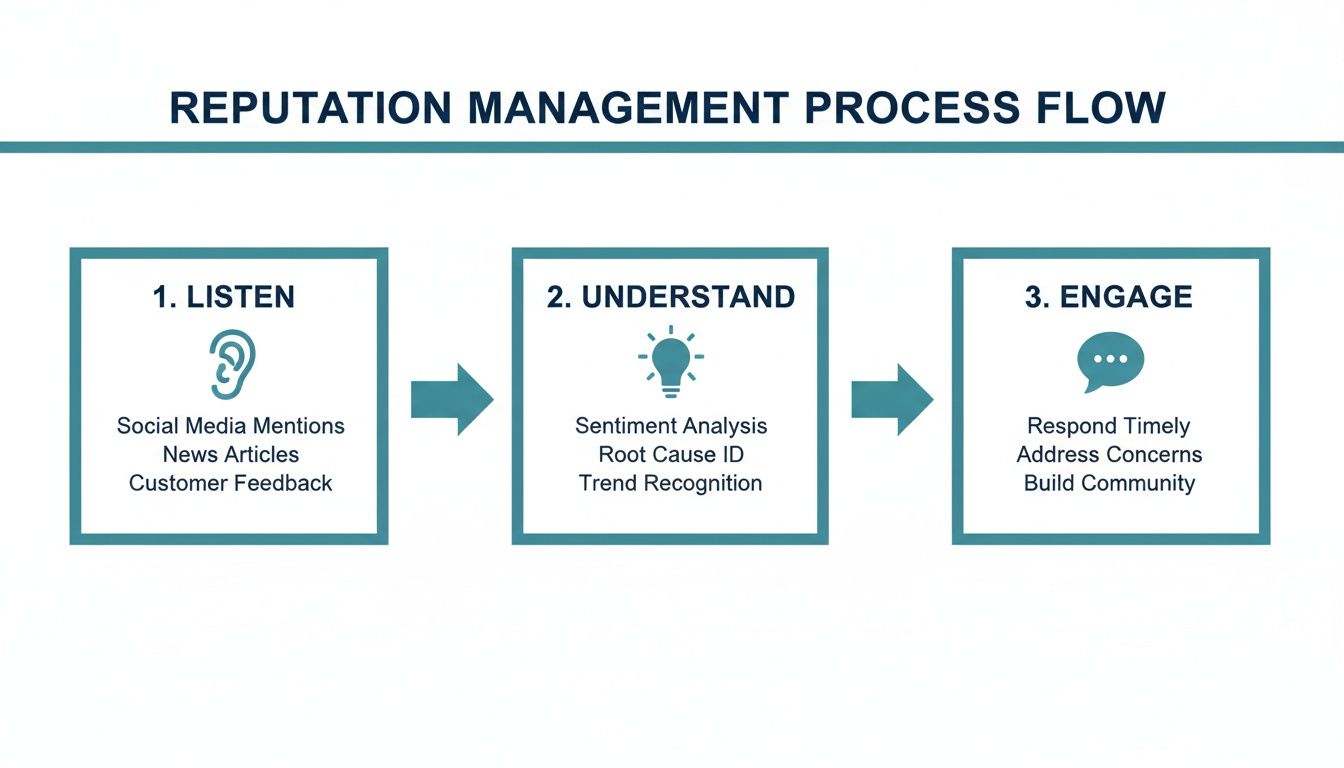
The flow from listening to understanding and finally engaging ensures every action is informed and strategic, not just reactive.
Step 1: Listen Beyond Your Brand Name
Most companies stop at monitoring their own name. That’s a rookie mistake. The most valuable conversations happen before anyone knows you exist. The real goal is to find people with problems you can solve. To do this, we set up keyword alerts that cast a wider net, moving our social reputation management from passive defense to active opportunity hunting.
Inside BillyBuzz, our actual alert filters look like this:
- Customer Pain Points:
"how to find customers on Reddit","best way to track brand mentions","social media monitoring for startups". These are direct buying signals. - Competitor Mentions:
"Brand24 alternative","frustrated with Mention","anyone tried Awario?". These are warm leads primed to switch. - Buying-Intent Keywords:
"recommend a social listening tool","need software for Reddit monitoring","tools for founder". This gets us into conversations when purchase decisions are being made.
Step 2: Prioritize Ruthlessly
As a lean startup, you can’t respond to everything. We use our AI to score relevancy, but the logic is simple: prioritize based on intent and impact. A user asking for an alternative to a competitor is a higher priority than a general industry mention.
We focus our energy on specific communities. For us, that means subreddits like:
- /r/SaaS: For industry trends, growth tactics, and competitor news.
- /r/startups: To connect with other founders and understand their core challenges.
- /r/marketing: To find marketing leaders discussing strategy and tools.
- /r/Entrepreneur: For direct conversations about the problems entrepreneurs face.
The goal isn't to be everywhere. It's to be in the right places at the right times. A single, well-placed, helpful comment in a high-value community is worth more than a hundred generic brand mentions.
Step 3: Engage with Value First
Once we find a conversation, we lead with value, not a sales pitch. We've developed response templates that act as frameworks, not rigid scripts, allowing our team to be authentic while staying on-message.
Template 1: Answering a Product Question
- Acknowledge & Validate: "That's a great question. A lot of founders struggle with X."
- Provide a Direct Answer: "The simplest way to do that is Y. You can use Reddit's own search with operators like
subreddit:SaaS "your topic"." - Offer Further Help (Subtle Mention): "We actually built BillyBuzz to automate this because doing it manually was so time-consuming. Happy to share more if you're interested, but the manual method works great to start."
Template 2: Handling Criticism
- Thank & Empathize: "Thanks for the honest feedback. I can see how that would be frustrating."
- Take Ownership: "That's on us. We're working on improving that, and this feedback helps."
- Offer Resolution: "I've passed this to our product team. In the meantime, could [workaround] help?"
This system transforms social reputation management from a defensive chore into a proactive growth engine. You can explore more strategies in our guide covering 10 ways BillyBuzz enhances your social media monitoring efforts. By systematically listening, prioritizing, and engaging with genuine value, you build trust and turn conversations into customers.
Choosing Your Battlegrounds for Maximum Impact
As a founder, your most valuable asset is time. You can't be everywhere. Trying to monitor every social platform is a path to burnout. Smart social reputation management isn't about casting the widest net; it's about making strategic choices and showing up where it counts.
The real, high-intent conversations—where people actively look for solutions and make buying decisions—are happening in community forums like Reddit and Quora. Here, authenticity is everything, and one genuinely helpful comment can build more trust than a dozen slick ads.
Your mission is to find the specific online communities where your ideal customers gather to share problems and ask for recommendations.
Finding Your Niche Communities
First, look beyond the obvious platforms. Sure, tracking Twitter mentions is part of the game, but the real gold is in niche subreddits. At BillyBuzz, we use our own platform to find these places, but you can do it manually.
Put yourself in your customer's shoes. What words would they use to describe the problem your product solves?
- Search Reddit Directly: Try queries like
"how to [solve a specific problem]","[competitor name] review", or"[your industry] tools". Note which subreddits appear most often. - Analyze User Histories: Find a relevant comment from someone who sounds like your target customer and check their profile. See what other communities they participate in. This is a great way to discover related subreddits.
- Look for 'Help Me' Phrases: Search for phrases like
"Does anyone know a tool for..."or"I'm struggling with..."to find active conversations.
This manual digging gives you an unfiltered look into how your customers think and talk.
Evaluating a Community's ROI
Not all communities are created equal. Once you have a list, qualify them to ensure your time will be well spent. We look for a few key signals.
Your time is too valuable to spend in digital ghost towns. Focus your energy on active, engaged communities where a single, high-value interaction can have a ripple effect, building both reputation and pipeline.
We size up communities using a simple scorecard:
- Activity Level: How many new posts and comments appear each day? A healthy community is always buzzing.
- Conversation Quality: Are the discussions meaningful and helpful, or just memes and spam? Look for detailed questions and thoughtful replies.
- Moderation and Rules: Read the community's rules. Some subreddits have strict policies against self-promotion. Know the rules before you engage.
- User Demographics: Does the language, tone, and vibe match your ideal customer profile? The way people talk tells you a lot.
By concentrating on high-quality, relevant communities, you make sure every minute invested in social reputation management delivers real value.
Engaging Authentically Without Being Cringey
So, you’ve found the right conversation. This is the moment of truth. How you respond determines whether you create a loyal fan or an instant critic.
As a founder, being authentic is your superpower. But on platforms like Reddit, the line between helpful and cringey is razor-thin. One wrong move, and you're downvoted into oblivion.
The secret to effective social reputation management is simple: give more than you take. Lead with genuine value, and you earn the right to mention your product. It's about creating engaging social media content that resonates instead of just shouting into the void.
The Give-First Framework
Here at BillyBuzz, we build every response around a "Give, Give, Ask" model—and the "Ask" is always subtle. This framework ensures we're always adding value first.
- Give #1 (Acknowledge and Empathize): Validate the original poster's (OP) problem. Show them you get their frustration. "I've been there, that's a tough problem to solve," builds instant rapport.
- Give #2 (Offer a Genuine Solution): Provide a real, actionable answer that solves their problem without needing your tool. This could be a manual workaround, a link to a resource, or a tactical tip. This proves your motive is to help, not sell.
- Ask (Subtle Mention): Only after you've provided standalone value do you bring up your product. Frame it as a way to automate or simplify the free solution you just gave. "We actually built a tool to automate this because we got so tired of doing it by hand."
This approach builds reputational capital and reframes the interaction from a sales pitch into a helpful recommendation from a peer.
Navigating Common Scenarios
Let's see how this plays out. You’ll run into these situations all the time.
Scenario 1: Someone asks for a recommendation.
A user posts, "What's the best tool for tracking brand mentions on Reddit?"
- Bad Response (Self-Promo): "You should check out BillyBuzz! We do exactly that." Instant downvotes.
- Good Response (Value-First Play): "Great question. You can start with Google Alerts, but they're often noisy. For a more focused manual approach, try Reddit's advanced search with operators like
subreddit:SaaS "your brand". If you need something more automated to cut the noise, a tool like ours (BillyBuzz) can help by filtering for sentiment and intent."
This response gives them something they can use immediately, for free, then positions the product as the logical next step.
Scenario 2: Someone complains about a competitor.
A user posts, "Ugh, [Competitor X] just doubled their prices without warning. So frustrated."
- Bad Response (Negative Sell): "Yeah, they're terrible. We're way better and cheaper!" This looks petty.
- Good Response (Empathetic Solution): "That's really frustrating. Pricing changes can be tough, especially for startups. As you look for alternatives, I'd suggest focusing on features that solve [specific pain point] and clear pricing. Full disclosure, I'm the founder of BillyBuzz, and we built our tool to be a more founder-friendly option."
This shows empathy, offers helpful advice, and introduces your brand with transparency.
The goal is never to "win" an argument online. It's to be seen as the most helpful, transparent, and empathetic voice in the conversation. When you achieve that, people naturally gravitate toward your solution.
By consistently leading with empathy and value, your social reputation management becomes a powerful engine for building trust and attracting customers.
Building an Early Warning System with AI
As you grow, manually tracking every mention of your brand, competitors, or industry topics is a losing battle. A single negative Reddit thread can explode into a crisis before you even know it’s there. You need to graduate from manual scrolling to an automated early warning system for your social reputation management.

This isn’t about simple keyword flagging. Modern tools like BillyBuzz use AI to analyze sentiment, user intent, and relevance. It’s the difference between an alert that says "your brand was mentioned" and one that says, "potential customer is fed up with a competitor and looking for an alternative."
Speed is everything. A social media crisis can spread 1200% faster than old news cycles. Companies that use monitoring tools to respond quickly can slash financial fallout by up to 30%. You can dig deeper into the impact of social media crises from Motion Gility.
How We Set Up Alerts Inside BillyBuzz
Our alert system is our first line of defense. We're obsessed with getting actionable information to the right person, right now. The heart of our system is real-time notifications piped straight into Slack. This means our team can see, evaluate, and jump into conversations in minutes, not hours.
Inside BillyBuzz, here are the actual alert rules we use to get high-signal notifications:
- Alert Rule 1 (Urgent Negative Sentiment):
IF "BillyBuzz" is mentioned AND sentiment is "Very Negative" THEN send real-time alert to #crisis-response Slack channel. - Alert Rule 2 (Competitor Pain):
IF "Brand24" OR "Mention" is mentioned AND keywords include "alternative" OR "frustrated" OR "complaint" THEN send daily digest to #sales-leads Slack channel. - Alert Rule 3 (High-Intent Questions):
IF keywords include "social listening tool" AND subreddit is "SaaS" OR "marketing" THEN send real-time alert to #engagement-ops Slack channel.
Your goal isn't just to listen; it's to listen intelligently. AI filters the noise so your team can focus on the 5% of conversations that genuinely move the needle—whether it's saving a customer, closing a deal, or addressing a product complaint before it goes viral.
Getting these alerts running is easier than you think. You can learn how to set up Slack alerts for Reddit mentions in just 10 minutes with our step-by-step guide. For a lean team, this automation is one of the highest-leverage things you can do.
Filtering Signal from Noise with AI Scoring
The real headache isn't finding mentions; it's getting buried by them. An AI-powered system fixes this by scoring every conversation for relevance, looking at factors beyond keywords:
- Urgency: Is the user just venting or expressing an immediate need for help?
- Intent: Are they asking for recommendations (buying intent) or just making an offhand comment?
- Influence: Is this comment in a tiny subreddit or a community with thousands of active users?
This scoring system weeds out low-value chatter so your team only gets pinged for conversations that need a human touch. It gives a small startup the efficiency of a much larger company.
Manual Monitoring vs AI-Powered Monitoring
For a growing team, the difference between doing this by hand versus using an AI tool is night and day.
| Capability | Manual Monitoring | AI-Powered Monitoring (e.g., BillyBuzz) |
|---|---|---|
| Speed | Reactive (hours or days) | Proactive (real-time alerts in minutes) |
| Scope | Limited to a few known keywords | Broad monitoring of pain points and competitors |
| Filtering | Overwhelming noise, hard to prioritize | AI relevance scoring highlights critical conversations |
| Workflow | Constant manual checking | Automated alerts pushed to Slack or email |
| Scalability | Breaks down quickly as volume grows | Easily scales with brand growth |
An AI-powered early warning system shifts your social reputation management from a frantic, reactive chore into a calm, strategic operation. You're no longer just putting out fires; you're preventing them.
Founder FAQs on Reputation Management
As a founder, you're juggling a million things. This section cuts through the noise to answer the questions I hear most from other founders, with practical advice you can use today.
How Much Time Should a Solo Founder Dedicate to This?
For a solo founder, it’s about efficiency. You can make a huge impact in just 2-3 hours per week with the right tools and a focused strategy. The goal is to ditch manual searches and set up an automated listening system.
Your time should be spent on high-leverage activities:
- Daily Alert Triage (30 minutes): Quickly scan your automated alerts. You’re looking for the top 3-5 conversations that need you right now. Think: a potential customer asking for a competitor alternative, or a legitimate complaint.
- Writing Thoughtful Replies (1-1.5 hours): Invest your time here. Focus on genuinely helpful, non-promotional answers to those high-priority mentions. One incredible response is worth more than a hundred generic comments.
- Proactive Community Help (30 minutes): Spend time in one or two key community threads offering expertise without mentioning your product. This builds goodwill and establishes you as an expert.
The biggest mistake is trying to be everywhere at once. Don't. Pick a couple of key communities where your customers hang out and be a valuable voice there.
What Are the Most Important Metrics to Track?
Forget vanity metrics like mention counts. Your reputation efforts must be tied to metrics that show business impact. At BillyBuzz, we obsess over four indicators.
Tracking the right KPIs is the difference between being busy and being productive. If you can't connect your reputation work to business outcomes, you're just spinning your wheels.
Here’s what we measure:
- Share of Voice (SOV): Of all the conversation in your niche, what percentage is about you versus your main competitors? This shows if you're gaining ground.
- Sentiment Score: Are people talking about you in a positive, negative, or neutral way? Watching this trend over time shows if your engagement is improving how people see your brand.
- Response Time: How fast are you getting to critical mentions, especially negative ones? A quick response can shut down a potential crisis.
- Engagement-to-Lead Conversions: How many conversations you join lead to an action, like a website click, a demo request, or a trial sign-up? This ties reputation management directly to revenue.
How Do You Handle Trolls or Coordinated Attacks?
First, take a breath. Figure out if this is one legitimate, frustrated customer or a bad-faith attack.
For a genuine complaint, respond publicly with empathy. Acknowledge their frustration, then immediately offer to take the conversation private (email or DMs) to solve it. This shows everyone you care.
For trolls and coordinated attacks, the rule is simple: Don't feed the trolls. Engaging gives them the attention they want. Instead, run this playbook:
- Report and Block: If the comments break the platform's rules, report them immediately.
- Make One Calm Statement: If you must, post a single, fact-based public statement. "We're aware of this discussion. For accurate information, you can find it here [link to a blog post]. We won't be engaging further with misinformation."
- Mobilize Your Community: Your happy customers are your best defense. Often, they will jump in to defend you—and their voices are far more powerful than your own.
Can Social Reputation Management Actually Improve SEO?
Absolutely. It’s one of the most underrated benefits. When people talk about your brand on high-authority platforms like Reddit and Quora, it sends strong signals to search engines.
Google's algorithm is increasingly focused on E-E-A-T (Experience, Expertise, Authoritativeness, and Trustworthiness). Positive, organic conversations about your brand on trusted third-party sites are a direct signal of your trustworthiness and authority.
Plus, Reddit threads themselves often rank on the first page of Google for high-intent searches. By actively and helpfully participating, you are co-creating top-ranking search content that can drive qualified traffic for years to come.
Ready to stop guessing and start growing? BillyBuzz gives you the AI-powered tools to find and engage customers on Reddit without spending hours scrolling. Get real-time alerts for high-intent conversations delivered right to your Slack. Start your free trial today.