

Your website feels like a digital billboard. People glance at it and leave without a trace. You’re shouting into the void with ads and content, hoping someone listens. We've all been there.
This is where conversational marketing comes in. It’s not a tactic; it's a fundamental shift. Instead of making people fill out a "Contact Us" form and wait, you start a real conversation, right then and there. It's like having your best team member ready to chat 24/7, answering questions the moment a visitor shows a flicker of interest.
Forget one-way broadcasts. This is about opening a two-way dialogue using tools like live chat, chatbots, and proactive community engagement. It’s built on a simple truth we live by as founders: people want help now.

What Makes It Tick?
At its core, conversational marketing isn't just about a chat widget. It's a strategy that creates a better, faster experience for your visitors.
- Engage Instantly: The magic is in the timing. You engage people the second they land on your site or social media. It’s immediate and respects their time.
- Personalize at Scale: A chatbot can pop up and say, "Hey, I see you're checking out our pricing. Need help finding the right plan?" It’s targeted and helpful.
- Create a Feedback Loop: Every conversation is a goldmine. You get raw, unfiltered feedback straight from your audience, helping you understand their real problems and improve your product.
A New Kind of Customer Journey
The real genius here is how quickly it builds trust. When you answer a question in seconds, you show customers you value their time. That simple act turns a cold transaction into a warm, relational one.
The goal is to make buying from you feel as easy and natural as talking to a friend. You’re removing friction and offering help, not a hard sell.
To see just how different this approach is, let's compare it to the old way of doing things.
Traditional Marketing vs Conversational Marketing
| Attribute | Traditional Marketing (The Old Way) | Conversational Marketing (The New Way) |
|---|---|---|
| Communication | One-way broadcast (Company to Customer) | Two-way dialogue (Back-and-forth conversation) |
| Timing | Delayed (Customer waits for a response) | Real-time (Instant engagement and answers) |
| Customer Role | Passive audience (Listens or reads) | Active participant (Asks questions, gives feedback) |
| Experience | Anonymous and generic (One-size-fits-all) | Personal and contextual (Tailored to the individual) |
| Goal | Lead capture (Get an email for later) | Building relationships (Help and guide now) |
The contrast is stark. It's a move from collecting leads to actually connecting with people.
This new model has also completely changed the game for customer service. Chatbots can now handle up to 80% of simple customer complaints, freeing up your human agents to tackle complex issues. If you want to dig deeper into the basics, check out this great explainer on what is conversational marketing.
Ultimately, this leads to a healthier bottom line. A whopping 80% of companies using these methods have reported a jump in sales. This isn't just a trend; it's a proven way to grow.
Why Conversational Marketing Is a Startup Superpower
As a founder, speed is your biggest advantage over larger, slower competitors. Conversational marketing is a genuine superpower that lets you punch way above your weight.
Traditional marketing is like setting a trap and hoping a customer wanders into it. You put up a "contact us" form and wait. That delay is a deal-killer. Every hour that passes gives a potential customer a chance to lose interest or find a competitor.
Conversational marketing flips that model. It’s about engaging people the moment their interest peaks. For a lean startup where every lead is gold, that immediacy is a game-changer.
Slash Your Sales Cycle Instantly
Closing the gap between interest and a sales conversation is a tough hurdle. Conversational tools build that bridge instantly.
Instead of a lead form that says, "we'll get back to you... eventually," a chatbot can qualify a visitor and book a demo on your calendar in under two minutes—all while you’re busy building your product.
This is a massive competitive advantage. Responding to a lead within the first minute can boost conversion odds by an incredible 391%. In a world where 35-50% of sales go to the vendor who responds first, speed isn’t just nice to have; it’s a survival skill. Wait a day, and those warm leads go cold. If you want to dig deeper, this 2025 conversational marketing report has eye-opening stats on how response times affect revenue.
Generate Higher Quality Leads
Let’s be honest: static lead forms are terrible at qualifying prospects. They’re a magnet for spam and tire-kickers. Your sales team—which might just be you—wastes precious time chasing people who were never a good fit.
A well-designed chatbot or proactive live chat acts as an intelligent filter. It can ask the right questions in a natural way:
- "What's the biggest challenge you're hoping to solve?"
- "How many people are on your team?"
- "Are you currently using a similar tool?"
This real-time qualification means that when a lead gets handed off to sales, they aren’t just a name and an email. They're a person with a clearly defined need and a confirmed interest. It lets you focus your energy where it truly matters.
Create an Unbeatable Feedback Loop
Finally, every conversation is a chance to learn. As a founder, you live and breathe customer feedback.
Conversational marketing gives you a direct line to your audience's thoughts, problems, and the exact language they use. You get to hear how they describe their pain points in their own words. This raw, unfiltered feedback is priceless.
For startups, understanding why real-time engagement is crucial for startup success can be the make-or-break factor between finding product-market fit and running out of runway.
The BillyBuzz Playbook: How We Find Customers in the Wild
So much of marketing feels passive. You build a great website, publish content, and cross your fingers.
We do things differently. We go where the fish are already schooling.
This is our playbook for finding potential customers where they're already talking about their problems. It’s less about selling and more about listening, finding real opportunities, and adding value before asking for anything. The goal is simple: go from stranger to trusted resource, one helpful comment at a time.
Step 1: Find Your Digital Watering Holes
First, you need to know where your ideal customers hang out online. For us at BillyBuzz, that’s startup founders, marketers, and SaaS builders. They live on Reddit.
Instead of trying to be everywhere, we get hyper-focused on specific subreddits.
Our core list is tight:
- /r/saas: A goldmine for discussions on growth, churn, and marketing headaches.
- /r/startups: The main hub for founders sharing wins and struggles.
- /r/marketing: Perfect for finding people talking about lead generation and analytics.
- /r/Entrepreneur: Great for uncovering pain points related to scaling a small business.
Focusing on a handful of high-quality communities is far more effective than spreading yourself thin. It lets you learn the culture and build credibility.
Step 2: Set Up Smart Alerts to Cut Through the Noise
Manually scrolling these communities all day? No founder has time for that.
This is where we use our own tool, BillyBuzz, as our intelligent filter. We create alerts that ping us in Slack the second a relevant conversation pops up. The magic is in the keywords we track. We aren't just looking for our brand name; we're listening for pain points and buying intent.
Here are the actual alert rules we use:
- Problem-Aware Keywords:
"how to find customers on reddit","reddit lead generation","monitor subreddit for keywords" - Competitor Mentions:
"alternative to [competitor name]","vs [competitor name]". What do people love? What do they hate? These are perfect openings. - Tool Recommendations:
"looking for a tool to","social listening tool recommendation". These phrases scream high-intent.
These alerts filter out 99% of the noise, ensuring we only jump into conversations where we can offer immediate value.
Step 3: Engage With Our "Value-First" Response Template
You get an alert. Your first instinct might be to pitch your product. Don't. That’s the fastest way to get downvoted. Instead, we use a simple, non-spammy framework.
The goal is to be so helpful that people ask you what you do. Your answer should solve their immediate problem, with your product being a logical next step.
Here is the exact response template we use internally:
- Acknowledge and Validate: Start with "Great question, we struggled with this too" or "That's a tough spot to be in." It shows you get it.
- Provide a Genuine, Tool-Agnostic Solution: Give them a direct, actionable answer that doesn't require your product. This builds trust instantly. For example, "You could manually track these subreddits daily or set up some complex IFTTT alerts, but it's a grind."
- Introduce Your Solution (Softly): After you’ve delivered value, mention your tool as what worked for you. "For what it's worth, we ended up building a tool called BillyBuzz to automate this because manual tracking was just taking too long."
- No Hard Sell: End there. Don’t add a pushy call-to-action. Let them connect the dots.
This approach has been our most effective channel for high-quality leads. It turns cold communities into warm, one-on-one conversations.
If you want to dive deeper, check our guide on how to get customers from Reddit in 2025. This proactive method built our brand inside the communities our customers already trust.
Choosing Your Channels: Chatbots, Live Chat, or Community?
So, you're sold on the idea. The next question is, "Where do I start?" Trying to be everywhere at once is a classic rookie mistake. The smart play is to pick the right tool for the job you need to get done right now.
Not all conversational channels are created equal. Let's break down the main players so you can make a strategic choice, not a frantic one.
Chatbots: The 24/7 Lead Qualifier
Think of chatbots as your tireless, front-line crew. Their superpower is handling repetitive tasks at scale, freeing you up to focus on conversations that matter.
A well-designed chatbot is a master at:
- Answering FAQs: It instantly handles "What are your hours?" or "Do you have a free trial?"
- Qualifying Leads: It can ask a few simple questions to see if a visitor is a good fit before passing them to a human.
- Booking Demos: It can hook into your calendar and get meetings on the books, killing painful email back-and-forth.
For early-stage founders, chatbots are a lifeline. They ensure you never miss a potential customer just because they showed up at 2 AM.
Live Chat: The High-Touch Deal Closer
A high-intent prospect is on your pricing page with a complex question. A chatbot won't cut it. This is where live chat comes in. It’s your tool for real-time, human-to-human connection at the most critical point in the buyer’s journey.
Live chat is perfect for turning warm leads into paying customers. It gives you a direct line to build rapport, handle objections, and offer personalized guidance that closes deals. Be warned, though—it’s resource-intensive because it needs a real person. If you go this route, staffing is key. This playbook explains how to hire a virtual assistant for live chat so you can manage conversations without blowing your budget.
Community: The Proactive Brand Builder
Chatbots and live chat are reactive—they wait for people to come to you. Community engagement is proactive. It's about finding where your potential customers already hang out, like Reddit, and joining their conversations.
At BillyBuzz, this is our bread and butter. We don't wait for leads; we actively monitor subreddits for pain points we can solve. This acts as a powerful engine at the top of our funnel, building awareness and authority long before a prospect visits our website.
This simple decision tree shows how we turn community conversations into customers.
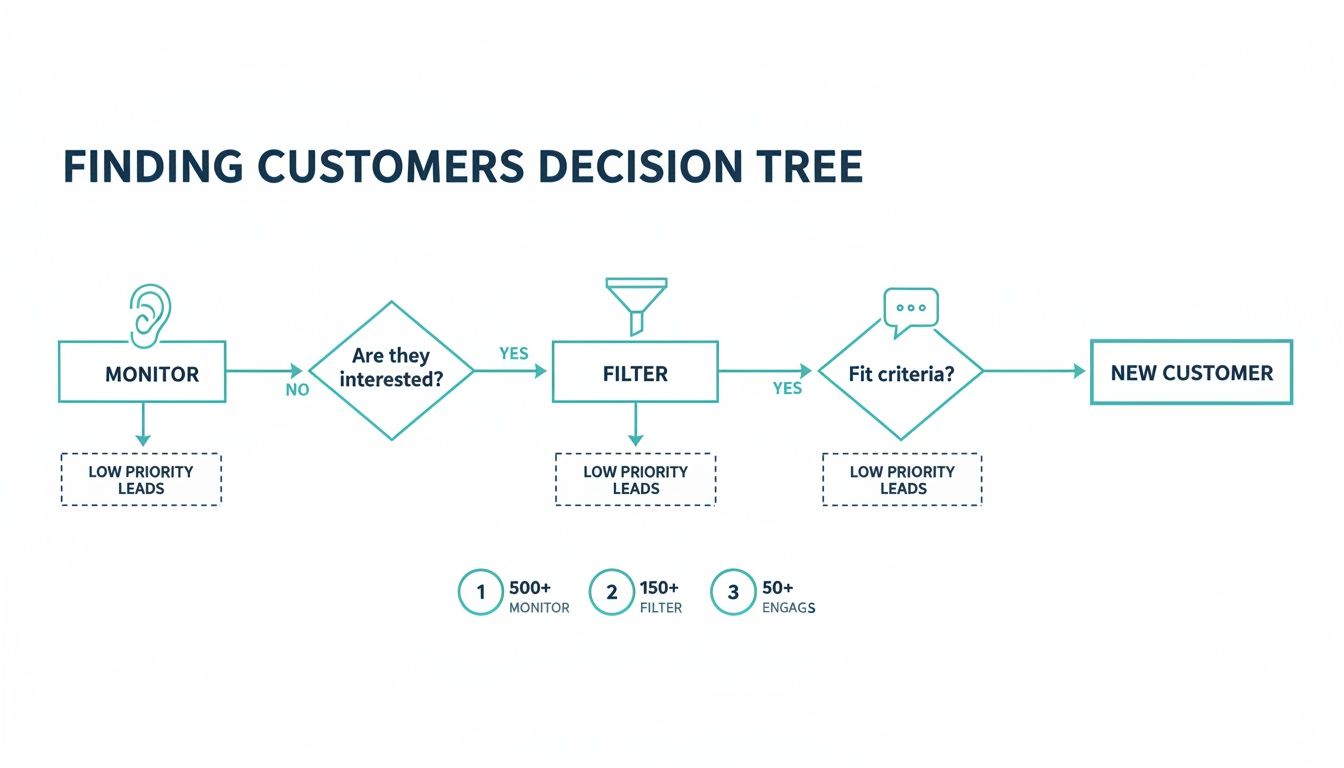
Great community marketing isn't about shouting. It’s a system: monitor for opportunities, filter the noise, and then jump in with genuine value.
Deciding where to begin can be overwhelming. Here’s a quick breakdown to help.
Which Conversational Channel Is Right for You?
| Channel | Best For | Primary Goal | Resource Intensity |
|---|---|---|---|
| Chatbots | Startups needing 24/7 lead capture and support automation. | Lead Qualification & FAQ Handling | Low (after initial setup) |
| Live Chat | Businesses with high-value products and active sales teams. | Sales Conversion & Complex Support | High (requires live staff) |
| Community | B2B companies & brands targeting niche audiences. | Brand Building & Proactive Lead Gen | Medium (requires monitoring) |
You don't have to do it all at once. Pick the channel that solves your biggest problem today, master it, and then expand.
The Lean Tech Stack We Use to Power Our Conversations
You don't need an enterprise-level tech stack. As a founder, you want the opposite: lean, effective, and affordable. A few carefully chosen tools that "talk" to each other are far more powerful than one bloated platform.
Here’s a look under the hood at the exact, no-fluff setup we use at BillyBuzz. It's a simple three-part system built to capture conversations wherever they happen.
Our Core On-Site and Off-Site Tools
Our strategy covers two fronts: conversations on our website and conversations out in the wild. We rely on two primary tools.
- For On-Site Chat: We use Crisp for live chat on our website. It’s lightweight, affordable, and just works.
- For Off-Site Monitoring: We use our own tool, BillyBuzz, to monitor Reddit. This is our proactive engine. It pings us the moment relevant conversations pop up so we can engage before they even know we exist.
This two-pronged approach gives us both reactive and proactive capabilities. We can help people who find us, and we can find people who need our help.
The Automation Glue Holding It All Together
Having the right tools is only half the battle. The magic happens when they work together automatically.
Our single most important tool for integration is Zapier. It’s the central nervous system for our entire conversational workflow, connecting our listening posts to our main workspace and CRM without a single line of code.
For example, a new lead from a Crisp chat can be instantly added to our CRM. This automation ensures every conversation is logged and followed up on.
A Real-Life Workflow Example
Here's how this fits together. This workflow runs for us multiple times a day, turning a Reddit comment into a qualified lead.
- The Spark: Someone posts in r/saas asking, "What’s the best tool for tracking brand mentions on Reddit?"
- The Alert: Our BillyBuzz monitor, tracking keywords like "brand mentions" and "tracking Reddit," spots the post and fires a real-time alert to a dedicated Slack channel.
- The Engagement: Our team sees the alert and uses our value-first template to write a helpful reply, mentioning how we solved that exact problem.
- The Connection (The Zapier Magic): If the poster replies or visits our site, our on-site tools take over. A chat via Crisp is automatically logged.
- The Handoff: A Zapier workflow triggers, creating a new contact and deal in our HubSpot CRM, pulling in the conversation details for full context.
This entire process, from a random comment to a structured lead in our CRM, is almost entirely automated. It ensures our conversations become real customer relationships.
Want to set up something similar? We wrote a guide on how to set up Slack alerts for Reddit mentions in 10 minutes that breaks down the process.
Common Conversational Marketing Mistakes to Avoid
Jumping into conversational marketing is exciting, but it's easy to trip over common hurdles. We've stumbled into our share of these traps and learned some tough lessons.
The biggest mistake is automating the humanity out of the conversation. It’s tempting to lean on chatbots, but if your messages sound robotic, you’ll push people away. A little personality and a warm, human touch make all the difference.
Another blunder is relying on generic, one-size-fits-all chatbot scripts. When someone has a specific question and gets a canned answer that misses the mark, they're gone. Your chatbot needs to guide people, not lock them in a frustrating loop.
Neglecting Critical Integrations
One of the most painful mistakes is failing to connect your conversational tools with your CRM. We learned this the hard way. When a great lead from a live chat or Reddit mention doesn't automatically land in your sales pipeline, that lead is as good as gone.
Without that integration, your conversations are stuck in a silo. You lose context, force your team into manual data entry, and watch good opportunities slip through the cracks.
Flying Blind Without Monitoring
Finally, the most common mistake is simply not listening. You can't join a conversation you don't know is happening. Waiting for people to find your website leaves your growth to chance. If you aren't actively monitoring for brand mentions, competitor chatter, or problem keywords, you're essentially invisible.
At BillyBuzz, we live by this rule: if you’re not proactively looking for opportunities, you're missing 90% of them. Setting up alerts for keywords like "alternative to [competitor]" or "tool to monitor subreddits" is non-negotiable for us.
This proactive listening is the bedrock of our strategy. It ensures we show up in the right place at the right time. Skipping this step is like opening a shop but forgetting to unlock the door.
Straight Talk for Founders: Conversational Marketing FAQs
As a founder, I know you’re juggling new strategies, a tight budget, and a clock that never stops. So, let’s cut to the chase. Here are real-world answers to the questions I hear most about putting conversational marketing to work in a lean startup.
What's This Actually Going to Cost Me?
Honestly, you can start for free and scale up. You don't need a massive budget.
You could begin today for $0 by using a basic live chat tool and monitoring social media yourself. When you're ready for more power, a solid chatbot platform combined with a monitoring tool like BillyBuzz might run you $100 to $500 a month. Start small, prove the value on one channel, and then expand.
Can I Really Do This as a Solo Founder?
Absolutely. The key isn't to be everywhere, but to be smart about where and when you show up.
Pick one channel where your customers hang out and focus there. On your site, a chatbot can qualify leads 24/7, and you can jump into live chat during work hours. For communities, a monitoring tool can ping you only when relevant conversations pop up so you're not lost in the endless scroll. It’s about using tech to be in the right place at the right time.
As a founder, your time is your most valuable asset. The goal isn't to join every conversation, but to join the right conversations. Technology helps you filter the signal from the noise, making this manageable even for a team of one.
What Numbers Should I Actually Be Watching?
Forget vanity metrics. You need to track numbers that connect directly to revenue.
At BillyBuzz, these are the KPIs we live and die by:
- Qualified conversations started: How many real, meaningful chats did we kick off this week?
- Lead-to-opportunity rate: How many of those chats turned into legitimate sales opportunities?
- Sales cycle length: Are these leads closing faster than ones from our old contact form? (Spoiler: they should be.)
- Traffic from community engagement: How many high-intent visitors are we bringing back to our site from places like Reddit?
Keeping a close eye on these metrics will give you a crystal-clear picture of your ROI and show you where to invest your time and money.
Ready to stop waiting for customers to find you? BillyBuzz is your AI-powered scout, finding high-intent leads on Reddit and alerting you in real-time so you can join the conversation at the perfect moment. Start finding your next customers today.