

As a founder, I used to think of earned media as a nice-to-have. It's the digital version of a friend giving you a solid recommendation, and that kind of trust is something money just can't buy. But I quickly learned it's not just "buzz"—it's a critical growth channel that brings in customers without the hefty price tag of paid ads.
Why Earned Media Is a Founder’s Secret Weapon
I’ll never forget the first time we got a major, completely unexpected shout-out on Reddit. Someone in r/SaaS asked, "What's the best tool for tracking brand mentions without a huge budget?" Another user jumped in and just dropped a link to BillyBuzz.
Within hours, our site traffic went through the roof. Sign-ups surged. And suddenly, we had an entire thread packed with raw, honest feedback. That one comment was pure earned media in action. We didn’t orchestrate it, and we certainly didn't pay for it. It was just one person genuinely helping another.
I think about marketing in three different buckets:
- Owned Media: This is your home turf—your website, blog, and company social media accounts. You create it, you control it.
- Paid Media: This is straightforward advertising. You’re paying for eyeballs, whether it's through Google Ads or a sponsored Instagram post. You're renting an audience.
- Earned Media: This is the holy grail. It’s the organic buzz that happens when people start talking about you on their own terms. Think reviews, press mentions, unsolicited social media posts, and forum discussions.
Paid media is you telling people, "We're great." Owned media is you showing them, "Here's why we're great." But earned media? That’s when a customer turns to someone else and says, "They're great." It’s a completely different ballgame.
The Power of Authentic Social Proof
For a founder, that authenticity is everything. It’s the most potent form of social proof because it comes from real users, not your marketing team. It’s proof that your product actually works and solves a problem. In a world where everyone is bombarded with ads, that kind of unbiased endorsement cuts through the noise.
And it’s not just a hunch; the industry is betting big on it. The global public relations market, which is all about generating earned media, is projected to hit $112.98 billion in 2025. It makes sense when you see stats showing that smart PR can boost revenue by 20%. For more on this, check out the 2025 Public Relations Statistics Report.
But here’s the good news: you don't need a massive PR budget to get started. You just need to be a good listener. In this guide, I’m going to pull back the curtain on how we measure the real-world value of earned media. I’ll share the exact playbook we use inside BillyBuzz to find these opportunities, track their impact, and prove their ROI.
Translating Online Buzz into Business Dollars
That initial Reddit buzz felt great, but as a founder, I had to ask: what was it actually worth? When you can put a hard number on organic mentions, you move from just feeling good about brand chatter to making smart, data-backed decisions. This is where Earned Media Value (EMV) comes in.
Forget the dry definitions. Think of EMV as a simple way to estimate what you would have paid in advertising to get the same level of exposure. It puts a dollar figure on the social proof and word-of-mouth you're generating for free.
The Old Way of Measuring Value
The traditional way to calculate EMV is to multiply the number of people who saw a mention (impressions) by the standard advertising cost to reach a thousand of them (CPM).
Traditional EMV Formula: (Impressions / 1,000) x CPM = Earned Media Value
Let's say a user posts about your product in a subreddit and it gets 50,000 impressions. If the average CPM for that audience is $20, the math is simple: (50,000 / 1,000) x $20 = $1,000 EMV.
Easy, right? A little too easy. This formula has a massive blind spot: it treats all buzz as equal. It assumes a glowing review from an industry expert holds the same weight as a passing, neutral comment from a random account. As founders, we know that’s just not true. Quality, context, and sentiment are everything.
To see where this fits into the bigger marketing picture, take a look at the three core media types.
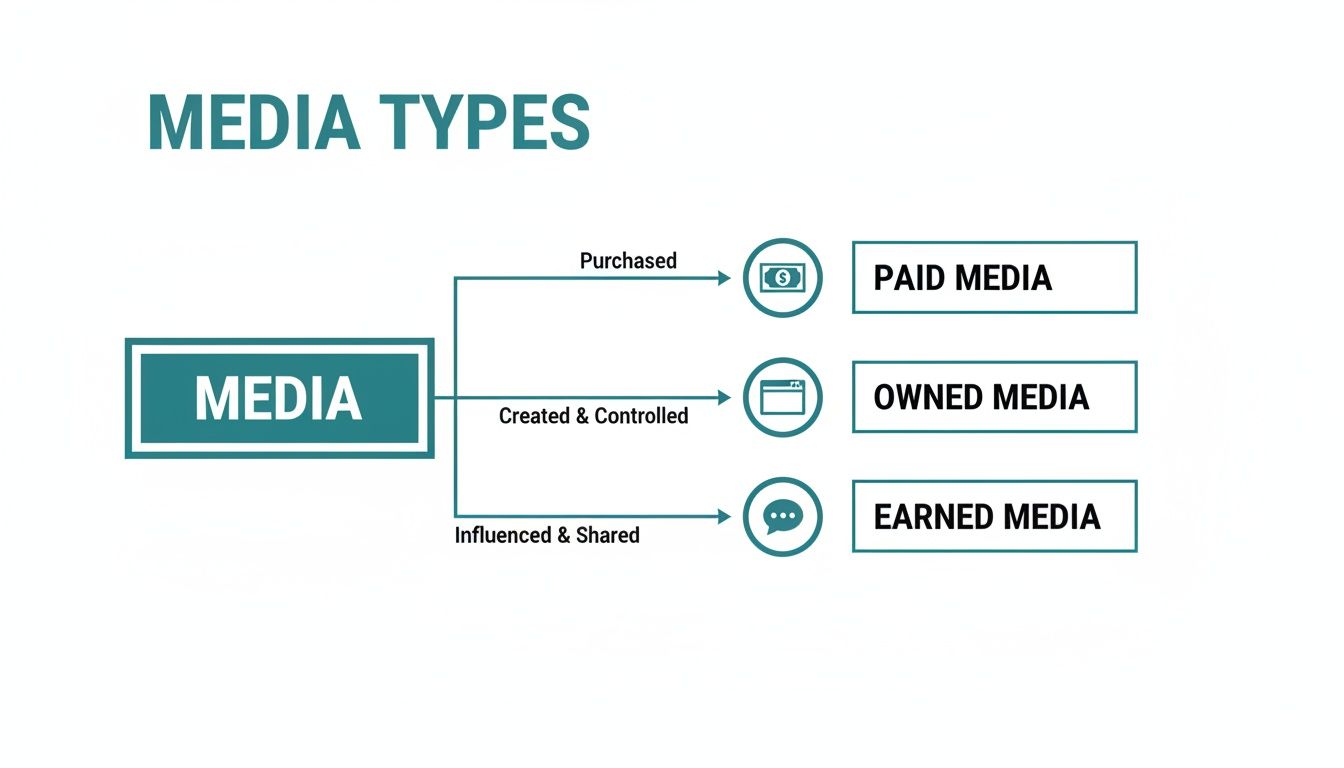
While you control paid and owned media, earned media's power comes from its authenticity. That authenticity is exactly why it needs a smarter way to measure its value.
A Better Model That Accounts For Quality
At BillyBuzz, the basic formula wasn't cutting it, so we built our own. We needed a model that understood a passionate recommendation from a trusted source is worth far more than a lukewarm mention. Our model adds crucial qualitative layers to get a truer sense of value.
Here are the key factors we bake into our calculation:
- Sentiment Score: Is the mention positive, negative, or neutral? A glowing review gets a higher multiplier, while a negative comment (still valuable for feedback!) has its EMV adjusted downward.
- Authority Multiplier: Who is doing the talking? A shout-out from a respected moderator or a user with high karma carries more weight than one from a brand-new account.
- Engagement Weight: A comment in a highly active, niche subreddit like r/Entrepreneur is way more valuable than a mention in a broader, less-engaged forum.
Our formula starts with the classic equation but then layers on these multipliers to generate a Weighted EMV. This gives us a number that actually reflects the real-world business impact. After all, translating buzz into dollars requires understanding the benefits of online reputation management for growth.
Traditional EMV vs The BillyBuzz Weighted EMV Model
This table breaks down how our weighted model provides a more realistic valuation by looking beyond just the raw numbers.
| Metric | Traditional EMV Calculation | BillyBuzz Weighted EMV Calculation | Why It Matters |
|---|---|---|---|
| Impressions | 150,000 | 150,000 | The baseline reach is the starting point for both models. |
| CPM | $18 | $18 | The standard cost to advertise to this audience remains constant. |
| Base EMV | $2,700 | $2,700 | Both calculations start with the same initial value. |
| Sentiment | Not considered | +90% (Highly Positive) | A glowing review is far more valuable than a neutral mention. |
| Authority | Not considered | +75% (Trusted User) | A recommendation from an influential voice amplifies the impact. |
| Engagement | Not considered | +50% (High Interaction) | A post with lots of comments and upvotes has more influence. |
| Final Weighted EMV | $2,700 | $8,100+ | The final value reflects the true marketing impact, not just views. |
As you can see, the difference is dramatic. The weighted model tells a much more complete story about the value you're actually getting.
This nuanced approach is especially critical in the creator economy, which is forecasted to top $528 billion by 2030. That simple $2,700 mention, when viewed through our AI-adjusted model, can easily jump to over $8,000 once you factor in the positive tone and strong community resonance. It’s clear proof that when it comes to earned media, context is king.
Our Internal Playbook for Finding Earned Media on Reddit

Even the best EMV model is useless if you can't find the conversations to apply it to. That's why we built a systematic process for finding earned media opportunities on Reddit. This isn't about mindlessly scrolling; it's a focused, founder-led strategy for finding high-intent customers right when they need a solution.
This is the exact playbook we use inside BillyBuzz every single day. I'm sharing the actual filters, subreddits, and templates we use to turn Reddit into a reliable pipeline for leads, directly boosting the value of earned media we track.
Setting Up Your Keyword Alerts (Our Exact Rules)
The whole system starts with a solid set of keyword alerts. We use our own tool, BillyBuzz, to monitor Reddit 24/7 and push notifications straight to our team Slack. Automation is non-negotiable—it saves us countless hours and ensures we never miss a valuable conversation.
We organize our alert rules around three core types of user intent:
- Problem-Focused Queries: This is our sweet spot. We track phrases like
"looking for a tool that","how to monitor brand mentions", and"software for reddit tracking". These are people actively looking for help, which makes them incredibly warm leads. - Competitor Comparisons: We always keep tabs on our competitors. Our alert rules include
"alternative to [competitor]","[competitor] vs", and just"[competitor name]". This lets us jump into discussions where users are weighing options and position BillyBuzz as a great choice. - Brand Mentions (Including Misspellings): This is simple but essential. We track "BillyBuzz," "Billy Buzz," and common typos. It allows us to thank people for shoutouts and quickly address any questions or feedback.
Founder-to-Founder Insight: Your time is your most valuable asset. Automating discovery is non-negotiable. It transforms earned media from a reactive, luck-based game into a proactive, strategic growth channel.
If you're just getting started, you can learn how to set up Slack alerts for Reddit mentions in 10 minutes and get your own workflow automated. It’s the first real step toward building a scalable system.
Targeting High-Value Subreddits
Not all subreddits are created equal. A single mention in a relevant, niche community can be worth ten times more than mentions in a broad one. We’ve categorized a list of subreddits based on where users are in their buying journey.
Here’s a simplified look at the actual subreddits we monitor:
- Problem Discovery & Awareness: Communities where people discuss industry challenges.
r/SaaSr/marketingr/startupsr/growmybusiness
- Consideration & Purchase Intent: Subreddits where users are actively comparing tools and asking for recommendations.
r/softwarer/Entrepreneurr/smallbusinessr/saasgrowhacks
By mapping subreddits to the user journey, our engagement becomes much more effective. We know exactly when to offer helpful advice versus when it’s appropriate to mention our own product.
Our Internal Response Templates
Once an alert comes in, it's time to engage. Our golden rule is simple: always add value first. We never just drop a link and run. Instead, we have a handful of battle-tested templates that we adapt for each specific conversation. Here are a few we use daily:
The Simple "Thank You"
- Scenario: A user gives BillyBuzz an unsolicited positive mention.
- Template: "Hey [Username]! Founder of BillyBuzz here. Just saw this and wanted to pop in and say thanks for the kind words. It means a lot to our small team. Glad you're finding it useful!"
The Helpful, Non-Promotional Reply
- Scenario: A user describes a problem that BillyBuzz solves, but isn't asking for a tool recommendation.
- Template: "That's a common challenge. We've found that setting up automated monitoring for keywords related to [user's pain point] can be a game-changer. It helps you catch those conversations early. Good luck!"
The Solution-Oriented Recommendation
- Scenario: A user explicitly asks for a tool that does what BillyBuzz does.
- Template: "Happy to offer a suggestion! For this, you'll want a tool that offers real-time alerts and good filtering. Full disclosure, I'm the founder of BillyBuzz, which we built to solve this exact problem. It might be a good fit. Either way, hope you find the right solution!"
This playbook isn’t magic. It's a disciplined, repeatable system that helps us consistently find and engage in conversations that matter. It's how we actively build the value of earned media for our brand, one helpful comment at a time.
Connecting Earned Media to Actual Revenue
A big, flashy EMV number looks great, but as founders, we care about the metric that keeps the lights on: revenue. The challenge is attribution, and it’s the toughest nut to crack in this entire process.
The biggest mistake you can make is trying to force a last-click attribution model onto your earned media efforts. That model gives 100% of the credit for a sale to the very last link a customer clicked. It works beautifully for a Google Ad, but it’s completely wrong for earned media.
Why? Because earned media isn't supposed to be a closer. Its job is to build awareness, trust, and curiosity long before anyone thinks about pulling out a credit card. A viral Reddit thread introduces your brand; a glowing review from a stranger builds confidence. These are crucial assists, not the final shot on goal.
Moving Beyond Last-Click Attribution
To see the real value, you have to shift your thinking to a multi-touch attribution mindset. Instead of looking for a single, direct link, you have to look for signals and correlations that show how organic mentions influence the entire customer journey.
At BillyBuzz, we don’t get lost chasing perfect attribution. Instead, we use a few practical, founder-friendly methods to connect the dots between organic buzz and real business results.
Here are the exact tactics we use:
Dedicated Landing Pages: If we're spending a lot of time in a specific community, like
r/SaaS, we might create a unique URL (billybuzz.com/saas) to use in our helpful replies. Any traffic or sign-ups coming through that page are easily tied back to our efforts in that community.Community-Specific Discount Codes: This is one of the most direct ways to measure impact. We'll offer a special discount code, like
REDDIT15, just for members of a subreddit liker/Entrepreneur. When that code pops up at checkout, we have a direct, undeniable link between that community and a paying customer.
These methods give us clean, hard data, but they honestly only capture a fraction of the total impact. The real story unfolds when we start looking for broader patterns in our analytics.
Tracking Correlated Spikes in Traffic
Most of the time, someone who discovers you on Reddit won't click a link. They’ll see your brand name, get curious, and then open a new tab later to search for you. This is where you need to watch your direct traffic and branded search traffic in Google Analytics like a hawk.
We keep a simple log of big earned media events—a viral thread, a shout-out from an influencer, a top comment in a major discussion. When we see a sudden, otherwise unexplainable jump in people searching for "BillyBuzz" or visiting our site directly, we can check it against our log.
If a Reddit thread blew up on Tuesday and our branded search traffic jumped 300% on Wednesday, that’s a powerful signal of cause and effect.
Founder-to-Founder Insight: Stop obsessing over direct referral links from Reddit. The real value is often hidden in the correlated spikes in your direct and branded search traffic. Tag these events and look for patterns—that's how you'll start to see the true impact.
To really put a dollar value on this, it's crucial to know how to measure marketing ROI in a way that translates this buzz into tangible financial gains. This moves the conversation from impressions to profit.
A Simple Framework for Estimating Impact
Once you've spotted a correlated spike, you can use a simple framework to estimate its impact on sign-ups. It's not scientifically perfect, but it's a hell of a lot better than just guessing. For a deeper dive, check out our post on measuring social media ROI.
Here’s the simple process we follow:
- Establish a Baseline: Figure out your average daily sign-ups from direct and branded search channels over the last 30 days. This is your "normal."
- Identify the Spike: Isolate the days where traffic and sign-ups jumped right after a big earned media event.
- Calculate the Lift: Subtract your baseline average from the total sign-ups you got during the spike period.
- Attribute the Difference: Confidently attribute that "lift" in sign-ups to the earned media event.
This approach gives you a tangible number you can actually use. It lets you go from saying, "We got some good buzz," to, "That Reddit thread generated an estimated 50 new sign-ups." That’s how you connect earned media to actual revenue.
How to Build Your Earned media Dashboard

The only way to really prove the value of earned media is to track the right things. But as a founder, you don't need some complex, 50-tab beast of a report. You need a simple, powerful dashboard that tells you what’s actually moving the needle for your business—not just stroking your ego.
This is your practical guide to building that exact dashboard. Forget the fluff. We're zeroing in on the five core KPIs we use ourselves at BillyBuzz to keep a real-time pulse on our brand’s health. It’s the setup we rely on, built with nothing more than a simple spreadsheet and data from tools like BillyBuzz and Google Analytics.
The Five Core KPIs for Your Founder Dashboard
Your dashboard should give you an at-a-glance read on your earned media performance. It needs to be simple enough to update without a headache but deep enough to actually inform your strategy. These five metrics strike that perfect balance.
Think of this as a founder-focused system you can copy and put to work today.
Volume of Mentions (Segmented by Sentiment): This is your starting point. How often are people talking about you? We track the total number of mentions, but we immediately split them into positive, negative, and neutral. This context is everything; a sudden spike in negative mentions demands a completely different response than a wave of positive ones.
Weighted EMV (Using Our Model): Here’s where we apply the weighted EMV formula we walked through earlier. This KPI translates those raw mentions into a tangible dollar value, giving us a consistent way to measure the financial impact of our organic reach over time.
Referral Traffic from Key Mentions: Using Google Analytics, we keep a close eye on referral traffic from domains like reddit.com. When a big mention happens, we look for a matching jump in traffic. It draws a direct line from a conversation to a website visitor.
Correlated Spikes in Branded Search: This one is huge. We track the daily search volume for our own brand name ("BillyBuzz"). A big, unprompted spike right after a major mention is a powerful sign that you’re building real brand awareness and recall.
Assisted Conversions: Deep inside Google Analytics, we check the multi-channel funnels report. This shows us how many times an earned media source (like a Reddit thread) was a touchpoint on the path to a conversion, even if it wasn't the final click. This helps us see the full, often-hidden, impact on the customer journey.
Don't get lost in vanity metrics like raw impressions. Focus on KPIs that connect directly to business outcomes: sentiment, traffic, search interest, and conversions. That's how you build a dashboard that drives decisions, not just reports.
To see how these ideas can be applied in different ways, check out these 10 real-time dashboard examples and use cases.
Setting Up Your Dashboard in a Spreadsheet
You don’t need fancy, expensive software to get started. A simple Google Sheet is more than enough to track these KPIs effectively.
The setup is incredibly straightforward. Just create columns for each of your five core KPIs and make a habit of updating the data weekly. This simple routine gives you a consistent rhythm for reviewing performance and, more importantly, spotting trends before they become major issues or missed opportunities. The goal is to make data collection a simple, repeatable process so you can spend your time on analysis and action.
And the financial upside is real. Businesses that get earned media right, especially through influencer marketing, see an average return of $5.78 for every dollar they put in. To see these kinds of numbers, you need to be tracking them—influencer campaigns, for example, can generate returns up to 18 times higher than old-school ads.
Essential KPIs for Your Founder Dashboard
Here’s a quick-glance table that breaks down the core metrics, what they actually measure, and the tools you’ll need to track them. It’s everything you need to build a dashboard that matters.
| Metric (KPI) | What It Measures | Primary Tool(s) for Tracking |
|---|---|---|
| Volume of Mentions | The raw frequency of brand conversations, segmented by positive, negative, and neutral sentiment. | BillyBuzz or another social listening tool |
| Weighted EMV | The estimated financial value of your organic mentions, adjusted for quality and context. | Your Spreadsheet + BillyBuzz Data |
| Referral Traffic | The number of visitors coming to your site directly from links in earned media mentions. | Google Analytics |
| Branded Search Spikes | Increases in people searching specifically for your brand name, correlated with media events. | Google Analytics or Google Search Console |
| Assisted Conversions | The number of sales or sign-ups where earned media was a touchpoint in the customer journey. | Google Analytics (Multi-Channel Funnels) |
Building this dashboard transforms earned media from a vague concept into a measurable growth engine. It gives you the hard data you need to justify your efforts, fine-tune your strategy, and prove the undeniable business value of authentic online conversations.
Turning Online Conversations into Customers
We’ve walked through a lot, from figuring out a realistic Earned Media Value to setting up a dashboard that actually shows you what's working. Now, let's tie it all together. The real value of earned media isn't just another number to report—it’s the raw, unfiltered proof that you've found your product-market fit.
Think about it. Every time someone mentions your product organically, whether on Reddit or some niche forum, it's a signal. A positive review isn't just a review; it’s a customer telling the world you built something that genuinely fixed their problem. For any founder, that's the ultimate validation.
And the negative feedback? That’s gold. It’s not just criticism; it’s a free, unsolicited roadmap showing you exactly where the friction is. These conversations pinpoint missing features and user frustrations, giving you priceless intel to make your product undeniably better. To ignore them is to turn your back on your most honest users.
From Buzz to Sustainable Growth
Consider this guide a friendly nudge from one founder to another. Stop letting these crucial conversations just drift by. The playbook we've laid out—from finding opportunities to linking that buzz back to your bottom line—isn't just theory. It's the exact system we live and breathe every day.
Your brand is being defined in public, with or without your input. When you listen and engage, you're not just doing marketing. You're doing product development, customer service, and brand building all in one go.
We created BillyBuzz to be the command center for this very mission. It's more than just a tool; it’s a way to turn the noisy, chaotic world of online chatter into a reliable engine for growth.
Start paying attention to these conversations, learn what they're telling you, and put that power to work. Your next customer is already out there talking about you. You just need to listen.
Your Top Questions About Earned Media Value, Answered
As founders ourselves, we've wrestled with the same questions about making earned media work. Here are some quick, no-nonsense answers to the things we get asked all the time.
How Much Time Should a Small Startup Spend on Earned Media?
For a startup just getting off the ground, aim for 20-30 minutes a day. Seriously, that's it. This is one area where consistency is far more powerful than sheer volume.
Your goal isn't to spend hours doomscrolling, but to be ready to jump in the moment a good opportunity pops up. We built BillyBuzz to handle the discovery part for us—it sends real-time alerts for our brand, competitors, and the problems we solve. That way, our time is spent purely on high-impact engagement, like thanking a user or answering a tough question, not on endless manual searching. As you grow, you can scale up, but this small daily habit is what really moves the needle.
What’s the Difference Between EMV and ROI?
Let's break it down simply. EMV measures exposure, while ROI measures profit.
EMV answers the question: "How much would we have paid for this same visibility if it were an ad?" It puts a dollar value on the buzz you're generating. On the other hand, ROI gets straight to the point: "Did we make money from this?" To get your ROI, you take the revenue you can trace back to earned media, subtract what you spent (your time, any tools), and divide that by your costs.
Think of EMV as a great pulse check on your brand's health. ROI is the bottom-line business result. You really need both to see the complete picture.
Is There Any Value in Negative Mentions?
Believe it or not, yes. While you obviously want to keep negative sentiment low, a critical comment is a golden opportunity if you handle it right. First off, it's raw, unfiltered feedback that can help you make your product better.
More importantly, it’s a public stage to show off your customer service chops. A fast, thoughtful response on a platform like Reddit can not only win over the original critic but also shows hundreds of silent lurkers that you're a company that listens and cares. The worst thing you can do is ignore it.
Ready to stop guessing and start measuring what your earned media is actually worth? BillyBuzz is the command center for founders who want to discover, track, and join the conversations that drive real growth. Start finding your next customers on Reddit today.