

So, what is a social media audit? It's a systematic check-up of your social accounts to see what's working, what's a waste of time, and where your real growth opportunities are. For a startup founder, this isn’t a box-checking exercise. It’s about finding the fastest path to growth by focusing on actions that land customers and protect your brand—not chasing empty metrics.
Why Most Social Media Audits Fail Startups
Let's be blunt. The classic social media audit is a bloated, time-sucking monster built for corporate marketing teams. It ends in a 50-page report filled with spreadsheets and dozens of KPIs that's too overwhelming to act on. As founders, we don't have time for that. We need results, not reports.

At BillyBuzz, we threw that old playbook out. Our approach is lean, mean, and laser-focused on what actually moves the needle for a growing business. It’s built on a founder-to-founder mindset.
Ditching Vanity for Value
The single biggest mistake founders make is getting mesmerized by vanity metrics. Follower counts and likes feel good, but they rarely correlate to revenue or customer loyalty.
Our internal audits are built to answer the questions that actually matter to the bottom line:
- Lead Quality: Are we attracting potential customers or just casual scrollers?
- Share of Voice: Are we showing up in the right conversations against our competitors?
- Sentiment: What are people really saying about our brand when they think we're not looking?
- Conversion Path: Is our content guiding people to sign up or buy?
This shift is critical. With 4.9 billion social media users worldwide in 2023—projected to climb to 5.85 billion by 2027—you can't afford to guess what's working. You have to be surgical. For more context, you can discover more social media trends on outsourcesem.com.
Here’s how our founder-focused audit stacks up against the old-school corporate version.
Traditional Audit vs. The Founder's Audit
| Metric | Traditional Audit Focus | Founder-Focused Audit Focus |
|---|---|---|
| Growth | Total Follower Count | Relevant Follower Growth Rate |
| Engagement | Likes & Comments per Post | Link Clicks & Website Referrals |
| Content | Volume & Frequency of Posts | Content-to-Conversion Rate |
| Competitors | Follower & Engagement Benchmarks | Competitor's Lead Sources & Messaging Wins |
| Sentiment | Positive vs. Negative Mentions | Unfiltered Feedback & Feature Requests |
The difference is clear: one is about looking busy, the other is about building a business.
As a founder, your most valuable resource is time. A proper social media audit shouldn't just tell you what happened last quarter; it should give you a clear, prioritized action plan for the next one. If it doesn't, it was a waste of time.
This guide is our internal playbook for running fast, actionable social media audits tied directly to business goals. No corporate fluff. Let's get it done.
Building Your Audit Toolkit and Gathering the Data
Before analyzing anything, you need to get the data. Let’s get our toolkit in order. This isn’t about expensive enterprise software. It's about being scrappy and using smart tools to get the job done right.
The goal: create a centralized dashboard of your social footprint without weeks of manual entry.
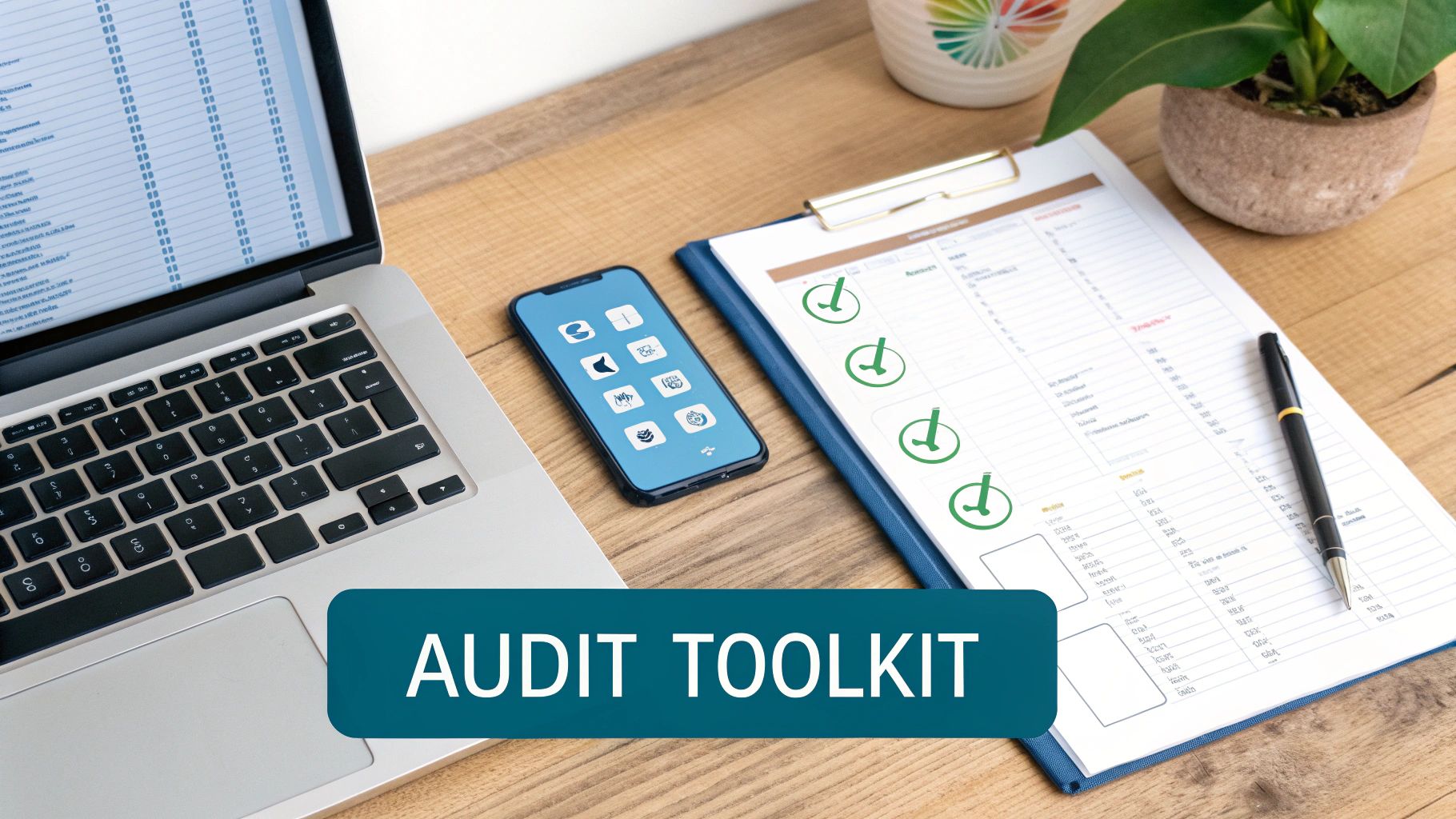
We start with the fundamentals: a spreadsheet (Google Sheets) and the native analytics dashboards on each social platform. They're robust and give you direct access to the raw data you need.
Your Data Command Center
Your spreadsheet is mission control. Create a separate tab for each social profile you're auditing—LinkedIn, X (Twitter), Instagram, and—this is a big one—Reddit.
Keep the structure consistent across tabs. We set up columns for core data points pulled straight from each platform's analytics dashboard. Keep it simple:
- Follower Count: Audience size.
- Impressions/Reach: Unique eyeballs on your content.
- Engagement Rate: (Likes + Comments + Shares + Saves) / Impressions.
- Click-Through Rate (CTR): Percentage of people who clicked a link.
- Website Referrals: Traffic each channel sends to your site (I pull this from Google Analytics).
Pulling this data for the last 90 days gives a solid quarterly snapshot. Stick to these core numbers to start.
The Untapped Goldmine: Reddit
Here’s where most audits fail: they ignore Reddit. This is a massive missed opportunity. Reddit is where the most honest, unfiltered, and sometimes brutal feedback on your brand lives.
At BillyBuzz, integrating Reddit is a core part of how we understand our market and reputation. We constantly track mentions of our brand, our competitors, and the specific problems our customers are trying to solve.
An audit focused only on your own channels is like listening to a conversation with earmuffs on. You hear yourself talk, but you miss what everyone else is really saying. Reddit is where the real conversations happen.
We use our own tool, BillyBuzz, to automate this. We set up powerful alerts that feed qualitative insights directly into our audit spreadsheet. These alerts go beyond keywords; they help us quantify sentiment and spot opportunities we'd otherwise miss. If you're looking for other options, we've broken down some of the top social monitoring tools for startups in a separate guide.
How We Set Up Our BillyBuzz Alerts for Audits
Here’s a look under the hood at the exact alert rules we have running inside BillyBuzz to fuel our own social media audits. These rules keep a pulse on brand health and surface customer pain points.
| Alert Goal | Keyword Combination Examples | Target Subreddits |
|---|---|---|
| Brand Sentiment | “BillyBuzz” AND (“love” OR “hate” OR “issue”) |
r/startups, r/SaaS, r/marketing |
| Competitor Gaps | “Competitor Name” AND (“alternative” OR “frustrated”) |
r/Entrepreneur, r/smallbusiness |
| Problem Discovery | “reddit monitoring” AND (“how to” OR “best tool”) |
r/socialmedia, r/digital_marketing |
These alerts are always on, collecting the qualitative data we drop into our Reddit audit tab. We track the number of positive, negative, and neutral mentions and log direct links to conversations that point to feature requests or complaints. This data is pure gold.
Analyzing Your Content and Channel Performance
Alright, you’ve got your data. Now it's time to be a detective. The point of a social media audit is to find the signal in the noise that tells you what to do next.

We're digging deeper than surface-level metrics. A "like" doesn't pay the bills. We're hunting for patterns that connect content to business results.
Finding Your Content Winners and Losers
We categorize every single post to figure out what type of content is moving the needle. This simple act of tagging is one of the most powerful things you can do.
Our categories map directly to our marketing funnel:
- Problem/Solution: Content zeroing in on a customer pain point and how our tool solves it.
- Founder Story: Posts sharing our journey, mission, and the "why" behind BillyBuzz. Gold for community building.
- Product Update: The latest on new features, improvements, or fixes.
- Educational/How-To: Actionable guides and tips about social monitoring and community building.
Tagging lets us slice the data to answer crucial questions. For instance, we might find our Problem/Solution posts crush it on CTRs, while Founder Story content sparks the most comments. That insight is huge—it tells us what to create for specific goals. One for lead gen, the other for brand building.
Measuring What Truly Matters
I can't overstate how important this is. Global social media ad spend hit $226 billion in 2022. With that much money at stake, you have to make every metric count. While social media ate up over a third of global digital ad spend, CPMs actually dropped 35% year-over-year. The competition is fierce.
In this environment, you have to be ruthless. Using tools with robust analytics features is a non-negotiable part of a serious social media audit.
An audit isn't about finding a single "best" content type. It's about building a balanced content mix where each piece has a specific job, whether it's driving a sign-up, starting a conversation, or building trust.
This detailed approach helps you understand the nature of engagement. You might discover certain formats spark high-value conversations while others attract passive likes. To get a better handle on this, check out our guide on how to measure social media engagement in a more meaningful way.
Evaluating Channel Performance
Not all social platforms are created equal, especially when you’re a startup. A huge piece of your social media audit is figuring out where to invest your time.
Lay out the data for each platform side-by-side. Are there clear winners?
- LinkedIn: For B2B, this is a powerhouse. It’s a key driver of our qualified leads and demo requests. Educational and solution-focused content works best.
- X (Twitter): Fantastic for community building, real-time conversations, and connecting with other founders. It might not drive as many direct sign-ups, but its value in shaping our brand's voice is immense.
- Reddit: Our secret weapon for sentiment analysis and lead gen. The unfiltered feedback from subreddits is invaluable for product development, and targeted conversations lead to our highest-quality sign-ups.
By comparing channels, you can quickly spot which ones are pulling their weight. If you’re spending five hours a week on a platform that has generated zero website clicks in 90 days, your audit just gave you permission to either change your strategy or cut it loose. This is about going all-in on what works.
Uncovering Opportunities with Competitor Analysis
Your social media doesn't exist in a vacuum. I’ve seen teams get obsessed with their own metrics and forget to look outside. That’s like playing chess and only looking at your own pieces. Real wins come from watching your competitors, seeing where they're stumbling, and finding the gaps.
This isn't about copying. It's about reverse-engineering their wins and losses to find shortcuts for your own growth. We pick two or three key competitors—companies just a step or two ahead—and put their social game under a microscope.
Building Your Competitor Benchmark
We keep this part ruthlessly simple. In a separate tab of our audit spreadsheet, we track the same core metrics for our competitors as we do for ourselves: follower growth rate, engagement per post, and their main content themes.
You might notice a competitor’s LinkedIn engagement is 3x higher. Digging in, you see they’re posting short, text-only stories from their founder. Boom. That’s an insight. You’ve found a content format that resonates with your shared audience—a hypothesis you can now test.
Competitor analysis is less about imitation and more about intelligence gathering. Your goal is to identify patterns and find underserved conversations. It's about finding the angle they've missed.
This benchmark sets you up for a much deeper analysis. It tells you what is happening, but the real gold is in understanding why. For that, we turn to Reddit. For a complete look at this process, check out our ultimate guide to competitor analysis for emerging businesses.
Listening in on Unfiltered Customer Feedback
Platforms like LinkedIn show you the polished version of your competitor’s brand. Reddit shows you what their customers really think when they're frustrated or looking for an alternative. This is where a tool like BillyBuzz becomes our secret weapon.
We set up specific, AI-powered alerts that act as our eyes and ears across relevant subreddits. We're not just tracking brand mentions; we're hunting for intent.
Our Live Reddit Competitor Monitoring Rules
This table shows the actual alert rules we use inside BillyBuzz to find high-intent conversations on Reddit.
| Alert Goal | Keyword/Phrase Combination | Target Subreddits |
|---|---|---|
| Find Unhappy Customers | "competitor name" + "frustrated" OR "issue" OR "buggy" |
r/SaaS, r/smallbusiness |
| Capture Switchers | "alternative to [competitor]" OR "looking for" |
r/startups, r/Entrepreneur |
| Identify Feature Gaps | "[competitor]" + "wish it could" OR "doesn't have" |
r/marketing, r/socialmedia |
These alerts are game-changers. Instead of guessing our competitors' weaknesses, we get a real-time feed of their customers telling us directly. A single thread on r/SaaS about a competitor's confusing UI is worth more than a dozen market research reports.
This process does more than inform your audit; it actively generates leads. When we see a comment like, "I'm so frustrated with [Competitor X]'s reporting features, I need an alternative," it’s a direct invitation to jump in. We don’t hard sell. We offer a helpful solution, maybe a link to a blog post, and build a relationship. That’s how an audit transforms from a passive review into an active tool for growth.
Turning Your Audit into an Actionable Growth Plan
You've done the work. The data is crunched. This is where most social media audits die, filed away as another report. An audit is useless without a clear, actionable plan. This final step is about translating findings into a prioritized roadmap for next quarter.
As a founder, you can't chase every shiny object. At BillyBuzz, we use a simple but effective way to prioritize: the Impact vs. Effort Matrix.
The Impact vs. Effort Matrix
Every finding from your audit gets plotted on a simple 2x2 grid. This forces you to be brutally honest about what's worth your time.
- Low-Effort, High-Impact (Quick Wins): Your top priorities. Jump on them immediately. A real example for us was finding a broken link in our X bio. Fixing it took two minutes but directly impacted sign-up conversions.
- High-Effort, High-Impact (Major Projects): The big strategic bets for the quarter. Think launching a video series or overhauling your LinkedIn strategy. They require planning but promise a significant payoff.
- Low-Effort, Low-Impact (Fill-ins): "Nice-to-haves." Tackle them when you have a spare moment. Don't let them derail you. This could be updating old profile banners.
- High-Effort, Low-Impact (Time Sinks): Avoid these like the plague. This is where good intentions die. An audit might reveal an opportunity on a new platform, but if your audience isn't there, it's a trap.
This framework instantly brings clarity to your next steps.
Setting Realistic Goals from Your Findings
With priorities straight, you can set realistic, measurable goals tied directly to your audit data. Vague goals like "get more engagement" are useless. Your audit gives you specifics to set sharp, actionable targets.
An audit’s true value isn’t in the data it collects, but in the focused action it inspires. The goal is to create a living document that guides your strategy, not a historical record that gathers dust.
For instance, say your Reddit analysis showed 10% negative sentiment around a specific feature. A great goal would be: "Increase positive sentiment on Reddit by 15% in Q3 by creating three educational posts that address common user frustrations." It's specific, measurable, and solves a problem you uncovered.
This visual flow shows how benchmarking your performance, monitoring what’s happening, and finding the gaps feed directly into your action plan.
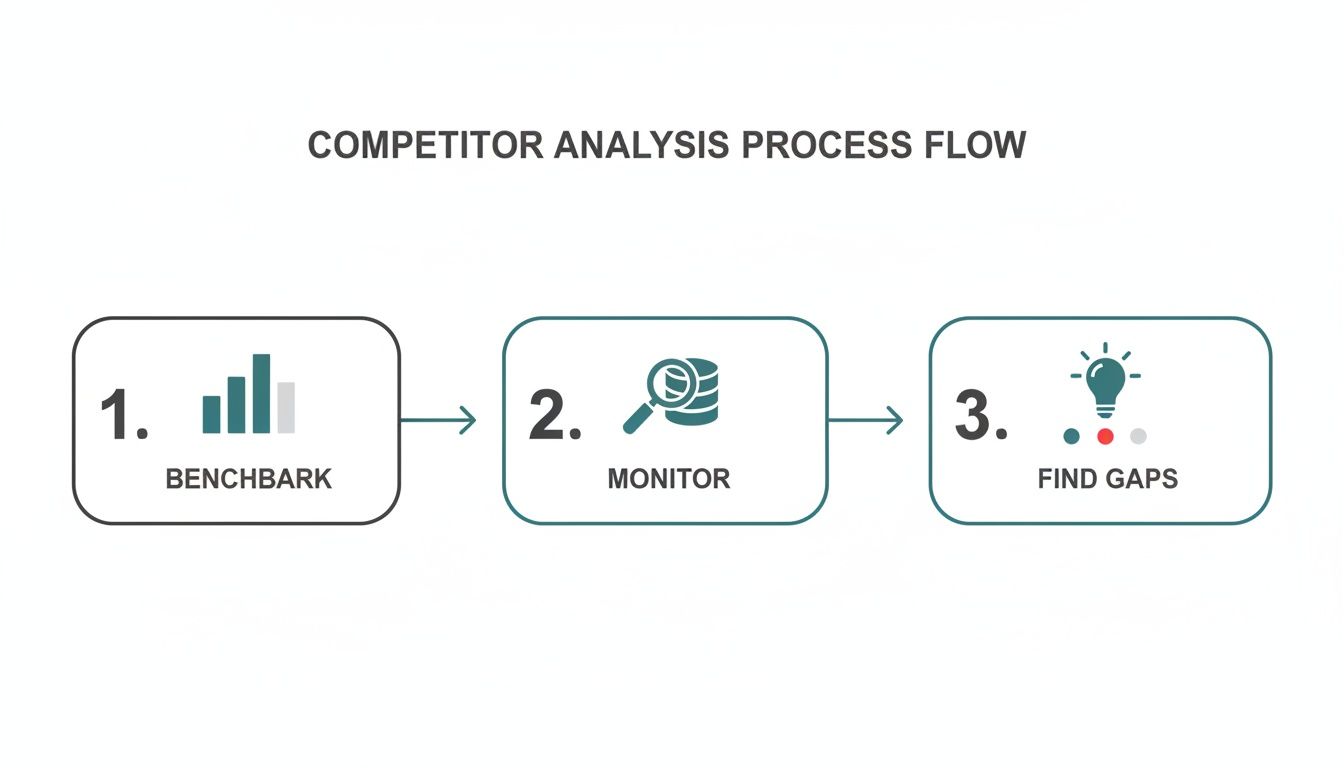
This process ensures your strategic decisions are grounded in reality, not assumptions.
Reporting That Inspires Action
Finally, share your findings in a way that sparks action. Forget dense reports. We use a dead-simple one-page template.
Our internal audit summary includes:
- Top 3 Insights: The most impactful "aha!" moments.
- Key Opportunities: A bulleted list of the highest-priority actions from our Impact vs. Effort matrix.
- Quarterly Goals: 2-3 specific, measurable goals.
- Stop/Start/Continue: A framework outlining what to stop, start, and continue doing based on the data.
This format is scannable, actionable, and keeps everyone on the same page. It turns your audit into a reliable engine for growth.
Common Questions About Social Media Audits
We've been through the trenches and hear these same questions from other founders. Here are the straight-up answers.
How Often Should a Startup Bother With a Social Media Audit?
More often than you think, but you don't need a massive, formal report.
A full, deep-dive audit is perfect once per quarter. It lines up with most business planning cycles and gives you enough data to spot real trends.
On top of that, we do a quick monthly "pulse check." This isn't the full audit; it's a fast review of our most important KPIs—website referrals from social, our sentiment score on Reddit, and lead quality from LinkedIn. It takes less than an hour and prevents any nasty surprises.
What If I Have Almost No Data to Start With?
This is a classic—and totally normal—worry for early-stage companies. But I’d argue this is the best time to do one. You’re not auditing performance yet; you're auditing your foundation.
When you're just starting, your first audit isn't about what you've done. It's about setting up the right framework for everything you're about to do.
Instead of getting hung up on metrics you don't have, your first "pre-launch" audit should be about:
- Profile Consistency: Is your branding, bio, and link identical and optimized on every platform?
- Competitor Benchmarking: Spend most of your energy here. Dig into what competitors with established audiences are doing. What content formats work? What’s their tone?
- Keyword & Subreddit Discovery: Pinpoint the core keywords your ideal customers use and the top 5-10 subreddits where they spend their time. Set up monitoring from day one.
Getting this groundwork right sets you up to collect meaningful data from the get-go.
What’s the Single Most Overlooked Part of an Audit?
Hands down, it's qualitative sentiment analysis. So many teams get lost in spreadsheets of likes and shares. They miss the why behind the numbers because they aren't reading the comments or seeing conversations happening around their brand.
This is especially true on platforms like Reddit, where the most honest feedback lives. A single, detailed thread dissecting your onboarding process is infinitely more valuable than a hundred likes on a marketing post. Ignoring this is like plugging your ears while your customers are trying to talk to you. For a look at the whole picture, this complete guide to social media auditing is a great resource that covers both the numbers and the nuance.
This is exactly why we built our process around monitoring real conversations. The numbers tell you what happened; the sentiment tells you why it matters.
Ready to stop guessing and start finding high-intent customers on Reddit? BillyBuzz uses AI to monitor conversations and alert you to opportunities in real-time, so you can join the right discussion at the perfect moment. Start finding your next customers today.