

Ever feel like you’re shouting into the void on social media? You post something you think is great, only to be met with crickets. The culprit isn't necessarily your content—it's the algorithm.
Forget the intimidating code and technical jargon. At its heart, a social media algorithm is simply a system designed to be a personal content curator for every single user. Its one and only job is to figure out what you'll find most interesting, so it can serve you a feed that keeps you scrolling.
What Exactly Is a Social Media Algorithm?
Think of the algorithm as a highly efficient, behind-the-scenes editor for your social feed. Instead of just showing you a firehose of every post from every account you follow in chronological order, it cherry-picks and arranges content based on what it thinks you’ll love.
The end goal here is simple: user retention. Every like, comment, share, and even the time you spend hovering over a post is a piece of data. The algorithm gobbles up these signals to build a detailed profile of your preferences, getting smarter and more personalized with every tap and click.
The Four Core Algorithm Signals
While each platform has its own secret sauce, they all rely on a similar set of core signals to decide what gets seen. Understanding these four pillars is the first step to creating content that actually gets distributed.
| Signal | What It Measures | Why It Matters to Your Startup |
|---|---|---|
| Relationships | Your history of interaction with a specific user or page. | The more a user engages with you, the more likely they are to see your future posts. This is why building a real community is non-negotiable. |
| Relevance | How closely a post's topic matches a user's known interests. | The algorithm connects your content to users who have shown interest in similar topics, keywords, or hashtags. Nailing your niche is critical. |
| Timeliness | How recently the content was published. | Newer content is almost always prioritized. But high engagement can give older posts a longer shelf life. |
| Engagement | The number and speed of likes, comments, shares, and saves a post receives. | Strong, early engagement is the most powerful signal you can send. It tells the algorithm, "Hey, people love this!" and triggers wider distribution. |
These signals aren't isolated; they work together. A relevant post from an account a user frequently interacts with, published recently and getting tons of shares, is the holy grail.
The Shift from Timelines to Curated Feeds
It wasn’t always this complicated. In the early days, social media was just a straightforward, reverse-chronological timeline. You saw the newest stuff first. Simple, but messy. You had to scroll through endless noise to find the gems.
The game changed when platforms realized a curated experience was a stickier experience. One of the first big moves was Facebook's EdgeRank in 2007. It began analyzing likes and comments to prioritize what it considered "relevant" content, and the modern, algorithm-driven feed was born.
This pivot from a simple timeline to a smart, curated feed is the single most important concept for any founder to internalize.
As a founder, you're not just competing with other businesses for visibility. You're competing with a user's best friend's wedding photos, their favorite comedian's new video, and viral news stories—all ranked by a system designed to maximize personal engagement.
Why This Matters for Your Startup
Getting a grip on how algorithms work isn't just a "marketing thing"—it's a fundamental business strategy. The success or failure of your content hinges on its ability to send the right signals to these powerful systems.
If your posts don't spark some kind of immediate reaction, the algorithm quickly dismisses them as uninteresting and chokes their reach. It's a brutal but efficient system.
To win, you have to start thinking like the algorithm. That means obsessing over:
- Relevance: Is this post genuinely useful or entertaining for my specific audience?
- Engagement: Does it make people want to talk, share, or react?
- Relationships: Am I actively building connections, not just broadcasting messages?
Mastering these elements is how you start working with the algorithm instead of fighting against it. By truly understanding how platforms use content-based filtering for social media recommendations, you lay the groundwork for a social strategy that actually drives growth.
The Great Algorithmic Shift
Remember when your social media feed was simple? You’d see every single post from every account you followed, all laid out neatly in the order they were published. That chronological era feels like ancient history now, thanks to a quiet but massive change that completely rewired how we experience the internet.
This wasn't just some minor technical update. It was a complete overhaul of the web's business model. Platforms figured out that to win, they had to capture and hold our most valuable asset: our attention. The old chronological feed, with its jumble of amazing and mediocre content, just wasn't addictive enough to keep us glued to our screens.
The Birth of the Attention Economy
To keep us scrolling, platforms had to turn their feeds from basic timelines into personalized, can't-look-away highlight reels. This was the start of the "attention economy," where every post, video, and photo is in a ruthless competition for a split-second of your focus. The social media algorithm became the powerful engine driving this new world.
For founders and businesses, this change was swift and brutal. The old "post and pray" method—where you could publish something and assume your followers would see it—died almost overnight. Organic reach for business pages tanked as algorithms started pushing posts from friends and family, the stuff that naturally sparks more personal interaction.
This shift forced everyone to evolve. Success was no longer about just broadcasting a message. It was about creating content so good that it earned its spot in the feed by sparking real, immediate engagement.
This algorithmic revolution really kicked into high gear between 2014 and 2016. It was a period when the major players totally rethought how they delivered content. In 2014, Facebook started boosting its own native video and trending topics, while burying clickbait and many business posts. By March 2016, Instagram followed suit, announcing a Facebook-style algorithm that sorted posts by relevance, not time. That same year, Twitter rolled out its 'While You Were Away' feature. This short window of innovation completely changed how billions of people saw the world online. You can read more about the evolution of social media algorithms on resoinsights.com.
Why Your Old Playbook Is Obsolete
Knowing this history is so important because it explains why the tactics that worked just a few years ago are now totally useless. The rules of the game have fundamentally changed.
Then: Success meant posting consistently at the "right" times.
Now: Success means triggering instant engagement signals—likes, comments, shares—the second your content goes live.
Then: You could build a following and reliably push your content to them.
Now: Having a huge audience means nothing if you can't create content the algorithm decides is worth showing people.
This great algorithmic shift made the online world more competitive, but you could also argue it made it more of a meritocracy. Truly great, engaging content can now explode and reach people far beyond your follower list. On the flip side, low-effort posts get buried almost instantly, no matter how many followers you have.
This is the foundational context for everything we're about to cover. Before we get into the nitty-gritty of each platform, you have to accept that the chronological world is gone for good. We're all playing in an attention-based arena, and the algorithm is the gatekeeper. Your job, as a founder, is to learn its language.
How Each Major Platform Algorithm Thinks
There’s no such thing as a single social media algorithm. If you're trying to master "the" algorithm, you're already behind. Each platform has its own playbook, its own priorities, and its own unique idea of what makes for "good content."
Trying to apply a one-size-fits-all strategy is the quickest way to be ignored everywhere. As founders, we need to think more like portfolio managers, understanding the distinct goals of each platform to diversify our content and get the best return on our efforts.
The game changed when feeds went from being chronological to being curated. This simple but profound evolution shifted the goalposts entirely.
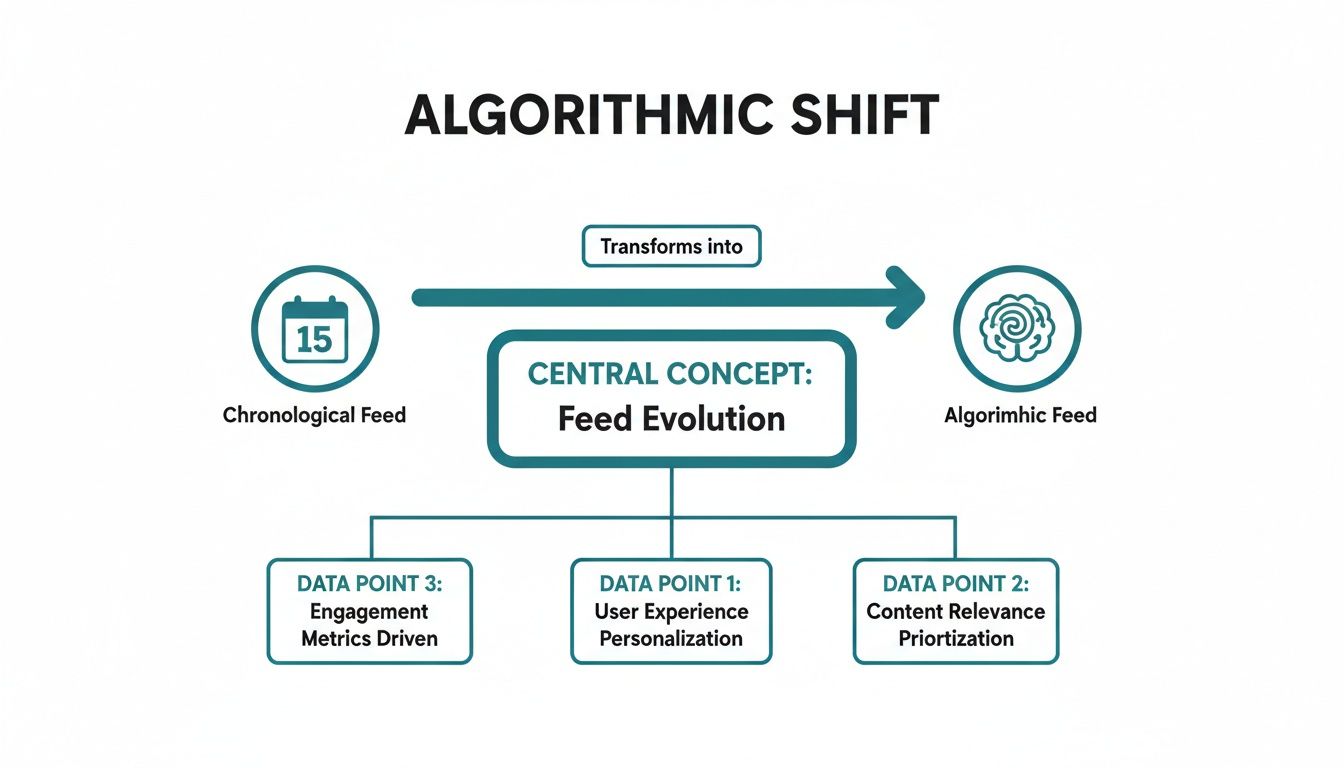
Suddenly, it wasn't enough to just show up consistently. Brands had to earn their audience's attention with every single post.
Platform Algorithm Cheat Sheet
To succeed, you have to know what each platform values most. This quick cheat sheet breaks down the main objective for each network and the signals that matter most for founders.
| Platform | Main Objective | Key Signals for Founders |
|---|---|---|
| Meta | Foster personal connections and discovery | Meaningful Social Interactions: Long comments, shares to Messenger, reactions. Reels are critical on Instagram. |
| X | Surface real-time news and conversations | Speed and Dialogue: Replies, Quote Tweets, and fresh content posted within the first few hours are heavily weighted. |
| Promote professional expertise and credibility | Dwell Time and Value: How long users linger on your post. Clicks on "See more..." and thoughtful comments. | |
| Empower community-driven content curation | Community Validation: Upvotes, downvotes, and active participation within specific subreddit rules. |
Think of this as your high-level guide to playing by their rules. Now, let's dig into the specifics.
Instagram and Facebook: The Engagement Machines
Meta's two powerhouse platforms, Instagram and Facebook, are built to deepen personal connections and spark discovery. Their algorithms are constantly on the hunt for signals that prove users are actively interacting, not just mindlessly scrolling.
On Instagram, the name of the game is visual entertainment. The algorithm heavily favors Reels that jump on trending audio or use creative effects because that's what keeps people glued to the app's most immersive feature. For founders, this is a clear signal: short-form video isn't just an option; it's your primary tool for reaching new people.
Facebook, on the other hand, is all about what it calls "Meaningful Social Interactions" (MSI). Think long comments that start a real conversation, shares via Messenger between friends, and reactions that show genuine emotion. A simple "like" barely moves the needle compared to a thoughtful comment that gets a reply. The whole system is designed to reward content that feels personal and builds community.
X (Twitter): The Conversation Catalyst
X is all about speed, relevance, and conversation. The algorithm is built to show you what’s happening right now and what everyone is talking about. Timeliness is a huge factor here; a post’s first few hours are absolutely critical to its success.
The platform gives a ton of weight to replies and Quote Tweets because those actions are what keep a conversation going and draw more people in. Posts that ask sharp questions or state a strong opinion tend to do well because they're practically begging for that kind of engagement. It's also why a well-crafted thread will almost always outperform a single, isolated tweet—it keeps people on the platform, reading for longer.
LinkedIn: The Professional Knowledge Hub
LinkedIn’s algorithm wants to find and promote credible, professional expertise. Its entire purpose is to make the feed a valuable resource for industry insights and career growth, which means it works hard to filter out salesy spam and low-effort posts.
One of the most important metrics here is "dwell time"—literally, how long someone stops to look at your post before scrolling on. This is exactly why you see so many popular posts start with a short, punchy hook that makes you want to hit that "See more..." link. That entire format is engineered to boost dwell time and tell the algorithm that your content is worth reading.
At BillyBuzz, we treat LinkedIn as a micro-blogging platform. We structure every post with a strong hook, use strategic line breaks to encourage that "See more" click, and always end with a question to get a discussion going in the comments. The algorithm loves this because it checks both boxes: maximizing dwell time and sparking meaningful conversation.
Reddit: The Community-Powered Democracy
And then there's Reddit. Reddit is the ultimate outlier because its algorithm is driven by people first, not just a personalization AI. While your home feed is tailored to you, a post's fate within a subreddit is decided almost entirely by the upvotes and downvotes of its members.
This system is basically a democracy where the community decides what's valuable, not a machine learning model. To get a better sense of how discovery-focused systems work, reading up on how the TikTok algorithm explained can offer some great parallels.
On Reddit, the real ranking factors are the subreddit's rules, the whims of its moderators, and the overall sentiment of the community. For founders, this means you can't just show up and drop a link. You have to earn your place by providing real value and becoming a trusted member. Understanding the principles behind AI-powered relevancy scoring can help you craft content that genuinely connects with these niche communities.
Our Internal Playbook for Navigating Algorithms
Knowing the theory behind social media algorithms is one thing. Actually using it to find customers is a whole different ballgame. At BillyBuzz, we don’t just build a Reddit monitoring tool; we’re its biggest and most demanding user. Our entire growth model is built on one core idea: skip the traditional content game and tap into the powerful “human algorithm” of community conversations.
That means we spend a whole lot less time churning out content and a whole lot more time listening for buying signals. Instead of shouting our message into the void and hoping an algorithm shows it to the right people, we find the folks already asking for a solution like ours and jump into their discussions. It's about precision, not volume.
When platforms shifted from chronological to algorithmic feeds, it changed everything. Success used to be about when you posted. Now, it's about relevance. This shift is precisely why we love platforms like Reddit, where community-driven discussions feel more transparent and less machine-driven than your typical feed. You can dive deeper into this algorithmic evolution over on storyful.com.
Our AI-Powered Listening Setup
Our process kicks off by pointing BillyBuzz at ourselves, turning it into our own 24/7 scout. We've set up incredibly specific, AI-driven alerts to pinpoint conversations where a founder or marketer is hitting a wall—a wall we can help them break through. We're not just tracking brand mentions; we're hunting for pain points.
We concentrate our efforts on a hand-picked list of subreddits where our ideal customers hang out. These aren't just generic marketing forums; they're active communities where people are troubleshooting real business problems.
- r/startups: The go-to spot for founders navigating the chaos of early-stage growth.
- r/saas: A goldmine of conversations about scaling, churn, and customer acquisition.
- r/marketing: Full of practitioners talking shop about tools, tactics, and what actually works.
- r/Entrepreneur: Where solo founders and bootstrappers go for advice on getting off the ground.
Inside these communities, we use keyword alerts that go way beyond just our brand name. The real goal is to intercept intent.
We’ve learned that the best leads don't come from people asking, "What's the best Reddit monitoring tool?" They come from someone venting, "How do you guys find your first customers?" or "I'm so tired of manually searching for brand mentions."
This screenshot shows our actual BillyBuzz dashboard, which we’ve set up to track competitors and specific pain-point keywords in our target subreddits.
This setup lets our AI do the heavy lifting, filtering out all the noise and piping only the most relevant, high-intent conversations straight into our team's Slack.
Crafting Non-Promotional Responses
Once our system flags a conversation, the next step is absolutely crucial: add value, don't sell. The Reddit algorithm—which is really just a reflection of human users—will sniff out and punish a lazy, self-promotional comment in a heartbeat. Our entire strategy is built on earning trust by being genuinely helpful first.
We use response frameworks, not copy-paste templates, to guide our replies. Each one follows a simple three-part structure.
- Acknowledge and Empathize: Kick things off by showing you get their problem. ("That's a tough spot to be in. Manually tracking mentions is a massive time sink.")
- Offer Actionable, Tool-Agnostic Advice: Give them a useful tip or strategy that works, no strings attached. ("One thing that helped us was focusing on 'pain point' keywords instead of just our brand name.")
- Subtle, Optional Mention: If—and only if—it feels natural, you can briefly mention your experience. ("We actually built a tool to automate this because it was eating up our time. Happy to share more, but the strategy is what really matters.")
Here’s what that looks like in a real-world situation:
Reddit Post Title: "How are you tracking mentions of your startup on social media?"
Our Response Framework in Action:
*"Manually searching for mentions is a grind, especially on Reddit where the native search can be tricky. We've been there.
One tactic that made a huge difference for us was creating a list of 'problem' keywords related to our industry. Instead of just looking for our name, we looked for phrases like 'customer feedback tool' or 'user interview alternative.' It helped us find conversations where people needed a solution but didn't know who to ask.
Full transparency, this process was so tedious that we ended up building BillyBuzz to automate it for our team. But the strategy itself works no matter what tool you use. Hope that helps!"*
This approach respects the community, provides instant value, and positions us as experts who are there to help, not just to sell. That's how we work with the human algorithm of Reddit, by giving users what they actually want: authenticity and substance.
Actionable Strategies to Optimize Your Content
Knowing how the algorithms work is one thing. Actually putting that knowledge into practice to get real results? That's the real challenge. This isn't about chasing viral fads; it's about building a solid, repeatable process for creating content that consistently tells the algorithms you're worth showing.
So, let's move past the generic advice like "create high-quality content." Here are the specific, battle-tested plays we use for the platforms that are most important to us as a growing startup. Think of these as mini-playbooks you can start using today to turn algorithmic theory into measurable growth.
Mastering LinkedIn Dwell Time
LinkedIn’s algorithm is all about professional expertise, but the metric it loves most is dwell time—how long people actually stop and linger on your post. To win here, we treat every single post like a mini-article specifically engineered to make people stop scrolling and hit that "See more..." link.
Here’s the simple structure we follow:
- The Hook (Lines 1-2): Kick things off with a bold statement, a surprising stat, or a problem everyone in your industry faces. You only get a couple of lines to grab their attention before the text gets cut off.
- The Body (Bulleted or Spaced-Out Text): Once they click to expand, make it easy on their eyes. We use short sentences, bullet points, and lots of white space to make the post scannable. This makes your insights much easier to digest and keeps people reading longer.
- The Call to Discussion (The Final Line): Always, always end with an open-ended question. This is your invitation for comments, which is another huge signal to the algorithm that your post is sparking a valuable conversation.
This isn't a random format; it’s a deliberate strategy to boost the two signals LinkedIn cares about most: dwell time and genuine comments. It turns a simple post into a small event that keeps your content circulating.
As a founder, your time is your most valuable asset. The goal isn't just to post, but to post with an intentional structure that respects the platform's algorithm. For LinkedIn, that means engineering every post to be a scroll-stopper.
Sparking Conversations on X (Twitter)
The X algorithm lives and breathes dialogue. A post that’s buzzing with replies and Quote Tweets will always blow past one that just collects likes. Your entire strategy should be built around starting conversations, not just broadcasting statements.
We deliberately craft our posts on X to be conversation starters. Here's how:
- State a strong, debatable opinion: A slightly controversial but well-argued take on an industry topic is almost guaranteed to get people talking.
- Ask targeted, open-ended questions: Ditch the generic "What do you think?" and ask something specific. Try something like, "What's one marketing tactic that completely failed for you this year?" It’s more personal and invites a real story.
- Create multi-tweet threads: A good thread tells a story and holds attention for longer. Plus, every tweet in that thread is a new opportunity for someone to reply and boost your overall visibility.
Likes are a passive signal. Replies are an active one. The more active engagement you can stir up, the harder the algorithm will work to push your content to a wider audience. If you're curious about the mechanics behind this, you can learn more about how AI measures social media engagement in our detailed guide.
Building Credibility on Reddit
Reddit is a completely different beast. Its "algorithm" is really the community itself, and it has a built-in allergy to self-promotion. You can't just drop a link to your blog and expect a warm welcome. Success here comes from earning credibility and karma by being genuinely helpful.
Our approach is dead simple: add value, don't advertise. When we find a relevant conversation, we write our comments to be useful on their own, without even needing to mention our product.
Our Reddit Comment Playbook:
- Acknowledge and Validate: We always start by showing we've actually read and understood the user's problem.
- Provide a Tool-Agnostic Solution: We offer a specific tip, strategy, or insight that can help them right away, no matter what tools they use.
- Establish Authority Subtly: We frame our advice from experience. ("When we were facing this, we found that...") This builds trust without being boastful.
This method establishes you as an expert member of the community, not a marketer. The upvotes and positive replies are the currency that gives you permission to keep participating.
To put these strategies into motion across all your platforms, using a great social media content planning template can help streamline everything and keep your team on the same page.
What's Next for Social Media Algorithms?
If there's one thing you can count on with social media algorithms, it's that they will always change. What works wonders for your engagement today might fall flat tomorrow. But instead of chasing every little tweak, smart founders focus on the bigger picture. Understanding where these systems are headed is the key to building a strategy that lasts.
A huge shift on the horizon is the move toward generative AI in content delivery. We're already seeing the early stages of this, but it's about to get much more sophisticated. Imagine algorithms that don't just show you content you might like, but actively help create and remix it on the fly, customized to your mood, location, or even the conversation you’re having.
A Return to Authenticity and User Control
As feeds get smarter and more polished, an interesting counter-trend is bubbling up: people are getting tired of hyper-perfect content. They're craving genuine connection, and that's driving a couple of major shifts you need to keep an eye on.
- The Power of Niche Communities: Users are flocking to smaller, dedicated groups where the conversations are real and less about performance. This is a golden opportunity for brands that can show up as valuable members of the community, not just as marketers trying to sell something.
- The "De-Influencing" Movement: More and more, people are tuning out traditional influencers. They want raw, honest reviews and recommendations from people they actually trust. In this new world, trust is your most valuable asset.
The future isn't a single, massive feed; it's a collection of a thousand tiny, passionate campfires. The brands that win will be the ones who learn how to add warmth to those fires instead of just trying to sell them firewood.
Deeper Experiences and Putting Users in the Driver's Seat
At the same time, technology is pushing us toward more immersive content. The explosive growth of short-form video was just the opening act. Platforms will start favoring content that engages multiple senses and invites interaction, pulling people deeper into the experience.
We'll also see a growing demand for algorithmic transparency and control. As people become more savvy about how their data shapes their reality, they'll want more say in what they see. Platforms will likely have to offer more tools to customize their feeds. For founders, being transparent in your own marketing will help you build much stronger, more loyal relationships with your audience.
The takeaway here is pretty simple. The social media algorithms of the future will reward authenticity, community, and genuine value above all else. If you build your strategy around these fundamentally human principles, your message will have a much better chance of cutting through the noise, no matter how much the tech changes.
Founder Questions About Algorithms Answered
Trying to understand social media algorithms can feel like you're playing a game where the rules are constantly changing. As a founder, you're probably hearing a lot of conflicting advice, and it's tough to know what actually works. Let's cut through the noise and answer some of the most common questions we hear from other founders.
How Often Does the Social Media Algorithm Change?
All the time. Seriously. Big platforms like Meta and X push major, noticeable updates a few times a year, but they're also making tiny adjustments almost every single day.
Chasing every little tweak is a recipe for burnout. The real secret is to stop worrying about the minor shifts and double down on what always works: creating genuinely valuable content and building real connections with your audience. Those two things will keep you winning, no matter how the algorithm of the day is behaving.
Is It Possible to Beat the Algorithm?
Let's reframe that. The goal isn't to "beat" the algorithm—it's to work with it. Think of the algorithm as a tool the platform uses to keep people scrolling. Its one and only job is to serve users content they'll find so interesting they stick around.
When you create content that your audience loves enough to save, share, and talk about, you're literally doing the algorithm's job for it. The platform sees this and rewards you with more reach. So, if you focus on what your audience actually wants, the algorithm naturally becomes your best friend.
The most effective mindset shift for a founder is to stop seeing the algorithm as an adversary to be tricked and start seeing it as a collaborator to be understood. Your audience's engagement is the language it speaks.
How Is the Reddit Algorithm Different?
Reddit is a completely different animal. Its algorithm is built on a foundation of community voting, not just what an AI thinks you want to see. While your main "home" feed is personalized, a post's success inside a subreddit is all about upvotes and downvotes from the community members themselves.
This means that a post's value is judged directly by a specific, niche audience. It’s a true democracy. This structure makes authentic participation and genuinely helpful contributions far more powerful than any standard growth hack. On Reddit, you have to earn your stripes by adding value, not just by showing up to post.
Should I Post the Same Content on All Platforms?
Definitely not. This is one of the quickest ways to waste your time and effort. Every platform has its own unique algorithm, its own culture, and its own set of user expectations.
Think about it: a long, professional text post that gets tons of engagement on LinkedIn would be dead on arrival on Instagram. A snappy, trending Reel that crushes it on Instagram just won't translate to a thoughtful discussion on Reddit. You have to tailor your core message to fit the environment. Always adapt your content’s format, tone, and delivery for each specific platform.
Stop manually searching for conversations and start finding real customers. At BillyBuzz, we built the AI-powered Reddit monitoring tool that filters out the noise and alerts you to high-intent discussions, so you can join in at the perfect moment. Find your first customers on Reddit with BillyBuzz.