

Let's get straight to it. Share of voice is simply how much of the conversation in your market you actually own compared to your competitors.
What Is Share of Voice and Why It Matters for Growth

Forget the marketing buzzwords for a second. Imagine your entire market is a crowded room, and every brand is trying to be heard. Your Share of Voice (SOV) is the measure of how much your voice cuts through that noise compared to everyone else.
This isn't just a feel-good metric for founders; it’s a surprisingly accurate crystal ball for predicting future market share. A dominant SOV today almost always translates to a bigger piece of the pie tomorrow.
The Evolution from Ad Budgets to Online Conversations
Back in the day, SOV was a straightforward calculation tied to advertising budgets. Think Mad Men era—it was all about how much of the total ad spend on TV, radio, and print your brand accounted for.
That old-school thinking still has merit. A major 2013 study found that brands with a share of voice just a bit higher than their market share saw 1.5 times higher growth in the long run.
But the game has completely changed. For a modern startup, the "conversation" has moved online, and SOV now tracks your visibility across every digital channel, especially the ones you earn, not buy.
This new view of SOV includes:
- Organic Search: Are you showing up on Google’s first page for the keywords that matter most to your customers?
- Social Media: When people talk about your industry, how many of those mentions are about your brand versus your rivals?
- Community Platforms: In niche forums or subreddits where real users seek advice, is your brand the one people consistently recommend?
At BillyBuzz, the true power of SOV isn't just knowing that people are talking about us. It’s about knowing where they're talking. It tells us if we're winning the discussions in the communities where our future customers actually hang out, like Reddit.
The table below breaks down this shift from a simple ad metric to a complex, conversation-based one.
How Share of Voice Has Evolved for Modern Startups
| Metric Focus | Traditional SOV (Legacy Brands) | Modern SOV (Digital Startups) |
|---|---|---|
| Primary Channel | Paid advertising (TV, radio, print) | Organic search, social media, online communities |
| Key Indicator | Percentage of total ad spend | Percentage of total online brand mentions & visibility |
| Measurement | Gross Rating Points (GRPs) | Keyword rankings, social listening, backlink analysis |
| Strategic Goal | Brand awareness through repetition | Building authority and trust through conversation |
As you can see, today’s SOV is far more about earning your audience's attention than just buying it.
Why Every Founder Should Obsess Over SOV
Tracking your share of voice gives you an unfiltered look at the competitive battlefield. It reveals exactly where you stand and, more importantly, uncovers the gaps your competitors are missing.
Ultimately, building a strong presence and becoming the most trusted voice in your space is the goal. This ties directly into activities like thought leadership marketing, which can significantly boost your SOV.
It’s about turning your marketing from a shot in the dark into a calculated plan. You don’t need the biggest budget to win; you just need to be smarter by showing up in the right conversations at the right time.
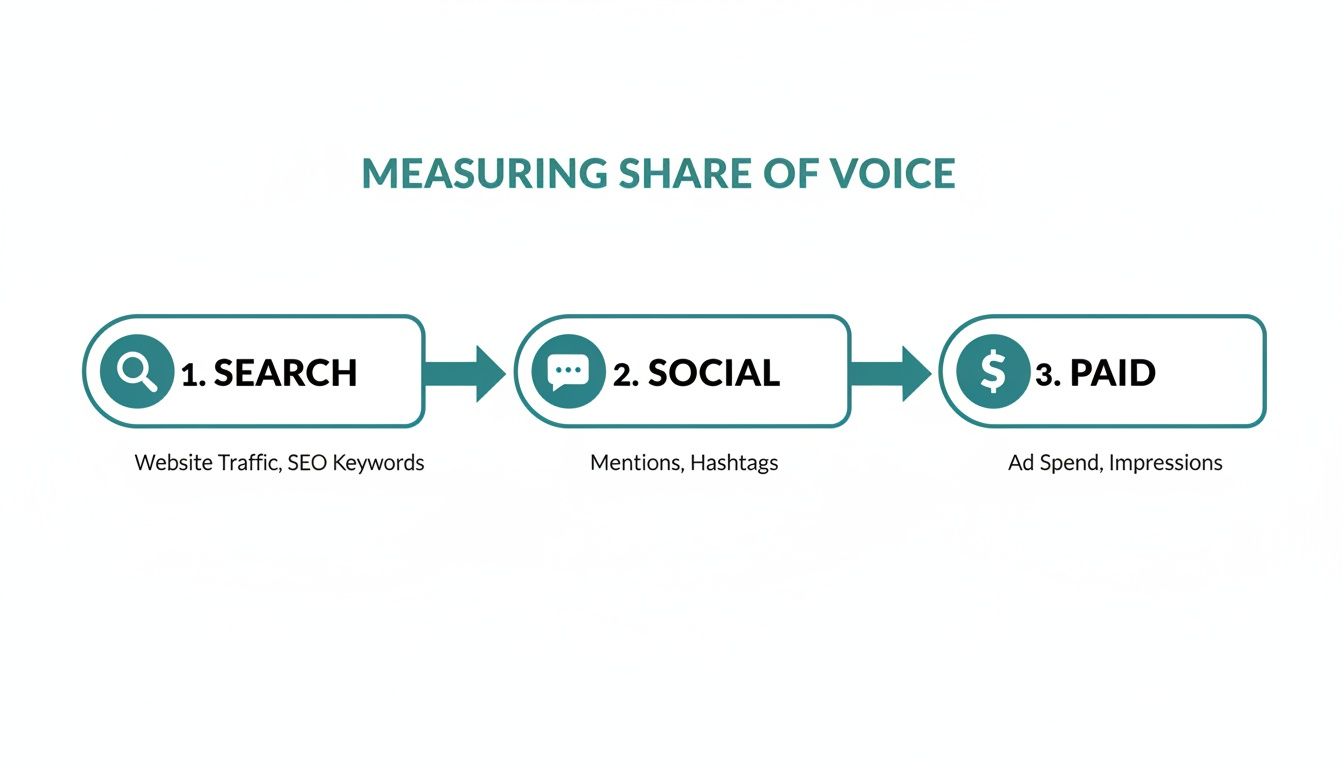
Alright, let's get into the nitty-gritty. Talking about Share of Voice is easy, but actually measuring it is where the real work—and the real value—comes in. The good news? You don't need a massive, complicated analytics department to figure this out.
As a founder, I know your time is gold. So, we'll focus on the channels that give you the biggest bang for your buck.
The basic formula is simpler than it sounds:
Share of Voice = Your Brand's Mentions / Total Market Mentions x 100
What do we mean by "mentions" or "metrics"? It could be anything from your ad spend to keyword impressions to social media chatter. It all depends on where you're looking.
Let's break down the two most important areas every startup should be tracking.
Figuring Out Your Organic Search SOV
Your organic search SOV is all about how much of the "digital shelf space" you own on Google. When a potential customer searches for a solution, how often do they see you? It’s not about your rank for one keyword, but your overall visibility across all the terms that matter.
Here’s a practical way to measure it:
- List Your Core Keywords: Start with 10-20 keywords that are absolutely essential to what you do. For us at BillyBuzz, that might be "social listening for startups" or "Reddit monitoring tool."
- Track Your Impressions: Hop into Google Search Console (it’s free!) to see how many impressions you got for those keywords over a specific time.
- Estimate the Total Market: Use a tool like Ahrefs or Semrush to find the total estimated search volume for that same list of keywords.
- Do the Math: Divide your total impressions by the total market search volume. Let's say your keywords have a total search volume of 100,000 per month and you get 15,000 impressions. Your organic search SOV is 15%.
Boom. Now you have a concrete number that shows how often people see your brand when they're actively looking for help.
Tracking Your Social and Community SOV
This is where you measure your piece of the pie on platforms like Twitter, LinkedIn, and especially Reddit. It's all about who's talking—about you, your competitors, and the problems you solve.
This is our bread and butter at BillyBuzz. Here’s a simplified version of what we do every day:
- Your Brand Mentions: How many times was "BillyBuzz" mentioned this week?
- Competitor Mentions: How often were our top three competitors talked about?
- Total Conversation: Add all those mentions together. That’s your total market conversation.
Let’s run an example. If we were mentioned 50 times and the total conversation across our brand and competitors was 500, our social SOV would be 10%.
This simple calculation tells us everything. Are we leading the conversation? Just keeping up? Or are we getting left in the dust? It points us exactly where we need to jump in and engage.
The BillyBuzz Playbook for Winning Share of Voice on Reddit
Okay, let's get tactical. Measuring your share of voice on Google is standard stuff. But for many of us, the real, untapped growth is hiding in niche communities. For us, that primary battleground is Reddit.
This isn’t a theoretical guide; this is the exact playbook we use internally to find customers.
Most brands just don't get Reddit. They treat it like another feed to spam links on, or they set up generic keyword alerts that miss 90% of the real conversations. To actually win here, you have to go deeper and get specific. To truly capture your share of voice, you have to understand the nuances of a dynamic platform like the Reddit community.
Step 1: Define Your Battleground (Pick Your Subreddits)
First thing's first: we define our territory. We don't try to monitor all of Reddit—that’s just a fast track to burnout. We hand-pick a list of subreddits where our ideal customers hang out.
Our core targets include:
- r/SaaS: The main hub for SaaS founders, marketers, and product folks. High-value conversations.
- r/growmybusiness: Entrepreneurs looking for real-world growth strategies and tools.
- r/marketing: A bit broader, but essential for keeping a pulse on general trends and social listening discussions.
- r/B2B: For targeted conversations around business-to-business sales and marketing tactics.
By narrowing our focus, we make sure every alert is relevant. It lets us be a big fish in a targeted pond instead of a minnow lost at sea.
Step 2: Set Up Hyper-Specific Alerts (Our Actual Rules)
This is where the magic happens. We use our own tool, BillyBuzz, to create alerts that go way beyond just catching our brand name. We track different keyword categories that map to the entire customer journey.
Here’s a look at our exact alert rules inside BillyBuzz.
This setup means we're not just monitoring our brand; we're intercepting competitor discussions and finding prospects who are practically raising their hands for a tool like ours. If you want to dive deeper into this, check out our guide on how to monitor keywords on Reddit.
Step 3: Engage with Value (Our Response Template)
Getting an alert is just the beginning. How you respond is what separates the people who build authority from those who get downvoted. Our number one rule is to never lead with a sales pitch. We use a simple, repeatable framework designed to add value first.
Here's the template we use 90% of the time:
Our Go-To Response Template:
- Acknowledge & Validate: "Great question. Finding new customers on Reddit without feeling spammy is tough."
- Offer Actionable Advice (No Product Mention): "I've had success by focusing on subreddits like r/SaaS and using specific keyword alerts for pain points (
how to find first customers,best way to get leads). This helps you find relevant conversations organically."- Introduce Your Solution (Softly & With Disclosure): "Full disclosure, I'm the founder of BillyBuzz, a tool we built to automate this. It might be helpful, but the manual strategy above works great to start."
This approach positions us as helpful experts, not just another vendor. It builds trust and invites people to check us out on their own terms—that’s the real secret to winning long-term share of voice on Reddit.
Setting Realistic Share of Voice Benchmarks
Alright, so you’ve started tracking your share of voice. The next question I always get from founders is, "What number should I be aiming for? What's good?"
The honest answer? There’s no magic number. A realistic benchmark depends entirely on how mature your market is and, frankly, how noisy it is.
For a new startup breaking into a crowded field, grabbing even 10-15% of the conversation is a huge win. It proves you’re more than just a blip on the radar—you're actually carving out a space for yourself. For a more established player, consistently hitting 25-30% is a strong sign that you’re leading the market.
But here’s the real secret: the goal isn’t just to match your current market share. It's to punch above your weight.
This brings us to a concept called extra share of voice (ESOV). Simply put, ESOV is the difference between your share of voice and your share of the market. It’s one of the best predictors of growth we have. If your SOV is consistently higher than your market share, you’re almost certainly going to grow.
Why Trends Matter More Than Numbers
It's easy to get obsessed with a single number, but that can be a trap. A competitor might drop a boatload of cash on a flashy ad campaign, causing their SOV to spike and making your numbers look weak in comparison.
That’s why the trendline is so much more important than a snapshot in time. Is your share of voice growing month after month? That’s what tells you if your strategy is actually working.
At BillyBuzz, we don't overreact to a single bad week. We pay more attention to our 90-day trendline. A steady upward slope tells us our focused community engagement on Reddit is paying off, even when a competitor makes a big, temporary splash.
This long-term perspective helps you stay focused and make smarter decisions. And, of course, this means you need to know what your competitors are up to. Our ultimate guide to competitor analysis can walk you through how to do that effectively.
The Impact of Strong SOV Benchmarks
A high share of voice isn't just a vanity metric; it directly translates into business results. The data is pretty clear on this—when you dominate the conversation, you win customers.
Take this 2024 analysis, for example. It found that brands holding over 25% SOV in relevant Reddit discussions saw 40% higher engagement rates. Even better, they had an 18% stronger conversion funnel than brands with less than 10% SOV.
Think of it this way: high SOV is a leading indicator. It can predict shifts in market share six to twelve months down the road. You can dig deeper into the history of this concept by checking out the share of voice definition on Wikipedia.
Connecting Share of Voice to Real Business Results

Let's be honest. Tracking your share of voice is a complete waste of time if it doesn't actually move the needle for your business. As founders, we simply can't afford to chase vanity metrics. The real test is whether dominating the conversation translates into tangible outcomes like leads, sales, and a stronger brand.
That connection isn't just a theory; it's a well-established principle in marketing. For decades, research has shown that brands with a share of voice higher than their share of market (what experts call ESOV) are almost always the ones that grow. A recent meta-analysis of over 600 campaigns confirmed this, showing that brands with a positive ESOV grew their market share by 0.3% to 1.1% annually.
Even more specific to the B2B world, where 67% of the buying journey now starts with social proof, a 15% SOV advantage in forums like Reddit has been shown to boost conversions by a whopping 21%. For more on this, HubSpot’s marketing blog digs into the data.
This all confirms what we see in the trenches every day: winning the conversation directly fuels your bottom line.
A Real-World Example From the Trenches
Numbers are great, but let's talk about a real-world scenario. We recently worked with an early-stage B2B SaaS startup that was struggling to get noticed. Their initial SOV in key subreddits like r/SaaS and r/smallbusiness was a measly 5%. They were practically invisible.
We helped them implement the focused BillyBuzz playbook, setting up alerts for specific competitor mentions and customer pain points. Instead of just pitching their product, their team jumped into conversations to offer genuinely helpful advice, building a solid reputation as a go-to resource.
The results were dramatic and, more importantly, measurable:
- Share of Voice Growth: In just three months, their SOV in those key subreddits skyrocketed from 5% to 20%.
- Website Traffic: They saw a 40% increase in direct referral traffic coming straight from Reddit.
- Lead Generation: Most critically, qualified demo requests directly attributed to these Reddit conversations shot up by 25%.
This is the power of translating a share of voice definition into action. It wasn't about shouting the loudest; it was about consistently being the most helpful voice in the right rooms. The leads and sales were a natural byproduct of that authority.
Turning Conversations Into Lasting SEO Assets
The benefits don't stop with immediate leads, either. Every time you win a conversation on a platform like Reddit, you're building a permanent digital asset. High-value threads often rank on Google for years, creating a sustainable source of traffic and credibility that works for you 24/7.
Think about it. When a potential customer searches for a problem and finds a Reddit thread where your brand is being praised as the solution, that’s social proof at its most powerful. That single discussion becomes an evergreen marketing channel, continuously building trust and driving traffic long after the initial conversation has ended. Of course, you need to track this, which is why understanding your social media ROI is essential.
Ultimately, increasing your share of voice isn’t just about being talked about more. It’s about strategically inserting your brand into the most critical conversations, building real authority, and creating a compounding effect that drives measurable business growth.
Common Questions We Get About Share of Voice
Once we wrap our heads around a new metric, the practical questions always start bubbling up. As founders who live and breathe this stuff, here are the most common questions we hear about Share of Voice, along with our straight-from-the-trenches answers.
How Often Should I Be Checking My Share of Voice?
There's no single right answer here—it really depends on what you're tracking and why.
For the big picture, like your overall standing in organic search, a monthly check-in is usually perfect. This gives you enough time to see real trends emerge and avoids the trap of overreacting to daily noise.
But for channels where the conversation moves at lightning speed, like Reddit, waiting a month is like waiting a year. When we're running an active campaign and engaging in specific subreddits, we're checking our SOV weekly. This lets us pivot quickly, double down on what’s resonating, and jump on opportunities before they go cold.
Can a Small Startup Actually Compete on SOV?
Yes, absolutely. But you can't play the same game as the industry giants.
Trying to go head-to-head with a huge, established competitor on a broad channel like Google Ads is a recipe for burning cash. They have the budget and brand recognition to drown you out easily.
The secret is to change the playing field. Don't fight for SOV across the entire market. Instead, pick a specific, high-value niche where the big players aren't looking, and dominate there.
For us, that niche is Reddit. Many large companies ignore specific subreddits because they see them as too small or too granular. That's your opening. You can become the most helpful, visible, and talked-about brand in a community like r/SaaS or r/growmybusiness. By doing so, you become a big fish in a small—but incredibly relevant—pond, owning the SOV where it matters most.
What Are the Best Free Tools for a Beginner?
You don't need to drop a ton of money on enterprise software to get started. A few free tools can give you a surprisingly solid baseline for your SOV.
If you’re just starting out, here’s what we recommend:
- Google Alerts: This is your basic listening post. Set up alerts for your brand name and your main competitors to track mentions across the web and in the news. It's simple but effective.
- Google Search Console: Dive into your "Impression share" report for your most important keywords. This tells you exactly how visible you are in the organic search results compared to the total potential.
- Manual Social Search: Don't underestimate the power of simply using the search bar on platforms like Twitter or Reddit. A quick search for your brand versus a competitor can give you a rough but immediate snapshot of the conversation.
Of course, these tools have their limits. They won't give you deep sentiment analysis, and they aren't built to scale. But for a founder trying to get a feel for the landscape without touching the marketing budget, they're the perfect first step.
Ready to stop guessing and start winning the conversations that matter? BillyBuzz uses AI to find your next customers on Reddit, filtering through the noise to deliver real opportunities directly to you. Start your free trial today.