

Calculating social media ROI is about one thing: proving the value you get back from all the time and money you pour in. It’s the straight answer to the question every founder asks: "Is our social media actually making us money?"
Why Founders Get Social Media ROI Wrong
As a founder, you care about results, not noise. You build, ship, and grow—every minute spent on something that doesn't move the needle feels wasted. This is where the typical approach to social media falls apart.
When we first started BillyBuzz, we fell into the classic trap. We chased follower counts and celebrated posts with tons of likes. The problem? Those vanity metrics weren't turning into sign-ups or product demos. They had zero impact on our cash flow.
The lesson was painful but simple: every social media action must be directly tied to a business goal. If it doesn't lead to a lead, a trial, or a sale, it’s a hobby, not a growth channel.
Stop Shouting, Start Selling
Stop thinking of social media as a megaphone. Think of it as a vending machine. You put in your investment—time, ad spend, tools—and you expect something valuable to pop out. If you feed it money and get nothing back, you stop using it.
That mental shift is everything. It forces you to stop asking, "How many people saw our post?" and start asking, "How many qualified leads did that Reddit comment generate?" This reframes social media from a vague marketing expense into a measurable growth channel.
Mapping Actions to Outcomes
To make this practical, we built a simple framework inside BillyBuzz. Before you get into complex attribution models, you need the right mental model. The goal is to get past fuzzy "engagement" and focus on actions that directly impact your bottom line.
This is how we connect our day-to-day activities to the metrics that matter.
Mapping Social Actions to Business Outcomes
| Social Media Action | Potential Business Outcome | Key Metric to Track |
|---|---|---|
| Answering a pain point on Reddit | High-intent lead generation | Demo sign-ups from Reddit traffic |
| Sharing a case study on LinkedIn | Building social proof and authority | Clicks to the case study page |
| Running a targeted Facebook Ad | Direct user acquisition | Cost Per Acquisition (CPA) |
| Engaging with industry influencers | Brand awareness and reach | Increase in branded search queries |
This approach ensures you’re not just being busy, but being productive. It’s the foundational step to proving—and improving—your social media ROI.
A Simple Formula for Calculating Social Media ROI
So, you’ve connected your social media activity to real business goals. Now it's time to put a number on it. Calculating your social media ROI isn’t as intimidating as it sounds. At its heart is one simple formula.
Here’s the classic formula:
Social Media ROI (%) = [(Profit − Investment) / Investment] x 100
This gives you a clear percentage showing the value you get back for every dollar spent. Positive? You're making money. Negative? Time to adjust your strategy.
Let's break down the two pieces you need: Investment and Profit.
This visual shows how the whole process connects—from a single social media action all the way to a measurable business outcome.
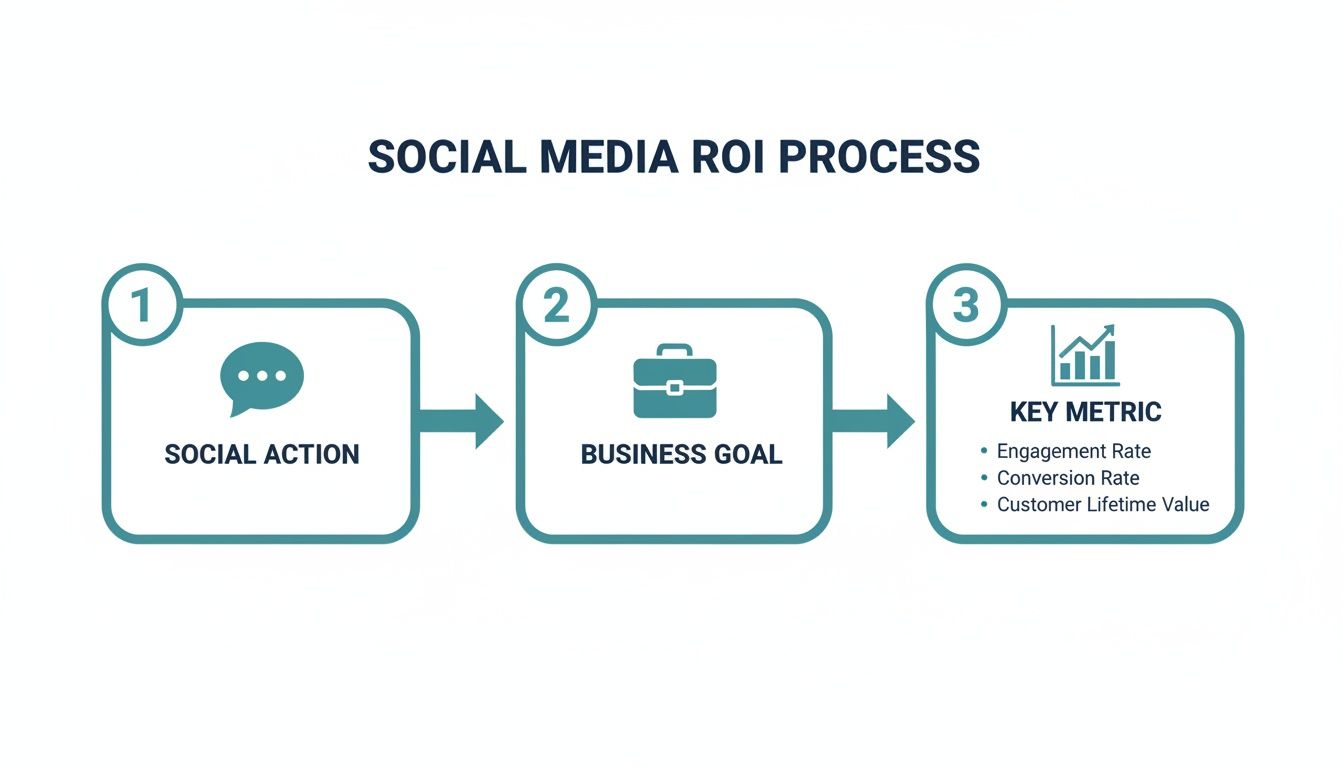
As you can see, every successful ROI measurement starts with a specific activity (like a Reddit post) and tracks it through to a meaningful business metric (like a demo sign-up).
Defining Your Total Investment
Your "investment" is more than your ad budget. To get a true picture, you have to account for every resource. Here's what we track at BillyBuzz:
- Ad Spend: The easy one. What you pay Facebook, LinkedIn, or Reddit.
- Tools and Software: Don't forget subscriptions. This includes social monitoring tools (like BillyBuzz), analytics platforms, and content creation software.
- Content Creation: Costs for freelancers, video editors, or any other production expenses.
- Team Time: The hidden cost that trips up most founders. Your time isn't free. Figure out a rough hourly rate for everyone involved and multiply it by the hours they spend on social media each month.
Add those four up. Don't skip time tracking—for early-stage startups, it’s often the biggest expense.
Calculating Your Profit from Social Media
"Profit" can feel fuzzy when you aren't selling products directly from a post. How do you value a demo request? Work backward from your Customer Lifetime Value (CLV).
CLV is the total revenue you expect from a single customer. Once you know that, you can assign value to the steps people take to become a customer.
For example, say your CLV is $2,000. If your data shows that 1 in 10 demo sign-ups becomes a paying customer, then each demo lead is worth $200 ($2,000 / 10). If 1 in 50 newsletter subscribers eventually converts, each subscriber is worth $40 ($2,000 / 50).
Suddenly, "soft" conversions have a hard dollar value.
A Real-World SaaS Example
Here’s a real example from one of our Reddit campaigns.
Investment Calculation:
- Team Time: 10 hours/month at $50/hour = $500
- BillyBuzz Subscription: $99
- Total Investment = $599
Profit Calculation:
- The Reddit campaign generated 5 qualified demo sign-ups.
- We know each demo lead is worth $200.
- Total Profit = 5 x $200 = $1,000
ROI Calculation:
- ROI = [($1,000 - $599) / $599] x 100
- ROI = ($401 / $599) x 100
- ROI = 66.9%
Boom. A 66.9% ROI is a real number you can take to your team or investors. It proves our Reddit strategy isn't just about upvotes—it's a profitable growth channel.
If you want to go even deeper, check out our guide on how to conduct a full social media cost-benefit analysis.
High-Value Metrics That Signal Real Growth
Chasing likes and followers is a trap. Vanity metrics feel good but tell you nothing about business growth. As a founder, you have to focus on the numbers that signal genuine momentum and connect to your bottom line.
At BillyBuzz, we organize tracking into four key areas that tell the story of how a stranger becomes a customer: Reach, Engagement, Conversion, and Advocacy.

From Reach to Revenue
Think of these as steps down a funnel. Are you reaching the right people? Do they care enough to interact? Are they taking the action you want? And finally, do they love your product enough to tell their friends?
Reach: Not just eyeballs. It’s about how much of the relevant conversation in your industry your brand captures versus competitors.
Engagement: A comment asking a thoughtful question about your product is worth 100 mindless likes. We look for interactions that signal real interest.
Conversion: This is where social media hits your business goals. A sign-up, a demo request, a purchase. This is the proof.
Advocacy: The jackpot. When customers become your marketers, your ROI skyrockets.
Focusing on Actionable Metrics Over Vanity
Adopt a "track this, not that" mentality. Every metric on your dashboard must pass this test: Does this number help me make a better business decision? If not, it's a vanity metric. Ditch it.
And if you want people to take meaningful action, you need to post content that grabs their attention. It's crucial to increase social media engagement with practical video strategies to build a more active—and therefore more valuable—audience.
Here’s a quick comparison of the metrics you should ignore versus the ones you should live by.
Vanity Metrics vs. Actionable ROI Metrics
| Vanity Metric (Avoid Obsessing Over) | Actionable Metric (Focus On) | Why It Matters for ROI |
|---|---|---|
| Impressions/Reach | Share of Voice (SOV) | SOV tells you what percentage of the conversation in your niche you own versus competitors. It measures market penetration, not just visibility. |
| Likes & Follower Count | Engagement Rate per Reach | This shows how many people who actually saw your post cared enough to interact. It's a true measure of content quality. |
| Clicks | Conversion Rate | Clicks are pointless if they don't lead to action. This metric tells you how effective your social content is at driving sign-ups, sales, or leads. |
| Brand Mentions | Customer Referral Rate | This tracks how many new customers come from existing ones. It’s a powerful indicator of customer satisfaction and a direct line to profitable growth. |
Building a dashboard around these actionable metrics gives you an honest, real-time look at your performance.
Putting It All Together for a Clearer Picture
Your goal is to see how these numbers connect. For example, you might see that a spike in your Share of Voice on Reddit leads to a higher Conversion Rate for demos two weeks later. That's a powerful insight. It proves the value of your organic efforts and gives you a reason to double down.
If you want to get more sophisticated, our guide on AI tools for social media ROI tracking can help you automate this analysis. By focusing on high-value metrics, you stop guessing and start building a predictable growth engine, making every bit of your investment count.
Our Playbook for High-ROI Reddit Marketing
Let's get practical. At BillyBuzz, Reddit is our main source for finding high-intent leads. Why? Because it's where people have raw, unfiltered conversations about their business frustrations every day.
Most platforms are about broadcasting at an audience. Reddit is a collection of communities centered on specific problems. When you tap into those conversations at the right moment, you can get a social media ROI that paid ads can only dream of. But you can't just show up and sell. Here’s the exact playbook we run inside BillyBuzz.
Step 1: Pinpoint High-Intent Conversations
The biggest mistake founders make on Reddit is tracking brand mentions. By the time someone talks about you, it’s too late. The real opportunity is monitoring for customer pain points.
We use our own tool, BillyBuzz, to set up specific alerts. These rules find people who are actively looking for a solution like ours, even if they’ve never heard of us.
Here’s our actual BillyBuzz alert setup:
Targeted Subreddit Monitoring: We don't spray and pray. We monitor a curated list of communities where we know our ideal customers hang out:
r/saasr/startupsr/ProductManagementr/Entrepreneurr/marketing
Pain-Point Keyword Filters: This is the key. We set up alerts that trigger on phrases signaling a problem we solve. Our system listens for keywords like:
- "how to track mentions"
- "customer feedback tool"
- "find leads on reddit"
- "alternative to [competitor name]"
- "social listening for startups"
The goal is to enter the conversation when someone is describing their problem, not after they've chosen a solution. This positions you as a helpful expert, not a salesperson.
Step 2: Deliver Genuine Value First
When an alert hits our Slack, our team follows one rule: help first, pitch later (if at all). Reddit users can smell self-promotion a mile away. If your first move is dropping a link, you’ll get downvoted.
Instead, we aim to solve the user's immediate problem right there in the comment. We might share a personal experience, offer a step-by-step solution, or point them to a useful resource. We aim to be undeniably helpful. This builds immediate trust. Only then might we subtly mention how BillyBuzz helps us do this at scale.
Step 3: Use Our Proven Response Templates
We never use canned scripts, but we do use flexible templates to structure our replies. This ensures every comment is high-quality but still feels personal. Here’s the anatomy of a comment that works.
Template: The "Give, Give, Ask" Framework
- Acknowledge and Empathize: Start by showing you get their problem. "I've been in this exact spot..." goes a long way.
- Provide Actionable Advice: Give them a real solution they can use right now, without buying anything. This could be a manual process or a different free tool.
- Subtly Introduce Your Solution: After you've helped, you can casually mention how you solved this for yourself. "We actually built a tool called BillyBuzz to automate this because doing it by hand was so time-consuming."
- Offer, Don't Push: End with a soft call to action. "Happy to share more if you're interested, but the manual method I described works well to start."
This strategy transforms a hard pitch into a helpful recommendation from a peer. A single, well-crafted comment can land on the first page of Google for years, generating leads long after it's posted.
For more advanced strategies, our complete guide on how to get customers from Reddit in 2025 dives even deeper. This founder-to-founder approach is the engine behind our organic growth. It's how you generate a social media ROI that actually moves the needle.
Choosing Your Platforms for Maximum Return
As a founder, your time is your most valuable asset. You can't afford to waste it on platforms that don't move the needle. The goal isn’t to be everywhere; it's to be exactly where your efforts will generate the highest social media ROI. This demands a focused strategy.
Every platform has its own purpose. Some are built for paid ads, while others are goldmines for organic customer discovery. Getting this right is the foundation of a high-impact strategy.
Paid Acquisition vs. Organic Discovery
Think of platforms on a spectrum. At one end are giants like Facebook, powerhouses for targeted paid acquisition. A recent study showed that 28% of global marketers believe Facebook delivers the best ROI. Its targeting tools let you place your product directly in front of your ideal audience.
On the other end is Reddit. The magic here is organic discovery. It’s less about pushing a message out and more about pulling insights from real conversations. People on Reddit aren't looking to be sold to; they're there to talk about their problems and ask for genuine advice.
At BillyBuzz, we've built our strategy around this organic opportunity. The highest-intent leads don't come from an ad—they come from conversations where someone is actively describing a pain point your product solves. Jumping into that moment delivers an ROI that paid ads can rarely touch.
Building Your High-ROI Tool Stack
Picking the right platforms is just the first step. You also need a lean tool stack to execute your plan and measure what’s working. You don't need an expensive setup. For a startup, it comes down to three core tools.
Here’s the essential stack we recommend for any founder serious about measuring roi social media:
Social Monitoring (BillyBuzz): First, you need to find those high-intent conversations. We built BillyBuzz to scan platforms like Reddit for customer pain points, competitor mentions, and questions. It cuts through the noise so you can engage where it matters.
Web Analytics (Google Analytics with UTMs): Once you share a link, you have to track what happens next. By adding UTM parameters to every link, you can see in Google Analytics exactly how many people clicked from a specific Reddit comment and what they did on your site. This is non-negotiable for attribution.
Customer Relationship Management (CRM): The final piece is connecting social interactions to actual customers. When a lead from Reddit enters your CRM (like HubSpot or Pipedrive), you can follow their entire journey—from that initial comment to becoming a paying user.
This simple, three-part stack creates a closed-loop system. You can trace a dollar in revenue all the way back to a specific conversation on social media, giving you undeniable proof of your ROI.
Beyond picking platforms, using the right social media content management tools is key for keeping your operations efficient. By focusing on a few key platforms and arming yourself with this simple tool stack, you can stop wasting time and start generating measurable results.
Your Top Social Media ROI Questions, Answered
Even with the formulas and metrics, practical questions always come up. Here are the most common ones we hear from other founders.
How Long Does It Take to See ROI from Social Media?
It depends on your game plan. Paid ads and organic community building have completely different timelines.
For Paid Campaigns (Short-Term): With ads on Facebook or LinkedIn, you should see results almost instantly. You'll know if a campaign is working or not within a few days to a week. The feedback loop is fast, letting you cut losses quickly and double down on what works.
For Organic Growth (Long-Term): Building a community and earning a reputation on a platform like Reddit is a marathon, not a sprint. You're building trust one conversation at a time. While a single great comment might bring in leads overnight, seeing consistent, predictable ROI often takes 3-6 months of dedicated effort.
Think of it this way: Paid social is like renting an audience. The minute you stop paying, the traffic stops. Organic social is like buying a house—it’s a long-term asset that grows in value the more you invest in it.
How Do I Measure ROI Without Direct Online Sales?
A classic challenge for B2B and SaaS startups. The trick is to assign a dollar value to the small steps a prospect takes on their way to becoming a customer.
As we covered earlier, you have to work backward from your Customer Lifetime Value (CLV).
- Figure Out Your Lead Value: Calculate the value of a key action. If your CLV is $5,000 and 1 in 20 demo sign-ups becomes a customer, then each demo lead is worth $250.
- Tag Everything: Use UTM parameters for every single link you post on social media. This is the only way to know for sure that a lead came from a specific Reddit comment versus a LinkedIn post.
- Connect to Your CRM: Make sure your CRM captures these UTM sources. This lets you follow a lead’s entire journey, from their first click on a Reddit thread to signing a contract months later.
These steps connect the dots, giving you concrete proof of your social media ROI, even when the final sale happens offline or much later.
What Is a Good Social Media ROI for a Startup?
You'll hear people throw around a 5:1 ratio (500% ROI) as a benchmark, but that can be misleading for a new startup. A 5:1 ratio means you get $5 back for every $1 you put in.
But early on, your "return" isn't always about money. It might be priceless product feedback, building relationships with your first 100 fans, or cementing your brand's authority. A lower financial ROI is fine if you're hitting these foundational goals.
Ultimately, a "good" ROI for a startup is one that is positive and improving. If you invested $1,000 this month and generated $1,500 in value (a 50% ROI), that's a win. The real goal is to consistently acquire customers for less than they're worth to you and watch that ROI percentage climb as you figure out what works.
Stop guessing and start engaging. With BillyBuzz, you can find high-intent leads on Reddit and turn real conversations into measurable ROI. Discover your next customer today.