

When we talk about reputation management on social media, we're really talking about listening to, influencing, and managing how your brand is seen on platforms like Reddit, X (formerly Twitter), and Instagram. As a founder, you're not just selling a product; you're building trust. And that trust gets built—or broken—in real-time, right out in the open.
Ignoring these unfiltered conversations is like letting total strangers run your customer service department. You just wouldn't do it.
Your Reputation Is Forged in Public Conversations

Think beyond the traditional marketing funnel for a second. These days, your brand’s reputation isn’t just shaped by controlled ad campaigns. It's constantly being molded in Reddit threads, X replies, and Facebook comments. These spaces are more than just support channels; they're your most direct line to raw customer feedback, organic leads, and genuine loyalty.
This guide is designed to cut through the fluff. I'm going to show you why active social listening isn't just a defensive move—it's one of your most powerful tools for growth.
The New Word-of-Mouth
At BillyBuzz, our philosophy is simple: your next big opportunity is hidden within the conversations already happening about you. This isn't just a theory; it’s a fundamental shift in how businesses grow. The average consumer mentions brands an incredible 90 times per week across their social circles, turning everyday chats into a real-time battleground for your reputation.
Even more telling, 71% of consumers who have a positive experience with a brand on social media will recommend it to their network. That’s organic reach you can’t buy. If you want to dive deeper, there are plenty of online reputation management statistics that back this up.
This constant chatter creates an environment where perception becomes reality almost instantly.
As a founder, you can't afford to guess what people are saying. Every mention is a data point, every comment a potential relationship, and every thread an opportunity to demonstrate your value.
Why This Playbook Matters
This guide isn't about generic advice. We're opening up our playbook to share the exact strategies we use inside BillyBuzz. You’ll learn how to move beyond basic keyword alerts and start having meaningful conversations in the communities that truly matter.
We'll get into the nitty-gritty of essential tactics, including:
- Pinpointing high-value subreddits where your ideal customers are actively looking for solutions.
- Setting up smart alerts that cut through the noise and surface real opportunities.
- Responding with authenticity to turn critics into fans and casual mentions into qualified leads.
By the end, you'll have a practical framework for reputation management with social media that actually drives business results.
Building Your Social Listening Dashboard
A great reputation management strategy starts with listening. But let's be honest, a firehose of notifications is just as useless as total silence. The goal isn't to see every single mention of your brand; it's to surface the conversations that actually matter.
This is where we move from theory to a practical, time-saving system. Forget the generic advice. I’m going to walk you through how to build a social listening dashboard that acts like a smart filter, not just a keyword tracker—it's the exact framework we use at BillyBuzz to cut through the noise.
The Four Pillars of Keyword Monitoring
Your whole monitoring setup should rest on four core keyword categories. This ensures you're not just tracking your brand name but also the wider conversations that affect your business. Think of it as casting four distinct, intelligent nets into the social media ocean.
- Your Brand Keywords: This is the obvious one, but you need to go deeper. We track our company name (BillyBuzz), common misspellings (Billy Buzz, BillyBuz), and our domain (billybuzz.com) to catch unlinked mentions.
- Competitor Keywords: We keep a close eye on our top two direct competitors by name. This is an absolute goldmine for spotting churn signals, feature comparison threads, and golden opportunities where their customers are publicly unhappy.
- Customer Pain Point Keywords: What specific problems does your product solve? We track phrases like
"how to track Reddit mentions","social media monitoring tool for startups", or"find customers on Reddit". These are basically buying signals lighting up in the wild. - Adjacent Industry Keywords: Track broader terms related to your space, like
"B2B SaaS marketing"or"founder tools". This is how you stay on top of industry trends and find organic opportunities to add value to conversations, which is key for building authority.
Following this multi-pronged approach will transform your dashboard from a simple alert system into a powerful source of real market intelligence.
A classic mistake I see founders make is only tracking their brand name. You'll miss 90% of the most valuable conversations where potential customers are describing their problems without even knowing your solution exists.
Setting Up Context-Aware Alerts
Noise is the number one enemy of effective social listening. The real key to a useful dashboard is configuring intelligent alerts that understand context. At BillyBuzz, we don't just dump raw keywords into a system; we layer them with rules to qualify each mention before it ever hits our Slack channels.
For example, a simple mention of "BillyBuzz" is a low-priority alert. But an alert for BillyBuzz AND (issue OR down OR alternative) is an urgent signal that gets pushed to a high-priority channel immediately. This is context-aware filtering. You can dive deeper into creating a highly effective system in our guide to custom dashboards for social media monitoring.
To give you a head start, here’s a look at the kind of alert configurations we use inside a tool like BillyBuzz.
This starter template will help you set up effective, context-aware monitoring alerts that surface real opportunities, not just chatter.
Actionable Alert Configuration Template for Founders
| Alert Category | Keywords & Phrases to Track | Target Communities (e.g., Subreddits) | Sentiment Filter | Action Trigger |
|---|---|---|---|---|
| Brand - High Urgency | BillyBuzz AND (issue OR down OR alternative) |
r/saas, r/startups, r/marketing |
Negative | Immediate Slack alert to #support-escalations channel |
| Competitor Mention | "Brandwatch vs", "Talkwalker alternative" |
r/saas, r/marketing, r/entrepreneur |
Neutral or Negative | Daily digest email to marketing team |
| Customer Pain Point | "track brand mentions", "social listening tool" |
r/startups, r/smallbusiness, r/growmybusiness |
Question or Neutral | Immediate Slack alert to #leads channel |
| Positive Feedback | "love BillyBuzz", "recommend BillyBuzz" |
All | Positive | Weekly digest for team morale & testimonials |
With a setup like this, you're not just monitoring; you're actively generating prioritized tasks for your team based on real-time social conversations.
Pinpointing High-Value Communities
Trying to monitor the entirety of social media is a massive waste of time and energy. Your ideal customers already congregate in specific digital watering holes. For us and many B2B startups, Reddit is a goldmine—but you have to be surgical.
Instead of tracking all of Reddit, we zero in on the specific subreddits where our ideal customers hang out and ask for advice.
- r/startups: A go-to for founders sharing challenges and actively looking for tools.
- r/saas: A hub for serious discussions on SaaS growth, marketing, and metrics.
- r/marketing: A community of professionals seeking advice on strategy and software.
- r/entrepreneur: Full of aspiring and current business owners trying to solve problems.
By targeting these communities, we make sure our alerts are coming from the right people. This focused approach makes our reputation management with social media efforts incredibly efficient, turning our dashboard into a lead-generation machine instead of a notification nightmare.
A Practical Triage and Response Workflow
An alert hitting your Slack channel is just the starting bell. The real work begins with what you do next. A rushed, disorganized response can do more harm than good, which is why we run every single mention through a simple but powerful triage framework we call Respond, Escalate, or Observe.
This isn't about some convoluted flowchart that takes five minutes to decipher. Think of it as a mental model for founders and small teams to make the right call in under 30 seconds. When you're managing your reputation, speed and authenticity are your best friends, and this framework helps you use them without creating chaos.
The visual below shows how we start this decision-making process the moment a new alert comes in.
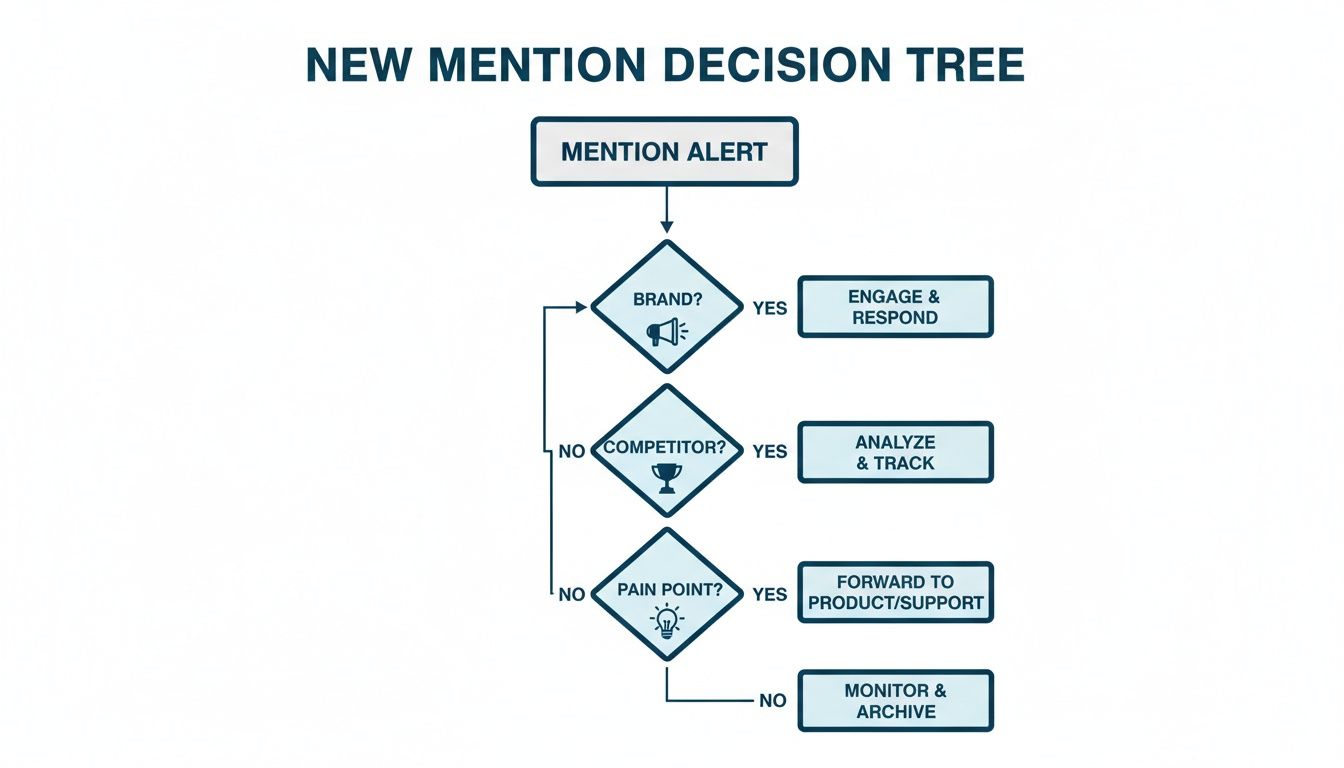
As you can see, the first question is always about the subject. Is it about our brand, a competitor, or a customer's pain point? The answer immediately points us toward the right workflow.
The 'Respond' Protocol
The "Respond" bucket is for any conversation where you can add real value by jumping in. This doesn't mean you need to reply to everything. It’s about picking your spots—moments where you can genuinely help someone, show some gratitude, or clear up a bit of misinformation.
We use a few core templates to guide our responses. These are not rigid, copy-paste scripts, but rather starting points that ensure we’re consistent while still sounding human.
Our Go-To Response Templates:
- For Positive Feedback: "Thanks so much for the kind words, [Username]! So glad you're finding [feature] useful. It means a lot to the team." This shows you’re listening and makes that person feel genuinely appreciated.
- For Direct Support Questions: "Hey [Username], great question. To do that, you'll want to head to Settings > Alerts and adjust the sentiment filter. Let me know if that works for you!" You've just turned a one-on-one support interaction into a helpful piece of content that anyone can find later.
- For Competitor Comparisons: "Great question. While Brandwatch is a fantastic enterprise tool, we built BillyBuzz specifically for founders who need to find leads on Reddit without the complexity or high price point. Our main focus is on simplicity and actionable alerts for small teams." The trick is to never attack the competitor. Just offer helpful, factual info.
I once saw a Reddit thread where a user was frustrated with a minor bug. Instead of a generic apology, our developer jumped in, explained why the bug was happening in simple terms, and gave a timeline for the fix. That single, authentic reply turned the critic into our biggest fan in that subreddit.
The 'Escalate' Trigger
The person watching your social feeds can't be an expert on everything. The "Escalate" trigger is for mentions that need a specialist or have the potential to blow up into a bigger crisis. Knowing how to prioritize tickets effectively is critical here, making sure the most urgent mentions get handled first.
A clear escalation path is your best defense against internal panic. At BillyBuzz, we use a few dedicated Slack channels to keep everything clean and organized.
Our Go-To Escalation Channels:
#support-escalations: For technical bugs or account issues that need an engineer or a customer success manager to dig in.#product-feedback: This is where all feature requests and recurring pain points go so the product team can see them.#pr-crisis: For potentially damaging public accusations, security concerns, or mentions from high-profile journalists. This is a private channel with a very small, specific group of people.
The key is to escalate with context. Don't just dump a link and run. The person escalating should add a quick summary: "User in r/saas is reporting a critical login issue, sentiment is highly negative, thread is gaining traction." This lets the right person grasp the situation in seconds. If you're curious, you can learn more about how AI ranks social media alerts by importance to see how automation can help with this.
The 'Observe' Mandate
Sometimes, the smartest move you can make is to do nothing at all. This is often the hardest thing for founders to learn. The "Observe" mandate is for those times when jumping in would be pointless or even make things worse.
So, when should you just watch from the sidelines?
- Vague, Non-Actionable Complaints: A comment like "Your UI is ugly" with no other detail isn't a great opening for a productive chat. Arguing is a waste of time. Just log the feedback and move on.
- Obvious Trolling or Bait: If a comment is clearly designed to start a fight and has no real criticism, engaging just feeds the troll. Don't take the bait.
- Happy Customers Defending You: This is the best-case scenario. When a negative comment pops up and one of your loyal customers jumps in to defend you, let them. A defense from a real user is 10x more powerful than anything you could say yourself. Stepping in can disrupt that amazing, organic advocacy.
Choosing to observe doesn't mean you ignore the mention. You still keep an eye on the conversation. If the sentiment shifts or a real issue bubbles up, you can always change your play from "Observe" to "Respond" or "Escalate." This flexibility is what makes the framework so effective.
From Defense to Offense: Proactive Community Engagement
So far, we've covered the essentials of a solid defense—keeping an eye on mentions and jumping into conversations as they pop up. That’s the foundation, no doubt. But if you truly want to build an unshakable brand reputation, you have to go on the offense.
Winning at reputation management isn't just about dousing fires. It's about building a brand so resilient and respected that small sparks rarely have a chance to ignite in the first place. This is where we make the critical shift from being a reactive player to a proactive, trusted voice in the communities that matter most.
Turn Social Listening into Your Product Roadmap
Think of your social listening dashboard as more than just a place to catch leads or handle complaints. It's a direct, unfiltered line into what your customers are really thinking. Every mention of a "pain point," a "wish list" feature, or a competitor's strength is a breadcrumb leading you toward your next great product update.
At our company, we have a dedicated #product-feedback Slack channel that's become the lifeblood of our development cycle. We pipe in any mention that even hints at a feature request, a point of friction, or a compliment about a competitor’s functionality.
It’s not complicated. Here’s one of the actual filters we use:("I wish BillyBuzz had" OR "missing feature" OR "hard to use") OR ("Brandwatch does this well")
This feed is a living, breathing document for our product team. Instead of guessing what to build next, we see clear patterns emerge straight from the mouths of users. Honestly, seeing the same pain point pop up five times in a week across different subreddits is a much stronger signal than any internal brainstorming session could ever produce.
We once noticed a surge in users asking for a way to filter out low-karma Reddit accounts from their alerts. It wasn't even on our radar, but the demand was right there in front of us. We shipped a simple version of this filter within two weeks, and the positive feedback was immediate and overwhelming.
This simple workflow turns proactive engagement into a powerful R&D tool, making sure you’re building a product people are genuinely excited to use.
Become a Community Resource, Not a Spammer
Here’s the golden rule for engaging in communities like Reddit, and it's non-negotiable: you must provide value before you ever ask for anything. This is the line that separates a helpful expert from a self-serving spammer who gets downvoted into oblivion. Your goal is to become a go-to resource.
We train our team to spot opportunities to share their expertise, even when it has nothing to do with our product.
For example, if someone in r/startups asks for advice on cold email subject lines, we’ll jump in with genuinely helpful, actionable tips. We might not mention our tool at all. This simple act builds incredible credibility and goodwill. Then, down the line, when we do mention our product in a relevant context, the community is far more receptive because they already see us as valuable members, not just drive-by marketers.
A Mini-Playbook for Authentic Reddit Engagement
Reddit has a unique culture. It’s a community that prizes authenticity and has a very low tolerance for corporate jargon or lazy sales pitches. To make sure our engagement always lands the right way, we follow a simple internal playbook.
- Lead with Helpfulness: Your first sentence should always be about solving the person's problem. Don't even think about opening with a sales pitch.
- Acknowledge the Alternatives: When you do mention your product, frame it as just one of several options. For instance: "You could definitely tackle this with a complex spreadsheet, or check out a tool like [Competitor A]. We actually built our product to simplify this exact workflow for founders."
- The 90/10 Rule: For every 10 comments you post, at least 9 should be purely helpful, with zero mention of your product. That 10th comment can be a tasteful mention where it's a perfect fit. This ratio keeps you firmly on the right side of the community guidelines.
Adopting this mindset transforms your brand from a simple vendor into a trusted partner. You’re not just selling; you're contributing.
This proactive stance directly builds trust. While responsive replies can rebuild bridges (78% of consumers trust brands more when they see management replying to reviews), a proactive presence builds the foundation. Businesses that actively manage their reputation see 93% higher customer satisfaction. On the flip side, ignoring it can be costly—just one negative search result can lose you 22% of potential customers. You can dive deeper into how these reputation management statistics impact business success.
By spotting pain points to inform your product and selflessly sharing your expertise, you build a brand that’s not just known, but genuinely respected. That's how you create a moat around your reputation that competitors will find nearly impossible to cross.
Measuring Reputation with Metrics That Matter

Let's be honest: if you're not measuring your reputation management efforts, you're flying blind. It's incredibly easy to get sucked into vanity metrics like likes and follower counts, which feel good but don't tell you much about your brand's actual health.
As a founder, your time is everything. Every report you see needs to give you actionable insights, not just a sea of numbers. At BillyBuzz, we've boiled it down to a handful of KPIs that tie what we do on social media directly to business outcomes. This isn't about building some monstrously complex dashboard; it's about a simple, powerful reporting framework that clearly shows what's working.
Core KPIs for Founder-Led Reputation Management
Forget the sprawling spreadsheets. We focus our reporting on three core areas that, together, paint a complete picture of our brand's health: Brand Perception, Operational Efficiency, and Business Impact. This trio ensures we're not just putting out fires but also improving our internal processes and actually driving growth.
- Brand Perception Metrics: This is all about how people feel about your brand. Are conversations generally positive or negative? Is the sheer volume of mentions growing?
- Operational Efficiency Metrics: These tell you how well your team is executing. How fast are you getting back to urgent mentions? Are you handling issues effectively?
- Business Impact Metrics: This is the money shot. Are your efforts leading to new customers, helping you keep existing ones, or building genuine loyalty?
By zeroing in on these three pillars, you can build a report that any founder can digest in under 15 minutes and walk away with a crystal-clear snapshot of their brand's standing in the wild.
Tracking Brand Perception with Sentiment Analysis
Sentiment is the absolute cornerstone of reputation measurement. Think of it as a real-time pulse check on the online conversation around your brand. We track this religiously over time, which lets us spot trends before they blow up into major problems. A sudden, sharp dip in sentiment is an immediate red flag that demands investigation.
A key metric here is the Net Sentiment Score, which we calculate as (% Positive Mentions - % Negative Mentions). Seeing this score rise month-over-month is a fantastic sign that your proactive engagement and customer service are hitting the mark. We've even put together a guide on how to visualize this data effectively using sentiment graphs for brand monitoring.
A rookie mistake is looking at sentiment as just a static number. The real insight comes from the trend line. A stable, positive score is good, but a score that's consistently improving is the hallmark of a winning strategy.
Measuring Operational Speed and Business Impact
In the world of social media, speed kills... the competition. How fast you respond really matters. Study after study has shown a direct link between faster response times and higher customer satisfaction. That's why we obsessively track our Average First Response Time (AFRT), especially for negative or neutral comments that need a reply. Our internal goal for any high-priority alert is to respond in under one hour.
But speed is only half the battle. You have to connect your activity to revenue. The single most powerful KPI we track is Qualified Leads from Social Conversations. We define a "qualified lead" as any interaction where a user openly discusses a pain point our product solves, and we successfully engage them in a meaningful way.
How do we do it? With a simple tagging system in our CRM. If a promising conversation on Reddit leads to a demo request, that contact gets tagged "Reddit-Lead." This simple step allows us to directly attribute real revenue back to our team's work, proving the ROI to the entire company. This is how you transform reputation management from a cost center into a powerful growth engine.
Here’s a stripped-down version of the monthly report we use internally. It’s designed to be scanned and understood in just a few minutes.
| KPI Category | Metric | Last Month | This Month | Trend |
|---|---|---|---|---|
| Brand Perception | Net Sentiment Score | +45% | +52% | ▲ |
| Volume of Mentions | 850 | 920 | ▲ | |
| Operational Efficiency | Average Response Time | 1.2 hours | 55 mins | ▼ |
| Business Impact | Qualified Leads | 12 | 18 | ▲ |
This lean framework provides a clear, concise overview of performance, ensuring your reputation management efforts are always tied to tangible goals like generating leads and building customer loyalty.
Founder's FAQ: Your Social Media Reputation Questions, Answered
Founders are always asking us how to get a grip on their brand's reputation on social media. Drawing from our day-to-day experience at BillyBuzz, here are some no-nonsense answers to the questions that come up most often.
I'm a Solo Founder. How Much Time Will This Take Every Week?
If you set up a smart system, you're looking at no more than 2-3 hours a week. Seriously.
The key is to lean on automation. Instead of endlessly scrolling and searching for mentions, a tool like BillyBuzz can surface the conversations that actually matter and push them straight to your Slack or email. This frees you up to spend your valuable time on thoughtful responses, not the tedious hunt.
My advice? Block out 20-30 minutes on your calendar every single day. Staying on top of alerts daily is far more effective than letting them pile up for a weekly catch-up session. You get to jump in while the conversation is still hot.
What’s the Right Way to Handle a Totally Unfair Negative Comment?
The urge to fight back is real, but trust me, that's a losing battle. The best move is a calm, public, and fact-based reply. Acknowledge their comment, state the facts clearly and without getting emotional, and then—this is crucial—offer to move the conversation to a private channel.
Here’s a script we use: "Thanks for bringing this to our attention. That certainly doesn't sound like the experience we aim for. I'm going to look into this with the team right now. Could you please send any specific details to us at support@billybuzz.com so we can investigate properly?"
This simple response shows everyone watching that you’re a professional who takes feedback seriously, all without getting tangled in a messy public argument. It’s a foundational skill for reputation management with social media. This becomes even more critical in sensitive fields; for instance, navigating healthcare online reputation management strategies demands an exceptional level of care and precision.
Is It Actually Possible to Get Customers from Reddit Without Looking Like a Spammer?
Absolutely, but you have to play by Reddit's rules. The number one rule is this: provide real value before you even think about mentioning your product.
Use your monitoring to spot people asking for help with a problem you can solve. Your first move should always be to offer a genuinely useful, detailed answer to their question.
Only after you’ve been helpful can you casually introduce your tool as another potential solution.
Let's look at the difference:
- The Spammy Way: "You need my tool, BillyBuzz! It does exactly that. Sign up now."
- The Right Way: "There are a couple of ways you could tackle that manually... We actually built a tool at BillyBuzz to automate this exact thing, which might be a good option if you find yourself doing this a lot."
See the difference? You're positioning yourself as a helpful community expert first and a founder second. This approach doesn't just avoid downvotes; it builds genuine trust and brings in warm leads who appreciate your expertise, not resent your pitch.
Ready to stop guessing and start engaging? BillyBuzz is the AI-powered social monitoring tool built for founders who need to find real customers on Reddit. Get started today and turn social conversations into your best lead source. Find out more at https://www.billybuzz.com.