

Qualifying sales leads isn't a process; it's a filter. It’s how you separate the genuine buyers—those with a real need, budget, and the authority to sign off—from everyone else. It's the most critical step to stop your team from wasting energy and focus them on closing deals that matter.
Stop Wasting Time on Bad Leads: A Founder's Perspective
Let's skip the corporate speak. I'm sharing the straight-up, founder-to-founder story of why we got obsessed with lead qualification at BillyBuzz. Your time is your most precious asset, and chasing dead-end leads is the fastest way to light it on fire.
In the early days, every new lead felt like a win. A bloated pipeline looked great on a spreadsheet, but our conversion rates told a different story. Our sales team was swamped, jumping on calls with people who were never going to buy. They didn't have the budget, the decision-making power, or even a problem we could solve. It was a morale killer and a colossal waste of time.
The Game-Changing Shift: From Quantity to Quality
Our breakthrough came when we stopped asking, "How many leads can we get?" and started asking, "How many qualified leads can we find?" It sounds simple, but that shift in mindset changed everything. We learned that a smaller pipeline filled with high-intent prospects is infinitely more valuable than a massive list of maybes.
This isn't just a sales strategy; it's a survival tactic for any startup. Here’s why focusing on quality is critical:
- Predictable Revenue: High-quality leads progress through your sales cycle in a way you can actually count on, making your forecasting accurate.
- A More Effective Team: Your reps can pour their energy into closing deals instead of educating tire-kickers.
- Sky-High Morale: Nothing crushes a sales team's spirit like a pipeline full of leads that go nowhere. Winning builds momentum.
As a founder, you have to be ruthless with your time. Every minute spent on a bad-fit lead is a minute you didn't spend on a future customer. Making this mental shift is the first step in building a truly efficient sales engine.
Zeroing in on quality completely altered our growth path. We started using tools to pinpoint prospects showing real intent, a journey that eventually led us to build our own AI-powered solutions. You can see a direct example of this in action in our case study on how a startup increased leads by 50% using AI tools.
The numbers back this up. The industry average shows that only 31% of initial leads ever become Marketing Qualified Leads (MQLs), proving just how many prospects are a poor fit right from the start. A strong filter isn't just a nice-to-have—it's non-negotiable.
Picking the Right Playbook: BANT, CHAMP, or MEDDIC?
So, you're ready to stop chasing dead-end leads. Great. To do that effectively, you need a system—a consistent way to figure out if a prospect is worth your time. This is where a qualification framework comes in. It’s not about creating bureaucracy; it's about bringing clarity to your sales process.
Let's break down the three big ones: BANT, CHAMP, and MEDDIC. Each has its strengths, and the best one for you depends on what you're selling and how complicated your customer's buying journey is. At its core, any good framework is just helping you answer one question: should we pursue this lead or not?
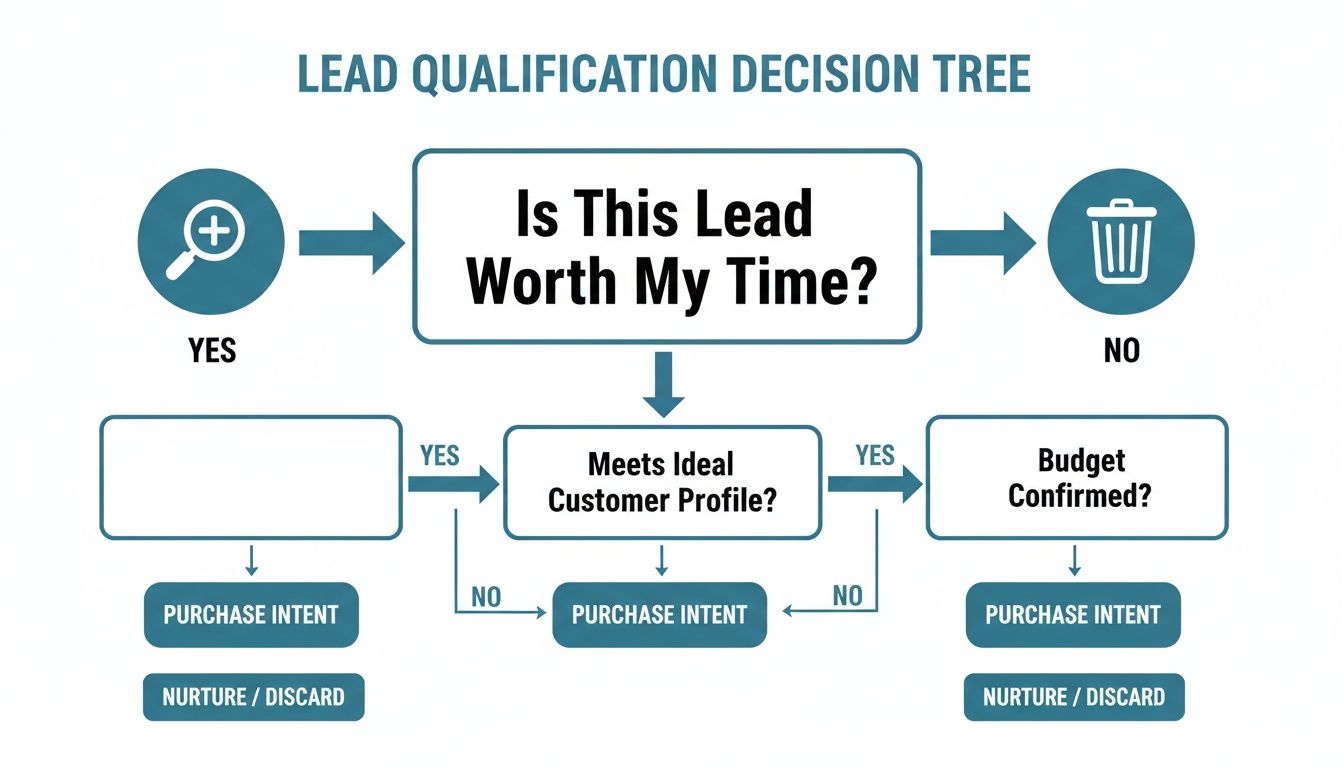
Getting to a clear "yes" or "no" protects your sales team from burnout and keeps your pipeline filled with real opportunities.
BANT: The Classic Starting Point
BANT is the original, and for good reason—it’s straightforward and gets right to the point. It’s a simple checklist:
- Budget: Can they afford your solution?
- Authority: Are you talking to the person who can sign off?
- Need: Do they have a problem you can genuinely solve?
- Timeline: Are they looking to make a move soon?
When we first started BillyBuzz, we lived by BANT. It was perfect for our fast-paced sales motion where speed was everything. If you have a shorter sales cycle and a clear value prop, BANT is a fantastic place to start. A green light on all four means you likely have a solid lead.
The drawback? BANT can be rigid. A prospect might not have a budget formally approved, but if their pain is sharp enough, they'll find the money. As we started selling to larger companies, we began to feel these limitations.
CHAMP: A More Customer-Focused Approach
CHAMP essentially flips BANT around, kicking off the conversation by focusing on the prospect's problems. This feels much more natural and consultative.
Here’s the breakdown:
- Challenges: What specific pain points are they dealing with?
- Authority: Who are all the people involved in solving this?
- Money: What's the budget for fixing these challenges?
- Prioritization: How high on their to-do list is this problem right now?
CHAMP is built for a consultative sales process, turning your reps into advisors. When you lead with their challenges, the conversation shifts from cost to value. It’s a small change that makes a huge difference in building trust.
Shifting our mindset from "Do they have a budget?" to "How painful is their challenge?" was a game-changer for maturing our sales process. It opened up opportunities where we could help create the budget by proving a clear ROI.
MEDDIC: The Framework for Complex Enterprise Deals
And then there's MEDDIC. This is the heavyweight champion, designed for complex, high-stakes B2B sales. If you're chasing six-figure deals with large corporations, this is your playbook.
MEDDIC gets incredibly specific:
- Metrics: What are the measurable results the prospect needs (e.g., "increase pipeline by 15%")?
- Economic Buyer: Who has the ultimate P&L responsibility?
- Decision Criteria: What specific technical and business requirements will they use to judge solutions?
- Decision Process: What are the exact steps and timeline they follow to sign a contract?
- Identify Pain: What are the real business consequences if they do nothing?
- Champion: Who is the person inside the company selling for you when you're not in the room?
As BillyBuzz started going after bigger fish, we didn't switch to MEDDIC overnight. Instead, we cherry-picked the most critical parts. Identifying the Economic Buyer and finding a true Champion became non-negotiable steps for any large deal we pursued.
Comparing BANT, CHAMP, and MEDDIC Frameworks
Choosing a framework isn't a one-and-done decision. It’s about finding the right fit for your current stage and customer profile. This table gives you a quick side-by-side look.
| Framework | Acronym | Primary Focus | Best For |
|---|---|---|---|
| BANT | Budget, Authority, Need, Timeline | Seller's priorities (fast deals) | High-volume sales, shorter sales cycles, and transactional products. |
| CHAMP | Challenges, Authority, Money, Prioritization | Customer's pain points | Consultative selling, solution-based products, and building long-term relationships. |
| MEDDIC | Metrics, Economic Buyer, Decision Criteria, Decision Process, Identify Pain, Champion | The entire buying committee and process | Complex, high-value enterprise sales with multiple stakeholders and long sales cycles. |
Ultimately, the best framework is the one your team will actually use. Don't be afraid to start simple with BANT and then layer in elements from CHAMP or MEDDIC as your business evolves. Your process should grow with you.
How to Build a Lead Scoring Model That Actually Works
Once you've picked a framework, you need a smart way to apply it at scale. That's where lead scoring comes in. You don't need a data science degree to build a great model—at BillyBuzz, we built ours on a simple premise that any founder can copy.
The whole point is to create a clear numerical line in the sand. A number that screams, "This lead is hot, call them now!" versus, "This one needs more nurturing." Think of it as an automated bouncer for your sales pipeline, separating Marketing Qualified Leads (MQLs) from the crowd so your sales team only talks to people who are ready.
We keep things simple by breaking our scoring into two buckets: who they are (explicit data) and what they do (implicit data).
Explicit Scoring: Nailing the "Who"
Explicit scoring is about the hard facts—the firmographic and demographic details a lead gives you. This is the "fit" piece of the puzzle. How closely do they resemble your Ideal Customer Profile (ICP)?
At BillyBuzz, we assign points for specific traits that tell us a lead is high-potential. It’s a no-fluff system designed to bubble up the decision-makers at companies that will get the most value from our tool.
Here's a peek at our actual explicit scoring rules:
- Job Title:
- C-Suite (CEO, CMO, CRO): +20 points
- VP or Director Level: +15 points
- Manager Level: +5 points
- Company Size:
- 11-50 Employees: +10 points
- 51-200 Employees: +5 points
- Industry:
- SaaS / Technology: +10 points
- Marketing Agency: +5 points
As a founder, you have a gut feeling for who your best customers are. Trust it. Start by translating that intuition into a simple point system. You only need 3-4 key attributes to get started.
This basic setup immediately highlights leads with the right authority in the right kind of company. It gives our sales team a clear signal on where to focus. For more ideas on refining your model, check out these lead scoring best practices.
Implicit Scoring: Tracking the "What"
Implicit scoring is about action. It’s the digital body language that reveals a lead’s interest and intent. These behaviors tell a story.
Someone reading a blog post is just browsing. Someone visiting your pricing page for the third time this week? That's a completely different signal. We assign higher point values to the actions that scream "I'm thinking about buying."
This is how we score behavior internally:
- High-Intent Actions:
- Submitted a Demo Request: +30 points
- Visited Pricing Page (in the last 7 days): +15 points
- Medium-Intent Actions:
- Visited Case Studies Page: +5 points
- Registered for a Webinar: +5 points
- Low-Intent Actions:
- Viewed a Blog Post: +1 point
- Subscribed to Newsletter: +1 point
This tiered system helps us separate the tire-kickers from the serious buyers. This is also where Product Qualified Leads (PQLs) become so powerful. In fact, 46.4% of sales pros rank PQLs as having the highest conversion potential, far outpacing other lead types.
The Unsung Hero: Negative Scoring
Just as crucial as adding points is knowing when to take them away. Negative scoring is your automatic pipeline cleaner, filtering out the noise so you can focus on the signal.
We dock points for attributes or actions that tell us a lead is a poor fit. This stops the sales team from chasing dead ends.
- Poor-Fit Indicators:
- Email address is from a student domain (
.edu): -20 points - Job Title includes "Intern" or "Student": -15 points
- Unsubscribed from emails: -10 points
- Email address is from a student domain (
This final filter is non-negotiable. It ensures that even if a student visits every page on our site, their negative score keeps them from ever becoming an MQL. A great way to automate this discovery is by tracking social media signals—you can learn more about how to find leads on social media with AI in our guide.
By combining these three elements—explicit, implicit, and negative scoring—you build a dynamic system that constantly prioritizes your leads for you. It frees up your team to do what they do best: close deals.
The Art of the Qualifying Question: Our Scripts and Templates
Frameworks and scoring models give you a skeleton, but the real magic happens on the discovery call. This is where you connect with a prospect, dig into their world, and uncover the truth. It all comes down to the questions you ask.
For years, sales reps have been trained to ask blunt questions like, "What's your budget?" or "Are you the decision-maker?" Honestly, it feels less like a conversation and more like an interrogation. It puts prospects on the defensive.
We threw that old script in the trash. At BillyBuzz, we treat discovery calls as a chance to be genuinely curious. Our goal isn't just to check boxes in BANT or MEDDIC; it's to have a real conversation that naturally reveals the answers we're looking for. It's about asking open-ended questions that get people talking.
Uncovering Need and Pain with BANT and MEDDIC
Let's get practical. Instead of just asking about "Need," we want to understand the catalyst. What finally happened that made this problem so unbearable they had to act now?
Instead of asking the generic: "What are your needs?"
We ask: "What prompted you to start looking for a solution for [problem] right now?"
This simple rephrase completely changes the dynamic. It opens the door for them to talk about a disastrous meeting, a missed quarterly goal, or mounting pressure from their CEO. The answer reveals not just the what, but the far more important why.
Here are a few other go-to questions we use to dig into the pain:
- "If you didn't do anything about this, what would the consequences look like in six months?" (This directly identifies Pain for MEDDIC)
- "Could you walk me through your current process for [task]? Where does it start to feel clunky?" (This uncovers Challenges for CHAMP)
- "Fast forward a year after implementing a tool like this. What does success look like for you?" (This helps define Metrics for MEDDIC)
The best qualifying questions don't even feel like questions. They feel like conversation starters. Your goal is to get the prospect talking, not to grill them. The more they open up, the more you learn.
Navigating Budget and Authority Without Being Awkward
Asking about money and power directly is a great way to kill a conversation. Prospects often don't know the budget, or they feel uncomfortable sharing it. And asking "Are you the decision-maker?" can make them feel small if they aren't.
We've learned to approach this indirectly by focusing on value and the company's decision-making landscape.
To gauge Budget, instead of the cringey: "What's your budget?"
We ask: "Just so we're on the same page, solutions in this space often range from X to Y. Does that fall within the ballpark of what you were expecting to invest to solve this problem?"
This reframes the entire discussion around value and investment, not just cost. It gives them an easy-to-digest range to react to, which is much less intimidating.
For Authority, instead of asking: "Are you the decision-maker?"
We ask: "Typically, when your team brings on a new tool like this, who else is usually involved in the evaluation process?"
This question is brilliant because it assumes collaboration, which is the reality for almost any B2B purchase. It shows respect for your contact's role while helping you map out the entire cast of characters you'll need to win over—from the Economic Buyer to key influencers.
Our Post-Call Email Template for Gentle Qualification
You're not always going to get every answer on the first call. That's fine. We use a carefully crafted follow-up email to fill in the gaps without being pushy. The whole point is to keep the conversation going and gather those last qualifying details naturally.
Here’s a template you can steal and adapt:
Subject: Quick Follow-Up from our chat
Hi [Prospect Name],
Great talking with you today. I really enjoyed learning about how you're tackling [Challenge discussed].
To make sure I'm putting together the most relevant proposal for you and the team, could you clarify one or two things for me?
- You mentioned that [Specific Pain Point] is a big priority. Is there a specific timeline your team is working against to get a solution in place?
- Besides yourself, who else on the team would be the best person to loop in for a more detailed look at how we can help?
Let me know what you think.
Best,
[Your Name]
This small shift in framing makes all the difference. You come across as a helpful partner trying to tailor a solution, not just another salesperson trying to check their qualification boxes. It builds trust and gets you the intel you need.
Automating Lead Qualification with BillyBuzz
Frameworks and scoring models are essential for handling the leads that come to you. But what about finding high-intent leads before your competitors even know they exist?
This is where we flip the script. Instead of waiting for prospects to fill out a form, we go where they are already talking: online communities like Reddit, where our ideal customers are actively asking for help and recommendations.
At BillyBuzz, this isn't just a theory—it's our secret weapon. We built our own tool to automate this entire workflow, turning raw conversations into a predictable stream of highly qualified leads. We're tapping into buying intent where most B2B companies aren't even looking.
The screenshot above shows the exact kind of post we live for—a user in a relevant community is straight-up asking for a tool recommendation. These conversations are pure, unfiltered buying signals.
Our Internal BillyBuzz Filters and Keywords
It all starts with targeted social listening. We don’t just cast a wide net across Reddit. We zero in on the specific corners where founders, sales leaders, and marketers hang out. Our system monitors these communities 24/7 for phrases that tell us someone is in a buying cycle.
Here are the exact subreddits we’re watching right now:
r/SaaSr/salesr/marketingr/startups
Within these hubs, we set up alerts for high-intent keywords. We focus on phrases that signal someone is actively looking for a solution to a problem we solve.
A few of our go-to keyword rules include:
- "looking for a tool that..."
- "alternative to [competitor name]"
- "recommend a software for..."
- "how do you track [pain point]"
- "best way to monitor [channel]"
The moment one of these keywords pops up in a monitored subreddit, BillyBuzz shoots an instant alert to our Slack. That's the first domino in our automated qualification process. You can get a deeper look at this strategy in our guide to social listening for B2B lead generation.
From Alert to Qualified Lead: Our Workflow
An alert is just a signal, not a qualified lead. The next part of the process is a quick, manual check that takes less than 60 seconds. This is where we inject a human touch.
First, we click through to the user's Reddit profile. We're doing a quick scan to see if they fit our Ideal Customer Profile (ICP). A quick look at their post history usually tells us everything we need to know. Are they posting in subreddits for founders? Do they mention leading a sales team? If their history points to "B2B professional," we move on.
Next, it’s all about how we engage. We never lead with a sales pitch. The goal is to be genuinely helpful.
A huge mistake people make is jumping straight into a hard sell. Your first interaction should always be helpful. Answer their question first, then you can briefly introduce your tool as one possible solution. This is how you build trust.
Here’s a simple response template we’ve had a lot of success with:
"Great question. A lot of founders in r/SaaS run into this. Have you tried [helpful suggestion]? We actually built BillyBuzz to solve this exact problem by [mention 1-2 key benefits]. Might be worth a look if you're evaluating options. Happy to answer any questions!"
This no-pressure approach turns a cold mention into a warm conversation. By finding prospects at their moment of need and engaging thoughtfully, we generate leads who are practically halfway through the sales cycle before they even hit our CRM.
To kick your sales process up a notch, think about how new technologies like AI can improve lead quality before they even get to the qualification stage. For a fantastic resource on this, check out this guide on AI-Powered Lead Generation.
3 Lead Qualification Mistakes We All Make (And How to Stop)
Every founder learns the hard way. When we first started building BillyBuzz, we made every mistake in the book, and each one cost us dearly in time and lost revenue. I'm walking you through our biggest blunders so you can sidestep them.
The first major error was getting star-struck by job titles. We assumed every "VP of Sales" was a golden ticket. It took us way too long to realize a fancy title doesn't tell you anything about their budget, their urgency, or if their company is even a good fit. Chasing titles is a classic rookie move.
Mistake 1: Relying Only on Surface-Level Data
A C-level title at a 500-person company looks fantastic on paper, but it’s just one piece of the puzzle. Focusing only on this explicit data means you're ignoring a lead's intent. We were burning hours chasing impressive titles at companies that had no interest in buying.
The Fix: You have to look at what they do, not just who they are. This means combining explicit data (title, company size) with implicit, behavioral data. Your lead scoring model is perfect for this. Track actions that signal real intent, like pricing page visits or demo requests. A manager who has visited your pricing page three times is a much hotter lead than a VP who downloaded an ebook six months ago.
Mistake 2: Using a One-Size-Fits-All Follow-Up
In our early rush to scale, every single lead got hit with the same aggressive follow-up sequence. This approach not only burned out our sales team but also alienated prospects who were just kicking the tires. A generic approach is inefficient and disrespectful to the buyer's journey.
The Fix: Create a tiered follow-up strategy based on the lead's score.
- High-Score Leads (Hot): These get an immediate, personalized call from a sales rep.
- Mid-Score Leads (Warm): They enter a lead nurturing email sequence designed to provide more value.
- Low-Score Leads (Cold): Add them to your monthly newsletter to stay on their radar without being pushy.
Mistake 3: Being Afraid to Disqualify
This was the hardest lesson for us to learn. We were so afraid of letting any potential lead go that our pipeline became a bloated mess of prospects who were never going to buy. Bad-fit leads don't just waste time; they drain team morale and wreck your sales forecasts.
Your goal isn't just to qualify leads; it's to disqualify the wrong ones as quickly and ruthlessly as possible. A clean pipeline is a predictable pipeline.
The Fix: Change your team's mindset. Make "disqualification" a celebrated outcome. Empower your reps to confidently close out opportunities that don't match your Ideal Customer Profile. Getting a "no" today is a win—it frees up your team to find the right "yes" tomorrow.
Got Questions About Qualifying Leads? We’ve Got Answers.
Founders and sales leaders ask us about lead qualification all the time. Here are the most common questions, answered straight-up.
What’s the Real Difference Between Lead Scoring and Lead Qualification?
It's easy to get these two mixed up, but they play very different roles. Think of them as two stages in the same process.
Lead scoring is the automated part. It’s a numbers game where your system assigns points to a lead based on who they are (job title, company size) and what they do (visit your pricing page). The goal is to rank a big pile of leads so your team knows who to call first.
Lead qualification, on the other hand, is all about human judgment. This is where a sales rep gets on a discovery call and uses a framework like BANT to dig in. They’re figuring out if this person with a high score is actually a real, closable opportunity.
Scoring gets them on the phone; qualification tells you if they’re worth keeping on the line.
How Do You Pre-Qualify a Sales Lead?
Pre-qualification is your first line of defense. It’s about saving your sales team’s time by filtering out the obvious non-starters before they ever book a meeting.
We look for quick signals that tell us if someone is at least in the right ballpark:
- Check the Basics: Does their company size, industry, or geography match your Ideal Customer Profile (ICP)? If not, it's an early red flag.
- Look at Their Behavior: What have they actually done? If they’ve only downloaded a blog post, they’re probably browsing. If they’ve downloaded a case study or watched a product demo webinar, that’s a much stronger signal.
- Make Your Forms Work for You: Add one killer question to your demo request form. Something like, "What's the #1 challenge you're hoping to solve?" A thoughtful, specific answer is a great sign. A one-word answer? Not so much.
Pre-qualification is the bouncer at the door of your sales pipeline. If a lead can't pass this basic check, they don't get in. Simple as that.
When Is It Time to Disqualify a Lead?
Knowing when to walk away is just as crucial as knowing when to pursue. Be ruthless here—your time is your most valuable asset.
Pull the plug immediately if you spot any of these deal-breakers:
- They have absolutely zero budget and no clear way of securing it.
- Your product genuinely doesn’t solve their problem. Don't try to force a fit.
- They’re a student, an intern, or anyone else with no authority to make a purchase.
- They’ve gone completely dark after a few genuine attempts to connect.
Getting to a "no" quickly is a victory. It cleans out your pipeline and lets your team focus their energy on deals that have a real chance of closing.
Ready to find high-intent leads before your competitors even know they exist? BillyBuzz uses AI to monitor Reddit for buying signals, sending you alerts when potential customers are actively looking for a solution like yours. Start discovering qualified leads today.