

As a founder, I'm constantly told to build complex funnels and dump cash into ads. But our most powerful growth engine isn't a campaign we launch; it's conversations we join. We use social media listening to turn casual followers into die-hard fans. The entire strategy is about intercepting real-time needs and solving problems the moment they surface. When you solve someone's pain right when they feel it, you're not making a sale—you're creating an advocate.
This value-first approach builds the kind of authentic relationships that turn neutral observers into vocal supporters who champion your brand for free.
Why Listening Is Your Ultimate Growth Hack
Forget shouting into the void and hoping someone hears you. Social listening is about plugging directly into the stream of customer consciousness. You find people fed up with a competitor or on the verge of a decision, and you offer a helping hand. This isn't a hard sell; it’s service.
At BillyBuzz, our entire growth model is built on this. We don't just monitor mentions of our own brand name. We actively listen for the problems our tool solves. We're constantly on the lookout for Redditors in niche subreddits like r/SaaS or r/growthhacking who are complaining about the limitations of other tools.
From Passive Monitoring to Active Advocacy
The magic happens when you stop being a passive monitor and become an active participant. When you find someone struggling with an issue your product was built to fix and you offer genuine help, you build real trust.
You don't just make a sale; you create a fan.
That one person you helped is now a micro-influencer for your brand. They'll be the one to mention you in future threads, defend you against critics, and recommend you to their peers—all without you having to ask.
As founders, we often think our job is to build the best product. That's only half of it. The other half is finding the people who need it most and proving we understand their world better than anyone else. Listening is the only way to do that authentically.
To understand how this works in practice, it helps to break down the specific actions and their direct outcomes.
From Listening to Advocacy The Core Mechanisms
Here's how specific listening tactics translate directly into experiences that fuel advocacy.
| Listening Action | Customer Experience | Advocacy Outcome |
|---|---|---|
| Intercepting competitor complaints | "They found me when I was frustrated and offered help." | Shares positive switching experience, recommends you as the better alternative. |
| Answering unbranded, problem-based questions | "This brand understands my actual problem, not just sales." | Becomes a go-to resource in their community, tagging your brand in discussions. |
| Engaging with positive mentions | "They actually noticed and appreciated my comment!" | Feels valued and is more likely to post positive content again in the future. |
| Acting on negative feedback quickly | "They listened to my issue and fixed it immediately." | Turns a potential detractor into a loyalist who praises your customer service. |
These aren't just one-off interactions; they are the building blocks of a community-driven brand.
The Power of Intercepting Intent
Imagine a founder scrolling through r/Entrepreneur seeing users complain about clunky monitoring tools. With a sharp social listening setup, you catch these conversations the moment they happen. In fact, we’ve seen one brand identify 400% more monthly mentions on social media through diligent listening, allowing them to swoop in with tailored solutions.
At BillyBuzz, we set up alerts for phrases like "frustrated with [competitor name]" or "looking for an alternative to [tool category]" to intercept these high-intent conversations. By understanding their pain points, we build relationships that transform observers into advocates. Before you can build this loyal following, it’s crucial to first grasp the fundamental question: What Is Brand Advocacy?
By focusing on these unbranded, problem-focused conversations, you tap into a continuous source of high-quality leads. For a deeper dive into practical application, check out our guide on 10 ways to enhance your social media monitoring efforts. This is how you build a brand that people not only buy from but truly believe in.
The Founder's Playbook for Building a Listening Engine
Forget bloated, enterprise platforms. As a founder, you need a lean, mean, signal-finding machine. Here at BillyBuzz, we built our listening engine from the ground up. I’m going to walk you through our exact process.
Most people start by tracking their brand name. That’s monitoring, not listening. Real listening is about finding conversations about the problem your product solves—often long before anyone has heard of you. This is where you uncover the raw pain points that are the seeds of advocacy.
We don't track hundreds of generic keywords. We keep a tight list of 10-15 high-intent phrases that signal someone is fed up with a competitor or actively looking for a solution. Think less "social media tools" and more "frustrated with [competitor tool]" or "does anyone know an alternative to [category]." This focus is about quality over quantity.
Choosing Your Battlegrounds: Where We Listen
Your mission is to pinpoint the subreddits where your target audience complains about their professional headaches. For us, that means finding the digital watering holes for other founders, marketers, and growth experts.
Here are our primary targets:
- r/SaaS: Ground zero. It’s where SaaS founders live, talking customer acquisition, churn, and the tools they despise.
- r/growthhacking: A fantastic spot for marketers searching for an edge. They’re early adopters and aren't shy about sharing what works.
- r/Entrepreneur: Broader, but packed with founders describing the exact operational nightmares our tool was built to fix.
- r/marketing: A goldmine for finding marketers debating strategy, including how they monitor and engage.
The logic is simple: go where the pain is. Find the communities where your ideal customers are already trying to solve the problem, and you’ll find endless opportunities to genuinely help.
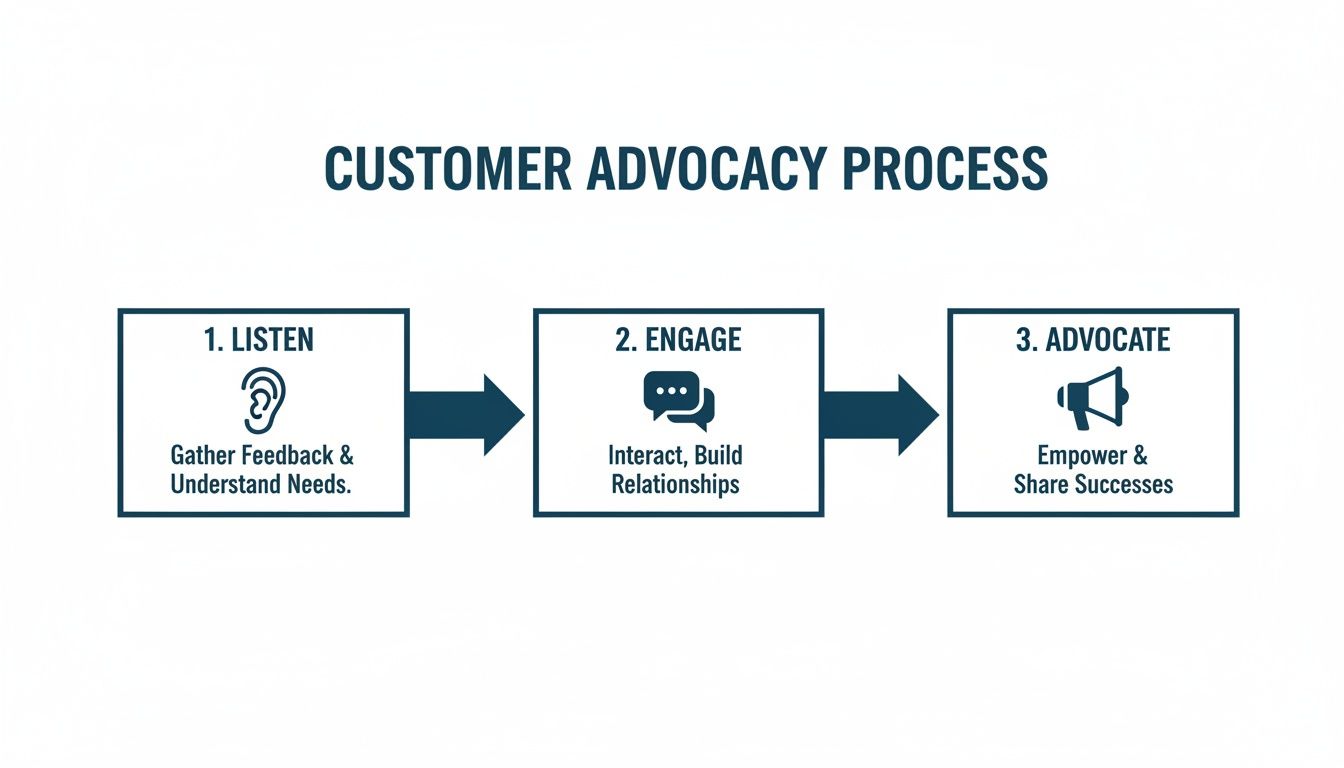
Each step builds on the last, turning a simple listening habit into an engine for growth.
Setting Up Actionable Alerts (Our Exact Rules)
You've found the conversations. Now, you need to turn that chatter into alerts you can act on without drowning in notifications. The goal is a curated feed of high-priority opportunities delivered right to Slack.
We built BillyBuzz to nail this. We pipe all relevant mentions into a dedicated #reddit-leads Slack channel. But we don't just dump everything in there. Every conversation is run through a set of internal rules to score and prioritize it. For a much deeper dive on the mechanics, check out our guide on setting up real-time social media alerts.
A post titled 'I'm about to cancel my [Competitor X] subscription' is a five-alarm fire for us. We prioritize posts with strong negative sentiment about competitors above all else. It's the highest-quality lead you can possibly find.
Our alert filters are tuned for very specific signals:
- Negative Competitor Sentiment: Mentions of our competitors paired with words like "frustrated," "annoyed," "buggy," or "poor support."
- Purchase Intent Keywords: Phrases like "looking for a tool," "any recommendations for," or "is there an alternative to."
- Problem-Specific Language: Users describing a pain point our features solve perfectly, even if they don’t name a single competitor.
This aggressive filtering cuts through 90% of the noise, ensuring that when an alert pops up, it’s a conversation demanding our immediate attention. This is how a small team can have a massive impact.
Our Engagement Framework: How We Respond
Finding the right conversation is only half the battle. Your response decides whether you create a loyal fan or just another person who feels spammed. This isn’t about dropping your homepage link and running. It’s about showing up, demonstrating value, and earning trust. The goal is to be seen as a helpful expert, not a desperate salesperson.
At BillyBuzz, we’ve built our entire engagement philosophy around a simple, three-part framework we call "Empathize, Solve, Delight." It’s our north star for every interaction on Reddit.

This simple framework is how we turn a negative comment into public praise, creating new advocates out of thin air.
The Empathize, Solve, Delight Framework
What does this actually look like? Imagine we find a Reddit post where someone is venting about a frustrating experience with a competitor. Instead of a hard sell, we do this:
- Empathize: First, we acknowledge their pain. Not a generic "I hear you," but reflecting their specific problem. "Ugh, that sounds incredibly frustrating. Dealing with buggy software when you're on a deadline is the absolute worst," immediately builds rapport.
- Solve: Next, we offer real, actionable advice without mentioning our product. The goal is to be helpful, period. "Have you tried exporting the data as a CSV first? Sometimes that bypasses the integration bug."
- Delight (Optional & Subtle): Only after providing real value have you earned the right to hint at your solution. Frame it as a contextual story, not a sales pitch. "We actually ran into that same issue when we were building our tool, which is why we built [feature X] to handle it differently. No pressure, but the method I described above should work for you either way."
This approach puts the user’s needs first and establishes you as a credible, helpful resource.
Public Replies vs. Private DMs
Knowing where to reply is just as important as knowing what to say. Our rule of thumb is simple: default to public unless the conversation is highly sensitive.
A public resolution is one of the most powerful marketing assets you can create. When others see you handle criticism gracefully, you're not just winning over the original poster. You're influencing the hundreds of silent readers who are watching.
Social listening makes this possible by enabling real-time engagement that can turn potential critics into vocal supporters. Research from Sprinklr shows that 30% of consumers would switch to a competitor after poor social customer service. But when you get it right, 73% of users are ready to buy from attentive brands, and 53% of users specifically appreciate seeing public resolutions, which builds enormous trust.
A single, well-crafted public response can become a permanent, high-ranking testimonial for your brand. That's a ripple effect a private DM could never accomplish. For a more detailed breakdown, check out our guide on creating an effective social media engagement checklist.
Our Internal Response Templates
To keep our team aligned, we use an internal guide with response templates. It ensures everyone responds in a way that reflects our brand values. Here’s a simplified version of what we use inside BillyBuzz:
| Mention Type | Recommended Action | Goal | BillyBuzz Template Snippet |
|---|---|---|---|
| Negative Competitor Comment | Empathize, Solve, then subtly introduce your solution. | Position BillyBuzz as the better alternative by demonstrating value. | "That sounds rough. We solved that by... Hope that helps either way!" |
| Problem-Based Question | Provide a comprehensive, helpful answer. Mention your tool only if it's a direct solution. | Build authority and trust as a subject matter expert. | "Great question. Here's a breakdown of how to approach X... We built a feature for this, but the manual process is..." |
| Positive BillyBuzz Mention | Thank the user personally and amplify their comment. | Reinforce positive behavior and show appreciation to build loyalty. | "Amazing! So glad to hear you're finding it useful. Thanks for sharing this!" |
| Direct Negative Feedback | Acknowledge the issue publicly, then move to DMs to resolve the specifics. | Show accountability and provide excellent support without airing dirty laundry. | "So sorry you're running into this. I'll send you a DM right now to get this sorted out for you." |
Having a structured approach like this transforms random mentions into predictable opportunities. It's how we consistently create new, vocal advocates for BillyBuzz.
Measuring the ROI of Your Advocacy Efforts
As a founder, you live by your numbers. Impressions and likes are vanity metrics. If you can’t draw a straight line from your advocacy work to your bottom line, you're flying blind. We had to get past the fluffy stuff and track the KPIs that actually show growth.
Moving Beyond Vanity Metrics
We redefined what "success" meant. Instead of chasing a high mention count, we started tracking metrics that showed genuine influence.
Here are the core metrics we live by at BillyBuzz:
- Advocacy Rate: The percentage of your brand mentions that are genuinely positive. A rising rate is a clear signal your engagement is working.
- Share of Voice (in Niche Communities): Forget overall market share. What's your share of voice in a key subreddit like
r/SaaS? We track how often BillyBuzz comes up in problem-solving conversations compared to our top competitors. - Response-to-Lead Conversion: This connects a specific Reddit engagement directly to a new trial signup. It’s the ultimate proof that your efforts are bringing in qualified leads.
Tracking these gives you an undeniable picture of your ROI. To get a complete view, it’s crucial to monitor a broad set of social media engagement metrics that capture both audience interaction and sentiment.
Tracking Conversions From Reddit to Signup
"How do you actually track a conversion from a Reddit comment?" In the early days, our method was scrappy but effective: a simple spreadsheet.
Here’s the low-tech system we started with:
- Unique Tracking Links: When we joined a high-intent conversation, we'd generate a unique Bitly link with UTM parameters telling us the exact subreddit and thread.
- Manual Spreadsheet Logging: We had a simple spreadsheet with columns for the Reddit Post URL, engagement date, unique link, and a "Trial Signup?" column.
- Cross-Referencing New Signups: Each day, we'd check new trial signups. If a new user's referral source matched one of our unique links, we’d mark "Yes" in the spreadsheet.
It was manual, but it gave us the hard data we needed. We could finally point to a conversation and say, "This comment led directly to a new customer."
When you can show your team, "Our engagement in
r/growthhackinglast Tuesday generated three trial signups," the value of social listening becomes undeniable. It's no longer a 'nice-to-have'—it's a core acquisition channel.
Automating Your Advocacy Reporting
That spreadsheet didn't scale. We needed an automated way to track our ROI, which is one of the main reasons we built BillyBuzz.
Our platform now handles this entire process automatically. It plugs into our CRM and attributes new leads to specific social media interactions without any manual work. Now, I can pull up a dashboard and see our advocacy rate, share of voice, and response-to-lead conversion rate in real-time. This automation frees us from data entry and gives us a clear, up-to-the-minute view of our advocacy ROI.
How to Scale Advocacy Without Scaling Your Team
As a solo founder or lean team, you can't be everywhere at once. The answer isn't to work harder—it's to build systems. This is how you move from a reactive scramble to a proactive machine that creates advocates without causing burnout.

Here are the systems we use inside BillyBuzz that make one person feel like a team of ten.
Using AI for Speed Without Losing Soul
The biggest time-suck is crafting a thoughtful reply from scratch. This is where AI is a force multiplier, but not in the way you think. We don't use it to fully automate conversations—that kills authenticity.
Instead, we treat AI-generated reply suggestions as a starting point. Our tool analyzes a Reddit post and suggests three response angles based on our internal playbook. This one feature cuts our initial response time in half. It gets rid of the "blank page" problem and lets our team focus on refining and personalizing the message.
The goal of using AI isn't to replace the human; it's to augment them. It handles the 80% of the reply that's standard, freeing you up to add the 20% that's pure, authentic human connection.
This approach gives us the speed of automation with the personal touch that builds trust.
Creating Your Internal Advocacy Playbook
You can't scale what's stuck inside your head. The moment you bring on your first team member, you need an Advocacy Playbook. We use Notion as the single source of truth for how our brand shows up online. It empowers anyone on the team to engage with the confidence of a founder.
Our playbook at BillyBuzz is built around three core pieces:
- Response Frameworks: Pre-vetted templates for common scenarios: handling competitor complaints, answering problem-focused questions, or thanking someone for a shout-out.
- Common Solutions & Talking Points: A bank of quick answers for frequent questions about our product, pricing, or features.
- Voice and Tone Guidelines: Simple rules like, "Lead with empathy, not a link," or "Never criticize a competitor directly; focus on our strengths."
This playbook is the operational backbone of our advocacy program. It ensures that no matter who is responding, the engagement is always on-brand.
From Listeners to an Extension of Your Team
The ultimate way social media listening can increase customer advocacy is by helping you find your most passionate users and giving them a seat at the table. Your listening data is a goldmine for finding these "superfans."
Once you’ve found them, don’t just thank them—enlist them.
When our listening tools flag a consistent, vocal supporter, we take two steps:
- Personal Outreach: I’ll send them a personal DM or email. I thank them for their support and mention specific instances where they’ve championed our brand so they know I'm paying attention.
- Exclusive Invitation: I invite them to a private beta group or our "BillyBuzz Insiders" Slack channel. This gives them early access to new features and a direct line to our product team.
This transforms your best customers from passive fans into an active extension of your marketing and product teams. They start providing invaluable feedback and becoming even more powerful advocates because they feel a sense of ownership. This is the endgame of scaling advocacy: creating a community that builds and grows right alongside you.
Got Questions About Social Listening and Advocacy? Let's Clear Things Up.
When founders dive into social listening, a few common questions always surface. Let's tackle them head-on.
How Long Does This Actually Take to Work?
This isn't like flipping a switch on a paid ad. You can create meaningful interactions within your first week. Those early wins are pure gold for momentum.
But building a real community of vocal advocates—people who recommend you without being asked—is a longer game. Trust comes from consistently showing up over time. Expect to see a noticeable lift in positive sentiment and organic mentions within 2-3 months of dedicated engagement. Think of it as a marathon, not a sprint.
Can a Solo Founder Realistically Do This?
Not only can you, but you have an advantage. Social listening is a solo founder's secret weapon. Modern tools do the heavy lifting, sifting through millions of conversations to find the handful you need to see.
Getting a personal reply from a founder on Reddit feels incredibly authentic—far more than a response from a faceless corporate account. You are the brand, and that allows you to forge genuine connections that big companies can only dream of.
Your biggest advantage as a solo founder is your authenticity. Don't ever underestimate the impact of personally jumping into a conversation to help someone. It's the most powerful 'unscalable' thing you can do to grow your business.
Wait, Isn't This Just Brand Monitoring?
This distinction is crucial.
- Brand Monitoring is reactive. It’s catching mentions of your brand name. You're playing defense, managing your existing reputation. Monitoring finds a tweet saying, "@YourBrand is awesome!"
- Social Listening is proactive. This is about finding conversations about the problems you solve, even if your brand is never mentioned. This is where you find new opportunities. Listening finds a Reddit post titled, "I'm so frustrated with finding new customers on Reddit."
Monitoring is for protecting the brand you have. Listening is for building the brand you want.
How Do I Talk About My Product on Reddit Without Sounding Like a Spammer?
The golden rule is simple: lead with value, not with a link. Your first priority is to be genuinely helpful. Solve the person's problem right there in the comments.
Offer practical advice. Ask insightful questions. If—and only if—your product is a perfect fit, you can mention it gently.
Instead of a hard pitch, try a softer approach: "This is a tough problem. When we were building our own tool to handle this, we learned that focusing on X made the biggest difference." Be a helpful community member first, a founder second. When you do that, the interest will come to you.
Ready to stop missing out on these conversations and start building your own army of advocates? BillyBuzz is the AI-powered listening engine built for founders who want to find and win customers on Reddit. Start your free trial today.