

Content marketing ROI is the measure of how much revenue you generate from your content compared to what you spent creating and promoting it. Simple.
It’s calculated by subtracting your total investment from your total return, dividing that by the investment, and multiplying by 100 to get a percentage. This metric proves your content is a profitable asset, not just a creative expense.
What Content Marketing ROI Actually Means for Founders

As founders, we're constantly told that "content is king." But in a startup, cash is the kingdom. If your content doesn't contribute to the bottom line, it's a liability. That’s why understanding content marketing ROI is non-negotiable.
It’s not about chasing vanity metrics like blog views or social media likes. True ROI is about tangible business outcomes—leads, sales, and customer retention.
Think of it this way: paid ads are like renting an audience. The moment you stop paying, the traffic disappears. Content, on the other hand, is like owning a business asset. A well-crafted blog post or a helpful Reddit guide can attract customers for years, appreciating in value as it climbs search rankings and builds authority.
For a lean startup, this shift in mindset is everything.
The Core Formula Demystified
On the surface, the basic formula for content marketing ROI looks simple enough:
(Return − Investment) / Investment × 100% = Content Marketing ROI
The real challenge, however, is accurately defining what goes into the 'Return' and 'Investment' buckets. For a founder, every minute and every dollar counts, so getting this right is essential for making smart decisions.
Breaking Down Your Investment
Your investment isn't just what you pay a freelance writer. It’s the total cost of bringing that content to life and getting it in front of the right people.
- Time: Your most valuable resource. Tally up the hours you and your team spend on ideation, writing, editing, and design.
- Tools: Include the prorated cost of software like your SEO tools, design apps, and monitoring platforms like BillyBuzz.
- Promotion: Any budget you put behind distributing the content, whether through paid social ads or other channels, must be counted.
Identifying the True Return
The 'Return' side of the equation is where the real value becomes clear. It’s not just about direct sales attributed to a single blog post.
To fully grasp content marketing ROI, it's essential for founders to explore content monetization strategies, as these directly contribute to the 'return' on your investment. Returns can be both direct and indirect, including new leads from a downloadable guide, trial sign-ups from a how-to article, or even the long-term SEO value that lowers customer acquisition costs down the road.
The data confirms this approach works. Compared to traditional ads, content marketing can slash costs by 62% while delivering three times more leads. In fact, an impressive 77% of businesses report satisfaction with their content marketing ROI—a figure that leaves other channels in the dust.
For us at BillyBuzz, this means crafting Reddit replies that build SEO, answer questions, and convert lurkers into paying customers.
Content Investment vs Potential Return at a Glance
To make this even clearer, let’s look at how specific investments can translate into real-world value. This table breaks down common costs and the tangible returns you can expect.
| Investment (Cost) | Example | Potential Return (Value) |
|---|---|---|
| Freelance Writer Fees | $500 for a comprehensive, SEO-optimized blog post. | First-page Google ranking, attracting 1,000+ targeted organic visitors per month. |
| In-House Team Time | 20 hours of your marketing manager's time to create an ebook. | 250 qualified leads captured via a download form, nurturing future sales. |
| Software Subscriptions | $150/month for SEO and analytics tools (e.g., Ahrefs, Google Analytics). | Data-driven insights that improve keyword targeting and conversion rates across all content. |
| Video Production | $1,500 for a professional product demo video. | Increased user engagement, higher conversion rates on landing pages, and a shareable asset. |
| Promotion Budget | $200 in targeted ads to promote a webinar. | 100 new sign-ups, direct interaction with potential customers, and valuable feedback. |
| Community Engagement | 5 hours/week on Reddit using a tool like BillyBuzz to answer questions. | Brand authority, direct user acquisition, and powerful social proof that drives trust. |
This isn't an exhaustive list, but it paints a picture of how every dollar and hour you invest in content can create a ripple effect that benefits your entire business. It's about connecting the dots from creation to conversion.
The Startup Metrics That Truly Matter
As a founder, it's dangerously easy to get hooked on vanity metrics. A sudden spike in social shares or a jump in page views feels fantastic, but those numbers don't keep the lights on. If you want to measure real content marketing ROI, you have to zero in on the key performance indicators (KPIs) that tie your content directly to business growth.
I like to think about metrics in two buckets: leading and lagging indicators. Leading indicators are the early tremors that tell you an earthquake is coming—they signal your strategy is working. Lagging indicators are the earthquake itself—the bottom-line results that show up later. A healthy content engine needs a clear view of both.
Leading Indicators: The Early Wins
Leading indicators are your forward-looking metrics, the ones that predict future success. They prove you're gaining traction and building an audience, even before the revenue hits your bank account. For us at BillyBuzz, these are our daily pulse checks.
- Organic Traffic: This is fundamental. When visitors from search engines increase, it’s a clear sign your SEO efforts are paying off and you’re pulling in the right crowd.
- Keyword Rankings: Watching your position for target keywords shows whether you're winning the visibility war. Jumping from page three to page one for a high-intent keyword is a huge leading indicator of future leads.
- Time on Page & Engagement: Are people actually reading your stuff? High engagement means your content is hitting the mark, which is a critical step before you can ever hope for a conversion.
These numbers might not make it into your investor report, but they’re the proof that you're building a foundation for sustainable growth. They are the smoke before the fire.
Lagging Indicators: The Revenue-Focused Results
Lagging indicators are the metrics your board and investors actually care about. They are the cold, hard proof that your content investment is generating a tangible return. These are the numbers that ultimately define your content marketing ROI.
As a founder, you have to be ruthless in connecting content to cash. If a piece of content doesn't eventually contribute to a conversion, it was a hobby, not a business activity.
Here are the critical lagging indicators you should build your dashboard around:
- Lead Conversion Rate: This is the percentage of people who read your content and then take a meaningful action—signing up for a newsletter, downloading a guide, or starting a trial. What’s a good rate? For a blog post, even 1-2% is solid. For a dedicated landing page promoting an ebook, you should be aiming for 20-30%.
- Customer Acquisition Cost (CAC): Your content should absolutely be lowering your CAC over time. By attracting organic leads, you cut down your reliance on pricey paid channels. A falling CAC is one of the most powerful signs of scalable, efficient growth.
- Customer Lifetime Value (CLV): Great content doesn't just win new customers; it helps you keep them. Educational articles, webinars, and community-building content can boost retention and turn one-time buyers into loyal fans, directly increasing CLV. It's a tougher metric to track, but it's a vital part of the ROI story. For those looking to apply these principles beyond blog content, it's helpful to see our guide on measuring social media ROI, which uses a similar cost-benefit framework.
By separating your metrics into these two buckets, you get the full picture. Leading indicators give you the confidence to stay the course, while lagging indicators provide the hard evidence you need to justify your budget and prove your strategy is a core driver of business success.
How We Calculate Our Content ROI Step-by-Step
Theory is one thing, but as founders, we live and die by execution. Talk is cheap. So, I’m going to pull back the curtain and show you the exact BillyBuzz playbook for calculating our content marketing ROI from a single, high-value Reddit comment.
This isn’t about fuzzy blog post analytics. We’re getting surgical, tracking the impact of one specific, high-intent interaction. The whole point is to prove that even a 150-word comment, placed in the right conversation at the right time, can generate a massive return.
Step 1: Pinpointing the Opportunity with AI
It all kicks off with an alert. We don't waste hours scrolling through Reddit, hoping to strike gold. We let our own tool, BillyBuzz, do the heavy lifting for us. We’ve got a rule configured to watch specific, high-intent subreddits like r/saas, r/startups, and r/marketing.
The alert that started this whole process flagged a keyword phrase: “social media monitoring tool alternative.”
This is a textbook "bottom-of-the-funnel" query. The user isn't just window shopping; they are actively searching for a new solution, which means they're probably fed up with their current one. Our AI flagged it as a perfect match because the post hit on pain points our product solves, like being "too expensive" or having a "clunky UI."
Step 2: Calculating the Total Investment
To get a true ROI, you have to be honest about your costs. For a single Reddit comment, the investment is lean, but every minute and every dollar counts.
Here’s exactly what it cost us for this one interaction:
- Writer's Time: Our community manager spent 20 minutes digging into the user's post history and writing a genuinely helpful, non-salesy response. At a blended rate of $60/hour, that comes out to $20.
- Tool Subscription Cost: We attribute a tiny slice of our monthly tool costs to each key interaction. Let's say our software stack (BillyBuzz, CRM, etc.) costs us $300/month, and we aim for 100 of these high-value interactions. That’s $3 per comment.
Total Investment = $20 (Time) + $3 (Tools) = $23
This is our fully-loaded cost for one targeted piece of micro-content. It’s a small number, but tracking it is essential for proving the model works.
Step 3: Tracking the Return with Multi-Touch Attribution
Okay, now for the good part—the return. The user saw our comment and clicked the link in our Reddit profile, which had a unique UTM parameter attached: ?utm_source=reddit&utm_medium=comment&utm_campaign=saas_alternative_q4.
This is how we connect the dots from traffic all the way down to revenue.
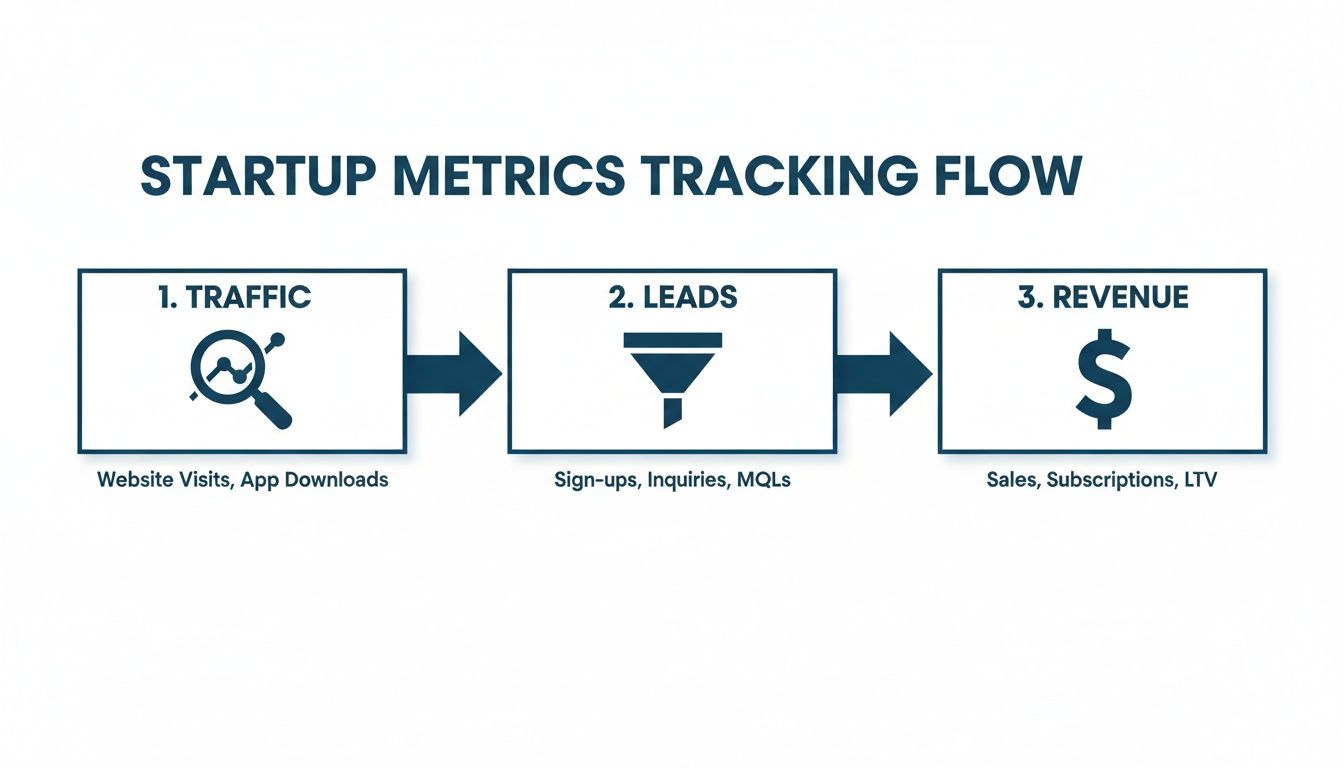
They landed on our site and signed up for a free trial. Two weeks later, after getting a few onboarding emails and reading another one of our blog posts, they converted to a paid plan at $99/month.
So, who gets the credit? This is where attribution models are so important.
- First-Touch Attribution: This model gives 100% of the credit to the very first interaction. In this scenario, that Reddit comment would get full credit for the $99/month subscription. It's simple, but it ignores everything else that helped nurture the lead.
- Multi-Touch Attribution: This is the model we prefer because it’s much more realistic. It spreads the credit across multiple touchpoints that influenced the decision. We use a linear model, which gives equal weight to the Reddit comment, the onboarding emails, and the blog post.
Under our multi-touch model, the Reddit comment is credited with 33% of the conversion. That translates to $32.67 in monthly recurring revenue (MRR) attributed directly to that one comment.
Step 4: Calculating the Final Content Marketing ROI
Using our multi-touch model, we can now calculate the ROI over the first year. We just project the annual value of the customer that we can attribute to this single piece of content.
- Annual Return: $32.67 (attributed MRR) x 12 months = $392.04
- Total Investment: $23
Now, we plug those figures right back into our ROI formula:
(($392.04 − $23) / $23) × 100% = 1,604% ROI
That’s a 1,604% ROI from a single, 20-minute effort. This is the power of finding and joining high-intent conversations. This kind of granular, step-by-step math proves the value of our Reddit strategy and makes it a no-brainer to keep investing in the channel.
For another founder's take on this, check out this guide on Measuring Content Marketing ROI: A Practical Guide. It offers another great perspective on tying content directly to revenue.
Finding High-ROI Opportunities on Reddit with AI

Most founders I talk to know they should be on Reddit, but they see it as a black hole for their time. And honestly, they're not wrong—if they approach it manually. Without a system, it's pretty much impossible to calculate a real content marketing ROI from just hanging out in communities.
That’s why we don’t just “hang out” on Reddit. We treat it like a predictable, high-intent customer acquisition channel, and AI monitoring is the engine that makes it run. The goal isn't just to show up; it's to find the exact conversations where we can provide genuine value the moment someone is looking for a solution.
This simple shift in thinking transforms Reddit from a time-consuming gamble into a measurable source of growth.
Setting Up Our AI Monitoring System in BillyBuzz
First things first, you have to move from mindless scrolling to automated precision. We use our own tool, BillyBuzz, to act as our eyes and ears, filtering out 99% of the noise to find that golden 1% of conversations that can actually lead to a new customer. This is a founder-to-founder look at our exact setup.
Our primary monitoring list includes these subreddits:
r/SaaSr/startupsr/marketingr/growmybusiness
Next, we built out our keyword alert rules. These are our best-performing filters, designed to catch conversations that signal someone is ready to buy:
- Competitor Alerts:
"[Competitor Name] alternative"or"tired of [Competitor Name]" - Problem-Based Queries:
"how to monitor mentions","best way to track keywords on reddit" - Recommendation Requests:
"looking for a social listening tool","any good tools for lead gen"
These rules make sure we get a ping the moment a potential customer voices a pain point our product can solve. This kind of precision is the absolute foundation for getting a high ROI on Reddit.
Crafting High-Value Responses That Convert
Once BillyBuzz sends an alert, our job is to add value, not just drop a link. A spammy comment is the fastest way to get downvoted. Our entire strategy hinges on being genuinely helpful first.
Here’s our go-to response template:
- Acknowledge: "That's a tough spot, finding a good tool that isn't overpriced is a real challenge."
- Offer Advice (Product-Agnostic): Give them a helpful tip they can use right away, even if they never click your link.
- Introduce Softly: Only after providing value, mention your tool. "Full disclosure, I'm the founder of BillyBuzz, which we built to solve this exact problem..."
- Connect to Pain Point: "...our AI relevancy scoring helps filter out all the noise you mentioned."
- No Hard Sell: End with a friendly sign-off. "Might be worth a look. Either way, good luck with the search!"
This founder-to-founder approach builds instant trust and positions us as a resource, not just another salesperson.
The global content marketing industry was valued at $413.2 billion in 2022 and is projected to keep growing, which shows just how much people crave valuable content. For us, that growth proves that context-aware monitoring on platforms like Reddit is a critical part of modern demand generation, especially since 97% of marketers see content as essential for boosting sales.
The AI relevancy scoring inside BillyBuzz is our secret weapon, helping us instantly prioritize which conversations are worth our time. It analyzes context and sentiment so we aren't wasting energy on low-quality threads. This direct line to high-intent users is how we consistently generate positive ROI, and it's also a key part of our strategy for how Reddit conversations get you cited by AI like ChatGPT and Claude.
Building a Lean Tool Stack to Track Your ROI
You can't improve what you don't measure. And as a founder, you definitely can't scale what's manual. To get a real grip on your content marketing ROI, you need a lean, intentional tool stack. This isn't about collecting a dozen expensive subscriptions; it’s about picking a few powerful tools that give you clarity at each stage of the funnel without overwhelming your team.
We have to move beyond just staring at Google Analytics. A solid stack should help you with discovery, SEO, and attribution. Here’s a founder-to-founder breakdown of our essential toolkit, showing exactly how each piece contributes to calculating and improving our ROI.
Discovery and Engagement: BillyBuzz
For us, the first step is finding high-intent conversations before they go cold. Manual scrolling is a time-sink with zero measurable return. This is where we use our own tool, BillyBuzz, to automate opportunity discovery on Reddit.
We set up specific alert rules to catch users who are actively looking for solutions. Our setup isn't complicated; it's laser-focused on buying signals.
- Alert Rule 1: We monitor
r/SaaSfor keywords like"competitor name" + alternative. This immediately flags users who are unhappy with an existing tool and are actively shopping for a replacement. - Alert Rule 2: We watch
r/startupsfor phrases like"looking for a tool that does X". This helps us find founders describing a pain point our product solves.
Each alert delivered to our Slack is a pre-qualified opportunity. This targeted approach is the foundation of our ROI calculation, as it allows us to tie our engagement efforts directly to high-potential leads from day one.
SEO and Rank Tracking: Ahrefs
While Reddit provides immediate engagement, long-term SEO is our engine for sustainable, low-cost growth. For this, we rely on a lean subscription to Ahrefs. We don't use every feature—we focus on the ones that directly impact our revenue.
Its primary role in our stack is tracking the keyword rankings of our blog content and, just as importantly, our high-performing Reddit posts. When a helpful Reddit comment starts ranking on Google for a valuable keyword, it becomes a long-term lead-generation asset. Ahrefs helps us quantify the SEO value of our community engagement, which is a key part of our "Return" calculation.
Analytics and Attribution: HubSpot and UTMs
Connecting the dots from a Reddit comment or a blog post to a new customer requires a central nervous system. For us, that's HubSpot, but you can achieve this with simpler CRMs, too. The real magic isn't the specific tool—it's the disciplined use of UTM parameters.
Every link we share has a unique UTM code. It’s a non-negotiable rule. Without it, you're flying blind, and your ROI calculation is just a guess.
For example, a link in a Reddit profile might be tagged with ?utm_source=reddit&utm_medium=profile. This simple tag allows HubSpot to track that user's entire journey, from their first click to their trial sign-up and eventual conversion. This gives us the hard data needed for our multi-touch attribution model, proving exactly how much revenue each piece of content influenced.
Founder-Friendly Tool Stack for Tracking Content ROI
Putting it all together, a smart tool stack doesn't have to be expensive or complicated. It's about choosing the right tool for the right job at each stage of the content lifecycle. Here's a look at how you can build a cost-effective stack that delivers real insights.
| Stage | Tool Recommendation | Primary Use Case | ROI Impact |
|---|---|---|---|
| Discovery & Ideation | BillyBuzz or AnswerThePublic | Find what your audience is actively asking about online. | Creates content that meets existing demand, shortening the path to conversion. |
| Creation & SEO | SurferSEO or Frase.io | Optimize content based on top-ranking competitors and search intent. | Increases organic traffic and lead quality by ranking for valuable keywords. |
| Analytics & Attribution | Google Analytics + HubSpot CRM (Free) | Track user journeys and attribute conversions with UTMs. | Provides hard data to prove which content is actually driving revenue. |
| Promotion & Engagement | Buffer or HootSuite | Schedule and monitor social media promotion efforts. | Measures engagement and click-through rates to refine promotion strategy. |
This kind of stack gives you a clear, data-backed picture of your content marketing ROI without breaking the bank. It's a lean approach that saves you time and proves that your efforts are actually moving the needle. You can apply a similar philosophy when choosing from the many AI tools available for social media ROI tracking, which helps automate much of this process.
Common Mistakes That Will Destroy Your Content ROI
Even the most brilliant strategy can implode. As founders, we learn things the hard way, and improving our content marketing ROI often comes from plugging the leaks that are sinking the ship. This isn't theory; these are the costly mistakes we've made—and seen others make—that silently kill returns.
One of the biggest blunders is confusing creation with distribution. So many people pour 100% of their effort into crafting the "perfect" blog post, hit publish, and then wonder why nobody shows up. At BillyBuzz, we live by an 80/20 rule for distribution: only 20% of our time goes into creating the core piece, while the other 80% is all about getting it in front of the right eyeballs.
Forgetting Content Distribution Entirely
A great article that no one reads has an ROI of zero. It’s that simple. Instead of letting a piece of content die after a single tweet, we repurpose it relentlessly. A deep-dive blog post becomes a series of targeted Reddit threads in r/SaaS or r/startups, each one tailored to a specific pain point we saw being discussed in the community.
We also turn key insights into quick, shareable assets. Short-form videos are the undisputed kings of ROI right now, with 31% of marketers reporting the highest returns from them. For us, this means turning a blog section into a 30-second animated explainer for Reddit, which can massively boost visibility and engagement. With 91% of brands now using video, it's a huge mistake to ignore its power. You can discover more insights about content marketing statistics to see just how effective it is.
Giving Up Too Soon
Another classic founder mistake is impatience. Content is a long-term asset, not a one-off campaign. We once wrote a detailed guide that got almost no traffic for three solid months. We were this close to just deleting it, but instead, we decided to wait.
Around month four, it started to rank for a few long-tail keywords. By month six, it was on the first page of Google, and today, it’s one of our top lead-generating assets, humming along in the background.
The ROI from content compounds. Your initial investment pays dividends for years, but only if you give it the time it needs to mature. Pulling the plug too early is like selling a stock the day before it skyrockets.
Avoid these pitfalls by shifting your mindset. Treat distribution just as seriously as you treat creation, and give your content the runway it needs to actually deliver a return.
Burning Questions About Content ROI
Look, I get it. As a founder, every penny counts and every decision has to tie back to the bottom line. Content marketing ROI can feel a bit like voodoo sometimes, so let's tackle the big questions I hear from other founders in the trenches.
How Long Does This Actually Take to Work?
This is the million-dollar question, isn't it? Unlike paid ads where you see a spike (and then a drop) almost instantly, content is a long-term play. It's more like planting a tree than flipping a switch.
Realistically, you’ll start seeing promising signs—what we call leading indicators, like a steady climb in organic traffic—within 3 to 6 months. But for a true, money-in-the-bank positive ROI? You're likely looking at 9 to 12 months. That’s the time it takes for your articles to climb the Google rankings, establish your authority, and start working for you 24/7 as a lead-gen machine. The payoff is huge, but it demands patience. The returns compound like nothing else.
Should I Write This Myself or Hire Someone?
Most founders start out writing everything themselves. Honestly, it’s a great way to bake your authentic voice and expertise right into your brand's DNA. But at some point, you'll hit a wall. As your company grows, your time becomes your most precious resource.
The tipping point comes when your time is better spent on the product, talking to customers, or closing deals. A great freelance writer might cost you $300 to $1,000 an article. But if that frees you up to land a new $5,000 client? The math is simple. My advice: start by doing it yourself to find your groove, then bring in help to crank up the volume.
How Can I Measure the ROI of Content Without a "Buy Now" Button?
This one trips people up. How do you measure the value of a helpful blog post or a smart comment on Reddit when there’s no direct sign-up form attached? It might seem fuzzy, but it's totally doable. You just have to shift your focus from direct conversions to overall influence.
Here’s how we track its impact:
- Look at the Whole Journey: We use multi-touch attribution to see how many people who eventually became customers read a specific blog post along the way.
- Track the "Assists": Google Analytics has a great feature called Assisted Conversions. It shows us which articles played a supporting role before a user finally converted on another page.
- Monitor Brand Searches: As we publish more helpful, non-gated content, we watch for an uptick in people searching directly for our brand name. It's a clear sign that our reputation is growing.
Not every piece of content is meant to be a hard sell. Top-of-funnel articles build trust and brand recognition. They warm up future customers, which has a very real—if indirect—impact on your bottom line.
By looking at it this way, you get a much clearer picture of how all that free, valuable content is actually building a pipeline of smart, engaged leads who are ready to buy.
Ready to stop guessing and find high-ROI conversations on Reddit? BillyBuzz uses AI to cut through the noise and sends you real-time alerts for discussions that can turn into customers. Sign up for your free trial today!