

I'm not going to give you a textbook definition of competitive analysis. As a founder, you don't have time for theory. You need to know what your competitors are doing, find the gaps they've left open, and use that intel to win. This is how we do it at BillyBuzz—no fluff, just the playbook we use every day.
A Founder-First Approach to Competitive Analysis

Most guides on this are built for corporate teams with big budgets. They'll tell you to build a 50-page report that nobody reads. That's not our world. We need actionable intel, and we need it now.
The goal isn't to copy your competitors. It's to understand why their stuff works (or doesn't) and spot the opportunities they're blind to. It's about finding an edge.
Define Your Objectives Like a Founder
"Beating the competition" isn't an objective—it's a wish. To get real results, you need specific, measurable goals. Here at BillyBuzz, every analysis we run is tied to a clear, tactical outcome.
Here are the actual objectives we've used recently:
- Identify three content gaps our main competitor is missing on Reddit within the next two weeks.
- Find five customer pain points our rivals aren't solving, based on comments in r/SaaS.
- Pinpoint the top two features users are begging for from competitors in subreddits like r/productmanagement.
See the pattern? Small, targeted, and they lead directly to an action. The result isn't a long report; it’s a new blog post, a product tweak, or a fresh marketing angle. If you need a good starting point, this competition analysis framework can help keep you organized.
The point of competitive analysis isn't to create some perfect, exhaustive document. It's to find one single, actionable insight that can make your business better this week. Always prioritize speed and action.
Choose The Right Competitors To Track
Don't just watch the big players. Your most dangerous threat might not be the market leader. It could be an indirect solution solving the same core problem in a totally different way.
We break down competitors into three tiers to avoid blind spots.
Three Tiers of Competition
Direct Competitors: They offer a nearly identical product to the same audience. For BillyBuzz, this is other social monitoring tools built for Reddit. Easy to spot, but rarely surprising.
Indirect Competitors: They solve the same problem with a different solution. Think of a marketing agency offering manual Reddit monitoring, or a huge social listening platform where Reddit is a minor feature. They're validating the market for you.
Aspirational Competitors: These are companies you admire for their marketing or community, even in a different industry. We look at how a B2C brand like Duolingo builds a rabid fan base on Reddit for inspiration.
This three-tiered view cuts through the noise and delivers insights you can actually use.
Uncovering Intel Where Your Competitors Aren't Looking

Everyone's fighting for eyeballs on LinkedIn and Twitter. The real advantage—the raw, unfiltered truth—comes from places they ignore. For us, that place is Reddit.
Forget just tracking brand mentions. We dive into niche subreddits where our ideal customers have candid conversations. This is where you find out what people really think about your competitors’ products, pricing, and support.
The Goldmine of Subreddit Monitoring
Most brands are scared of Reddit. They see chaos; we see our primary source of intelligence. The trick is knowing where to look. We don't just track our brand name; we monitor conversations around problems, competitors, and specific use cases.
Here's exactly where we look:
- Industry Hubs (like r/SaaS and r/marketing): Great for spotting broad trends and posts where people compare tools.
- Founder Communities (r/startups, r/Entrepreneur): Raw, honest talk about founder challenges—the very pain points our tool solves.
- Niche Product Groups (r/productmanagement, r/sales): Professionals talking about their workflows. A single complaint about a competitor's clunky UI here is pure gold.
This strategy is critical as organic reach on other platforms tanks. Engagement rates have plummeted on X (48% drop) and Facebook (36% decline), according to RivalIQ. Getting seen is harder, making insights from these candid communities more valuable.
Your goal is to find the gap between what your competitors say in their marketing and what their customers experience in reality. Reddit is where that gap is exposed every single day.
Our Internal BillyBuzz Setup for Reddit
We use our own tool, BillyBuzz, to automate this. It's about building a system that brings relevant conversations to us. We configure alerts to find high-intent discussions—buying signals, competitor complaints, and feature requests. Our guide on how to set up Slack alerts for Reddit mentions shows you how to do this in under 10 minutes.
Here’s a peek behind the curtain at the exact filters we use inside BillyBuzz.
BillyBuzz Reddit Monitoring Setup Example
| Target Subreddit | Keywords to Include | Keywords to Exclude | BillyBuzz Alert Rule |
|---|---|---|---|
| r/SaaS | ("social listening" OR "reddit monitoring" OR "customer feedback tool") AND (recommend OR alternative OR tool) |
free, job, hiring, intern |
Send real-time Slack alert for new posts with high relevancy score |
| r/startups | ("how to find customers" OR "get feedback" OR "competitor name") |
survey, course, giveaway |
Send daily email digest of all mentions |
This setup finds conversations where potential customers are looking for a solution like ours or are frustrated with a competitor.
Expanding Beyond Reddit
While Reddit is our secret weapon, it's not the only place. The same principles apply anywhere honest conversations happen.
Think about places your competitors have forgotten:
- Industry-Specific Forums: Every niche has them. Find them.
- Product Review Sites: Go beyond star ratings on G2 or Capterra. The detailed negative reviews for your competitors are a goldmine.
- Webinar Q&A Sections: The questions attendees ask at the end of a competitor's webinar reveal confusion and feature gaps.
This is how you find your edge.
The Metrics And Tools That Actually Matter

As a founder, data overload is the enemy. It's easy to get lost tracking vanity metrics that don't move the needle.
We cut through the clutter and focus on a handful of KPIs that give us a real pulse on the market. These are direct indicators of where opportunities are hiding.
Ditching Vanity Metrics for Reddit SOV
Share of Voice (SOV) is a classic metric, but we don’t care about our SOV across the entire internet. It's too broad. Instead, we track our Share of Voice specifically within relevant Reddit communities.
Why? Because one mention in r/SaaS is worth more to us than a hundred mentions elsewhere. This targeted SOV tells us if our message is reaching the right people.
Beyond counting mentions, we dig into two other critical qualitative metrics:
- Sentiment Analysis: What’s the general feeling when people mention a competitor? Is it frustration, praise, or indifference? A spike in negative sentiment for a rival is a perfect opening.
- Pain-Point Frequency: How often are users talking about specific problems that our product solves? We look for phrases like "Competitor X is too clunky" or "wish [Competitor Y] had this feature."
These metrics help us understand the story behind the mentions.
Our Lean Tech Stack for Competitive Intelligence
You don’t need a dozen expensive tools. A complicated tech stack just creates more work. Our approach is lean and built for speed.
Our entire system boils down to three components:
- BillyBuzz: This is our frontline soldier. We use it for real-time Reddit alerts. Its AI relevancy scoring filters out the noise so we only see high-intent conversations.
- A Simple Spreadsheet: We use a Google Sheet to track and categorize qualitative insights. It's not fancy, but it’s effective. We tag every finding with categories like 'Product Gap' or 'Marketing Angle.'
- Slack: This is our command center. High-priority alerts from BillyBuzz are piped directly into a dedicated Slack channel for immediate discussion.
This simple, three-part system is our engine for competitive analysis. It’s designed to be fast, cheap, and focused on action. Spend less time managing tools and more time acting on insights.
How We Organize Our Findings
That tracking spreadsheet is the brain of our operation. When a BillyBuzz alert comes in, we immediately log and categorize it.
Here’s a snapshot of the actual columns we use:
| Date | Source (Subreddit/Link) | Competitor Mentioned | Insight Type | Key Quote/Summary | Action Taken |
|---|---|---|---|---|---|
| Oct 26 | r/marketing | Competitor A | Product Gap | "Their new UI is impossible to navigate. I miss the old version." | Emailed product team |
| Oct 27 | r/startups | Competitor B | Pricing Complaint | "Can't believe they charge extra for basic alerts. It's a rip-off." | Drafted a new blog post |
This simple structure makes it easy to spot patterns. If we see multiple entries under 'Pricing Complaint' for the same competitor, we know we have a powerful marketing angle.
This organic discovery is more important than ever. With social media ad spend projected to hit $406 billion by 2029, paid channels are only getting more saturated. For a rundown of other tools, this list of the 12 Best Social Media Competitor Analysis Tools is a solid resource. Ultimately, this lean, systematic approach is what allows a small team to punch far above its weight.
Turning Raw Intel Into A Winning Action Plan
Collecting data is easy. The founder trap is getting addicted to gathering intel without ever doing anything with it. The part that moves the needle is turning that stream of insights into a concrete action plan.
This is our internal playbook for translating what we find into marketing actions that win.
From Reddit Insight To Revenue Growth
A single, well-timed insight can be more valuable than a month of generic market research. When a user on Reddit complains about a competitor, it’s a direct signal telling you where to aim your marketing.
Here’s a real-world example from our playbook. We kept seeing users in r/productmanagement gripe about how clunky a competitor's integration process was.
Here's what we did:
- The Insight: Users find Competitor X’s integration process a major pain point.
- The Action: We launched a blog post titled, "How to Seamlessly Integrate Your Workflow (Without the Headaches)." The content hit on the exact frustrations from Reddit and framed our tool as the simpler alternative.
- The Result: That one post led to a 30% increase in qualified demo requests from that channel over the next month.
This isn’t a one-off success; it’s the result of a system.
Raw data is worthless. An insight is a piece of data that points to a specific action. Your goal isn't to collect data; it's to find insights that demand you do something about them.
Prioritizing Actions With A Simple Framework
You can't act on everything. As a founder, you need a quick way to decide what’s worth your time. We use a simple Impact vs. Effort matrix.
For every potential action, we ask two questions:
- Impact: How much will this move the needle on our key goals (leads, sign-ups)?
- Effort: How much time and resources will this take?
This sorts every opportunity into one of four buckets:
- Quick Wins (High Impact, Low Effort): Do these immediately. Example: Writing a Reddit response snippet to address a common competitor complaint.
- Major Projects (High Impact, High Effort): Bigger, strategic bets. Example: Building a new feature that targets a competitor's product gap.
- Fill-Ins (Low Impact, Low Effort): "Nice-to-haves." We tackle them when there’s downtime.
- Time Sinks (Low Impact, High Effort): Avoid these like the plague.
This framework keeps us focused on activities that drive real growth.
Arming Your Team With Reddit Response Snippets
When you spot a competitor question on Reddit, speed and authenticity are everything. You can’t spend an hour crafting the perfect response every time. That’s why we created a "Response Snippet" library in a shared doc.
This isn’t about spamming. It's about having pre-approved, authentic-sounding starting points for common scenarios.
Here’s our internal template for these snippets:
| Snippet Category | Key Talking Points | Example Starter Template |
|---|---|---|
| Competitor Comparison | - Acknowledge the competitor is solid. - Highlight our key differentiator for their use case. - Offer a no-pressure look at our solution. |
Hey, [Competitor Name] is a great option for [their strong suit], but if you’re specifically looking for [our key feature], you might find our approach at BillyBuzz a bit more direct for that. Happy to answer any questions! |
| Feature Gap Mention | - Empathize with their frustration. - Briefly explain how our tool solves that exact problem. - Share a link to a relevant resource. |
I know how frustrating it is when [pain point]. We actually built our tool to solve that exact issue. The way we handle it is by [brief explanation]. Here’s a quick look at how it works: [link]. |
These snippets empower anyone on our team to jump into a conversation with confidence. This is how competitive analysis for marketing becomes an active, lead-generating engine.
Putting Your Intelligence Engine on Autopilot
As a founder, your time is your most precious resource. Manually scouring forums and subreddits every day doesn't scale. That's a chore, not a strategy.
The real game-changer is building an intelligence machine—a system that works for you. You should only step in to make a strategic call, not to sift through noise. This is why we built BillyBuzz. We needed an automated engine to bring opportunities and insights to us.
Building Your Automated Alert System
Our setup is designed for one thing: maximum signal, minimum noise. We can't afford constant pings, but we can't miss a high-intent conversation.
This is our exact alert setup inside BillyBuzz:
Real-Time Slack Notifications: For emergencies only. A direct comparison like, "Anyone used BillyBuzz vs. Competitor X?" gets piped into our
#intelSlack channel instantly. These are active buying conversations.Daily Email Digest: For everything else. Broader competitor mentions and industry pain points get bundled into a single email. This keeps us in the loop without constant interruptions.
This two-tiered system is the heart of our process. It's sustainable. Our post on AI-powered social media alerts breaks down how this real-time monitoring works.
It’s all part of a simple plan: gather intel, take action, and win the customer.
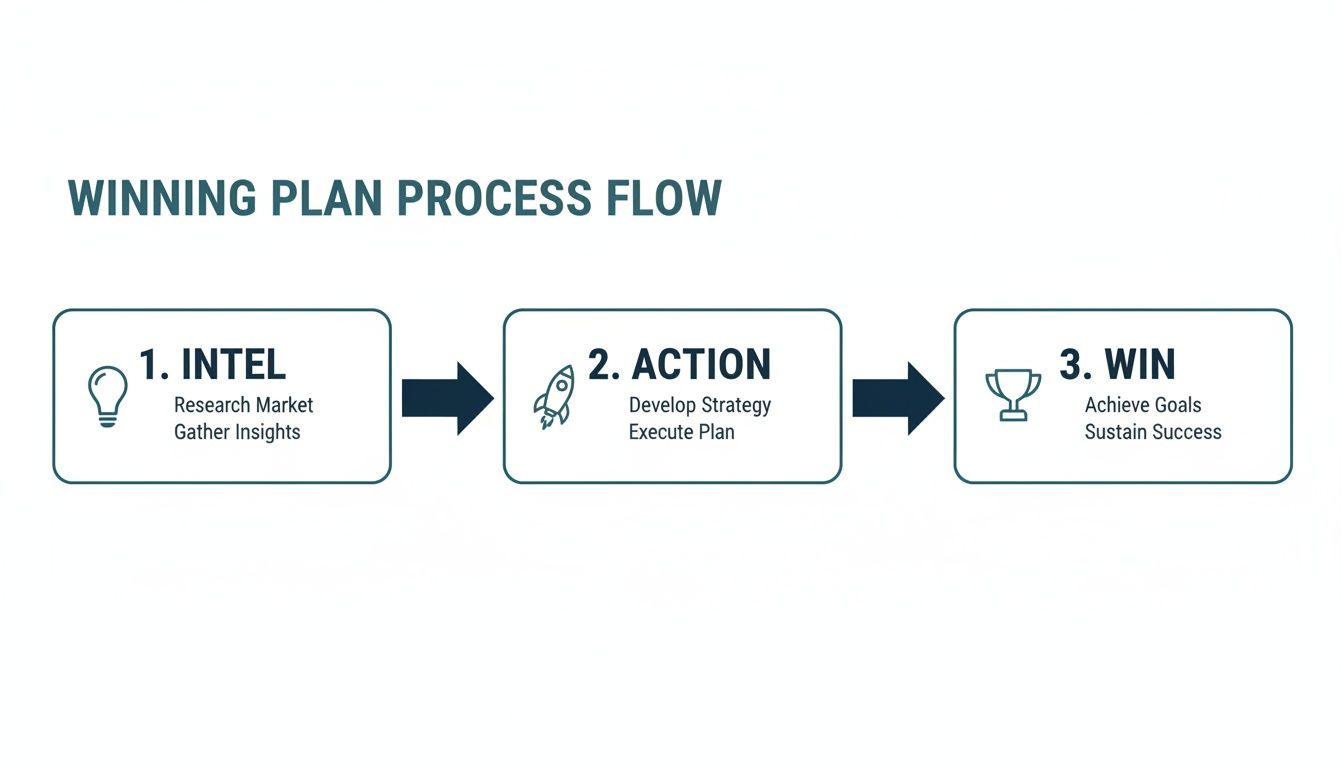
Gathering intel is just the beginning. The magic happens when you act on it quickly.
Scaling the System as Your Team Grows
This process is designed to grow with you.
When you're starting out, you do it all. You set up the alerts, watch Slack, and decide when to jump in.
As you bring on your first marketer, the process evolves:
- Assigning Ownership: Team members can own specific areas, like monitoring two key competitors or a specific subreddit.
- Creating Specialized Channels: Get more granular with Slack channels, like
#competitor-a-intelor#product-feedback, to route alerts automatically. - Refining Alert Rules: Build more sophisticated alert rules in BillyBuzz. Track specific feature names, pricing complaints, or mentions of key employees leaving a competitor.
The point is to build a sustainable, scalable intelligence engine that powers your growth. It should be a system that works for you, not the other way around.
This is how you transform competitive analysis from a reactive task into a proactive source of leads. It's how a small team can outmaneuver larger competitors.
Founder FAQs on Competitive Analysis
We talk to a lot of other founders, and the same questions pop up again and again. Here are the most common ones.
How Often Should I Conduct a Competitive Analysis?
Don't treat this like a one-off project. The best competitive analysis is an ongoing, "always-on" process. At BillyBuzz, we see it as a constant pulse check on the market.
We recommend a deep-dive analysis quarterly to reassess your main competitors and market positioning.
But your tactical monitoring—especially on fast-moving platforms like Reddit—needs to be happening daily. Using an automated tool for real-time alerts makes this manageable. You catch opportunities as they happen, not weeks later.
How Do I Analyze Competitors in a New Niche?
When you’re in a new niche, your focus shifts from direct competitors to "problem competitors" or indirect alternatives.
Ask one question: who or what is your customer hiring to solve this problem right now?
It’s often not another piece of software. It might be:
- A ridiculously complicated spreadsheet.
- A freelance consultant or a small agency.
- A buried feature inside a larger tool they already use.
Your analysis should zero in on the exact language customers use to describe their frustrations with these makeshift solutions. This is where you'll find your most powerful marketing angles.
What Is the Biggest Mistake Startups Make?
The single biggest mistake is analysis paralysis. Founders get so obsessed with gathering every last piece of data that they never actually do anything.
The point isn't to create the world's most perfect report. The goal is to find one or two actionable insights that can improve your marketing or product this week. Start small, focus on channels your competitors are ignoring, and always prioritize action over endless research.
Ready to automate your competitive analysis and find hidden customers on Reddit? BillyBuzz is an AI-powered monitoring tool that filters out the noise and delivers real-time, high-intent leads directly to your Slack or email. Start uncovering opportunities today.